Identification
- Summary
Pantothenic acid is a vitamin B5 found in various nutritional supplements.
- Brand Names
- Concept Ob, Irospan 24/6 Kit, Pregvit, Tandem Plus
- Generic Name
- Pantothenic acid
- DrugBank Accession Number
- DB01783
- Background
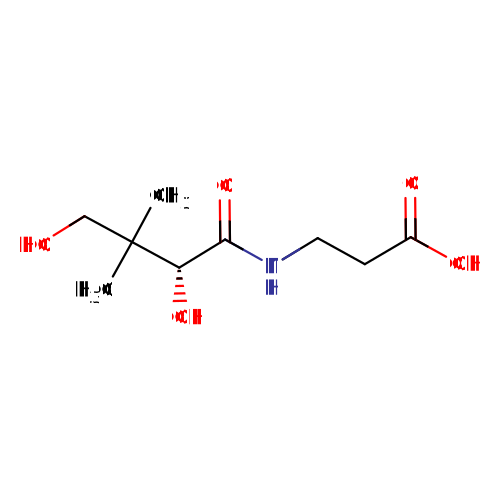
Pantothenic acid, also called pantothenate or vitamin B5 (a B vitamin), is a water-soluble vitamin discovered by Roger J. Williams in 1919. For many animals, pantothenic acid is an essential nutrient as it is required to synthesize coenzyme-A (CoA), as well as to synthesize and metabolize proteins, carbohydrates, and fats. Pantothenic acid is the amide between pantoic acid and β-alanine and commonly found as its alcohol analog, the provitamin panthenol, and as calcium pantothenate. Small quantities of pantothenic acid are found in nearly every food, with high amounts in whole-grain cereals, legumes, eggs, meat, royal jelly, avocado, and yogurt. Pantothenic acid is an ingredient in some hair and skin care products. Only the dextrorotatory (D) isomer of pantothenic acid possesses biological activity. while the levorotatory (L) form may antagonize the effects of the dextrorotatory isomer.
- Type
- Small Molecule
- Groups
- Approved, Nutraceutical, Vet approved
- Structure
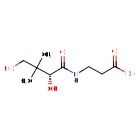
Structure for Pantothenic acid (DB01783)
- Weight
- Average: 219.235
Monoisotopic: 219.110672659 - Chemical Formula
- C9H17NO5
- Synonyms
- (+)-Pantothenic acid
- D-pantothenic acid
- Pantothenate
- Vitamin B5

Pharmacology
- Indication
Studied for the treatment of many uses such as treatment of testicular torsion, diabetic ulceration, wound healing, acne, obesity, diabetic peripheral polyneuropathy. It has also been investigated for its hypolipidemic effects and as cholesterol lowering agent.
 Reduce drug development failure ratesBuild, train, & validate machine-learning modelswith evidence-based and structured datasets.Build, train, & validate predictive machine-learning models with structured datasets.
- Associated Therapies
- Contraindications & Blackbox Warnings
 Prevent Adverse Drug Events TodayTap into our Clinical API for life-saving information on contraindications & blackbox warnings, population restrictions, harmful risks, & more.Avoid life-threatening adverse drug events with our Clinical API
- Pharmacodynamics
Pantothenic acid is used in the synthesis of coenzyme A (CoA). CoA is thought to act as a carrier molecule, allowing the entry of acyl groups into cells. This is of critical importance as these acyl groups are used as substrates in the tricarboxylic acid cycle to generate energy and in the synthesis of fatty acids, cholesterol, and acetylcholine. Additionally, CoA is part of acyl carrier protein (ACP), which is required in the synthesis of fatty acids in addition to CoAs use as a substrate.
Pantothenic acid in the form of CoA is also required for acylation and acetylation, which, for example, are involved in signal transduction and enzyme activation and deactivation, respectively.
Since pantothenic acid participates in a wide array of key biological roles, it may have numerous wide-ranging effects.
- Mechanism of action
Pantothenic acid is incorporated into COENZYME A and protects cells against peroxidative damage by increasing the level of GLUTATHIONE.
Target Actions Organism UPantothenate kinase Not Available Escherichia coli (strain K12) - Absorption
Dietary pantothenic acid is primarily in the form of CoA or ACP and must be converted into free pantothenic acid for absorption. CoA and ACP are hydrolyzed into 4'-phosphopantetheine which is then dephosphorylated into pantetheine and subsequently hydrolyzed again to free pantothenic acid by Pantetheinase in the intestinal lumen. Free pantothenic acid is absorbed into intestinal cells via a saturable, sodium-dependent active transport system with passive diffusion acting as a secondary pathway. As intake increases up to 10-fold absorption rate can decrease to as low as 10% due to transporter saturation.
- Volume of distribution
Not Available
- Protein binding
Not Available
- Metabolism
- Not Available
- Route of elimination
Not Available
- Half-life
Not Available
- Clearance
Not Available
- Adverse Effects
 Improve decision support & research outcomesWith structured adverse effects data, including: blackbox warnings, adverse reactions, warning & precautions, & incidence rates. View sample adverse effects data in our new Data Library!Improve decision support & research outcomes with our structured adverse effects data.
- Toxicity
No Tolerable Upper Level Intake (UL) has been established for the vitamin.
- Pathways
Pathway Category Carnosinuria, Carnosinemia Disease beta-Alanine Metabolism Metabolic Pantothenate and CoA Biosynthesis Metabolic GABA-Transaminase Deficiency Disease Ureidopropionase Deficiency Disease - Pharmacogenomic Effects/ADRs
- Not Available
Interactions
- Drug Interactions
- This information should not be interpreted without the help of a healthcare provider. If you believe you are experiencing an interaction, contact a healthcare provider immediately. The absence of an interaction does not necessarily mean no interactions exist.
Drug Interaction Integrate drug-drug
interactions in your softwareAbciximab The therapeutic efficacy of Pantothenic acid can be decreased when used in combination with Abciximab. Acenocoumarol The therapeutic efficacy of Pantothenic acid can be decreased when used in combination with Acenocoumarol. Alpha-1-proteinase inhibitor Alpha-1-proteinase inhibitor may increase the thrombogenic activities of Pantothenic acid. Alteplase The therapeutic efficacy of Pantothenic acid can be decreased when used in combination with Alteplase. Aminocaproic acid The risk or severity of adverse effects can be increased when Aminocaproic acid is combined with Pantothenic acid. - Food Interactions
- No interactions found.
Products
 Drug product information from 10+ global regionsOur datasets provide approved product information including:dosage, form, labeller, route of administration, and marketing period.Access drug product information from over 10 global regions.
- Product Ingredients
Ingredient UNII CAS InChI Key Calcium pantothenate 568ET80C3D 137-08-6 FAPWYRCQGJNNSJ-UBKPKTQASA-L Sodium pantothenate OES0R93F0C 867-81-2 GQTHJBOWLPZUOI-FJXQXJEOSA-M - Product Images


- Over the Counter Products
Name Dosage Strength Route Labeller Marketing Start Marketing End Region Image Acti Pantothenic Acid 1000 Timed Caplet Tablet 1 g Oral Acti Form Ltd. 1991-12-31 2005-03-21 Canada 
Acti-pantothenic Acid 300 Caplet 300mg Tablet 300 mg Oral Acti Form Ltd. 1991-12-31 2005-03-21 Canada Calcium Pantothenate Tab 250mg Tablet 250 mg / tab Oral Trophic Canada Ltd. 1991-12-31 1996-09-17 Canada Calpan Tab 100mg Tablet 100 mg / tab Oral Icn Pharmaceuticals 1973-12-31 1998-08-13 Canada Calpan Tab 250mg Tablet 250 mg / tab Oral Icn Pharmaceuticals 1973-12-31 1998-08-13 Canada - Mixture Products
Name Ingredients Dosage Route Labeller Marketing Start Marketing End Region Image 24 Multivitamins + Minerals Calcium pantothenate (25 mg) + Ascorbic acid (150 mg) + Beta carotene (10000 unit) + Biotin (25 mcg) + Calcium (130 mg) + Cholecalciferol (400 unit) + Choline bitartrate (25 mg) + Chromium (20 mcg) + Copper (1 mg) + Cyanocobalamin (25 mcg) + Ferrous fumarate (15 mg) + Folic acid (.8 mg) + Inositol (25 mg) + Magnesium (65 mg) + Manganese (2 mg) + Molybdenum (20 mcg) + Niacin (25 mg) + Potassium (15 mg) + Potassium Iodide (.1 mg) + Pyridoxine hydrochloride (25 mg) + Racemethionine (25 mg) + Riboflavin (25 mg) + Selenium (20 mcg) + Thiamine hydrochloride (25 mg) + Vanadium (20 mcg) + Vitamin A palmitate (5000 unit) + Vitamin E (50 unit) + Zinc (10 mg) Tablet Oral Stanley Pharmaceuticals, A Division Of Vita Health Products Inc. 1997-04-30 2002-07-31 Canada 50 Plus Calcium pantothenate (20 mg) + Ascorbic acid (200 mg) + Biotin (20 mcg) + Choline bitartrate (20 mg) + Cyanocobalamin (20 mcg) + Folic acid (.2 mg) + Inositol (20 mg) + Niacin (20 mg) + Pyridoxine hydrochloride (20 mg) + Racemethionine (20 mg) + Riboflavin (20 mg) + Thiamine hydrochloride (20 mg) + Vitamin A palmitate (10000 unit) + Vitamin D (400 unit) + Vitamin E (20 unit) Tablet Oral Quest Vitamins A Div Of Purity Life Health Products 1998-08-04 2001-07-06 Canada 50 Plus Multiple Vitamins & Minerals Pantothenic acid (10 mg) + Ascorbic acid (90 mg) + Biotin (45 mcg) + Calcium (200 mg) + Cholecalciferol (400 unit) + Chromium (10 mcg) + Copper (2 mg) + Cyanocobalamin (25 mcg) + Folic acid (0.4 mg) + Magnesium (100 mg) + Manganese (5 mg) + Molybdenum (25 mcg) + Nicotinamide (40 mg) + Potassium Iodide (0.15 mg) + Pyridoxine hydrochloride (3 mg) + Riboflavin (3.2 mg) + Selenium (25 mcg) + Thiamine mononitrate (2.25 mg) + Vanadium (10 mcg) + Vitamin A palmitate (6000 unit) + Zinc (15 mg) Tablet Oral Gfr Pharma Ltd. 2002-10-20 2004-06-15 Canada Adeks Tablets Calcium pantothenate (10 mg) + Ascorbic acid (60 mg) + Beta carotene (3 mg) + Biotin (50 mcg) + Cholecalciferol (400 unit) + Cyanocobalamin (12 mcg) + Folic acid (0.2 mg) + Niacin (10 mg) + Phylloquinone (0.15 mg) + Pyridoxine (1.5 mg) + Riboflavin (1.3 mg) + Thiamine (1.2 mg) + Vitamin A palmitate (4000 unit) + Vitamin E (150 unit) + Zinc gluconate (7.5 mg) Tablet Oral Axcan Pharma 1998-01-20 2011-04-20 Canada Adrenergy Tablets Pantothenic acid (60 mg) + Ascorbic acid (150 mg) + Manganese (1 mg) + Nicotinamide (80 mg) + Zinc gluconate (5 mg) Tablet Oral Morter Healthsystem Not applicable Not applicable Canada - Unapproved/Other Products
Name Ingredients Dosage Route Labeller Marketing Start Marketing End Region Image Abavite Calcium pantothenate (5 mg/1) + Ascorbic acid (60 mg/1) + Cholecalciferol (0.025 mg/1) + DL-alpha tocopheryl acetate (13.5 mg/1) + Ferrous sulfate (30 mg/1) + Folic acid (1 mg/1) + Magnesium oxide (25 mg/1) + Mecobalamin (0.5 mg/1) + Niacin (15 mg/1) + Potassium Iodide (0.25 mg/1) + Riboflavin (1.8 mg/1) + Thiamine mononitrate (1.6 mg/1) + Vitamin A palmitate (0.33 mg/1) + Zinc oxide (15 mg/1) Tablet Oral ABACOS HEALTH 2021-03-31 Not applicable US 
Bacmin Calcium pantothenate (25 mg/1) + Ascorbic acid (500 mg/1) + Biotin (150 ug/1) + Chromium Cr-51 chloride (0.1 mg/1) + Cupric oxide (3 mg/1) + Cyanocobalamin (50 ug/1) + Ferrous fumarate (27 mg/1) + Flavone (50 mg/1) + Folic acid (1 mg/1) + Magnesium oxide (50 mg/1) + Manganese gluconate (5 mg/1) + Nicotinamide (100 mg/1) + Pyridoxine hydrochloride (25 mg/1) + Riboflavin (20 mg/1) + Selenomethionine (50 ug/1) + Thiamine mononitrate (20 mg/1) + Vitamin A acetate (2000 [iU]/1) + Zinc oxide (22.5 mg/1) + alpha-Tocopherol acetate (30 [iU]/1) Tablet, coated Oral Marnel Pharmaceuticals, Llc 2000-04-01 Not applicable US Cavan Heme OB Calcium pantothenate (10 mg/1) + Biotin (30 ug/1) + Cholecalciferol (400 [iU]/1) + Cupric sulfate pentahydrate (0.8 mg/1) + Cyanocobalamin (12 ug/1) + Folic acid (1 mg/1) + Iron (28 mg/1) + Niacin (17 mg/1) + Potassium Iodide (175 ug/1) + Pyridoxine hydrochloride (50 mg/1) + Riboflavin (1.6 mg/1) + Sodium selenate (65 ug/1) + Thiamine mononitrate (1.5 mg/1) + Zinc oxide (15 mg/1) + alpha-Tocopherol succinate (10 [iU]/1) Tablet Oral Seton Pharmaceuticals 2010-08-03 2012-06-10 US Centratex Calcium pantothenate (10 mg/1) + Cupric sulfate (0.8 mg/1) + Cyanocobalamin (15 ug/1) + Folic acid (1 mg/1) + Iron (106 mg/1) + Magnesium sulfate (6.9 mg/1) + Manganese sulfate (1.3 mg/1) + Nicotinamide (30 mg/1) + Pyridoxine hydrochloride (5 mg/1) + Riboflavin (6 mg/1) + Sodium ascorbate (200 mg/1) + Thiamine mononitrate (10 mg/1) + Zinc sulfate, unspecified form (18.2 mg/1) Capsule Oral Centurion Labs, LLC 2009-06-14 Not applicable US Concept DHA Calcium pantothenate (5 mg/1) + Ascorbic acid (25 mg/1) + Biotin (300 ug/1) + Cupric sulfate pentahydrate (2 mg/1) + Cyanocobalamin (12.5 ug/1) + Ferrous fumarate (17.5 mg/1) + Folic acid (1 mg/1) + Iron (17.5 mg/1) + Magnesium sulfate (5 mg/1) + Niacin (1.8 mg/1) + Omega-3-acid ethyl esters (200 mg/1) + Pyridoxine hydrochloride (25 mg/1) + Riboflavin (3 mg/1) + Thiamine mononitrate (2 mg/1) + Zinc sulfate, unspecified form (10 mg/1) Capsule, liquid filled Oral U.S. Pharmaceutical Corporation 2009-06-24 Not applicable US


Categories
- ATC Codes
- D03AX04 — Calcium pantothenate
- D03AX — Other cicatrizants
- D03A — CICATRIZANTS
- D03 — PREPARATIONS FOR TREATMENT OF WOUNDS AND ULCERS
- D — DERMATOLOGICALS
- Drug Categories
- Chemical TaxonomyProvided by Classyfire
- Description
- This compound belongs to the class of organic compounds known as secondary alcohols. These are compounds containing a secondary alcohol functional group, with the general structure HOC(R)(R') (R,R'=alkyl, aryl).
- Kingdom
- Organic compounds
- Super Class
- Organic oxygen compounds
- Class
- Organooxygen compounds
- Sub Class
- Alcohols and polyols
- Direct Parent
- Secondary alcohols
- Alternative Parents
- Propargyl-type 1,3-dipolar organic compounds / Polyols / Monocarboxylic acids and derivatives / Carboxylic acids / Carboximidic acids / Primary alcohols / Organopnictogen compounds / Organonitrogen compounds / Organic oxides / Hydrocarbon derivatives show 1 more
- Substituents
- Aliphatic acyclic compound / Carbonyl group / Carboximidic acid / Carboximidic acid derivative / Carboxylic acid / Carboxylic acid derivative / Hydrocarbon derivative / Monocarboxylic acid or derivatives / Organic 1,3-dipolar compound / Organic nitrogen compound show 7 more
- Molecular Framework
- Aliphatic acyclic compounds
- External Descriptors
- pantothenic acid (CHEBI:46905) / Water-soluble vitamins (C00864)
- Affected organisms
- Humans and other mammals
Chemical Identifiers
- UNII
- 19F5HK2737
- CAS number
- 79-83-4
- InChI Key
- GHOKWGTUZJEAQD-ZETCQYMHSA-N
- InChI
- InChI=1S/C9H17NO5/c1-9(2,5-11)7(14)8(15)10-4-3-6(12)13/h7,11,14H,3-5H2,1-2H3,(H,10,15)(H,12,13)/t7-/m0/s1
- IUPAC Name
- 3-[(2R)-2,4-dihydroxy-3,3-dimethylbutanamido]propanoic acid
- SMILES
- CC(C)(CO)[C@@H](O)C(=O)NCCC(O)=O
References
- Synthesis Reference
John F. Verbeeck, "Process for the production of the calcium salt of pantothenic acid." U.S. Patent US3935256, issued February, 1971.
US3935256- General References
- Trumbo, P. R. (2005). Pantothenic Acid. In Modern Nutrition in Health and Disease (10th ed., pp. 462–467). Lippincott Williams & Wilkins. [ISBN:0-7817-4133-5]
- External Links
- Human Metabolome Database
- HMDB0000210
- KEGG Drug
- D07413
- KEGG Compound
- C00864
- PubChem Compound
- 988
- PubChem Substance
- 46505022
- ChemSpider
- 6361
- BindingDB
- 50240040
- 7891
- ChEBI
- 46905
- ChEMBL
- CHEMBL1594
- ZINC
- ZINC000005356910
- PDBe Ligand
- PAU
- Wikipedia
- Pantothenic_acid
- PDB Entries
- 1sq5 / 2f9w / 2zs9 / 2zse / 3af0 / 3af3 / 3avo / 3bex / 3bf1 / 3uy4 … show 4 more
- MSDS
- Download (47.9 KB)
Clinical Trials
- Clinical Trials
Phase Status Purpose Conditions Count 4 Completed Treatment Diabetic Peripheral Neuropathic Pain (DPN) 1 4 Completed Treatment Hyperemesis Gravidarum / Morning Sickness / Nausea / Pregnancy / Vomiting 1 4 Completed Treatment Pregnancy 1 4 Terminated Treatment Myocardial Stunning 1 4 Unknown Status Treatment Hyperuricemia 1
Pharmacoeconomics
- Manufacturers
- Not Available
- Packagers
- Not Available
- Dosage Forms
Form Route Strength Tablet Oral 1 g Tablet Oral 300 mg Tablet, sugar coated Oral Syrup Oral Tablet, delayed release Oral Tablet Oral 40.000 mg Tablet Oral 250 mg / tab Capsule Oral 250 mg Tablet, extended release Oral 1 g / tab Tablet, film coated Capsule, coated Oral Tablet Capsule Capsule Cutaneous; Oral Tablet Oral 0.071 g/100g Solution / drops Oral Gel Oral Tablet, extended release Oral Tablet, coated Oral 150 mcg Liquid Cutaneous Kit; tablet; tablet, film coated Oral Tablet, effervescent Oral Lotion Cutaneous Liquid Intravenous Elixir Oral Tablet, chewable Oral Capsule Oral Capsule, liquid filled Oral Tablet, orally disintegrating Oral Gum, chewing Oral Tablet Oral 0.057 g/100g Solution Oral Capsule Oral 100 mg Capsule Oral 250 mg / cap Tablet Oral 500 mg / tab Capsule Oral 500 mg Tablet Oral 500 mg Capsule Oral 100 mg / cap Tablet Oral 100 mg Tablet Oral 200 mg / tab Tablet Oral 250 mg Tablet, extended release Oral 500 mg / tab Tablet Oral 100 mg / tab Capsule, liquid filled; kit; tablet, coated Oral Liquid Oral Injection, solution Intravenous Injection, powder, for solution Intravenous Injection, powder, lyophilized, for solution Intravenous Powder, for solution Intravenous Injection, powder, for solution Intravenous 100 mg Solution Intravenous Capsule, extended release Oral Powder, for solution Oral Injection, powder, lyophilized, for solution Intramuscular; Intravenous Tablet, film coated Oral Capsule, gelatin coated Oral Capsule Oral 300 mg / cap Tablet, coated Oral Tablet Oral 50 mg / tab Tablet Oral Kit Oral Powder Oral Granule Oral Syrup Tablet Oral 200 mg - Prices
- Not Available
- Patents
- Not Available
Properties
- State
- Solid
- Experimental Properties
Property Value Source melting point (°C) 195ºC (D-Calcium Pantothenate salt) MSDS water solubility Soluble MSDS - Predicted Properties
Property Value Source Water Solubility 60.5 mg/mL ALOGPS logP -1.1 ALOGPS logP -1.4 Chemaxon logS -0.56 ALOGPS pKa (Strongest Acidic) 4.35 Chemaxon pKa (Strongest Basic) -2.8 Chemaxon Physiological Charge -1 Chemaxon Hydrogen Acceptor Count 5 Chemaxon Hydrogen Donor Count 4 Chemaxon Polar Surface Area 106.86 Å2 Chemaxon Rotatable Bond Count 6 Chemaxon Refractivity 51.51 m3·mol-1 Chemaxon Polarizability 21.99 Å3 Chemaxon Number of Rings 0 Chemaxon Bioavailability 1 Chemaxon Rule of Five Yes Chemaxon Ghose Filter No Chemaxon Veber's Rule No Chemaxon MDDR-like Rule No Chemaxon - Predicted ADMET Features
Property Value Probability Human Intestinal Absorption - 0.6189 Blood Brain Barrier + 0.6889 Caco-2 permeable - 0.7055 P-glycoprotein substrate Substrate 0.5464 P-glycoprotein inhibitor I Non-inhibitor 0.836 P-glycoprotein inhibitor II Non-inhibitor 0.9184 Renal organic cation transporter Non-inhibitor 0.95 CYP450 2C9 substrate Non-substrate 0.8235 CYP450 2D6 substrate Non-substrate 0.8051 CYP450 3A4 substrate Non-substrate 0.5411 CYP450 1A2 substrate Non-inhibitor 0.9133 CYP450 2C9 inhibitor Non-inhibitor 0.9137 CYP450 2D6 inhibitor Non-inhibitor 0.9417 CYP450 2C19 inhibitor Non-inhibitor 0.8929 CYP450 3A4 inhibitor Non-inhibitor 0.9587 CYP450 inhibitory promiscuity Low CYP Inhibitory Promiscuity 0.9305 Ames test Non AMES toxic 0.9278 Carcinogenicity Non-carcinogens 0.9062 Biodegradation Ready biodegradable 0.662 Rat acute toxicity 1.7394 LD50, mol/kg Not applicable hERG inhibition (predictor I) Weak inhibitor 0.9968 hERG inhibition (predictor II) Non-inhibitor 0.944
Spectra
- Mass Spec (NIST)
- Not Available
- Spectra
- Chromatographic Properties
Collision Cross Sections (CCS)
Adduct CCS Value (Å2) Source type Source [M-H]- 147.3702079 predictedDarkChem Lite v0.1.0 [M-H]- 151.1639079 predictedDarkChem Lite v0.1.0 [M-H]- 145.3581079 predictedDarkChem Lite v0.1.0 [M-H]- 147.53111 predictedDeepCCS 1.0 (2019) [M+H]+ 147.0393079 predictedDarkChem Lite v0.1.0 [M+H]+ 151.1284079 predictedDarkChem Lite v0.1.0 [M+H]+ 146.0168079 predictedDarkChem Lite v0.1.0 [M+H]+ 149.88911 predictedDeepCCS 1.0 (2019) [M+Na]+ 146.8065079 predictedDarkChem Lite v0.1.0 [M+Na]+ 150.7474079 predictedDarkChem Lite v0.1.0 [M+Na]+ 151.8865079 predictedDarkChem Lite v0.1.0 [M+Na]+ 155.98239 predictedDeepCCS 1.0 (2019)
Targets

- Kind
- Protein
- Organism
- Escherichia coli (strain K12)
- Pharmacological action
- Unknown
- General Function
- Pantothenate kinase activity
- Specific Function
- Not Available
- Gene Name
- coaA
- Uniprot ID
- P0A6I3
- Uniprot Name
- Pantothenate kinase
- Molecular Weight
- 36359.435 Da
References
- Kuo YM, Hayflick SJ, Gitschier J: Deprivation of pantothenic acid elicits a movement disorder and azoospermia in a mouse model of pantothenate kinase-associated neurodegeneration. J Inherit Metab Dis. 2007 Jun;30(3):310-7. doi: 10.1007/s10545-007-0560-8. Epub 2007 Apr 12. [Article]

Drug created at June 13, 2005 13:24 / Updated at April 18, 2024 09:15