Identification
- Summary
Metamizole is an antipyretic and analgesic drug used to relieve severe and persistent fever and pain.
- Generic Name
- Metamizole
- DrugBank Accession Number
- DB04817
- Background
Metamizole (dipyrone) is a pyrazolone derivative that belongs to the group of nonacid nonopioids. It is considered a potent analgesic and antipyretic with favourable gastrointestinal tolerability.2 Metamizole was formerly marketed in the US as Dimethone tablets and injection, Protemp oral liquid, and other drug products, and was withdrawn due to its association with potentially fatal agranulocytosis. Approvals of the NDA's for metamizole drug products were withdrawn on June 27, 1977 (see the Federal Register of June 17, 1977, 42 FR 30893).9 In 1963, metamizole was withdrawn from the Canadian market and banned in the UK, France, Sweden, Norway and Australia.1 Metamizole is still used in certain countries in Europe, Asia and South America.1
- Type
- Small Molecule
- Groups
- Approved, Investigational, Withdrawn
- Structure
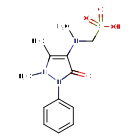
Structure for Metamizole (DB04817)
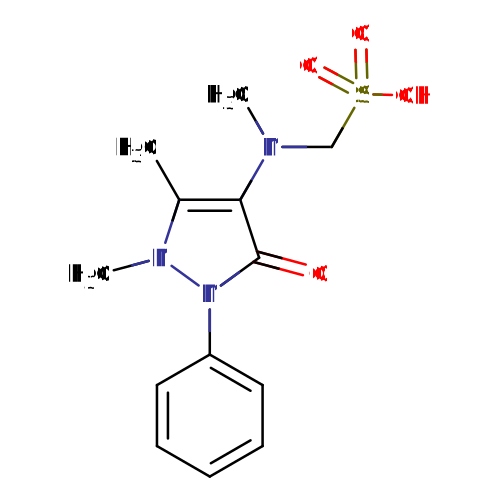
- Weight
- Average: 311.36
Monoisotopic: 311.093977213 - Chemical Formula
- C13H17N3O4S
- Synonyms
- Dipyrone
- Metamizol

Pharmacology
- Indication
Metamizole is banned in several countries, where it was previously used as a powerful analgesic and fever reducer. In countries where it is still available, metamizole is indicated for acute severe pain after injuries or surgeries, colic, tumor pain, and acute or severe pain symptoms, as well as high fever if other treatments are unsuccessful.1
 Reduce drug development failure ratesBuild, train, & validate machine-learning modelswith evidence-based and structured datasets.Build, train, & validate predictive machine-learning models with structured datasets.
- Associated Conditions
Indication Type Indication Combined Product Details Approval Level Age Group Patient Characteristics Dose Form Symptomatic treatment of Severe pain •••••••••••• Symptomatic treatment of Severe fever •••••••••••• - Contraindications & Blackbox Warnings
 Prevent Adverse Drug Events TodayTap into our Clinical API for life-saving information on contraindications & blackbox warnings, population restrictions, harmful risks, & more.Avoid life-threatening adverse drug events with our Clinical API
- Pharmacodynamics
Metamizole is a strong analgesic and antipyretic with spasmolytic properties. It has weak anti-inflammatory or antithrombotic properties and does not follow the same mechanism of action as conventional non-steroidal anti-inflammatory drugs (NSAIDs).1 Metamizole can lead to agranulocytosis, a life-threatening side effect where a patient’s neutrophil count falls below 500 cells per microliter.1 It has been shown that metamizole-induced agranulocytosis is caused by the development of drug-dependent anti-neutrophil antibodies requiring covalent binding of neutrophils to metamizole and its metabolites.2
- Mechanism of action
The mechanism of action of metamizole is not fully understood. Its active metabolites, 4-methyl-amino-antipyrine (MAA) and 4-amino-antipyrine (AA), inhibit prostaglandin E2 (PGE2)-induced hyperalgesia.7 It has been suggested that the anti-hyperalgesic effect of MAA is mediated by guanosine 3',5'-cyclic monophosphate (cGMP) activation and ATP-sensitive potassium channel opening, while the effects of AA are associated with the activation of cannabinoid receptor type 1 (CB1).7 Metamizole is classified in some sources as a weak non-steroidal anti-inflammatory drug (NSAID);2 however, evidence suggests that its analgesic effects do not depend on its anti-inflammatory properties.7 Although the inhibition of cyclooxygenase (COX) 2 may play a role in the central nervous system effects of metamizole,7 reports suggest that metamizole inhibits COX-3 with a higher affinity compared to COX-1 or COX-2.6,8
Target Actions Organism UProstaglandin G/H synthase 1 Not Available Humans - Absorption
Metamizole is hydrolyzed to 4-methyl-amino-antipyrine (MAA) in gastric juice and is mostly absorbed in this form. MAA bioavailability differs based on the administration route. In patients given metamizole tablets, the bioavailability of MAA is 85%, in patients given drops, 89%, in patients given suppositories, 54%, and in patients given an intramuscular injection, 87%.3 There is a linear relationship between metamizole oral dose and MAA Cmax. After oral doses ranging between 0.75 and 3 g, the tmax is reached at 1.4-2.0 hours.3
- Volume of distribution
Metamizole is quickly metabolized into 4-methyl-amino-antipyrine (MAA), its active metabolite. MAA has a volume of distribution of 1.15 L/kg.3
- Protein binding
The protein binding of metamizole and its metabolites is low, with an average of 60% for the metabolites 4-methyl-amino-antipyrine, 4-formyl-amino-antipyrine, 4-amino-antipyrine and 4-acetyl-amino-antipyrine.3,4
- Metabolism
Metamizole undergoes rapid hydrolysis to the active moiety 4-methyl-amino-antipyrine (MAA). MAA is then metabolized to 4-formyl-amino-antipyrine (FAA) via c-oxidation and 4-amino-antipyrine (AA) via N-demethylation. The N-demethylation of MAA is mainly mediated by CYP3A4, although CYP2B6, CYP2C8 and CYP2C9 may also be involved.2 FAA is an end metabolite, while AA is acetylated by N-acetyl-transferase to form 4-acetyl-amino-antipyrine (AAA).3 The unchanged drug may be present in plasma following the intravenous administration of metamizole; however, following oral administration, it cannot be detected in plasma or urine.3
Hover over products below to view reaction partners
- Route of elimination
After intravenous or oral administration, 90% of metamizole is recovered in urine, while 10% is recovered in feces.3 Approximately 60% of four metamizole metabolites (4-methyl-amino-antipyrine, 4-formyl-amino-antipyrine, 4-amino-antipyrine and 4-acetyl-amino-antipyrine) are excreted through urine.3
- Half-life
In vitro, the half-life of metamizole is 16 minutes. The half-life of 4-methyl-amino-antipyrine (MAA), its active metabolite, ranges from 2.6 to 3.5 hours.3
- Clearance
The clearance of 4-methyl-amino-antipyrine (MAA), the active metabolite of metamizole, ranges from 110 mL/min to 180 mL/min after oral administration.3
- Adverse Effects
 Improve decision support & research outcomesWith structured adverse effects data, including: blackbox warnings, adverse reactions, warning & precautions, & incidence rates. View sample adverse effects data in our new Data Library!Improve decision support & research outcomes with our structured adverse effects data.
- Toxicity
A metamizole overdose (7.5 g) may lead to gastrointestinal toxicity. If less than an hour has passed since metamizole ingestion, gastrointestinal decontamination and supportive measures are suggested as overdose treatment.5 Metamizole can also cause myelotoxicity, leading to drug-induced agranulocytosis.2,6
- Pathways
- Not Available
- Pharmacogenomic Effects/ADRs
- Not Available
Interactions
- Drug Interactions
- This information should not be interpreted without the help of a healthcare provider. If you believe you are experiencing an interaction, contact a healthcare provider immediately. The absence of an interaction does not necessarily mean no interactions exist.
Drug Interaction Integrate drug-drug
interactions in your softwareAbacavir Metamizole may decrease the excretion rate of Abacavir which could result in a higher serum level. Acebutolol Metamizole may decrease the antihypertensive activities of Acebutolol. Aceclofenac The risk or severity of nephrotoxicity can be increased when Metamizole is combined with Aceclofenac. Acemetacin The risk or severity of nephrotoxicity can be increased when Metamizole is combined with Acemetacin. Acetaminophen Metamizole may decrease the excretion rate of Acetaminophen which could result in a higher serum level. - Food Interactions
- Not Available
Products
 Drug product information from 10+ global regionsOur datasets provide approved product information including:dosage, form, labeller, route of administration, and marketing period.Access drug product information from over 10 global regions.
- Product Ingredients
Ingredient UNII CAS InChI Key Metamizole magnesium MS15642725 6150-97-6 NHMUJYOBLYTIKO-UHFFFAOYSA-L Metamizole sodium VSU62Z74ON 68-89-3 DJGAAPFSPWAYTJ-UHFFFAOYSA-M Metamizole sodium monohydrate 6429L0L52Y 5907-38-0 UNZIDPIPYUMVPA-UHFFFAOYSA-M - International/Other Brands
- Algocalmin / Algozone / Analgin / Dimethone / Dipirona / Neo-Melubrina / Novalgin / Optalgin / Protemp / Pyralgin
- Mixture Products
Name Ingredients Dosage Route Labeller Marketing Start Marketing End Region Image ANTIALGINA® Metamizole sodium (300 mg) + Caffeine (30 mg) + Isometheptene mucate (30 mg) Tablet, film coated Oral TECNOQUIMICAS S.A. 2007-04-24 Not applicable Colombia 
ANTIALGINA® Metamizole sodium (300 mg) + Caffeine (30 mg) + Isometheptene (50 mg) Solution Oral TECNOFAR TQ S.A.S 2007-03-06 2015-02-27 Colombia BUSCAPINA® COMPOSITUM AMPOLLAS Metamizole sodium (2.5 g) + Butylscopolamine bromide (0.02 g) Solution Intramuscular; Intravenous BOEHRINGER INGELHEIM ESPAŃA S.A. 2006-11-10 2020-06-01 Colombia CAFETRIN ® Metamizole (300 mg) + Caffeine (30 mg) + Isometheptene mucate (30 mg) Tablet, coated Oral LABORATORIOS RICH MONDS S.A.S 2018-05-11 Not applicable Colombia DIPIRONA 2.5 G + HIOSCINA 20 MG/5 ML SOLUCION INYECTABLE Metamizole sodium (2.5 g) + Butylscopolamine bromide (20 mg) Solution Intramuscular; Intravenous DISTRIBUIDORA SICMAFARMA S.A.S. 2006-11-10 2016-01-14 Colombia
Categories
- ATC Codes
- N02BB72 — Metamizole sodium, combinations with psycholepticsN02BB02 — Metamizole sodiumN02BB52 — Metamizole sodium, combinations excl. psycholeptics
- Drug Categories
- Agents causing hyperkalemia
- Agents that produce hypertension
- Aminopyrine
- Analgesics
- Analgesics, Non-Narcotic
- Anti-Inflammatory Agents
- Antipyretics
- Cytochrome P-450 CYP2B6 Inducers
- Cytochrome P-450 CYP2B6 Inducers (strength unknown)
- Cytochrome P-450 CYP3A Inducers
- Cytochrome P-450 CYP3A4 Inducers
- Cytochrome P-450 CYP3A4 Inducers (strength unknown)
- Cytochrome P-450 Enzyme Inducers
- Nephrotoxic agents
- Nervous System
- Peripheral Nervous System Agents
- Pyrazoles
- Pyrazolones
- Sensory System Agents
- Classification
- Not classified
- Affected organisms
- Humans and other mammals
Chemical Identifiers
- UNII
- 934T64RMNJ
- CAS number
- 50567-35-6
- InChI Key
- LVWZTYCIRDMTEY-UHFFFAOYSA-N
- InChI
- InChI=1S/C13H17N3O4S/c1-10-12(14(2)9-21(18,19)20)13(17)16(15(10)3)11-7-5-4-6-8-11/h4-8H,9H2,1-3H3,(H,18,19,20)
- IUPAC Name
- [(1,5-dimethyl-3-oxo-2-phenyl-2,3-dihydro-1H-pyrazol-4-yl)(methyl)amino]methanesulfonic acid
- SMILES
- CN(CS(O)(=O)=O)C1=C(C)N(C)N(C1=O)C1=CC=CC=C1
References
- General References
- Cascorbi I: The Uncertainties of Metamizole Use. Clin Pharmacol Ther. 2021 Jun;109(6):1373-1375. doi: 10.1002/cpt.2258. [Article]
- Lutz M: Metamizole (Dipyrone) and the Liver: A Review of the Literature. J Clin Pharmacol. 2019 Nov;59(11):1433-1442. doi: 10.1002/jcph.1512. Epub 2019 Aug 21. [Article]
- Levy M, Zylber-Katz E, Rosenkranz B: Clinical pharmacokinetics of dipyrone and its metabolites. Clin Pharmacokinet. 1995 Mar;28(3):216-34. doi: 10.2165/00003088-199528030-00004. [Article]
- Zylber-Katz E, Granit L, Levy M: Plasma protein binding of dipyrone metabolites in man. Eur J Clin Pharmacol. 1985;29(1):67-71. doi: 10.1007/BF00547371. [Article]
- Bentur Y, Cohen O: Dipyrone overdose. J Toxicol Clin Toxicol. 2004;42(3):261-5. doi: 10.1081/clt-120037425. [Article]
- Jasiecka A, Maslanka T, Jaroszewski JJ: Pharmacological characteristics of metamizole. Pol J Vet Sci. 2014;17(1):207-14. doi: 10.2478/pjvs-2014-0030. [Article]
- dos Santos GG, Dias EV, Teixeira JM, Athie MC, Bonet IJ, Tambeli CH, Parada CA: The analgesic effect of dipyrone in peripheral tissue involves two different mechanisms: neuronal K(ATP) channel opening and CB(1) receptor activation. Eur J Pharmacol. 2014 Oct 15;741:124-31. doi: 10.1016/j.ejphar.2014.07.019. Epub 2014 Jul 21. [Article]
- Chandrasekharan NV, Dai H, Roos KL, Evanson NK, Tomsik J, Elton TS, Simmons DL: COX-3, a cyclooxygenase-1 variant inhibited by acetaminophen and other analgesic/antipyretic drugs: cloning, structure, and expression. Proc Natl Acad Sci U S A. 2002 Oct 15;99(21):13926-31. Epub 2002 Sep 19. [Article]
- FDA Federal Register: List of Drug Products That Have Been Withdrawn or Removed From the Market for Reasons of Safety or Effectiveness [Link]
- External Links
- KEGG Drug
- D08188
- PubChem Compound
- 522325
- PubChem Substance
- 46509035
- ChemSpider
- 3000
- BindingDB
- 235671
- 3523
- ChEBI
- 62088
- ChEMBL
- CHEMBL461522
- ZINC
- ZINC000001782155
- Therapeutic Targets Database
- DNC000568
- PharmGKB
- PA166128206
- Wikipedia
- Metamizole
Clinical Trials
- Clinical Trials
Phase Status Purpose Conditions Count 4 Completed Supportive Care Beta Endorphin / Dipyrone / Hernia Surgery / Pain 1 4 Completed Treatment Abdominal Aorta Aneurysm / Abdominal Aorta Atheroma / Postoperative pain / Surgery 1 4 Completed Treatment Cesarean Sections / Neuropathic Pain / Pain Management 1 4 Completed Treatment Cesarean Sections / Neuropathic Pain / Postoperative pain 1 4 Completed Treatment Cesarean Sections / Postoperative pain 1
Pharmacoeconomics
- Manufacturers
- Not Available
- Packagers
- Zhejiang Haisen Pharmaceutical Co. Ltd.
- Dosage Forms
Form Route Strength Injection, solution 1 gr/2ml Injection, solution Injection, solution 2.5 gr/5ml Injection, solution Parenteral 1000 mg Syrup Oral 50 mg/mL Syrup Oral 250 mg/5ml Solution Oral Solution Intramuscular 1.000 g Tablet Oral 500.00 mg Solution / drops Oral 15 ml Tablet Oral 500 mg/1 Suppository Rectal 1000 MG Solution Parenteral Suppository Rectal Solution Intramuscular; Intravenous Solution Intravenous Syrup Oral 3 g Injection, solution Intramuscular; Intravenous Solution Intramuscular; Intravenous Solution Parenteral 2.5 g Injection Parenteral 1 g Solution Intramuscular 1 g Tablet, coated Oral 500 mg Solution Parenteral 2000 mg Injection Intramuscular; Intravenous 2 g Solution Intramuscular; Intravenous 2 g Solution Parenteral 2 g Solution Intramuscular; Intravenous 1 g Solution Intramuscular; Intravenous; Subcutaneous 2.5 g Injection Intramuscular; Intravenous 2500 mg Tablet Oral 0.5 g Solution Intramuscular 1.0 g Tablet Oral Injection Parenteral Capsule, coated Oral Tablet, coated Oral Syrup Oral 5.00 g Injection, solution Intramuscular; Intravenous 1000 mg/2ml Injection Intravenous Solution Oral 0.5 g Solution Intramuscular 200.000 mg Solution Intramuscular 2.5 g Solution Intravenous; Parenteral 2.5 g Solution Parenteral 1 g Solution Parenteral 2.000 g Injection, solution Parenteral 1.0 g Tablet, film coated Oral 1000 mg Solution Oral 500 MG/ML Injection, solution Parenteral 500 mg/ml Tablet, film coated Oral 500 MG Injection, solution Parenteral 7.5 mg Injection Tablet Oral Solution / drops Oral Tablet Oral 5 mg Solution Parenteral 2.500 g Solution Intramuscular Solution Oral 300 mg Solution Oral 96 mg Tablet Tablet; tablet, film coated Oral Injection Intramuscular; Intravenous 1 gr/2ml Injection Intramuscular; Intravenous 2.5 gr/5ml Solution / drops; suspension / drops Ointment Injection, solution Intramuscular; Intravenous 1 gr/2ml Suppository Rectal 300 mg Syrup Oral Injection, solution Intramuscular; Intravenous 500 mg/ml Injection, solution Parenteral 2.5 G Syrup Oral 250 mg/ml Injection, solution Intramuscular; Intravenous 1 G/2ML Solution / drops Oral 500 MG/ML Suppository Rectal 1 G Tablet Oral 500 MG Solution Intramuscular; Intravenous 2.5 g Solution Oral 500 MG Injection, solution Parenteral 1 G/2ML Injection Intramuscular; Intravenous Injection Intramuscular; Intravenous 1 g/2ml Solution Oral 5.0 g Injection 500 mg/ml Tablet Oral 500.000 mg Tablet, coated Oral 850 mg Injection 1 g Injection 2 g Solution Oral 500.00000 mg Tablet, film coated Oral Tablet, sugar coated Oral Solution Parenteral 1.000 g Syrup Oral 5.000 g - Prices
- Not Available
- Patents
- Not Available
Properties
- State
- Solid
- Experimental Properties
- Not Available
- Predicted Properties
Property Value Source Water Solubility 2.53 mg/mL ALOGPS logP -0.4 ALOGPS logP -0.82 Chemaxon logS -2.1 ALOGPS pKa (Strongest Acidic) -1.4 Chemaxon pKa (Strongest Basic) -0.54 Chemaxon Physiological Charge -1 Chemaxon Hydrogen Acceptor Count 6 Chemaxon Hydrogen Donor Count 1 Chemaxon Polar Surface Area 81.16 Å2 Chemaxon Rotatable Bond Count 4 Chemaxon Refractivity 80.04 m3·mol-1 Chemaxon Polarizability 31.41 Å3 Chemaxon Number of Rings 2 Chemaxon Bioavailability 1 Chemaxon Rule of Five Yes Chemaxon Ghose Filter No Chemaxon Veber's Rule No Chemaxon MDDR-like Rule No Chemaxon - Predicted ADMET Features
Property Value Probability Human Intestinal Absorption + 0.7868 Blood Brain Barrier + 0.8896 Caco-2 permeable - 0.5869 P-glycoprotein substrate Non-substrate 0.8148 P-glycoprotein inhibitor I Non-inhibitor 0.828 P-glycoprotein inhibitor II Non-inhibitor 0.8107 Renal organic cation transporter Non-inhibitor 0.921 CYP450 2C9 substrate Non-substrate 0.8588 CYP450 2D6 substrate Non-substrate 0.7959 CYP450 3A4 substrate Substrate 0.6035 CYP450 1A2 substrate Non-inhibitor 0.7153 CYP450 2C9 inhibitor Non-inhibitor 0.7064 CYP450 2D6 inhibitor Non-inhibitor 0.8562 CYP450 2C19 inhibitor Non-inhibitor 0.6768 CYP450 3A4 inhibitor Non-inhibitor 0.9297 CYP450 inhibitory promiscuity Low CYP Inhibitory Promiscuity 0.8506 Ames test AMES toxic 0.7763 Carcinogenicity Carcinogens 0.8197 Biodegradation Ready biodegradable 0.7192 Rat acute toxicity 2.6224 LD50, mol/kg Not applicable hERG inhibition (predictor I) Weak inhibitor 0.8411 hERG inhibition (predictor II) Non-inhibitor 0.6724
Spectra
- Mass Spec (NIST)
- Not Available
- Spectra
Spectrum Spectrum Type Splash Key Predicted MS/MS Spectrum - 10V, Negative (Annotated) Predicted LC-MS/MS splash10-03di-1009000000-431728299201b0fb868d Predicted MS/MS Spectrum - 10V, Positive (Annotated) Predicted LC-MS/MS splash10-03di-0019000000-b8d7405e368fa22b6915 Predicted MS/MS Spectrum - 20V, Negative (Annotated) Predicted LC-MS/MS splash10-01q9-9004000000-79f614717a7a99cafbbd Predicted MS/MS Spectrum - 20V, Positive (Annotated) Predicted LC-MS/MS splash10-014i-0390000000-eb45759e184b23c05705 Predicted MS/MS Spectrum - 40V, Negative (Annotated) Predicted LC-MS/MS splash10-001l-9220000000-2c0ed857809190b300d8 Predicted MS/MS Spectrum - 40V, Positive (Annotated) Predicted LC-MS/MS splash10-000f-3930000000-f710a44ca4cfcfa52e2a Predicted 1H NMR Spectrum 1D NMR Not Applicable Predicted 13C NMR Spectrum 1D NMR Not Applicable - Chromatographic Properties
Collision Cross Sections (CCS)
Adduct CCS Value (Å2) Source type Source [M-H]- 172.57713 predictedDeepCCS 1.0 (2019) [M+H]+ 174.93513 predictedDeepCCS 1.0 (2019) [M+Na]+ 181.58745 predictedDeepCCS 1.0 (2019)
Targets

- Kind
- Protein
- Organism
- Humans
- Pharmacological action
- Unknown
- General Function
- Prostaglandin-endoperoxide synthase activity
- Specific Function
- Converts arachidonate to prostaglandin H2 (PGH2), a committed step in prostanoid synthesis. Involved in the constitutive production of prostanoids in particular in the stomach and platelets. In gas...
- Gene Name
- PTGS1
- Uniprot ID
- P23219
- Uniprot Name
- Prostaglandin G/H synthase 1
- Molecular Weight
- 68685.82 Da
References
- Chen X, Ji ZL, Chen YZ: TTD: Therapeutic Target Database. Nucleic Acids Res. 2002 Jan 1;30(1):412-5. [Article]
Enzymes
- Kind
- Protein
- Organism
- Humans
- Pharmacological action
- Unknown
- Actions
- Inducer
- General Function
- Steroid hydroxylase activity
- Specific Function
- Cytochromes P450 are a group of heme-thiolate monooxygenases. In liver microsomes, this enzyme is involved in an NADPH-dependent electron transport pathway. It oxidizes a variety of structurally un...
- Gene Name
- CYP2B6
- Uniprot ID
- P20813
- Uniprot Name
- Cytochrome P450 2B6
- Molecular Weight
- 56277.81 Da
References
- Saussele T, Burk O, Blievernicht JK, Klein K, Nussler A, Nussler N, Hengstler JG, Eichelbaum M, Schwab M, Zanger UM: Selective induction of human hepatic cytochromes P450 2B6 and 3A4 by metamizole. Clin Pharmacol Ther. 2007 Sep;82(3):265-74. doi: 10.1038/sj.clpt.6100138. Epub 2007 Mar 7. [Article]
- Kind
- Protein
- Organism
- Humans
- Pharmacological action
- Unknown
- Actions
- Inducer
- General Function
- Vitamin d3 25-hydroxylase activity
- Specific Function
- Cytochromes P450 are a group of heme-thiolate monooxygenases. In liver microsomes, this enzyme is involved in an NADPH-dependent electron transport pathway. It performs a variety of oxidation react...
- Gene Name
- CYP3A4
- Uniprot ID
- P08684
- Uniprot Name
- Cytochrome P450 3A4
- Molecular Weight
- 57342.67 Da
References
- Saussele T, Burk O, Blievernicht JK, Klein K, Nussler A, Nussler N, Hengstler JG, Eichelbaum M, Schwab M, Zanger UM: Selective induction of human hepatic cytochromes P450 2B6 and 3A4 by metamizole. Clin Pharmacol Ther. 2007 Sep;82(3):265-74. doi: 10.1038/sj.clpt.6100138. Epub 2007 Mar 7. [Article]

Drug created at September 11, 2007 20:09 / Updated at April 24, 2024 13:53