Identification
- Generic Name
- Methaqualone
- DrugBank Accession Number
- DB04833
- Background
Methaqualone is a sedative-hypnotic drug that is similar in effect to barbiturates, a general central nervous system depressant. The sedative-hypnotic activity was first noted by Indian researchers in the 1950s and in 1962 methaqualone itself was patented in the US by Wallace and Tiernan. Its use peaked in the early 1970s as a hypnotic, sedative, and muscle relaxant commonly used for insomnia. It has also been used illegally as a recreational drug, commonly known as Quaaludes, Sopors, Ludes or Mandrax (particularly in the 1970s in North America) depending on the manufacturer. Since at least 2001, it has been widely used in South Africa, where it is commonly referred to as "smarties" or "geluk-tablette" (meaning happy tablets). Clandestinely produced methaqualone is still seized by government agencies and police forces around the world.
- Type
- Small Molecule
- Groups
- Illicit, Withdrawn
- Structure
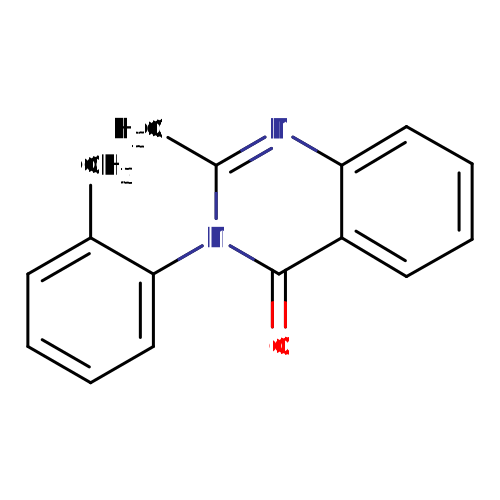
Structure for Methaqualone (DB04833)
- Weight
- Average: 250.2952
Monoisotopic: 250.11061308 - Chemical Formula
- C16H14N2O
- Synonyms
- metacualona
- Methaqualone
- External IDs
- CI-705
- CN 38703
- R-148

Pharmacology
- Indication
For the treatment of insomnia, and as a sedative and muscle relaxant.
 Reduce drug development failure ratesBuild, train, & validate machine-learning modelswith evidence-based and structured datasets.Build, train, & validate predictive machine-learning models with structured datasets.
- Contraindications & Blackbox Warnings
 Prevent Adverse Drug Events TodayTap into our Clinical API for life-saving information on contraindications & blackbox warnings, population restrictions, harmful risks, & more.Avoid life-threatening adverse drug events with our Clinical API
- Pharmacodynamics
Not Available
- Mechanism of action
- Not Available
- Absorption
Not Available
- Volume of distribution
Not Available
- Protein binding
Not Available
- Metabolism
- Not Available
- Route of elimination
Not Available
- Half-life
Not Available
- Clearance
Not Available
- Adverse Effects
 Improve decision support & research outcomesWith structured adverse effects data, including: blackbox warnings, adverse reactions, warning & precautions, & incidence rates. View sample adverse effects data in our new Data Library!Improve decision support & research outcomes with our structured adverse effects data.
- Toxicity
Symptoms of overdose include delirium, convulsions, muscle spasms or seizure, cardiac arrest, shortness or loss of breath, vomiting or nausea, and coma or death. The LD50 for mice is 1250 mg/kg and for rats is 326 mg/kg (Strasenburg Labs).
- Pathways
- Not Available
- Pharmacogenomic Effects/ADRs
- Not Available
Interactions
- Drug Interactions
- This information should not be interpreted without the help of a healthcare provider. If you believe you are experiencing an interaction, contact a healthcare provider immediately. The absence of an interaction does not necessarily mean no interactions exist.
Drug Interaction Integrate drug-drug
interactions in your software1,2-Benzodiazepine The risk or severity of CNS depression can be increased when Methaqualone is combined with 1,2-Benzodiazepine. Abametapir The serum concentration of Methaqualone can be increased when it is combined with Abametapir. Acetazolamide The risk or severity of CNS depression can be increased when Acetazolamide is combined with Methaqualone. Acetophenazine The risk or severity of CNS depression can be increased when Acetophenazine is combined with Methaqualone. Agomelatine The risk or severity of CNS depression can be increased when Methaqualone is combined with Agomelatine. - Food Interactions
- Not Available
Products
 Drug product information from 10+ global regionsOur datasets provide approved product information including:dosage, form, labeller, route of administration, and marketing period.Access drug product information from over 10 global regions.
- International/Other Brands
- Quaalude (Rorer)
Categories
- ATC Codes
- N05CX02 — Methaqualone, combinations
- N05CX — Hypnotics and sedatives in combination, excl. barbiturates
- N05C — HYPNOTICS AND SEDATIVES
- N05 — PSYCHOLEPTICS
- N — NERVOUS SYSTEM
- Drug Categories
- Central Nervous System Agents
- Central Nervous System Depressants
- Cytochrome P-450 CYP3A Substrates
- Cytochrome P-450 CYP3A4 Substrates
- Cytochrome P-450 Substrates
- Heterocyclic Compounds, Fused-Ring
- Hypnotics and Sedatives
- Muscle Relaxants
- Muscle Relaxants, Centrally Acting Agents
- Nervous System
- Psycholeptics
- Quinazolines
- Quinazolinones
- Chemical TaxonomyProvided by Classyfire
- Description
- This compound belongs to the class of organic compounds known as quinazolines. These are compounds containing a quinazoline moiety, which is made up of two fused six-member aromatic rings, a benzene ring and a pyrimidine ring.
- Kingdom
- Organic compounds
- Super Class
- Organoheterocyclic compounds
- Class
- Diazanaphthalenes
- Sub Class
- Benzodiazines
- Direct Parent
- Quinazolines
- Alternative Parents
- Toluenes / Pyrimidones / Heteroaromatic compounds / Lactams / Azacyclic compounds / Organopnictogen compounds / Organooxygen compounds / Organonitrogen compounds / Organic oxides / Hydrocarbon derivatives
- Substituents
- Aromatic heteropolycyclic compound / Azacycle / Benzenoid / Heteroaromatic compound / Hydrocarbon derivative / Lactam / Monocyclic benzene moiety / Organic nitrogen compound / Organic oxide / Organic oxygen compound
- Molecular Framework
- Aromatic heteropolycyclic compounds
- External Descriptors
- quinazolines (CHEBI:6821)
- Affected organisms
- Humans and other mammals
Chemical Identifiers
- UNII
- 7ZKH8MQW6T
- CAS number
- 72-44-6
- InChI Key
- JEYCTXHKTXCGPB-UHFFFAOYSA-N
- InChI
- InChI=1S/C16H14N2O/c1-11-7-3-6-10-15(11)18-12(2)17-14-9-5-4-8-13(14)16(18)19/h3-10H,1-2H3
- IUPAC Name
- 2-methyl-3-(2-methylphenyl)-3,4-dihydroquinazolin-4-one
- SMILES
- CC1=CC=CC=C1N1C(C)=NC2=CC=CC=C2C1=O
References
- Synthesis Reference
Potential Analgesics. Part I. Synthesis of substituted 4-quinazolones, I. K. Kacker and S. H. Zaheer, J. Ind. Chem. Soc. 28 (1951), pp. 344–346.
- General References
- Not Available
- External Links
- Human Metabolome Database
- HMDB0240285
- KEGG Drug
- D00557
- KEGG Compound
- C07560
- PubChem Compound
- 6292
- PubChem Substance
- 46507178
- ChemSpider
- 6055
- BindingDB
- 50089081
- 6823
- ChEBI
- 6821
- ChEMBL
- CHEMBL282052
- ZINC
- ZINC000002568176
- Wikipedia
- Methaqualone
Clinical Trials
Pharmacoeconomics
- Manufacturers
- Not Available
- Packagers
- Not Available
- Dosage Forms
- Not Available
- Prices
- Not Available
- Patents
- Not Available
Properties
- State
- Solid
- Experimental Properties
Property Value Source melting point (°C) 120 °C PhysProp - Predicted Properties
Property Value Source Water Solubility 0.0407 mg/mL ALOGPS logP 2.54 ALOGPS logP 3.17 Chemaxon logS -3.8 ALOGPS pKa (Strongest Basic) 1.18 Chemaxon Physiological Charge 0 Chemaxon Hydrogen Acceptor Count 2 Chemaxon Hydrogen Donor Count 0 Chemaxon Polar Surface Area 32.67 Å2 Chemaxon Rotatable Bond Count 0 Chemaxon Refractivity 77.11 m3·mol-1 Chemaxon Polarizability 27.32 Å3 Chemaxon Number of Rings 3 Chemaxon Bioavailability 1 Chemaxon Rule of Five Yes Chemaxon Ghose Filter Yes Chemaxon Veber's Rule Yes Chemaxon MDDR-like Rule No Chemaxon - Predicted ADMET Features
Property Value Probability Human Intestinal Absorption + 0.9953 Blood Brain Barrier + 0.9921 Caco-2 permeable + 0.8171 P-glycoprotein substrate Non-substrate 0.7737 P-glycoprotein inhibitor I Inhibitor 0.6427 P-glycoprotein inhibitor II Inhibitor 0.5 Renal organic cation transporter Non-inhibitor 0.8537 CYP450 2C9 substrate Non-substrate 0.6892 CYP450 2D6 substrate Non-substrate 0.9116 CYP450 3A4 substrate Substrate 0.6475 CYP450 1A2 substrate Non-inhibitor 0.9045 CYP450 2C9 inhibitor Inhibitor 0.5 CYP450 2D6 inhibitor Non-inhibitor 0.9593 CYP450 2C19 inhibitor Non-inhibitor 0.8585 CYP450 3A4 inhibitor Non-inhibitor 0.8509 CYP450 inhibitory promiscuity Low CYP Inhibitory Promiscuity 0.5384 Ames test AMES toxic 0.5126 Carcinogenicity Non-carcinogens 0.9142 Biodegradation Not ready biodegradable 0.9488 Rat acute toxicity 2.8349 LD50, mol/kg Not applicable hERG inhibition (predictor I) Weak inhibitor 0.9864 hERG inhibition (predictor II) Non-inhibitor 0.61
Spectra
- Mass Spec (NIST)
- Not Available
- Spectra
- Chromatographic Properties
Collision Cross Sections (CCS)
Adduct CCS Value (Å2) Source type Source [M-H]- 165.3931391 predictedDarkChem Lite v0.1.0 [M-H]- 165.5252391 predictedDarkChem Lite v0.1.0 [M-H]- 148.06432 predictedDeepCCS 1.0 (2019) [M+H]+ 165.8677391 predictedDarkChem Lite v0.1.0 [M+H]+ 165.8225391 predictedDarkChem Lite v0.1.0 [M+H]+ 150.43983 predictedDeepCCS 1.0 (2019) [M+Na]+ 165.4437391 predictedDarkChem Lite v0.1.0 [M+Na]+ 156.51544 predictedDeepCCS 1.0 (2019)
Enzymes
- Kind
- Protein
- Organism
- Humans
- Pharmacological action
- Unknown
- Actions
- Substrate
- General Function
- Vitamin d3 25-hydroxylase activity
- Specific Function
- Cytochromes P450 are a group of heme-thiolate monooxygenases. In liver microsomes, this enzyme is involved in an NADPH-dependent electron transport pathway. It performs a variety of oxidation react...
- Gene Name
- CYP3A4
- Uniprot ID
- P08684
- Uniprot Name
- Cytochrome P450 3A4
- Molecular Weight
- 57342.67 Da
References
- Prost F, Thormann W: Assessment of the stereoselective metabolism of methaqualone in man by capillary electrophoresis. Electrophoresis. 2003 Aug;24(15):2598-607. doi: 10.1002/elps.200305512. [Article]

Drug created at September 11, 2007 21:07 / Updated at February 21, 2021 18:51