Identification
- Generic Name
- Voacamine
- DrugBank Accession Number
- DB04877
- Background
Voacamine is an alkaloid isolated from the bark of the Pescheria fuchsiae folia tree. It is an antimalarial drug approved for use in several African countries. Voacamine is also under investigation for use in modulating multidrug-resistance in tumor cells.
- Type
- Small Molecule
- Groups
- Experimental
- Structure
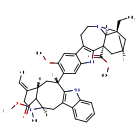
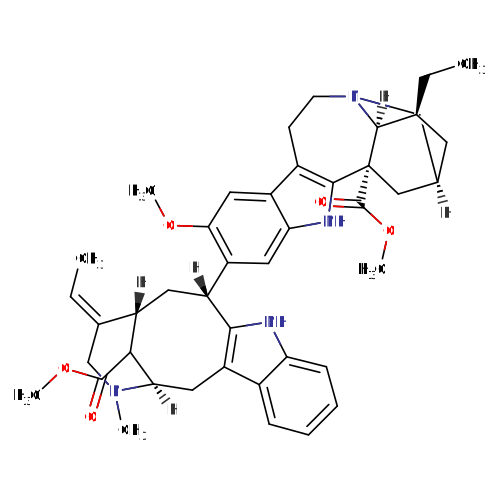
Structure for Voacamine (DB04877)
- Weight
- Average: 704.8968
Monoisotopic: 704.393770794 - Chemical Formula
- C43H52N4O5
- Synonyms
- Methyl 12-methoxy-13-(17-methoxy-17-oxovobasan-3alpha-yl)ibogamine-18-carboxylate
- Voacanginine
- Vocamine
- External IDs
- MMH-18

Pharmacology
- Indication
For the treatment of malaria. Also under investigation for the modulation of multidrug resistance in cancer cells.
 Reduce drug development failure ratesBuild, train, & validate machine-learning modelswith evidence-based and structured datasets.Build, train, & validate predictive machine-learning models with structured datasets.
- Contraindications & Blackbox Warnings
 Prevent Adverse Drug Events TodayTap into our Clinical API for life-saving information on contraindications & blackbox warnings, population restrictions, harmful risks, & more.Avoid life-threatening adverse drug events with our Clinical API
- Pharmacodynamics
Voacamine is an anti-malarial extracted from the Brazilian tree Peschiera fuchsiaefolia. In one study (PMID: 11180519), the in vivo antiplasmodial activity of voacamine was assessed in a 4-day test. It was shown to exhibit in vivo activity with 25.4% and 43.4% inhibition of parasitaemia with 2.5 and 10 mg/kg, respectively. In synchronized cultures, it was found to act on trophozoite and schizont stages of Plasmodium falciparum. Voacamine is a bisindolic alkaloid under investigation for modulation of multidrug resistance to enhance anticancer drugs such as doxorubicin.
- Mechanism of action
Voacamine is possibly a substrate for P-glycoprotein (P-gp), an efflux pump responsible for multidrug resistance in tumor cells. Voacamine may compete with anticancer drugs such as doxorubicin for P-gp transport, decreasing removal of doxorubicin.
Target Actions Organism UP-glycoprotein 1 inhibitorHumans - Absorption
Not Available
- Volume of distribution
Not Available
- Protein binding
Not Available
- Metabolism
- Not Available
- Route of elimination
Not Available
- Half-life
Not Available
- Clearance
Not Available
- Adverse Effects
 Improve decision support & research outcomesWith structured adverse effects data, including: blackbox warnings, adverse reactions, warning & precautions, & incidence rates. View sample adverse effects data in our new Data Library!Improve decision support & research outcomes with our structured adverse effects data.
- Toxicity
Not Available
- Pathways
- Not Available
- Pharmacogenomic Effects/ADRs
- Not Available
Interactions
- Drug Interactions
- This information should not be interpreted without the help of a healthcare provider. If you believe you are experiencing an interaction, contact a healthcare provider immediately. The absence of an interaction does not necessarily mean no interactions exist.Not Available
- Food Interactions
- Not Available
Categories
- Drug Categories
- Chemical TaxonomyProvided by Classyfire
- Description
- This compound belongs to the class of organic compounds known as ibogan-type alkaloids. These are indole alkaloids with a structure based on the ibogamine skeleton or a derivative thereof. Ibogamine is a pentacyclic heterocyclic compound consisting of an indole fused to an azepane-containing tricyclic moiety ring. Iboga alkaloids arise from the cyclization of a secodine-type precursor through the formation of a 16,21 bond.
- Kingdom
- Organic compounds
- Super Class
- Alkaloids and derivatives
- Class
- Ibogan-type alkaloids
- Sub Class
- Not Available
- Direct Parent
- Ibogan-type alkaloids
- Alternative Parents
- Vobasan alkaloids / 3-alkylindoles / Pyrroloazepines / Piperidinecarboxylic acids / Anisoles / Alkyl aryl ethers / Aralkylamines / Azepines / Dicarboxylic acids and derivatives / Pyrroles show 9 more
- Substituents
- 3-alkylindole / Alkyl aryl ether / Amine / Amino acid or derivatives / Anisole / Aralkylamine / Aromatic heteropolycyclic compound / Azacycle / Azepine / Benzenoid show 26 more
- Molecular Framework
- Aromatic heteropolycyclic compounds
- External Descriptors
- Not Available
- Affected organisms
- Plasmodium
Chemical Identifiers
- UNII
- 2Z504YT5AG
- CAS number
- 3371-85-5
- InChI Key
- VCMIRXRRQJNZJT-XRMSBCOFSA-N
- InChI
- InChI=1S/C43H52N4O5/c1-7-24-15-23-20-43(42(49)52-6)39-27(13-14-47(21-23)40(24)43)29-19-36(50-4)30(17-34(29)45-39)31-16-28-25(8-2)22-46(3)35(37(28)41(48)51-5)18-32-26-11-9-10-12-33(26)44-38(31)32/h8-12,17,19,23-24,28,31,35,37,40,44-45H,7,13-16,18,20-22H2,1-6H3/b25-8-/t23-,24-,28-,31+,35+,37?,40-,43+/m0/s1
- IUPAC Name
- methyl (1S,15S,17S,18S)-17-ethyl-6-[(1R,12R,14R,15E)-15-ethylidene-18-(methoxycarbonyl)-17-methyl-10,17-diazatetracyclo[12.3.1.0^{3,11}.0^{4,9}]octadeca-3(11),4,6,8-tetraen-12-yl]-7-methoxy-3,13-diazapentacyclo[13.3.1.0^{2,10}.0^{4,9}.0^{13,18}]nonadeca-2(10),4,6,8-tetraene-1-carboxylate
- SMILES
- [H][C@@]12C[C@H](CC)[C@]3([H])N(C1)CCC1=C(NC4=CC(=C(OC)C=C14)[C@@]1([H])C[C@]4([H])C(C(=O)OC)[C@@]([H])(CC5=C1NC1=CC=CC=C51)N(C)C\C4=C\C)[C@@]3(C2)C(=O)OC
References
- General References
- Meschini S, Marra M, Condello M, Calcabrini A, Federici E, Dupuis ML, Cianfriglia M, Arancia G: Voacamine, an alkaloid extracted from Peschiera fuchsiaefolia, inhibits P-glycoprotein action in multidrug-resistant tumor cells. Int J Oncol. 2005 Dec;27(6):1597-603. [Article]
- Meschini S, Condello M, Marra M, Formisano G, Federici E, Arancia G: Autophagy-mediated chemosensitizing effect of the plant alkaloid voacamine on multidrug resistant cells. Toxicol In Vitro. 2007 Mar;21(2):197-203. Epub 2006 Sep 16. [Article]
- Meschini S, Marra M, Calcabrini A, Federici E, Galeffi C, Arancia G: Voacamine, a bisindolic alkaloid from Peschiera fuchsiaefolia, enhances the cytotoxic effect of doxorubicin on multidrug-resistant tumor cells. Int J Oncol. 2003 Dec;23(6):1505-13. [Article]
- External Links
- Human Metabolome Database
- HMDB0015597
- KEGG Compound
- C09252
- PubChem Compound
- 11953931
- PubChem Substance
- 99443228
- ChemSpider
- 10128230
- ChEMBL
- CHEMBL445022
- PharmGKB
- PA165958347
- Wikipedia
- Voacamine
Clinical Trials
Pharmacoeconomics
- Manufacturers
- Not Available
- Packagers
- Not Available
- Dosage Forms
- Not Available
- Prices
- Not Available
- Patents
- Not Available
Properties
- State
- Solid
- Experimental Properties
- Not Available
- Predicted Properties
Property Value Source Water Solubility 0.00323 mg/mL ALOGPS logP 6.26 ALOGPS logP 6.21 Chemaxon logS -5.3 ALOGPS pKa (Strongest Acidic) 15.56 Chemaxon pKa (Strongest Basic) 8.53 Chemaxon Physiological Charge 2 Chemaxon Hydrogen Acceptor Count 5 Chemaxon Hydrogen Donor Count 2 Chemaxon Polar Surface Area 99.89 Å2 Chemaxon Rotatable Bond Count 7 Chemaxon Refractivity 203.68 m3·mol-1 Chemaxon Polarizability 44.36 Å3 Chemaxon Number of Rings 9 Chemaxon Bioavailability 0 Chemaxon Rule of Five No Chemaxon Ghose Filter No Chemaxon Veber's Rule No Chemaxon MDDR-like Rule Yes Chemaxon - Predicted ADMET Features
Property Value Probability Human Intestinal Absorption + 0.9928 Blood Brain Barrier - 0.5295 Caco-2 permeable + 0.5 P-glycoprotein substrate Substrate 0.9264 P-glycoprotein inhibitor I Inhibitor 0.8829 P-glycoprotein inhibitor II Inhibitor 0.8026 Renal organic cation transporter Non-inhibitor 0.5461 CYP450 2C9 substrate Non-substrate 0.8491 CYP450 2D6 substrate Non-substrate 0.5836 CYP450 3A4 substrate Substrate 0.7867 CYP450 1A2 substrate Non-inhibitor 0.7083 CYP450 2C9 inhibitor Non-inhibitor 0.6209 CYP450 2D6 inhibitor Non-inhibitor 0.8255 CYP450 2C19 inhibitor Non-inhibitor 0.7443 CYP450 3A4 inhibitor Inhibitor 0.7262 CYP450 inhibitory promiscuity High CYP Inhibitory Promiscuity 0.5987 Ames test Non AMES toxic 0.7269 Carcinogenicity Non-carcinogens 0.9345 Biodegradation Not ready biodegradable 0.9943 Rat acute toxicity 2.9345 LD50, mol/kg Not applicable hERG inhibition (predictor I) Weak inhibitor 0.8902 hERG inhibition (predictor II) Inhibitor 0.6025
Spectra
- Mass Spec (NIST)
- Not Available
- Spectra
- Chromatographic Properties
Collision Cross Sections (CCS)
Adduct CCS Value (Å2) Source type Source [M-H]- 283.7600277 predictedDarkChem Lite v0.1.0 [M-H]- 269.8898 predictedDeepCCS 1.0 (2019) [M+H]+ 282.8867277 predictedDarkChem Lite v0.1.0 [M+H]+ 271.61356 predictedDeepCCS 1.0 (2019) [M+Na]+ 284.3140277 predictedDarkChem Lite v0.1.0 [M+Na]+ 277.94308 predictedDeepCCS 1.0 (2019)
Targets

- Kind
- Protein
- Organism
- Humans
- Pharmacological action
- Unknown
- Actions
- Inhibitor
- General Function
- Xenobiotic-transporting atpase activity
- Specific Function
- Energy-dependent efflux pump responsible for decreased drug accumulation in multidrug-resistant cells.
- Gene Name
- ABCB1
- Uniprot ID
- P08183
- Uniprot Name
- Multidrug resistance protein 1
- Molecular Weight
- 141477.255 Da
References
- Meschini S, Marra M, Condello M, Calcabrini A, Federici E, Dupuis ML, Cianfriglia M, Arancia G: Voacamine, an alkaloid extracted from Peschiera fuchsiaefolia, inhibits P-glycoprotein action in multidrug-resistant tumor cells. Int J Oncol. 2005 Dec;27(6):1597-603. [Article]
- Meschini S, Marra M, Calcabrini A, Federici E, Galeffi C, Arancia G: Voacamine, a bisindolic alkaloid from Peschiera fuchsiaefolia, enhances the cytotoxic effect of doxorubicin on multidrug-resistant tumor cells. Int J Oncol. 2003 Dec;23(6):1505-13. [Article]
Transporters
- Kind
- Protein
- Organism
- Humans
- Pharmacological action
- No
- Actions
- Inhibitor
- General Function
- Xenobiotic-transporting atpase activity
- Specific Function
- Energy-dependent efflux pump responsible for decreased drug accumulation in multidrug-resistant cells.
- Gene Name
- ABCB1
- Uniprot ID
- P08183
- Uniprot Name
- Multidrug resistance protein 1
- Molecular Weight
- 141477.255 Da
References
- Meschini S, Marra M, Condello M, Calcabrini A, Federici E, Dupuis ML, Cianfriglia M, Arancia G: Voacamine, an alkaloid extracted from Peschiera fuchsiaefolia, inhibits P-glycoprotein action in multidrug-resistant tumor cells. Int J Oncol. 2005 Dec;27(6):1597-603. [Article]

Drug created at October 20, 2007 16:45 / Updated at June 12, 2020 16:52