Identification
- Summary
Lofexidine is a centrally acting alpha2-adrenergic agonist used for the symptomatic treatment of acute opioid withdrawal syndrome to facilitate abrupt opioid discontinuation in adults.
- Brand Names
- Lucemyra
- Generic Name
- Lofexidine
- DrugBank Accession Number
- DB04948
- Background
Lofexidine is a non-opioid centrally acting alpha2-adrenergic receptor agonist that was first approved for the treatment of opioid withdrawal in the United Kingdom in 1992.2 It was first studied for use as an antihypertensive in 1980, but its researched was stopped as it was found less effective for the treatment of hypertension than clonidine.6 Lofexidine was then repurposed for the treatment of opioid withdrawal, as it was seen to be more economical and have fewer side effects than clonidine.5 Lofexidine was developed by US Woldmeds LLC and it was approved by the FDA on May 16, 2018.8
- Type
- Small Molecule
- Groups
- Approved, Investigational
- Structure
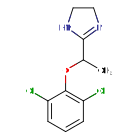
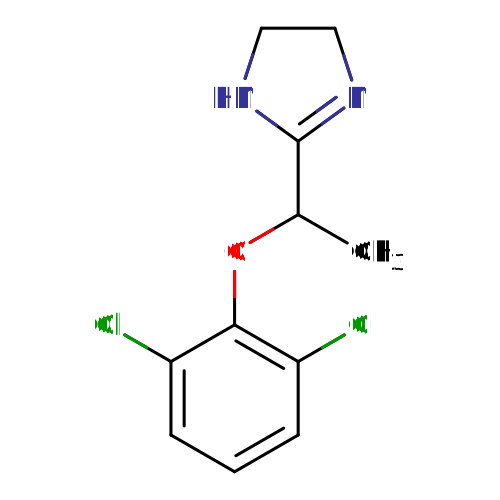
Structure for Lofexidine (DB04948)
- Weight
- Average: 259.132
Monoisotopic: 258.03266843 - Chemical Formula
- C11H12Cl2N2O
- Synonyms
- 2-(alpha-(2,6-Dichlorophenoxy)ethyl)2-imidazoline
- Lofexidina
- Lofexidine
- Lofexidinum

Pharmacology
- Indication
Lofexidine is indicated for mitigation of symptoms associated with acute withdrawal from opioids and for facilitation of the completion of opioid discontinuation treatment. It is the first non-opioid medication for the symptomatic management of opioid discontinuation.9
Opioid withdrawal syndrome is a debilitating manifestation of opioid dependence.3 This condition is extremely unpleasant lasting several days with some of the main features being abdominal pain, nausea, diarrhea, mydriasis, lacrimation, and piloerection. These symptoms are often observed after abrupt reductions in the opioid dose and can be resolved by re-administration of the opioid.4
 Reduce drug development failure ratesBuild, train, & validate machine-learning modelswith evidence-based and structured datasets.Build, train, & validate predictive machine-learning models with structured datasets.
- Associated Conditions
Indication Type Indication Combined Product Details Approval Level Age Group Patient Characteristics Dose Form Symptomatic treatment of Abrupt opioid withdrawal •••••••••••• - Contraindications & Blackbox Warnings
 Prevent Adverse Drug Events TodayTap into our Clinical API for life-saving information on contraindications & blackbox warnings, population restrictions, harmful risks, & more.Avoid life-threatening adverse drug events with our Clinical API
- Pharmacodynamics
In clinical trials, lofexidine presented more severe opioid withdrawal effects than observed with methadone. On the other hand, in clinical trials of methadone withdrawal, lofexidine effectively reduced withdrawal symptoms, especially hypotension.5 The clinical reports have also indicated that lofexidine presents a better outcome when used briefly.6 In phase 3 clinical trials, lofexidine was shown to generate a significantly higher completion rate of opioid discontinuation. Some pharmacological studies were performed and there were no off-target effects reported.9
- Mechanism of action
Lofexidine is a potent alpha2-adrenergic receptor agonist with some moderate agonistic affinity towards Alpha-1A adrenergic receptor and 5-HT1a, 5-HT7, 5HT2c and 5HT1d receptors.9
The alpha2-adrenergic receptor is normally targeted by norepinephrine and its activation inhibits the synthesis of cAMP which in turn leads to potassium efflux and suppression of neural firing and inhibition of norepinephrine release. All of this activity can reduce the heart rate, blood pressure, and attenuate sympathetic stress response.9
Opioids inhibit cAMP in the noradrenergic neurons and their discontinuation produces a rise in the level of cAMP. This will generate an increase in norepinephrine which is associated with the symptoms of withdrawal. The magnitude of the effect is augmented by chronic opioid use due to the compensatory mechanisms of continuous negative feedback. Therefore, chronic opioid use translates into an exacerbated production of cAMP and norepinephrine release.9
Lofexidine replaces the opioid-driven inhibition of cAMP production by activating the alpha2-adrenergic receptor and moderating the symptoms of opioid withdrawal. This effect is performed without interacting with opioid receptors which mediate other activities of opioid dependence or addiction.9
Target Actions Organism AAlpha-2A adrenergic receptor agonistHumans NAlpha-1A adrenergic receptor agonistHumans N5-hydroxytryptamine receptor 1A agonistHumans N5-hydroxytryptamine receptor 7 agonistHumans N5-hydroxytryptamine receptor 2C agonistHumans N5-hydroxytryptamine receptor 1D agonistHumans - Absorption
Lofexidine has a good oral bioavailability and the peak plasma concentration occurs after 2-5 hours of oral administration.6 The bioavailability is registered to be even higher than 72%.7 About 30% of the administered dose of lofexidine is lost during first-pass metabolism. The absorption is registered to be very rapidly recirculated in the gut. After oral administration of 0.8 mg of lofexidine, a maximal dose of 1.26 ng/ml is achieved after 3 hours.9
- Volume of distribution
Lofexidine has a volume of distribution of 300 L, indicating that it distributes readily into the tissues.9
- Protein binding
The protein binding of lofexidine is determined to be moderate and it represents about 55% of the administered dose.9
- Metabolism
Lofexidine metabolic ratio is highly variable among people.6 It is metabolized mainly by the activity of CYP2D6 and in a minor degree by CYP1A2 and CYP2C19. These enzymes catalyze the hydroxylation of lofexidine and the opening of imidazoline ring to form N-(2-aminoethyl)-2-(2,6-dichlorophenoxy)propanamide. This metabolite is deamidated and forms 2-(2,6-dichlorophenoxy) propionic acid and 2,6-dichlorophenol. These three main metabolites are inactive.9
Hover over products below to view reaction partners
- Route of elimination
The elimination of lofexidine is primarily through the renal system and it represents 94% of the administered dose while elimination in feces corresponds to only 0.93%.6 From the eliminated dose in urine, about 10% is formed by unchanged drug and 5% is constituted by the first hydrolysis product N-(2-aminoethyl)-2-(2,6-dichlorophenoxy)propanamide. 2,6-dichlorophenol represents the majority of the administered dose by occupying about 80% of the administered dose.9
- Half-life
The reported elimination half-life of lofexidine is 11 hours.7
- Clearance
The total elimination clearance following intravenous administration is 17.6 L/h.9
- Adverse Effects
 Improve decision support & research outcomesWith structured adverse effects data, including: blackbox warnings, adverse reactions, warning & precautions, & incidence rates. View sample adverse effects data in our new Data Library!Improve decision support & research outcomes with our structured adverse effects data.
- Toxicity
Lofexidine did not exhibit genotoxic, mutagenic nor mutagenic potential. Administration at gestational period showed a reduction in the neonatal weight, survival, and increased abortion.9
- Pathways
- Not Available
- Pharmacogenomic Effects/ADRs
- Not Available
Interactions
- Drug Interactions
- This information should not be interpreted without the help of a healthcare provider. If you believe you are experiencing an interaction, contact a healthcare provider immediately. The absence of an interaction does not necessarily mean no interactions exist.
Drug Interaction Integrate drug-drug
interactions in your software1,2-Benzodiazepine The therapeutic efficacy of 1,2-Benzodiazepine can be increased when used in combination with Lofexidine. Abacavir Abacavir may decrease the excretion rate of Lofexidine which could result in a higher serum level. Abaloparatide The risk or severity of adverse effects can be increased when Lofexidine is combined with Abaloparatide. Abametapir The serum concentration of Lofexidine can be increased when it is combined with Abametapir. Abatacept The metabolism of Lofexidine can be increased when combined with Abatacept. - Food Interactions
- Avoid excessive or chronic alcohol consumption. Lofexidine may potentiate the CNS depressant effects of alcohol.
- Take with or without food.
Products
 Drug product information from 10+ global regionsOur datasets provide approved product information including:dosage, form, labeller, route of administration, and marketing period.Access drug product information from over 10 global regions.
- Product Ingredients
Ingredient UNII CAS InChI Key Lofexidine hydrochloride V47G1SDI1B 21498-08-8 DWWHMKBNNNZGHF-UHFFFAOYSA-N - International/Other Brands
- Britlofex (Britannia)
- Brand Name Prescription Products
Name Dosage Strength Route Labeller Marketing Start Marketing End Region Image Lucemyra Tablet, film coated 0.2 mg/1 Oral USWM, LLC 2021-02-09 Not applicable US 
Lucemyra Tablet, film coated 0.2 mg/1 Oral US WorldMeds, LLC 2018-06-18 Not applicable US
Categories
- ATC Codes
- N07BC04 — Lofexidine
- Drug Categories
- Adrenergic Agents
- Adrenergic Agonists
- Adrenergic alpha-2 Receptor Agonists
- Adrenergic alpha-Agonists
- Agents producing tachycardia
- Agents that produce hypertension
- Antidepressive Agents
- Antihypertensive Agents
- Cardiovascular Agents
- Central alpha-2 Adrenergic Agonist
- Central Nervous System Agents
- Central Nervous System Depressants
- Cytochrome P-450 CYP1A2 Substrates
- Cytochrome P-450 CYP2C19 Substrates
- Cytochrome P-450 CYP2D6 Substrates
- Cytochrome P-450 Substrates
- Drugs that are Mainly Renally Excreted
- Drugs Used in Addictive Disorders
- Drugs Used in Opioid Dependence
- Hypotensive Agents
- Imidazoles
- Imidazolines
- MATE 1 Inhibitors
- MATE inhibitors
- Moderate Risk QTc-Prolonging Agents
- Nervous System
- Neurotransmitter Agents
- Peripheral Nervous System Agents
- QTc Prolonging Agents
- Sensory System Agents
- Serotonergic Drugs Shown to Increase Risk of Serotonin Syndrome
- Serotonin 5-HT2 Receptor Agonists
- Serotonin Agents
- Serotonin Receptor Agonists
- Chemical TaxonomyProvided by Classyfire
- Description
- This compound belongs to the class of organic compounds known as dichlorobenzenes. These are compounds containing a benzene with exactly two chlorine atoms attached to it.
- Kingdom
- Organic compounds
- Super Class
- Benzenoids
- Class
- Benzene and substituted derivatives
- Sub Class
- Halobenzenes
- Direct Parent
- Dichlorobenzenes
- Alternative Parents
- Phenoxy compounds / Phenol ethers / Alkyl aryl ethers / Imidolactams / Aryl chlorides / Imidazolines / Propargyl-type 1,3-dipolar organic compounds / Carboximidamides / Carboxamidines / Azacyclic compounds show 3 more
- Substituents
- 1,3-dichlorobenzene / 2-imidazoline / Alkyl aryl ether / Amidine / Aromatic heteromonocyclic compound / Aryl chloride / Aryl halide / Azacycle / Carboximidamide / Carboxylic acid amidine show 15 more
- Molecular Framework
- Aromatic heteromonocyclic compounds
- External Descriptors
- aromatic ether, imidazoles, carboxamidine, dichlorobenzene (CHEBI:51368)
- Affected organisms
- Humans and other mammals
Chemical Identifiers
- UNII
- UI82K0T627
- CAS number
- 31036-80-3
- InChI Key
- KSMAGQUYOIHWFS-UHFFFAOYSA-N
- InChI
- InChI=1S/C11H12Cl2N2O/c1-7(11-14-5-6-15-11)16-10-8(12)3-2-4-9(10)13/h2-4,7H,5-6H2,1H3,(H,14,15)
- IUPAC Name
- 2-[1-(2,6-dichlorophenoxy)ethyl]-4,5-dihydro-1H-imidazole
- SMILES
- CC(OC1=C(Cl)C=CC=C1Cl)C1=NCCN1
References
- Synthesis Reference
U.S. Patent 3,966,757.
- General References
- Walsh SL, Strain EC, Bigelow GE: Evaluation of the effects of lofexidine and clonidine on naloxone-precipitated withdrawal in opioid-dependent humans. Addiction. 2003 Apr;98(4):427-39. [Article]
- Haney M, Hart CL, Vosburg SK, Comer SD, Reed SC, Foltin RW: Effects of THC and lofexidine in a human laboratory model of marijuana withdrawal and relapse. Psychopharmacology (Berl). 2008 Mar;197(1):157-68. doi: 10.1007/s00213-007-1020-8. Epub 2007 Dec 27. [Article]
- Rehni AK, Jaggi AS, Singh N: Opioid withdrawal syndrome: emerging concepts and novel therapeutic targets. CNS Neurol Disord Drug Targets. 2013 Feb 1;12(1):112-25. [Article]
- Juurlink DN, Dhalla IA: Dependence and addiction during chronic opioid therapy. J Med Toxicol. 2012 Dec;8(4):393-9. doi: 10.1007/s13181-012-0269-4. [Article]
- Ries R. and Miller S. (2009). Principles of Addiction Medicine (4th ed.). Lippincott Williams & Wilkins. [ISBN:978-0-7817-7477-2]
- Strain E. and Stitzer M. (2006). The treatment of Opiod Dependence. The Johns Hopkins University Press. [ISBN:0-8018-8303-2]
- Zaragoza Dorwald F. (2012). Lead optimization for medicinal chemists. Wiley-VCH.
- FDA News [Link]
- FDA reports [Link]
- External Links
- Human Metabolome Database
- HMDB0015606
- PubChem Compound
- 30668
- PubChem Substance
- 46508453
- ChemSpider
- 28460
- BindingDB
- 50019646
- 28863
- ChEBI
- 51368
- ChEMBL
- CHEMBL17860
- Therapeutic Targets Database
- DAP000064
- PharmGKB
- PA164744510
- Wikipedia
- Lofexidine
- FDA label
- Download (530 KB)
- MSDS
- Download (72.7 KB)
Clinical Trials
- Clinical Trials
Phase Status Purpose Conditions Count 4 Completed Treatment Opiate Dependent Patients Who Are Undergoing Inpatient Detoxification in Singapore 1 4 Completed Treatment Opiate Withdrawal Syndrome 1 4 Completed Treatment Opioid Withdrawal (Disorder) 1 3 Completed Treatment Acute Opioid Withdrawal (Disorder) / Opioid Dependence 1 3 Completed Treatment Opiate Addiction 1
Pharmacoeconomics
- Manufacturers
- Not Available
- Packagers
- Not Available
- Dosage Forms
Form Route Strength Tablet, film coated Oral Tablet, film coated Oral 0.2 mg/1 - Prices
- Not Available
- Patents
- Not Available
Properties
- State
- Solid
- Experimental Properties
Property Value Source melting point (°C) 221-223 U.S. Patent 3,966,757. boiling point (°C) 421.5 ºC at 760 mm Hg 'MSDS' water solubility Soluble 'MSDS' logP 5.37 FDA Advisory Committee Briefing Document. pKa 9.43 FDA Advisory Committee Briefing Document. - Predicted Properties
Property Value Source Water Solubility 0.147 mg/mL ALOGPS logP 3.31 ALOGPS logP 2.66 Chemaxon logS -3.2 ALOGPS pKa (Strongest Basic) 9.27 Chemaxon Physiological Charge 1 Chemaxon Hydrogen Acceptor Count 3 Chemaxon Hydrogen Donor Count 1 Chemaxon Polar Surface Area 33.62 Å2 Chemaxon Rotatable Bond Count 3 Chemaxon Refractivity 64.41 m3·mol-1 Chemaxon Polarizability 25.11 Å3 Chemaxon Number of Rings 2 Chemaxon Bioavailability 1 Chemaxon Rule of Five Yes Chemaxon Ghose Filter Yes Chemaxon Veber's Rule Yes Chemaxon MDDR-like Rule No Chemaxon - Predicted ADMET Features
Property Value Probability Human Intestinal Absorption + 0.9969 Blood Brain Barrier + 0.9582 Caco-2 permeable + 0.539 P-glycoprotein substrate Substrate 0.7119 P-glycoprotein inhibitor I Non-inhibitor 0.9326 P-glycoprotein inhibitor II Non-inhibitor 0.8089 Renal organic cation transporter Inhibitor 0.6897 CYP450 2C9 substrate Non-substrate 0.744 CYP450 2D6 substrate Non-substrate 0.6421 CYP450 3A4 substrate Non-substrate 0.5055 CYP450 1A2 substrate Inhibitor 0.8023 CYP450 2C9 inhibitor Non-inhibitor 0.739 CYP450 2D6 inhibitor Inhibitor 0.6616 CYP450 2C19 inhibitor Non-inhibitor 0.6593 CYP450 3A4 inhibitor Non-inhibitor 0.9304 CYP450 inhibitory promiscuity High CYP Inhibitory Promiscuity 0.5075 Ames test Non AMES toxic 0.7322 Carcinogenicity Non-carcinogens 0.913 Biodegradation Not ready biodegradable 0.996 Rat acute toxicity 2.9567 LD50, mol/kg Not applicable hERG inhibition (predictor I) Weak inhibitor 0.6244 hERG inhibition (predictor II) Non-inhibitor 0.7293
Spectra
- Mass Spec (NIST)
- Not Available
- Spectra
- Chromatographic Properties
Collision Cross Sections (CCS)
Adduct CCS Value (Å2) Source type Source [M-H]- 149.4922845 predictedDarkChem Lite v0.1.0 [M-H]- 144.09695 predictedDeepCCS 1.0 (2019) [M+H]+ 149.9356845 predictedDarkChem Lite v0.1.0 [M+H]+ 146.45497 predictedDeepCCS 1.0 (2019) [M+Na]+ 149.6057845 predictedDarkChem Lite v0.1.0 [M+Na]+ 152.80626 predictedDeepCCS 1.0 (2019)
Targets

- Kind
- Protein
- Organism
- Humans
- Pharmacological action
- Yes
- Actions
- Agonist
- General Function
- Thioesterase binding
- Specific Function
- Alpha-2 adrenergic receptors mediate the catecholamine-induced inhibition of adenylate cyclase through the action of G proteins. The rank order of potency for agonists of this receptor is oxymetazo...
- Gene Name
- ADRA2A
- Uniprot ID
- P08913
- Uniprot Name
- Alpha-2A adrenergic receptor
- Molecular Weight
- 48956.275 Da
References
- Jin Y, Verstappen A, Elko E, Cammarata P, Yorio T: Effects of lofexidine, an alpha 2-adrenoreceptor agonist, on ocular blood flow and ion transport of rabbit iris-ciliary body. J Ocul Pharmacol. 1992 Spring;8(1):23-33. [Article]
- Strang J, Bearn J, Gossop M: Lofexidine for opiate detoxification: review of recent randomised and open controlled trials. Am J Addict. 1999 Fall;8(4):337-48. [Article]
- Erb S, Hitchcott PK, Rajabi H, Mueller D, Shaham Y, Stewart J: Alpha-2 adrenergic receptor agonists block stress-induced reinstatement of cocaine seeking. Neuropsychopharmacology. 2000 Aug;23(2):138-50. [Article]
- Kind
- Protein
- Organism
- Humans
- Pharmacological action
- No
- Actions
- Agonist
- General Function
- Protein heterodimerization activity
- Specific Function
- This alpha-adrenergic receptor mediates its action by association with G proteins that activate a phosphatidylinositol-calcium second messenger system. Its effect is mediated by G(q) and G(11) prot...
- Gene Name
- ADRA1A
- Uniprot ID
- P35348
- Uniprot Name
- Alpha-1A adrenergic receptor
- Molecular Weight
- 51486.005 Da
References
- FDA reports [Link]
- Kind
- Protein
- Organism
- Humans
- Pharmacological action
- No
- Actions
- Agonist
- General Function
- Serotonin receptor activity
- Specific Function
- G-protein coupled receptor for 5-hydroxytryptamine (serotonin). Also functions as a receptor for various drugs and psychoactive substances. Ligand binding causes a conformation change that triggers...
- Gene Name
- HTR1A
- Uniprot ID
- P08908
- Uniprot Name
- 5-hydroxytryptamine receptor 1A
- Molecular Weight
- 46106.335 Da
References
- FDA reports [Link]
- Kind
- Protein
- Organism
- Humans
- Pharmacological action
- No
- Actions
- Agonist
- General Function
- Serotonin receptor activity
- Specific Function
- This is one of the several different receptors for 5-hydroxytryptamine (serotonin), a biogenic hormone that functions as a neurotransmitter, a hormone, and a mitogen. The activity of this receptor ...
- Gene Name
- HTR7
- Uniprot ID
- P34969
- Uniprot Name
- 5-hydroxytryptamine receptor 7
- Molecular Weight
- 53554.43 Da
References
- FDA reports [Link]
- Kind
- Protein
- Organism
- Humans
- Pharmacological action
- No
- Actions
- Agonist
- General Function
- Serotonin receptor activity
- Specific Function
- G-protein coupled receptor for 5-hydroxytryptamine (serotonin). Also functions as a receptor for various drugs and psychoactive substances, including ergot alkaloid derivatives, 1-2,5,-dimethoxy-4-...
- Gene Name
- HTR2C
- Uniprot ID
- P28335
- Uniprot Name
- 5-hydroxytryptamine receptor 2C
- Molecular Weight
- 51820.705 Da
References
- FDA reports [Link]
- Kind
- Protein
- Organism
- Humans
- Pharmacological action
- No
- Actions
- Agonist
- General Function
- Serotonin receptor activity
- Specific Function
- G-protein coupled receptor for 5-hydroxytryptamine (serotonin). Also functions as a receptor for ergot alkaloid derivatives, various anxiolytic and antidepressant drugs and other psychoactive subst...
- Gene Name
- HTR1D
- Uniprot ID
- P28221
- Uniprot Name
- 5-hydroxytryptamine receptor 1D
- Molecular Weight
- 41906.38 Da
References
- FDA reports [Link]
Enzymes
- Kind
- Protein
- Organism
- Humans
- Pharmacological action
- No
- Actions
- Substrate
- General Function
- Steroid hydroxylase activity
- Specific Function
- Responsible for the metabolism of many drugs and environmental chemicals that it oxidizes. It is involved in the metabolism of drugs such as antiarrhythmics, adrenoceptor antagonists, and tricyclic...
- Gene Name
- CYP2D6
- Uniprot ID
- P10635
- Uniprot Name
- Cytochrome P450 2D6
- Molecular Weight
- 55768.94 Da
References
- FDA reports [Link]
- Kind
- Protein
- Organism
- Humans
- Pharmacological action
- No
- Actions
- Substrate
- General Function
- Oxidoreductase activity, acting on paired donors, with incorporation or reduction of molecular oxygen, reduced flavin or flavoprotein as one donor, and incorporation of one atom of oxygen
- Specific Function
- Cytochromes P450 are a group of heme-thiolate monooxygenases. In liver microsomes, this enzyme is involved in an NADPH-dependent electron transport pathway. It oxidizes a variety of structurally un...
- Gene Name
- CYP1A2
- Uniprot ID
- P05177
- Uniprot Name
- Cytochrome P450 1A2
- Molecular Weight
- 58293.76 Da
References
- Kind
- Protein
- Organism
- Humans
- Pharmacological action
- No
- Actions
- Substrate
- General Function
- Steroid hydroxylase activity
- Specific Function
- Responsible for the metabolism of a number of therapeutic agents such as the anticonvulsant drug S-mephenytoin, omeprazole, proguanil, certain barbiturates, diazepam, propranolol, citalopram and im...
- Gene Name
- CYP2C19
- Uniprot ID
- P33261
- Uniprot Name
- Cytochrome P450 2C19
- Molecular Weight
- 55930.545 Da
References
- FDA reports [Link]
Transporters
- Kind
- Protein
- Organism
- Humans
- Pharmacological action
- No
- Actions
- Inhibitor
- General Function
- Efflux transmembrane transporter activity
- Specific Function
- Drug efflux transporter present in a number of stem cells that acts as a regulator of cellular differentiation. Able to mediate efflux from cells of the rhodamine dye and of the therapeutic drug do...
- Gene Name
- ABCB5
- Uniprot ID
- Q2M3G0
- Uniprot Name
- ATP-binding cassette sub-family B member 5
- Molecular Weight
- 138639.48 Da
References
- FDA reports [Link]
- Kind
- Protein
- Organism
- Humans
- Pharmacological action
- No
- Actions
- Inhibitor
- General Function
- Monovalent cation:proton antiporter activity
- Specific Function
- Solute transporter for tetraethylammonium (TEA), 1-methyl-4-phenylpyridinium (MPP), cimetidine, N-methylnicotinamide (NMN), metformin, creatinine, guanidine, procainamide, topotecan, estrone sulfat...
- Gene Name
- SLC47A1
- Uniprot ID
- Q96FL8
- Uniprot Name
- Multidrug and toxin extrusion protein 1
- Molecular Weight
- 61921.585 Da
References
- FDA reports [Link]

Drug created at October 21, 2007 22:23 / Updated at March 03, 2024 02:34