Identification
- Summary
Methsuximide is a succinimide anticonvulsant that increases the seizure threshold. Primarily used for childhood absence seizures. Functions by suppressing paroxysmal spike-and-wave patterns associated with lapses of consciousness in absence seizures.
- Brand Names
- Celontin
- Generic Name
- Methsuximide
- DrugBank Accession Number
- DB05246
- Background
Mesuximide (or methsuximide) is an anticonvulsant medication. It is sold by Pfizer under the name Petinutin.
- Type
- Small Molecule
- Groups
- Approved
- Structure
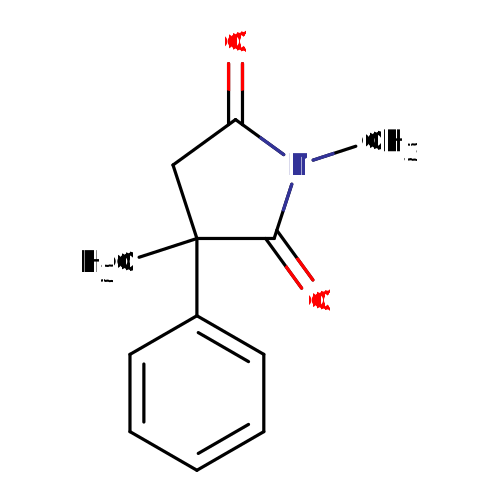
Structure for Methsuximide (DB05246)
- Weight
- Average: 203.2371
Monoisotopic: 203.094628665 - Chemical Formula
- C12H13NO2
- Synonyms
- (RS)-1,3-Dimethyl-3-phenyl-2,5-pyrrolidindion
- 1,3-Dimethyl-3-phenyl-2,5-dioxopyrrolidine
- 1,3-Dimethyl-3-phenyl-pyrrolidin-2,5-dione
- 1,3-Dimethyl-3-phenylsuccinimide
- alpha-Methyl-alpha-phenyl N-methyl succinimide
- alpha-Methylphensuximide
- Mesuximida
- Mesuximide
- Mesuximidum
- Methsuximid
- Methsuximide
- Metosuccimmide
- N-methyl-alpha-methyl-alpha-phenylsuccinimide
- N,2-Dimethyl-2-phenylsuccinimide

Pharmacology
- Indication
For the control of absence (petit mal) seizures that are refractory to other drugs.
 Reduce drug development failure ratesBuild, train, & validate machine-learning modelswith evidence-based and structured datasets.Build, train, & validate predictive machine-learning models with structured datasets.
- Associated Conditions
Indication Type Indication Combined Product Details Approval Level Age Group Patient Characteristics Dose Form Management of Refractory absence seizure •••••••••••• - Contraindications & Blackbox Warnings
 Prevent Adverse Drug Events TodayTap into our Clinical API for life-saving information on contraindications & blackbox warnings, population restrictions, harmful risks, & more.Avoid life-threatening adverse drug events with our Clinical API
- Pharmacodynamics
Used in the treatment of epilepsy. Methsuximide suppresses the paroxysmal three cycle per second spike and wave activity associated with lapses of consciousness which is common in absence (petit mal) seizures. The frequency of epileptiform attacks is reduced, apparently by depression of the motor cortex and elevation of the threshold of the central nervous system to convulsive stimuli.
- Mechanism of action
Binds to T-type voltage sensitive calcium channels. Voltage-sensitive calcium channels (VSCC) mediate the entry of calcium ions into excitable cells and are also involved in a variety of calcium-dependent processes, including muscle contraction, hormone or neurotransmitter release, gene expression, cell motility, cell division and cell death. The isoform alpha-1G gives rise to T-type calcium currents. T-type calcium channels belong to the "low-voltage activated (LVA)" group and are strongly blocked by mibefradil. A particularity of this type of channels is an opening at quite negative potentials and a voltage-dependent inactivation. T-type channels serve pacemaking functions in both central neurons and cardiac nodal cells and support calcium signaling in secretory cells and vascular smooth muscle. They may also be involved in the modulation of firing patterns of neurons which is important for information processing as well as in cell growth processes.
Target Actions Organism AVoltage-dependent T-type calcium channel subunit alpha-1G inhibitorHumans - Absorption
Not Available
- Volume of distribution
Not Available
- Protein binding
Not Available
- Metabolism
- Not Available
- Route of elimination
Not Available
- Half-life
1.4-2.6 hours for mesuximide and 28-38 hours for the active metabolite.
- Clearance
Not Available
- Adverse Effects
 Improve decision support & research outcomesWith structured adverse effects data, including: blackbox warnings, adverse reactions, warning & precautions, & incidence rates. View sample adverse effects data in our new Data Library!Improve decision support & research outcomes with our structured adverse effects data.
- Toxicity
Acute overdoses may produce nausea, vomiting, and CNS depression including coma with respiratory depression. Levels greater than 40 µg/mL have caused toxicity and coma has been seen at levels of 150 µg/mL.
- Pathways
- Not Available
- Pharmacogenomic Effects/ADRs
- Not Available
Interactions
- Drug Interactions
- This information should not be interpreted without the help of a healthcare provider. If you believe you are experiencing an interaction, contact a healthcare provider immediately. The absence of an interaction does not necessarily mean no interactions exist.
Drug Interaction Integrate drug-drug
interactions in your software1,2-Benzodiazepine The risk or severity of CNS depression can be increased when Methsuximide is combined with 1,2-Benzodiazepine. Abatacept The metabolism of Methsuximide can be increased when combined with Abatacept. Abrocitinib The metabolism of Abrocitinib can be decreased when combined with Methsuximide. Acarbose The risk or severity of hypoglycemia can be increased when Methsuximide is combined with Acarbose. Acebutolol Acebutolol may increase the arrhythmogenic activities of Methsuximide. - Food Interactions
- Avoid alcohol.
- Take with food.
Products
 Drug product information from 10+ global regionsOur datasets provide approved product information including:dosage, form, labeller, route of administration, and marketing period.Access drug product information from over 10 global regions.
- International/Other Brands
- Petinutin
- Brand Name Prescription Products
Name Dosage Strength Route Labeller Marketing Start Marketing End Region Image Celontin Capsule 300 mg/1 Oral Parke-Davis Div of Pfizer Inc 1957-02-08 Not applicable US 
Celontin Capsule 300 mg/1 Oral Farmea 1999-01-01 Not applicable US Celontin Capsule 150 mg/1 Oral PARKE-DAVIS 2006-11-03 2006-11-03 US Celontin Cap 300mg Capsule 300 mg Oral Erfa Canada 2012 Inc 1957-12-31 2015-06-05 Canada 
- Generic Prescription Products
Name Dosage Strength Route Labeller Marketing Start Marketing End Region Image Methsuximide Capsule 300 mg/1 Oral ANI Pharmaceuticals, Inc. 2023-05-01 Not applicable US
Categories
- ATC Codes
- N03AD03 — Mesuximide
- Drug Categories
- Agents causing hyperkalemia
- Anti-epileptic Agent
- Antiarrhythmic agents
- Anticonvulsants
- Bradycardia-Causing Agents
- Calcium Channel Blockers
- Central Nervous System Agents
- Central Nervous System Depressants
- Cytochrome P-450 CYP2C19 Inhibitors
- Cytochrome P-450 CYP2C19 inhibitors (strength unknown)
- Cytochrome P-450 CYP2C19 Substrates
- Cytochrome P-450 Enzyme Inhibitors
- Cytochrome P-450 Substrates
- Decreased Central Nervous System Disorganized Electrical Activity
- Imides
- Nervous System
- Potential QTc-Prolonging Agents
- Pyrrolidines
- Pyrrolidinones
- QTc Prolonging Agents
- Succinimide Derivatives
- Chemical TaxonomyProvided by Classyfire
- Description
- This compound belongs to the class of organic compounds known as phenylpyrrolidines. These are polycyclic aromatic compounds containing a benzene ring linked to a pyrrolidine ring through a CC or CN bond. Pyrrolidine is a five-membered saturated aliphatic heterocycle with one nitrogen atom and four carbon atoms.
- Kingdom
- Organic compounds
- Super Class
- Organoheterocyclic compounds
- Class
- Pyrrolidines
- Sub Class
- Phenylpyrrolidines
- Direct Parent
- Phenylpyrrolidines
- Alternative Parents
- Pyrrolidine-2-ones / N-substituted carboxylic acid imides / N-alkylpyrrolidines / Benzene and substituted derivatives / Pyrroles / Dicarboximides / Lactams / Azacyclic compounds / Organopnictogen compounds / Organonitrogen compounds show 3 more
- Substituents
- 2-pyrrolidone / 3-phenylpyrrolidine / Aromatic heteromonocyclic compound / Azacycle / Benzenoid / Carbonyl group / Carboxylic acid derivative / Carboxylic acid imide / Carboxylic acid imide, n-substituted / Dicarboximide show 12 more
- Molecular Framework
- Aromatic heteromonocyclic compounds
- External Descriptors
- Not Available
- Affected organisms
- Humans and other mammals
Chemical Identifiers
- UNII
- 0G76K8X6C0
- CAS number
- 77-41-8
- InChI Key
- AJXPJJZHWIXJCJ-UHFFFAOYSA-N
- InChI
- InChI=1S/C12H13NO2/c1-12(9-6-4-3-5-7-9)8-10(14)13(2)11(12)15/h3-7H,8H2,1-2H3
- IUPAC Name
- 1,3-dimethyl-3-phenylpyrrolidine-2,5-dione
- SMILES
- CN1C(=O)CC(C)(C1=O)C1=CC=CC=C1
References
- General References
- Hurst DL: Methsuximide therapy of juvenile myoclonic epilepsy. Seizure. 1996 Mar;5(1):47-50. [Article]
- Besag FM, Berry DJ, Pool F: Methsuximide lowers lamotrigine blood levels: A pharmacokinetic antiepileptic drug interaction. Epilepsia. 2000 May;41(5):624-7. [Article]
- Wright JD, Helsby NA, Ward SA: The role of S-mephenytoin hydroxylase (CYP2C19) in the metabolism of the antimalarial biguanides. Br J Clin Pharmacol. 1995 Apr;39(4):441-4. [Article]
- External Links
- Human Metabolome Database
- HMDB0015611
- KEGG Drug
- D00404
- PubChem Compound
- 6476
- PubChem Substance
- 46505339
- ChemSpider
- 6231
- 47858
- ChEBI
- 6846
- ChEMBL
- CHEMBL697
- Therapeutic Targets Database
- DAP001253
- PharmGKB
- PA164743145
- RxList
- RxList Drug Page
- Drugs.com
- Drugs.com Drug Page
- Wikipedia
- Mesuximide
Clinical Trials
Pharmacoeconomics
- Manufacturers
- Not Available
- Packagers
- Farmea
- Kaiser Foundation Hospital
- Pfizer Inc.
- Dosage Forms
Form Route Strength Capsule Oral 150 mg/1 Capsule Oral 300 mg/1 Capsule Oral 300 mg - Prices
Unit description Cost Unit Celontin 300 mg kapseal 1.53USD each Celontin 300 mg Capsule 1.1USD capsule DrugBank does not sell nor buy drugs. Pricing information is supplied for informational purposes only.- Patents
- Not Available
Properties
- State
- Solid
- Experimental Properties
Property Value Source melting point (°C) 52.5 °C PhysProp boiling point (°C) 121.5 °C at 1.00E-01 mm Hg PhysProp - Predicted Properties
Property Value Source Water Solubility 2.13 mg/mL ALOGPS logP 1.46 ALOGPS logP 1.46 Chemaxon logS -2 ALOGPS pKa (Strongest Acidic) 19.03 Chemaxon pKa (Strongest Basic) -7.2 Chemaxon Physiological Charge 0 Chemaxon Hydrogen Acceptor Count 2 Chemaxon Hydrogen Donor Count 0 Chemaxon Polar Surface Area 37.38 Å2 Chemaxon Rotatable Bond Count 1 Chemaxon Refractivity 56.35 m3·mol-1 Chemaxon Polarizability 21.45 Å3 Chemaxon Number of Rings 2 Chemaxon Bioavailability 1 Chemaxon Rule of Five Yes Chemaxon Ghose Filter Yes Chemaxon Veber's Rule Yes Chemaxon MDDR-like Rule No Chemaxon - Predicted ADMET Features
Property Value Probability Human Intestinal Absorption + 1.0 Blood Brain Barrier + 0.9967 Caco-2 permeable + 0.6968 P-glycoprotein substrate Non-substrate 0.7118 P-glycoprotein inhibitor I Non-inhibitor 0.8599 P-glycoprotein inhibitor II Non-inhibitor 0.9433 Renal organic cation transporter Non-inhibitor 0.7784 CYP450 2C9 substrate Non-substrate 0.7943 CYP450 2D6 substrate Non-substrate 0.8923 CYP450 3A4 substrate Substrate 0.6004 CYP450 1A2 substrate Non-inhibitor 0.888 CYP450 2C9 inhibitor Non-inhibitor 0.8882 CYP450 2D6 inhibitor Non-inhibitor 0.922 CYP450 2C19 inhibitor Non-inhibitor 0.845 CYP450 3A4 inhibitor Non-inhibitor 0.9748 CYP450 inhibitory promiscuity Low CYP Inhibitory Promiscuity 0.9629 Ames test Non AMES toxic 0.9099 Carcinogenicity Non-carcinogens 0.8355 Biodegradation Not ready biodegradable 0.8265 Rat acute toxicity 2.1961 LD50, mol/kg Not applicable hERG inhibition (predictor I) Weak inhibitor 0.9942 hERG inhibition (predictor II) Non-inhibitor 0.9625
Spectra
- Mass Spec (NIST)
- Not Available
- Spectra
- Chromatographic Properties
Collision Cross Sections (CCS)
Adduct CCS Value (Å2) Source type Source [M-H]- 151.0311316 predictedDarkChem Lite v0.1.0 [M-H]- 147.6462 predictedDeepCCS 1.0 (2019) [M+H]+ 151.4765316 predictedDarkChem Lite v0.1.0 [M+H]+ 150.04178 predictedDeepCCS 1.0 (2019) [M+Na]+ 151.8832316 predictedDarkChem Lite v0.1.0 [M+Na]+ 156.00587 predictedDeepCCS 1.0 (2019)
Targets

- Kind
- Protein
- Organism
- Humans
- Pharmacological action
- Yes
- Actions
- Inhibitor
- General Function
- Scaffold protein binding
- Specific Function
- Voltage-sensitive calcium channels (VSCC) mediate the entry of calcium ions into excitable cells and are also involved in a variety of calcium-dependent processes, including muscle contraction, hor...
- Gene Name
- CACNA1G
- Uniprot ID
- O43497
- Uniprot Name
- Voltage-dependent T-type calcium channel subunit alpha-1G
- Molecular Weight
- 262468.62 Da
References
- Gomora JC, Daud AN, Weiergraber M, Perez-Reyes E: Block of cloned human T-type calcium channels by succinimide antiepileptic drugs. Mol Pharmacol. 2001 Nov;60(5):1121-32. [Article]
- Coulter DA, Huguenard JR, Prince DA: Characterization of ethosuximide reduction of low-threshold calcium current in thalamic neurons. Ann Neurol. 1989 Jun;25(6):582-93. [Article]
- Wang G, Thompson SM: Maladaptive homeostatic plasticity in a rodent model of central pain syndrome: thalamic hyperexcitability after spinothalamic tract lesions. J Neurosci. 2008 Nov 12;28(46):11959-69. doi: 10.1523/JNEUROSCI.3296-08.2008. [Article]
- Matthews EA, Dickenson AH: Effects of ethosuximide, a T-type Ca(2+) channel blocker, on dorsal horn neuronal responses in rats. Eur J Pharmacol. 2001 Mar;415(2-3):141-9. [Article]
Enzymes
- Kind
- Protein
- Organism
- Humans
- Pharmacological action
- Unknown
- Actions
- SubstrateInhibitor
- General Function
- Steroid hydroxylase activity
- Specific Function
- Responsible for the metabolism of a number of therapeutic agents such as the anticonvulsant drug S-mephenytoin, omeprazole, proguanil, certain barbiturates, diazepam, propranolol, citalopram and im...
- Gene Name
- CYP2C19
- Uniprot ID
- P33261
- Uniprot Name
- Cytochrome P450 2C19
- Molecular Weight
- 55930.545 Da
References
- Wright JD, Helsby NA, Ward SA: The role of S-mephenytoin hydroxylase (CYP2C19) in the metabolism of the antimalarial biguanides. Br J Clin Pharmacol. 1995 Apr;39(4):441-4. [Article]

Drug created at October 31, 2007 01:03 / Updated at February 21, 2021 18:51