Identification
- Brand Names
- Benzedrex
- Generic Name
- Propylhexedrine
- DrugBank Accession Number
- DB06714
- Background
Propylhexedrine is an alpha-adrenergic agonist often used in nasal decongestant inhalers. It is used to give temporary relief for nasal congestion from colds, allergic rhinitis, or allergies.
- Type
- Small Molecule
- Groups
- Approved
- Structure
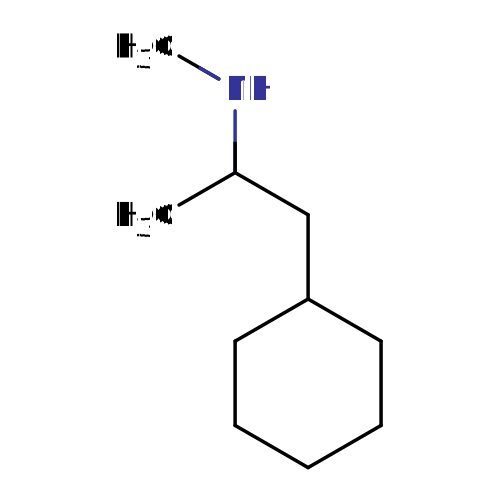
Structure for Propylhexedrine (DB06714)
- Weight
- Average: 155.2804
Monoisotopic: 155.167399677 - Chemical Formula
- C10H21N
- Synonyms
- Propylhexedrine

Pharmacology
- Indication
It is used to provide temporary symptomatic relief of nasal congestion due to colds, allergies and allergic rhinitis.
 Reduce drug development failure ratesBuild, train, & validate machine-learning modelswith evidence-based and structured datasets.Build, train, & validate predictive machine-learning models with structured datasets.
- Associated Conditions
Indication Type Indication Combined Product Details Approval Level Age Group Patient Characteristics Dose Form Symptomatic treatment of Nasal congestion ••• ••• ••••• - Contraindications & Blackbox Warnings
 Prevent Adverse Drug Events TodayTap into our Clinical API for life-saving information on contraindications & blackbox warnings, population restrictions, harmful risks, & more.Avoid life-threatening adverse drug events with our Clinical API
- Pharmacodynamics
Like other monoamine releasing stimulants propylhexedrine is active as a norepinephrine and dopamine releaser in the central nervous system. The acute effects of the drug closely resemble the physiological and psychological effects of an epinephrine-provoked fight-or-flight response, including increased heart rate and blood pressure, vasoconstriction (constriction of the arterial walls), bronchodilation, and hyperglycemia (increased blood sugar).
- Mechanism of action
Propylhexidrine causes the norepinephrine, dopamine, and serotonin (5HT) transporters to reverse their direction of flow. This inversion leads to a release of these transmitters from the vesicles to the cytoplasm and from the cytoplasm to the synapse. It also antagonizes the action of VMAT2, causing the release of more neurotransmitters.
Target Actions Organism ASynaptic vesicular amine transporter Not Available Humans UTrace amine-associated receptor 1 agonistHumans - Absorption
Not Available
- Volume of distribution
Not Available
- Protein binding
Not Available
- Metabolism
- Not Available
- Route of elimination
Not Available
- Half-life
Not Available
- Clearance
Not Available
- Adverse Effects
 Improve decision support & research outcomesWith structured adverse effects data, including: blackbox warnings, adverse reactions, warning & precautions, & incidence rates. View sample adverse effects data in our new Data Library!Improve decision support & research outcomes with our structured adverse effects data.
- Toxicity
The signs and symptoms that are produced after the acute overdosage of Propylhexidrine include Psychosis, Burning sensation.
- Pathways
- Not Available
- Pharmacogenomic Effects/ADRs
- Not Available
Interactions
- Drug Interactions
- This information should not be interpreted without the help of a healthcare provider. If you believe you are experiencing an interaction, contact a healthcare provider immediately. The absence of an interaction does not necessarily mean no interactions exist.
Drug Interaction Integrate drug-drug
interactions in your softwareAcebutolol The therapeutic efficacy of Propylhexedrine can be decreased when used in combination with Acebutolol. Alfuzosin The therapeutic efficacy of Propylhexedrine can be decreased when used in combination with Alfuzosin. Amitriptyline The therapeutic efficacy of Propylhexedrine can be decreased when used in combination with Amitriptyline. Amitriptylinoxide The risk or severity of hypertension can be increased when Amitriptylinoxide is combined with Propylhexedrine. Amoxapine The therapeutic efficacy of Propylhexedrine can be decreased when used in combination with Amoxapine. - Food Interactions
- No interactions found.
Products
 Drug product information from 10+ global regionsOur datasets provide approved product information including:dosage, form, labeller, route of administration, and marketing period.Access drug product information from over 10 global regions.
- International/Other Brands
- Benzedrex / Dristan inhaler / Obesin
- Over the Counter Products
Name Dosage Strength Route Labeller Marketing Start Marketing End Region Image Benzedrex Inhalant 175 mg/1 Nasal BF ASCHER AND CO INC 2023-06-23 Not applicable US 
Benzedrex 09-19-2014 Inhalant 250 mg/1 Nasal BF ASCHER AND CO INC 2014-09-19 2025-02-28 US Benzedrex Nasal Decongestant Inhalant 250 mg/1 Nasal Denison Pharmaceuticals LLC 2019-01-21 Not applicable US
Categories
- Drug Categories
- Chemical TaxonomyProvided by Classyfire
- Description
- This compound belongs to the class of organic compounds known as dialkylamines. These are organic compounds containing a dialkylamine group, characterized by two alkyl groups bonded to the amino nitrogen.
- Kingdom
- Organic compounds
- Super Class
- Organic nitrogen compounds
- Class
- Organonitrogen compounds
- Sub Class
- Amines
- Direct Parent
- Dialkylamines
- Alternative Parents
- Organopnictogen compounds / Hydrocarbon derivatives
- Substituents
- Aliphatic homomonocyclic compound / Hydrocarbon derivative / Organopnictogen compound / Secondary aliphatic amine
- Molecular Framework
- Aliphatic homomonocyclic compounds
- External Descriptors
- Not Available
- Affected organisms
- Not Available
Chemical Identifiers
- UNII
- LQU92IU8LL
- CAS number
- 101-40-6
- InChI Key
- JCRIVQIOJSSCQD-UHFFFAOYSA-N
- InChI
- InChI=1S/C10H21N/c1-9(11-2)8-10-6-4-3-5-7-10/h9-11H,3-8H2,1-2H3
- IUPAC Name
- (1-cyclohexylpropan-2-yl)(methyl)amine
- SMILES
- CNC(C)CC1CCCCC1
References
- Synthesis Reference
- US2454746
- General References
- Not Available
- External Links
- Human Metabolome Database
- HMDB0015659
- KEGG Drug
- D05637
- PubChem Compound
- 7558
- PubChem Substance
- 99443266
- ChemSpider
- 7277
- 8792
- ChEBI
- 134783
- ChEMBL
- CHEMBL2105275
- PharmGKB
- PA165958387
- Wikipedia
- Propylhexedrine
Clinical Trials
Pharmacoeconomics
- Manufacturers
- Not Available
- Packagers
- Not Available
- Dosage Forms
Form Route Strength Inhalant Nasal 175 mg/1 Inhalant Nasal 250 mg/1 - Prices
- Not Available
- Patents
- Not Available
Properties
- State
- Solid
- Experimental Properties
- Not Available
- Predicted Properties
Property Value Source Water Solubility 0.0904 mg/mL ALOGPS logP 3.37 ALOGPS logP 2.7 Chemaxon logS -3.2 ALOGPS pKa (Strongest Basic) 10.61 Chemaxon Physiological Charge 1 Chemaxon Hydrogen Acceptor Count 1 Chemaxon Hydrogen Donor Count 1 Chemaxon Polar Surface Area 12.03 Å2 Chemaxon Rotatable Bond Count 3 Chemaxon Refractivity 49.54 m3·mol-1 Chemaxon Polarizability 20.27 Å3 Chemaxon Number of Rings 1 Chemaxon Bioavailability 1 Chemaxon Rule of Five Yes Chemaxon Ghose Filter No Chemaxon Veber's Rule Yes Chemaxon MDDR-like Rule No Chemaxon - Predicted ADMET Features
Property Value Probability Human Intestinal Absorption + 0.9657 Blood Brain Barrier + 0.9829 Caco-2 permeable + 0.7226 P-glycoprotein substrate Non-substrate 0.6278 P-glycoprotein inhibitor I Non-inhibitor 0.8635 P-glycoprotein inhibitor II Non-inhibitor 0.9148 Renal organic cation transporter Non-inhibitor 0.6 CYP450 2C9 substrate Non-substrate 0.7991 CYP450 2D6 substrate Substrate 0.7284 CYP450 3A4 substrate Non-substrate 0.6368 CYP450 1A2 substrate Non-inhibitor 0.7982 CYP450 2C9 inhibitor Non-inhibitor 0.9671 CYP450 2D6 inhibitor Non-inhibitor 0.7367 CYP450 2C19 inhibitor Non-inhibitor 0.8882 CYP450 3A4 inhibitor Non-inhibitor 0.9827 CYP450 inhibitory promiscuity Low CYP Inhibitory Promiscuity 0.8718 Ames test Non AMES toxic 0.9178 Carcinogenicity Non-carcinogens 0.8877 Biodegradation Not ready biodegradable 0.8187 Rat acute toxicity 3.2412 LD50, mol/kg Not applicable hERG inhibition (predictor I) Weak inhibitor 0.8496 hERG inhibition (predictor II) Non-inhibitor 0.7482
Spectra
- Mass Spec (NIST)
- Not Available
- Spectra
Spectrum Spectrum Type Splash Key Predicted GC-MS Spectrum - GC-MS Predicted GC-MS splash10-0a7l-9400000000-efba189ef1f141e8b0b3 Predicted MS/MS Spectrum - 10V, Negative (Annotated) Predicted LC-MS/MS splash10-0udi-0900000000-8617ce91f76434f64bcc Predicted MS/MS Spectrum - 10V, Positive (Annotated) Predicted LC-MS/MS splash10-0a4j-9700000000-cd59cfe95c42e1eaa968 Predicted MS/MS Spectrum - 20V, Negative (Annotated) Predicted LC-MS/MS splash10-0uk9-1900000000-43d6aa8840a38d5b417b Predicted MS/MS Spectrum - 20V, Positive (Annotated) Predicted LC-MS/MS splash10-0ab9-9100000000-44a0f221898e42fd9dbe Predicted MS/MS Spectrum - 40V, Negative (Annotated) Predicted LC-MS/MS splash10-006x-8900000000-e09a9777ebca36c809bf Predicted MS/MS Spectrum - 40V, Positive (Annotated) Predicted LC-MS/MS splash10-0a4j-9000000000-abf868631281c7b7bf13 Predicted 1H NMR Spectrum 1D NMR Not Applicable Predicted 13C NMR Spectrum 1D NMR Not Applicable - Chromatographic Properties
Collision Cross Sections (CCS)
Adduct CCS Value (Å2) Source type Source [M-H]- 139.8226535 predictedDarkChem Lite v0.1.0 [M-H]- 140.49129 predictedDeepCCS 1.0 (2019) [M+H]+ 139.5980535 predictedDarkChem Lite v0.1.0 [M+H]+ 143.06384 predictedDeepCCS 1.0 (2019) [M+Na]+ 139.4034535 predictedDarkChem Lite v0.1.0 [M+Na]+ 152.12643 predictedDeepCCS 1.0 (2019)
Targets

- Kind
- Protein
- Organism
- Humans
- Pharmacological action
- Yes
- General Function
- Monoamine transmembrane transporter activity
- Specific Function
- Involved in the ATP-dependent vesicular transport of biogenic amine neurotransmitters. Pumps cytosolic monoamines including dopamine, norepinephrine, serotonin, and histamine into synaptic vesicles...
- Gene Name
- SLC18A2
- Uniprot ID
- Q05940
- Uniprot Name
- Synaptic vesicular amine transporter
- Molecular Weight
- 55712.075 Da
References
- Sulzer D, Sonders MS, Poulsen NW, Galli A: Mechanisms of neurotransmitter release by amphetamines: a review. Prog Neurobiol. 2005 Apr;75(6):406-33. [Article]
- Docherty JR: Pharmacology of stimulants prohibited by the World Anti-Doping Agency (WADA). Br J Pharmacol. 2008 Jun;154(3):606-22. doi: 10.1038/bjp.2008.124. [Article]
- Kind
- Protein
- Organism
- Humans
- Pharmacological action
- Unknown
- Actions
- Agonist
- General Function
- Trace-amine receptor activity
- Specific Function
- Receptor for trace amines, including beta-phenylethylamine (b-PEA), p-tyramine (p-TYR), octopamine and tryptamine, with highest affinity for b-PEA and p-TYR. Unresponsive to classical biogenic amin...
- Gene Name
- TAAR1
- Uniprot ID
- Q96RJ0
- Uniprot Name
- Trace amine-associated receptor 1
- Molecular Weight
- 39091.34 Da
References
- Reese EA, Bunzow JR, Arttamangkul S, Sonders MS, Grandy DK: Trace amine-associated receptor 1 displays species-dependent stereoselectivity for isomers of methamphetamine, amphetamine, and para-hydroxyamphetamine. J Pharmacol Exp Ther. 2007 Apr;321(1):178-86. Epub 2007 Jan 11. [Article]
- Xie Z, Westmoreland SV, Bahn ME, Chen GL, Yang H, Vallender EJ, Yao WD, Madras BK, Miller GM: Rhesus monkey trace amine-associated receptor 1 signaling: enhancement by monoamine transporters and attenuation by the D2 autoreceptor in vitro. J Pharmacol Exp Ther. 2007 Apr;321(1):116-27. Epub 2007 Jan 18. [Article]
- Wolinsky TD, Swanson CJ, Smith KE, Zhong H, Borowsky B, Seeman P, Branchek T, Gerald CP: The Trace Amine 1 receptor knockout mouse: an animal model with relevance to schizophrenia. Genes Brain Behav. 2007 Oct;6(7):628-39. Epub 2006 Dec 21. [Article]
- Xie Z, Miller GM: Trace amine-associated receptor 1 is a modulator of the dopamine transporter. J Pharmacol Exp Ther. 2007 Apr;321(1):128-36. Epub 2007 Jan 18. [Article]
- Miller GM, Verrico CD, Jassen A, Konar M, Yang H, Panas H, Bahn M, Johnson R, Madras BK: Primate trace amine receptor 1 modulation by the dopamine transporter. J Pharmacol Exp Ther. 2005 Jun;313(3):983-94. Epub 2005 Mar 11. [Article]

Drug created at May 16, 2010 18:30 / Updated at February 21, 2021 18:52