Identification
- Generic Name
- Dihomo-gamma-linolenic acid
- DrugBank Accession Number
- DB00154
- Background
A 20-carbon-chain fatty acid, unsaturated at positions 8, 11, and 14. It differs from arachidonic acid, 5,8,11,14-eicosatetraenoic acid, only at position 5.
- Type
- Small Molecule
- Groups
- Investigational, Nutraceutical
- Structure
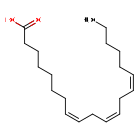
Structure for Dihomo-gamma-linolenic acid (DB00154)

- Weight
- Average: 306.4828
Monoisotopic: 306.255880332 - Chemical Formula
- C20H34O2
- Synonyms
- (8Z,11Z,14Z)-Icosatrienoic acid
- (Z,Z,Z)-8,11,14-Eicosatrienoic acid
- (Z,Z,Z)-8,11,14-Icosatrienoate
- (Z,Z,Z)-8,11,14-Icosatrienoic acid
- 20:3, n-6,9,12 all-cis
- 8,11,14-Eicosatrienoic Acid
- 8c,11c,14c-eicosatrienoic acid
- 8c,11c,14c-Eicosatriensäure
- all-cis-8,11,14-eicosatrienoic acid
- all-cis-8,11,14-icosatrienoic acid
- all-cis-eicosa-8,11,14-trienoic acid
- all-cis-Eicosa-8,11,14-triensäure
- all-cis-icosa-8,11,14-trienoic acid
- C20:3, n-6,9,12 all-cis
- cis,cis,cis-8,11,14-eicosatrienoic acid
- DGLA
- dihomo-γ-linolenic acid
- eicosa-8Z,11Z,14Z-trienoic acid
- gamma-Homolinolenic acid
- Homo-gamma-linolenic acid
- Homo-gamma-linolensäure
- Homo-γ-linolensäure
- External IDs
- DS-107G
- DS107G
- RO 12-1989

Pharmacology
- Indication
For nutritional supplementation, also for treating dietary shortage or imbalance
 Reduce drug development failure ratesBuild, train, & validate machine-learning modelswith evidence-based and structured datasets.Build, train, & validate predictive machine-learning models with structured datasets.
- Contraindications & Blackbox Warnings
 Prevent Adverse Drug Events TodayTap into our Clinical API for life-saving information on contraindications & blackbox warnings, population restrictions, harmful risks, & more.Avoid life-threatening adverse drug events with our Clinical API
- Pharmacodynamics
Dihomo gamma-linolenic acid or DHLA is an n-6 (omega-6) polyunsaturated fatty acid. It is comprised of 20 carbon atoms and three double bonds. DHLA is a byproduct of the 18 carbon gamma-linolenic acid (GLA). DHLA is then converted into prostaglandin E1 (PGE1). PGE1 inhibits platelet aggregation and also exerts a vasodilatory effect.
- Mechanism of action
DHLA (or DGLA) is a precursor in the synthesis of prostaglandin E1 (PGE1) as well as the series-3 prostaglandins. It also serves as a precursor in the synthesis of eicosapentaenoic acid (EPA). EPA is a precursor of the series-3 prostaglandins, the series-5 leukotrienes and the series-3 thromboxanes. These eicosanoids have anti-thrombogenic, anti-inflammatory and anti-atherogenic properties. PGE1 inhibits platelet aggregation and has a vasodilation action. DHLA has also been shown to reduce the production/activity of tumor necrosis factor alpha.
Target Actions Organism AProstaglandin G/H synthase 2 Not Available Humans AProstaglandin G/H synthase 1 inhibitorHumans - Absorption
Not Available
- Volume of distribution
Not Available
- Protein binding
Not Available
- Metabolism
- Not Available
- Route of elimination
Not Available
- Half-life
Not Available
- Clearance
Not Available
- Adverse Effects
 Improve decision support & research outcomesWith structured adverse effects data, including: blackbox warnings, adverse reactions, warning & precautions, & incidence rates. View sample adverse effects data in our new Data Library!Improve decision support & research outcomes with our structured adverse effects data.
- Toxicity
Not Available
- Pathways
Pathway Category Alpha Linolenic Acid and Linoleic Acid Metabolism Metabolic - Pharmacogenomic Effects/ADRs
- Not Available
Interactions
- Drug Interactions
- This information should not be interpreted without the help of a healthcare provider. If you believe you are experiencing an interaction, contact a healthcare provider immediately. The absence of an interaction does not necessarily mean no interactions exist.Not Available
- Food Interactions
- Not Available
Products
 Drug product information from 10+ global regionsOur datasets provide approved product information including:dosage, form, labeller, route of administration, and marketing period.Access drug product information from over 10 global regions.
- Product Ingredients
Ingredient UNII CAS InChI Key Sodium dihomo-gamma-linolenate DIY57A1X5I 65881-87-0 SQGOEODKLMPIRQ-HPFCUAHCSA-M - International/Other Brands
- Star GLA (GNC) / Tona-lean 1000 CLA (Action Labs)
Categories
- Drug Categories
- Chemical TaxonomyProvided by Classyfire
- Description
- This compound belongs to the class of organic compounds known as long-chain fatty acids. These are fatty acids with an aliphatic tail that contains between 13 and 21 carbon atoms.
- Kingdom
- Organic compounds
- Super Class
- Lipids and lipid-like molecules
- Class
- Fatty Acyls
- Sub Class
- Fatty acids and conjugates
- Direct Parent
- Long-chain fatty acids
- Alternative Parents
- Unsaturated fatty acids / Straight chain fatty acids / Monocarboxylic acids and derivatives / Carboxylic acids / Organic oxides / Hydrocarbon derivatives / Carbonyl compounds
- Substituents
- Aliphatic acyclic compound / Carbonyl group / Carboxylic acid / Carboxylic acid derivative / Hydrocarbon derivative / Long-chain fatty acid / Monocarboxylic acid or derivatives / Organic oxide / Organic oxygen compound / Organooxygen compound
- Molecular Framework
- Aliphatic acyclic compounds
- External Descriptors
- long-chain fatty acid, icosatrienoic acid (CHEBI:53486) / Polyunsaturated fatty acids (C03242) / Unsaturated fatty acids (LMFA01030158)
- Affected organisms
- Humans and other mammals
Chemical Identifiers
- UNII
- FC398RK06S
- CAS number
- 1783-84-2
- InChI Key
- HOBAELRKJCKHQD-QNEBEIHSSA-N
- InChI
- InChI=1S/C20H34O2/c1-2-3-4-5-6-7-8-9-10-11-12-13-14-15-16-17-18-19-20(21)22/h6-7,9-10,12-13H,2-5,8,11,14-19H2,1H3,(H,21,22)/b7-6-,10-9-,13-12-
- IUPAC Name
- (8Z,11Z,14Z)-icosa-8,11,14-trienoic acid
- SMILES
- CCCCC\C=C/C\C=C/C\C=C/CCCCCCC(O)=O
References
- Synthesis Reference
Hiroshi Kawashima, "Process for production of dihomo-gamma-linolenic acid and lipid containing same." U.S. Patent US20010021522, issued September 13, 2001.
US20010021522- General References
- Not Available
- External Links
- Human Metabolome Database
- HMDB0002925
- KEGG Compound
- C03242
- PubChem Compound
- 5280581
- PubChem Substance
- 46508866
- ChemSpider
- 4444199
- BindingDB
- 50269534
- ChEBI
- 53486
- ChEMBL
- CHEMBL465183
- ZINC
- ZINC000004521470
- Therapeutic Targets Database
- DAP000806
- PharmGKB
- PA164743249
- PDBe Ligand
- LAX
- PDRhealth
- PDRhealth Drug Page
- Wikipedia
- Dihomo-%CE%B3-linolenic_acid
- PDB Entries
- 1fe2
- MSDS
- Download (71 KB)
Clinical Trials
- Clinical Trials
Phase Status Purpose Conditions Count 2 Completed Treatment Atopic Dermatitis 1
Pharmacoeconomics
- Manufacturers
- Not Available
- Packagers
- Not Available
- Dosage Forms
- Not Available
- Prices
- Not Available
- Patents
- Not Available
Properties
- State
- Solid
- Experimental Properties
Property Value Source logP 6.8 Not Available - Predicted Properties
Property Value Source Water Solubility 7.71e-05 mg/mL ALOGPS logP 7.24 ALOGPS logP 6.95 Chemaxon logS -6.6 ALOGPS pKa (Strongest Acidic) 4.89 Chemaxon Physiological Charge -1 Chemaxon Hydrogen Acceptor Count 2 Chemaxon Hydrogen Donor Count 1 Chemaxon Polar Surface Area 37.3 Å2 Chemaxon Rotatable Bond Count 15 Chemaxon Refractivity 98.84 m3·mol-1 Chemaxon Polarizability 39.01 Å3 Chemaxon Number of Rings 0 Chemaxon Bioavailability 0 Chemaxon Rule of Five No Chemaxon Ghose Filter No Chemaxon Veber's Rule No Chemaxon MDDR-like Rule No Chemaxon - Predicted ADMET Features
Property Value Probability Human Intestinal Absorption + 0.9945 Blood Brain Barrier + 0.9539 Caco-2 permeable + 0.8371 P-glycoprotein substrate Non-substrate 0.5962 P-glycoprotein inhibitor I Non-inhibitor 0.9487 P-glycoprotein inhibitor II Non-inhibitor 0.8964 Renal organic cation transporter Non-inhibitor 0.9272 CYP450 2C9 substrate Non-substrate 0.7643 CYP450 2D6 substrate Non-substrate 0.8954 CYP450 3A4 substrate Non-substrate 0.6678 CYP450 1A2 substrate Inhibitor 0.9107 CYP450 2C9 inhibitor Non-inhibitor 0.8972 CYP450 2D6 inhibitor Non-inhibitor 0.9545 CYP450 2C19 inhibitor Non-inhibitor 0.9467 CYP450 3A4 inhibitor Non-inhibitor 0.9295 CYP450 inhibitory promiscuity Low CYP Inhibitory Promiscuity 0.9349 Ames test Non AMES toxic 0.9674 Carcinogenicity Non-carcinogens 0.6568 Biodegradation Ready biodegradable 0.811 Rat acute toxicity 1.3991 LD50, mol/kg Not applicable hERG inhibition (predictor I) Weak inhibitor 0.9133 hERG inhibition (predictor II) Non-inhibitor 0.9103
Spectra
- Mass Spec (NIST)
- Not Available
- Spectra
- Chromatographic Properties
Collision Cross Sections (CCS)
Adduct CCS Value (Å2) Source type Source [M-H]- 222.0491598 predictedDarkChem Lite v0.1.0 [M-H]- 186.4974236 predictedDarkChem Standard v0.1.0 [M-H]- 221.7687598 predictedDarkChem Lite v0.1.0 [M-H]- 186.41916 predictedDeepCCS 1.0 (2019) [M+H]+ 188.77719 predictedDeepCCS 1.0 (2019) [M+Na]+ 194.87044 predictedDeepCCS 1.0 (2019)
Targets

- Kind
- Protein
- Organism
- Humans
- Pharmacological action
- Yes
- General Function
- Prostaglandin-endoperoxide synthase activity
- Specific Function
- Converts arachidonate to prostaglandin H2 (PGH2), a committed step in prostanoid synthesis. Constitutively expressed in some tissues in physiological conditions, such as the endothelium, kidney and...
- Gene Name
- PTGS2
- Uniprot ID
- P35354
- Uniprot Name
- Prostaglandin G/H synthase 2
- Molecular Weight
- 68995.625 Da
References
- Das UN: Can COX-2 inhibitor-induced increase in cardiovascular disease risk be modified by essential fatty acids? J Assoc Physicians India. 2005 Jul;53:623-7. [Article]
- Levin G, Duffin KL, Obukowicz MG, Hummert SL, Fujiwara H, Needleman P, Raz A: Differential metabolism of dihomo-gamma-linolenic acid and arachidonic acid by cyclo-oxygenase-1 and cyclo-oxygenase-2: implications for cellular synthesis of prostaglandin E1 and prostaglandin E2. Biochem J. 2002 Jul 15;365(Pt 2):489-96. [Article]
- Das UN: COX-2 inhibitors and metabolism of essential fatty acids. Med Sci Monit. 2005 Jul;11(7):RA233-7. Epub 2005 Jun 29. [Article]
- Thuresson ED, Malkowski MG, Lakkides KM, Rieke CJ, Mulichak AM, Ginell SL, Garavito RM, Smith WL: Mutational and X-ray crystallographic analysis of the interaction of dihomo-gamma -linolenic acid with prostaglandin endoperoxide H synthases. J Biol Chem. 2001 Mar 30;276(13):10358-65. Epub 2000 Dec 19. [Article]
- Kind
- Protein
- Organism
- Humans
- Pharmacological action
- Yes
- Actions
- Inhibitor
- General Function
- Prostaglandin-endoperoxide synthase activity
- Specific Function
- Converts arachidonate to prostaglandin H2 (PGH2), a committed step in prostanoid synthesis. Involved in the constitutive production of prostanoids in particular in the stomach and platelets. In gas...
- Gene Name
- PTGS1
- Uniprot ID
- P23219
- Uniprot Name
- Prostaglandin G/H synthase 1
- Molecular Weight
- 68685.82 Da
References
- Levin G, Duffin KL, Obukowicz MG, Hummert SL, Fujiwara H, Needleman P, Raz A: Differential metabolism of dihomo-gamma-linolenic acid and arachidonic acid by cyclo-oxygenase-1 and cyclo-oxygenase-2: implications for cellular synthesis of prostaglandin E1 and prostaglandin E2. Biochem J. 2002 Jul 15;365(Pt 2):489-96. [Article]
- Das UN: Can COX-2 inhibitor-induced increase in cardiovascular disease risk be modified by essential fatty acids? J Assoc Physicians India. 2005 Jul;53:623-7. [Article]
- Das UN: COX-2 inhibitors and metabolism of essential fatty acids. Med Sci Monit. 2005 Jul;11(7):RA233-7. Epub 2005 Jun 29. [Article]
- Thuresson ED, Malkowski MG, Lakkides KM, Rieke CJ, Mulichak AM, Ginell SL, Garavito RM, Smith WL: Mutational and X-ray crystallographic analysis of the interaction of dihomo-gamma -linolenic acid with prostaglandin endoperoxide H synthases. J Biol Chem. 2001 Mar 30;276(13):10358-65. Epub 2000 Dec 19. [Article]
- Malkowski MG, Thuresson ED, Lakkides KM, Rieke CJ, Micielli R, Smith WL, Garavito RM: Structure of eicosapentaenoic and linoleic acids in the cyclooxygenase site of prostaglandin endoperoxide H synthase-1. J Biol Chem. 2001 Oct 5;276(40):37547-55. Epub 2001 Jul 27. [Article]
- Chen X, Ji ZL, Chen YZ: TTD: Therapeutic Target Database. Nucleic Acids Res. 2002 Jan 1;30(1):412-5. [Article]
Carriers
- Kind
- Protein
- Organism
- Humans
- Pharmacological action
- Unknown
- General Function
- Transporter activity
- Specific Function
- B-FABP could be involved in the transport of a so far unknown hydrophobic ligand with potential morphogenic activity during CNS development. It is required for the establishment of the radial glial...
- Gene Name
- FABP7
- Uniprot ID
- O15540
- Uniprot Name
- Fatty acid-binding protein, brain
- Molecular Weight
- 14888.855 Da
References

Drug created at June 13, 2005 13:24 / Updated at April 09, 2024 18:12