Identification
- Summary
Alfuzosin is an alpha-1 adrenergic antagonist used in the symptomatic management of benign prostatic hypertrophy (BPH).
- Brand Names
- Uroxatral, Xatral
- Generic Name
- Alfuzosin
- DrugBank Accession Number
- DB00346
- Background
Benign prostatic hyperplasia (BPH) refers to a benign growth or hyperplasia of the prostate and leads to lower urinary tract symptoms in men, such as urgency, frequency and changes to urine flow. The prevalence of BPH is as high as 50%-60% for males in their 60's, and this prevalence increases to 80%-90% of those over 70.6 Alfuzosin is an alpha-1 adrenergic blocker used in the symptomatic treatment of BPH that works by relaxing the muscles in the prostate and bladder neck.10 It was initially approved by the FDA in 2003 and is marketed by several pharmaceutical companies.9
- Type
- Small Molecule
- Groups
- Approved, Investigational
- Structure
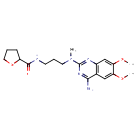
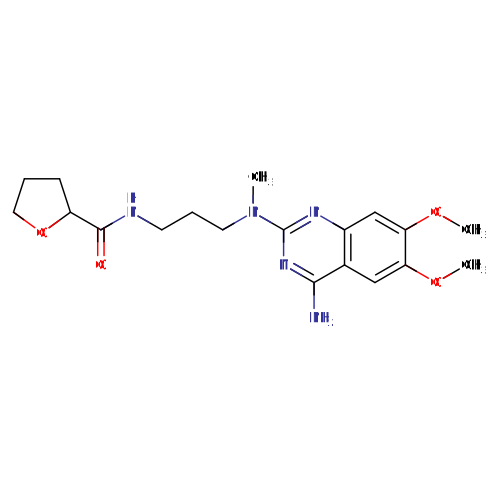
Structure for Alfuzosin (DB00346)
- Weight
- Average: 389.4488
Monoisotopic: 389.206304377 - Chemical Formula
- C19H27N5O4
- Synonyms
- (±)-N-[3-[(4-amino-6,7-dimethoxy-2-quinazolinyl)methylamino]propyl]tetrahydro-2-furamide
- Alfuzosin
- Alfuzosina
- Alfuzosine
- Alfuzosinum
- N-[3-[(4-amino-6,7-dimethoxy-quinazolin-2-yl)- methyl-amino]propyl] tetrahydrofuran- 2-carboxamide
- External IDs
- SL 77499-10

Pharmacology
- Indication
Alfuzosin is used to treat the signs and symptoms of benign prostatic hyperplasia (BPH).9
 Reduce drug development failure ratesBuild, train, & validate machine-learning modelswith evidence-based and structured datasets.Build, train, & validate predictive machine-learning models with structured datasets.
- Associated Conditions
Indication Type Indication Combined Product Details Approval Level Age Group Patient Characteristics Dose Form Symptomatic treatment of Benign prostatic hyperplasia •••••••••••• ••••••• ••••••• •••••••• ••••••• - Contraindications & Blackbox Warnings
 Prevent Adverse Drug Events TodayTap into our Clinical API for life-saving information on contraindications & blackbox warnings, population restrictions, harmful risks, & more.Avoid life-threatening adverse drug events with our Clinical API
- Pharmacodynamics
By selectively inhibiting alpha adrenergic receptors in the lower urinary tract, alfuzosin causes smooth muscle relaxation in the bladder neck and prostate, improving urine flow, thereby reducing BPH symptoms.9 Additionally, alfuzosin reduces the vasoconstrictor effect of catecholamines (epinephrine and norepinephrine), leading to peripheral vasodilation.11 This leads to a risk of postural hypotension/syncope, and prescribing information warns that caution should be exercised in patients who take nitrates, antihypertensives, or have experienced decreased blood pressure after using other medications.9
- Mechanism of action
Alpha(1)-adrenoreceptors are found in the prostate, bladder base, bladder neck, prostatic capsule, and prostatic urethra; their activation may lead to contraction of smooth muscle and urinary symptoms in patients with BPH.7,9 Alfuzosin selectively binds to and inhibits alpha(1)-adrenergic receptors in the lower urinary tract.3 This leads to the relaxation of smooth muscle in both the prostate and bladder neck, resulting in the improvement in urine flow and a reduction of urinary symptoms.9
Target Actions Organism AAlpha-1 adrenergic receptors antagonistHumans AAlpha-1A adrenergic receptor antagonistHumans AAlpha-1B adrenergic receptor antagonistHumans AAlpha-1D adrenergic receptor antagonistHumans - Absorption
Alfuzosin is readily absorbed in the gastrointestinal tract and the absolute bioavailability under fed conditions is 49%.9 In patients over 75 years of age, alfuzosin is absorbed more rapidly and peak plasma levels are higher.12 One source mentions a bioavailability of 64%.12 After multiple doses under fed conditions, Cmax is achieved in 8 hours. Cmax and AUC0-24 values are about 13.6 ng/mL and 194 ng·h/mL, respectively. Steady-state plasma concentrations are achieved after the second dose and are 1.2 to 1.6 times higher than after a single dose.9 With the extended-release formulation, alfuzosin release is sustained over 20 hours with a rate of dissolution ranging between 2 and 12 hours.1
- Volume of distribution
The volume of distribution of alfuzosin after intravenous administration in healthy volunteers is about 3.2 L/kg.9 Alfuzosin distributes heavily to the tissues of the prostate.8
- Protein binding
The protein biding of alfuzosin is moderate and ranges from 82% to 90%.9 Alfuzosin is 68.2% bound to human serum albumin and 52.5% bound to human serum alpha-glycoprotein.12
- Metabolism
Alfuzosin undergoes extensive hepatic metabolism; only 11% of the administered dose is detected unchanged in the urine. Alfuzosin is metabolism occurs via three metabolic pathways: oxidation, O-demethylations, and N-dealkylation. Metabolites of alfuzosin are not pharmacologically active and CYP3A4 is main hepatic cytochrome enzyme responsible for its metabolism.9
- Route of elimination
It is partially metabolised and excreted mainly in the bile and faeces. Following oral administration of a radiolabeled alfuzosin solution, the detection of radioactivity after one week was 69% in the feces and 24% in the urine.9
- Half-life
The apparent elimination half-life of alfuzosin after oral administration is about 10 hours.9 The terminal half-life is 3-5 hours.12
- Clearance
Exercise caution if renal clearance is < 30 mL/min.9 The clearance of alfuzosin is increased in renal insufficiency (with or without dialysis), due to an increase in the free fraction.12
- Adverse Effects
 Improve decision support & research outcomesWith structured adverse effects data, including: blackbox warnings, adverse reactions, warning & precautions, & incidence rates. View sample adverse effects data in our new Data Library!Improve decision support & research outcomes with our structured adverse effects data.
- Toxicity
The oral LD50 of alfuzosin is 2300 mg/kg in male mice and 1950 mg/kg in female mice.14 An overdose of alfuzosin can cause hypotension. Cardiovascular support should be initiated immediately. The patient should be kept in the supine position to aid in restoring pressure and managing heart rate. Fluid resuscitation should also be considered in severe cases; sometimes, vasopressors are required. Renal function should be monitored frequently. Dialysis may not be of benefit to alfuzosin protein binding of up to 90%.9
- Pathways
- Not Available
- Pharmacogenomic Effects/ADRs
- Not Available
Interactions
- Drug Interactions
- This information should not be interpreted without the help of a healthcare provider. If you believe you are experiencing an interaction, contact a healthcare provider immediately. The absence of an interaction does not necessarily mean no interactions exist.
Drug Interaction Integrate drug-drug
interactions in your softwareAbametapir The serum concentration of Alfuzosin can be increased when it is combined with Abametapir. Acalabrutinib The metabolism of Alfuzosin can be decreased when combined with Acalabrutinib. Acebutolol Alfuzosin may increase the hypotensive activities of Acebutolol. Acetaminophen The metabolism of Alfuzosin can be decreased when combined with Acetaminophen. Acetazolamide The metabolism of Alfuzosin can be decreased when combined with Acetazolamide. - Food Interactions
- Take after a meal. Take alfuzosin after the same meal everyday. Do not take on an empty stomach.
Products
 Drug product information from 10+ global regionsOur datasets provide approved product information including:dosage, form, labeller, route of administration, and marketing period.Access drug product information from over 10 global regions.
- Product Ingredients
Ingredient UNII CAS InChI Key Alfuzosin hydrochloride 75046A1XTN 81403-68-1 YTNKWDJILNVLGX-UHFFFAOYSA-N - Product Images
- International/Other Brands
- Alcinin (Pharmathen) / Alfasin XR (Incepta) / Alfetim (Sanofi-Aventis) / Alfoo (Dr. Reddy's) / Alfu (Rowex) / Alfuran (Terapia) / Alfusozina (Grey Inversiones) / Flotral (Ranbaxy) / Fual (Alkem) / Profuzo (Neiss) / Rantral (Ranbaxy) / Uriten (Square) / Xantral (Sanofi-Aventis) / Xelflo (Sun) / Zatral (Eskayef)
- Brand Name Prescription Products
Name Dosage Strength Route Labeller Marketing Start Marketing End Region Image Alfuzosin Tablet, extended release 10 mg Oral Sivem Pharmaceuticals Ulc 2015-11-25 Not applicable Canada 
Alfuzosin Tablet, extended release 10 mg Oral Pro Doc Limitee 2013-11-21 2018-11-30 Canada Alfuzosin Tablet, extended release 10 mg Oral Sanis Health Inc 2022-02-24 Not applicable Canada Uroxatral Tablet, extended release 10 mg/1 Oral Concordia Pharmaceuticals Inc. 2013-06-03 Not applicable US 
Uroxatral Tablet, extended release 10 mg/1 Oral Physicians Total Care, Inc. 2004-06-22 Not applicable US 
- Generic Prescription Products
Name Dosage Strength Route Labeller Marketing Start Marketing End Region Image Alfuzosin Hydrochloride Tablet, extended release 10 mg/1 Oral Torrent Pharmaceuticals Limited 2011-07-18 Not applicable US 
Alfuzosin Hydrochloride Tablet, extended release 10 mg/1 Oral Golden State Medical Supply, Inc. 2011-07-18 Not applicable US Alfuzosin hydrochloride Tablet, extended release 10 mg/1 Oral bryant ranch prepack 2016-03-15 Not applicable US Alfuzosin Hydrochloride Tablet, film coated, extended release 10 mg/1 Oral Northwind Pharmaceuticals, LLC 2022-10-04 Not applicable US Alfuzosin Hydrochloride Tablet, extended release 10 mg/1 Oral bryant ranch prepack 2011-11-22 Not applicable US


Categories
- ATC Codes
- G04CA01 — Alfuzosin
- G04CA — Alpha-adrenoreceptor antagonists
- G04C — DRUGS USED IN BENIGN PROSTATIC HYPERTROPHY
- G04 — UROLOGICALS
- G — GENITO URINARY SYSTEM AND SEX HORMONES
- Drug Categories
- Adrenergic Agents
- Adrenergic alpha-1 Receptor Antagonists
- Adrenergic alpha-Antagonists
- Adrenergic Antagonists
- Cytochrome P-450 CYP3A Substrates
- Cytochrome P-450 CYP3A4 Substrates
- Cytochrome P-450 Substrates
- Drugs Used in Benign Prostatic Hypertrophy
- Genito Urinary System and Sex Hormones
- Genitourinary Agents
- Heterocyclic Compounds, Fused-Ring
- Neurotransmitter Agents
- P-glycoprotein substrates
- Peripheral alpha-1 blockers
- Potential QTc-Prolonging Agents
- Prostatic Hyperplasia
- QTc Prolonging Agents
- Selective Alfa-1-adrenergic Blocking Agents
- Urological Agents
- Urologicals
- Chemical TaxonomyProvided by Classyfire
- Description
- This compound belongs to the class of organic compounds known as quinazolinamines. These are heterocyclic aromatic compounds containing a quianazoline moiety substituted by one or more amine groups.
- Kingdom
- Organic compounds
- Super Class
- Organoheterocyclic compounds
- Class
- Diazanaphthalenes
- Sub Class
- Benzodiazines
- Direct Parent
- Quinazolinamines
- Alternative Parents
- Dialkylarylamines / Anisoles / Aminopyrimidines and derivatives / Alkyl aryl ethers / Imidolactams / Tetrahydrofurans / Heteroaromatic compounds / Propargyl-type 1,3-dipolar organic compounds / Oxacyclic compounds / Dialkyl ethers show 4 more
- Substituents
- Alkyl aryl ether / Aminopyrimidine / Anisole / Aromatic heteropolycyclic compound / Azacycle / Benzenoid / Carboximidic acid / Carboximidic acid derivative / Dialkyl ether / Dialkylarylamine show 15 more
- Molecular Framework
- Aromatic heteropolycyclic compounds
- External Descriptors
- monocarboxylic acid amide, tetrahydrofuranol, quinazolines (CHEBI:51141)
- Affected organisms
- Humans and other mammals
- Rat
- Mouse
Chemical Identifiers
- UNII
- 90347YTW5F
- CAS number
- 81403-80-7
- InChI Key
- WNMJYKCGWZFFKR-UHFFFAOYSA-N
- InChI
- InChI=1S/C19H27N5O4/c1-24(8-5-7-21-18(25)14-6-4-9-28-14)19-22-13-11-16(27-3)15(26-2)10-12(13)17(20)23-19/h10-11,14H,4-9H2,1-3H3,(H,21,25)(H2,20,22,23)
- IUPAC Name
- N-{3-[(4-amino-6,7-dimethoxyquinazolin-2-yl)(methyl)amino]propyl}oxolane-2-carboxamide
- SMILES
- COC1=CC2=C(C=C1OC)C(N)=NC(=N2)N(C)CCCNC(=O)C1CCCO1
References
- Synthesis Reference
Mathias Scheer, "Alfuzosin tablets and synthesis." U.S. Patent US20060062845, issued March 23, 2006.
US20060062845- General References
- McKeage K, Plosker GL: Alfuzosin: a review of the therapeutic use of the prolonged-release formulation given once daily in the management of benign prostatic hyperplasia. Drugs. 2002;62(4):633-53. [Article]
- Wilde MI, Fitton A, McTavish D: Alfuzosin. A review of its pharmacodynamic and pharmacokinetic properties, and therapeutic potential in benign prostatic hyperplasia. Drugs. 1993 Mar;45(3):410-29. [Article]
- Andersson KE, Lepor H, Wyllie MG: Prostatic alpha 1-adrenoceptors and uroselectivity. Prostate. 1997 Feb 15;30(3):202-15. [Article]
- Elhilali MM: Alfuzosin: an alpha1-receptor blocker for the treatment of lower urinary tract symptoms associated with benign prostatic hyperplasia. Expert Opin Pharmacother. 2006 Apr;7(5):583-96. [Article]
- Roehrborn CG: Alfuzosin: overview of pharmacokinetics, safety, and efficacy of a clinically uroselective alpha-blocker. Urology. 2001 Dec;58(6 Suppl 1):55-63; discussion 63-4. [Article]
- Roehrborn CG: Benign prostatic hyperplasia: an overview. Rev Urol. 2005;7 Suppl 9:S3-S14. [Article]
- Schwinn DA, Roehrborn CG: Alpha1-adrenoceptor subtypes and lower urinary tract symptoms. Int J Urol. 2008 Mar;15(3):193-9. doi: 10.1111/j.1442-2042.2007.01956.x. [Article]
- Mottet N, Bressolle F, Delmas V, Robert M, Costa P: Prostatic tissual distribution of alfuzosin in patients with benign prostatic hyperplasia following repeated oral administration. Eur Urol. 2003 Jul;44(1):101-5. doi: 10.1016/s0302-2838(03)00154-4. [Article]
- FDA Approved Drug Products: Alfuzosin Extended Release Tablets [Link]
- NIH StatPearls: Benigh Prostatic Hyperplasia [Link]
- NIH StatPearls: Alpha adrenergic receptors [Link]
- Medicines UK: Alfuzosin hydrochloride tablets [Link]
- Cayman Chem: Alfuzosin MSDS [Link]
- Product monograph: Sandoz Alfuzosin (alfuzosin hydrochloride) prolonged-release tablets [Link]
- External Links
- Human Metabolome Database
- HMDB0014490
- KEGG Drug
- D07124
- PubChem Compound
- 2092
- PubChem Substance
- 46508512
- ChemSpider
- 2008
- BindingDB
- 50033110
- 17300
- ChEBI
- 51141
- ChEMBL
- CHEMBL709
- Therapeutic Targets Database
- DCL000664
- PharmGKB
- PA164774795
- RxList
- RxList Drug Page
- Drugs.com
- Drugs.com Drug Page
- PDRhealth
- PDRhealth Drug Page
- Wikipedia
- Alfuzosin
- FDA label
- Download (72.9 KB)
Clinical Trials
- Clinical Trials
Phase Status Purpose Conditions Count 4 Completed Treatment Benign Prostatic Hyperplasia (BPH) 1 4 Completed Treatment Benign Prostatic Hyperplasia (BPH) / Choroid Disease / Pupil Anomaly 1 4 Completed Treatment Benign Prostatic Hyperplasia (BPH) / Lower Urinary Tract Symptoms (LUTS) 1 4 Completed Treatment Benign Prostatic Hypertrophy 1 4 Completed Treatment BPH/LUTS/Sexual Functions 1
Pharmacoeconomics
- Manufacturers
- Sanofi aventis us llc
- Packagers
- A-S Medication Solutions LLC
- Atlantic Biologicals Corporation
- Heartland Repack Services LLC
- Lake Erie Medical and Surgical Supply
- Murfreesboro Pharmaceutical Nursing Supply
- Nucare Pharmaceuticals Inc.
- Physicians Total Care Inc.
- Sanofi-Aventis Inc.
- Stat Rx Usa
- Dosage Forms
Form Route Strength Tablet, extended release Oral 5 MG Tablet, film coated, extended release Oral 10 mg/1 Tablet Oral 10 mg/1 Tablet, extended release Oral 10.000 mg Tablet, film coated Oral 2.5 MG Tablet, film coated Oral Tablet, coated Oral 2.5 MG Tablet, coated Oral 5 MG Tablet Oral 10.000 mg Tablet Oral Tablet, extended release Oral 10 mg/1 Tablet, coated Oral Tablet, extended release Oral 1000000 mg Tablet, film coated Oral 5 mg Tablet, extended release Oral Tablet, extended release Oral 10 mg Tablet Oral 10 mg - Prices
Unit description Cost Unit Uroxatral 10 mg 24 Hour tablet 4.06USD tablet Uroxatral 10 mg tablet 3.95USD tablet DrugBank does not sell nor buy drugs. Pricing information is supplied for informational purposes only.- Patents
Patent Number Pediatric Extension Approved Expires (estimated) Region US4661491 No 1987-04-28 2011-01-18 US CA2264250 No 2005-07-05 2017-08-22 Canada US6149940 Yes 2000-11-21 2018-02-22 US
Properties
- State
- Solid
- Experimental Properties
Property Value Source melting point (°C) 240 https://www.accessdata.fda.gov/drugsatfda_docs/label/2018/021287s021lbl.pdf boiling point (°C) 688 https://www.chemsrc.com/en/cas/81403-68-1_1026747.html logP 1.604 https://www.researchgate.net/publication/235399114_Terpenes_Effect_of_lipophilicity_in_enhancing_transdermal_delivery_of_alfuzosin_hydrochloride pKa 8.13 https://www.chemicalbook.com/ChemicalProductProperty_US_CB8703590.aspx - Predicted Properties
Property Value Source Water Solubility 0.282 mg/mL ALOGPS logP 2.02 ALOGPS logP 1.19 Chemaxon logS -3.1 ALOGPS pKa (Strongest Acidic) 14.64 Chemaxon pKa (Strongest Basic) 7.3 Chemaxon Physiological Charge 1 Chemaxon Hydrogen Acceptor Count 8 Chemaxon Hydrogen Donor Count 2 Chemaxon Polar Surface Area 111.83 Å2 Chemaxon Rotatable Bond Count 8 Chemaxon Refractivity 107.11 m3·mol-1 Chemaxon Polarizability 42.71 Å3 Chemaxon Number of Rings 3 Chemaxon Bioavailability 1 Chemaxon Rule of Five Yes Chemaxon Ghose Filter Yes Chemaxon Veber's Rule No Chemaxon MDDR-like Rule Yes Chemaxon - Predicted ADMET Features
Property Value Probability Human Intestinal Absorption + 1.0 Blood Brain Barrier + 0.6215 Caco-2 permeable - 0.5504 P-glycoprotein substrate Substrate 0.8105 P-glycoprotein inhibitor I Inhibitor 0.5971 P-glycoprotein inhibitor II Non-inhibitor 0.5479 Renal organic cation transporter Non-inhibitor 0.7288 CYP450 2C9 substrate Non-substrate 0.8722 CYP450 2D6 substrate Non-substrate 0.7748 CYP450 3A4 substrate Substrate 0.7766 CYP450 1A2 substrate Non-inhibitor 0.9045 CYP450 2C9 inhibitor Non-inhibitor 0.9071 CYP450 2D6 inhibitor Non-inhibitor 0.9231 CYP450 2C19 inhibitor Non-inhibitor 0.9025 CYP450 3A4 inhibitor Non-inhibitor 0.8309 CYP450 inhibitory promiscuity Low CYP Inhibitory Promiscuity 0.8017 Ames test Non AMES toxic 0.559 Carcinogenicity Non-carcinogens 0.8721 Biodegradation Not ready biodegradable 0.9945 Rat acute toxicity 2.6826 LD50, mol/kg Not applicable hERG inhibition (predictor I) Weak inhibitor 0.8527 hERG inhibition (predictor II) Inhibitor 0.5929
Spectra
- Mass Spec (NIST)
- Not Available
- Spectra
- Chromatographic Properties
Collision Cross Sections (CCS)
Adduct CCS Value (Å2) Source type Source [M-H]- 204.178126 predictedDarkChem Lite v0.1.0 [M-H]- 184.76788 predictedDeepCCS 1.0 (2019) [M+H]+ 204.086326 predictedDarkChem Lite v0.1.0 [M+H]+ 187.12589 predictedDeepCCS 1.0 (2019) [M+Na]+ 204.020026 predictedDarkChem Lite v0.1.0 [M+Na]+ 194.26265 predictedDeepCCS 1.0 (2019)
Targets

- Kind
- Protein group
- Organism
- Humans
- Pharmacological action
- Yes
- Actions
- Antagonist
- General Function
- Protein heterodimerization activity
- Specific Function
- This alpha-adrenergic receptor mediates its action by association with G proteins that activate a phosphatidylinositol-calcium second messenger system. Its effect is mediated by G(q) and G(11) prot...
Components:
| Name | UniProt ID |
|---|---|
| Alpha-1A adrenergic receptor | P35348 |
| Alpha-1B adrenergic receptor | P35368 |
| Alpha-1D adrenergic receptor | P25100 |
References
- McKeage K, Plosker GL: Alfuzosin: a review of the therapeutic use of the prolonged-release formulation given once daily in the management of benign prostatic hyperplasia. Drugs. 2002;62(4):633-53. [Article]
- Lowe FC: Role of the newer alpha, -adrenergic-receptor antagonists in the treatment of benign prostatic hyperplasia-related lower urinary tract symptoms. Clin Ther. 2004 Nov;26(11):1701-13. [Article]
- FDA Approved Drug Products: Alfuzosin Extended Release Tablets [Link]
- Kind
- Protein
- Organism
- Humans
- Pharmacological action
- Yes
- Actions
- Antagonist
- General Function
- Protein heterodimerization activity
- Specific Function
- This alpha-adrenergic receptor mediates its action by association with G proteins that activate a phosphatidylinositol-calcium second messenger system. Its effect is mediated by G(q) and G(11) prot...
- Gene Name
- ADRA1A
- Uniprot ID
- P35348
- Uniprot Name
- Alpha-1A adrenergic receptor
- Molecular Weight
- 51486.005 Da
References
- Kenny BA, Miller AM, Williamson IJ, O'Connell J, Chalmers DH, Naylor AM: Evaluation of the pharmacological selectivity profile of alpha 1 adrenoceptor antagonists at prostatic alpha 1 adrenoceptors: binding, functional and in vivo studies. Br J Pharmacol. 1996 Jun;118(4):871-8. [Article]
- Lee M: Alfuzosin hydrochloride for the treatment of benign prostatic hyperplasia. Am J Health Syst Pharm. 2003 Jul 15;60(14):1426-39. [Article]
- Andersson KE, Lepor H, Wyllie MG: Prostatic alpha 1-adrenoceptors and uroselectivity. Prostate. 1997 Feb 15;30(3):202-15. [Article]
- Lowe FC: Role of the newer alpha, -adrenergic-receptor antagonists in the treatment of benign prostatic hyperplasia-related lower urinary tract symptoms. Clin Ther. 2004 Nov;26(11):1701-13. [Article]
- Martin DJ, Lluel P, Guillot E, Coste A, Jammes D, Angel I: Comparative alpha-1 adrenoceptor subtype selectivity and functional uroselectivity of alpha-1 adrenoceptor antagonists. J Pharmacol Exp Ther. 1997 Jul;282(1):228-35. [Article]
- Faure C, Pimoule C, Vallancien G, Langer SZ, Graham D: Identification of alpha 1-adrenoceptor subtypes present in the human prostate. Life Sci. 1994;54(21):1595-605. [Article]
- Beique L, Por CP, Evans MF: Are the new selective alpha-blockers better than non-selective alpha-blockers for benign prostatic hyperplasia? Can Fam Physician. 1998 Dec;44:2659-62. [Article]
- McVary KT: BPH: epidemiology and comorbidities. Am J Manag Care. 2006 Apr;12(5 Suppl):S122-8. [Article]
- Elhilali MM: Alfuzosin: an alpha1-receptor blocker for the treatment of lower urinary tract symptoms associated with benign prostatic hyperplasia. Expert Opin Pharmacother. 2006 Apr;7(5):583-96. [Article]
- Roehrborn CG: Alfuzosin: overview of pharmacokinetics, safety, and efficacy of a clinically uroselective alpha-blocker. Urology. 2001 Dec;58(6 Suppl 1):55-63; discussion 63-4. [Article]
- FDA Approved Drug Products: Alfuzosin Extended Release Tablets [Link]
- Kind
- Protein
- Organism
- Humans
- Pharmacological action
- Yes
- Actions
- Antagonist
- General Function
- Protein heterodimerization activity
- Specific Function
- This alpha-adrenergic receptor mediates its action by association with G proteins that activate a phosphatidylinositol-calcium second messenger system. Its effect is mediated by G(q) and G(11) prot...
- Gene Name
- ADRA1B
- Uniprot ID
- P35368
- Uniprot Name
- Alpha-1B adrenergic receptor
- Molecular Weight
- 56835.375 Da
References
- Kenny BA, Miller AM, Williamson IJ, O'Connell J, Chalmers DH, Naylor AM: Evaluation of the pharmacological selectivity profile of alpha 1 adrenoceptor antagonists at prostatic alpha 1 adrenoceptors: binding, functional and in vivo studies. Br J Pharmacol. 1996 Jun;118(4):871-8. [Article]
- Andersson KE, Lepor H, Wyllie MG: Prostatic alpha 1-adrenoceptors and uroselectivity. Prostate. 1997 Feb 15;30(3):202-15. [Article]
- Lowe FC: Role of the newer alpha, -adrenergic-receptor antagonists in the treatment of benign prostatic hyperplasia-related lower urinary tract symptoms. Clin Ther. 2004 Nov;26(11):1701-13. [Article]
- Faure C, Pimoule C, Vallancien G, Langer SZ, Graham D: Identification of alpha 1-adrenoceptor subtypes present in the human prostate. Life Sci. 1994;54(21):1595-605. [Article]
- Beique L, Por CP, Evans MF: Are the new selective alpha-blockers better than non-selective alpha-blockers for benign prostatic hyperplasia? Can Fam Physician. 1998 Dec;44:2659-62. [Article]
- McVary KT: BPH: epidemiology and comorbidities. Am J Manag Care. 2006 Apr;12(5 Suppl):S122-8. [Article]
- Elhilali MM: Alfuzosin: an alpha1-receptor blocker for the treatment of lower urinary tract symptoms associated with benign prostatic hyperplasia. Expert Opin Pharmacother. 2006 Apr;7(5):583-96. [Article]
- Roehrborn CG: Alfuzosin: overview of pharmacokinetics, safety, and efficacy of a clinically uroselective alpha-blocker. Urology. 2001 Dec;58(6 Suppl 1):55-63; discussion 63-4. [Article]
- Kind
- Protein
- Organism
- Humans
- Pharmacological action
- Yes
- Actions
- Antagonist
- General Function
- Alpha1-adrenergic receptor activity
- Specific Function
- This alpha-adrenergic receptor mediates its effect through the influx of extracellular calcium.
- Gene Name
- ADRA1D
- Uniprot ID
- P25100
- Uniprot Name
- Alpha-1D adrenergic receptor
- Molecular Weight
- 60462.205 Da
References
- Kenny BA, Miller AM, Williamson IJ, O'Connell J, Chalmers DH, Naylor AM: Evaluation of the pharmacological selectivity profile of alpha 1 adrenoceptor antagonists at prostatic alpha 1 adrenoceptors: binding, functional and in vivo studies. Br J Pharmacol. 1996 Jun;118(4):871-8. [Article]
- Andersson KE, Lepor H, Wyllie MG: Prostatic alpha 1-adrenoceptors and uroselectivity. Prostate. 1997 Feb 15;30(3):202-15. [Article]
- Lowe FC: Role of the newer alpha, -adrenergic-receptor antagonists in the treatment of benign prostatic hyperplasia-related lower urinary tract symptoms. Clin Ther. 2004 Nov;26(11):1701-13. [Article]
- Faure C, Pimoule C, Vallancien G, Langer SZ, Graham D: Identification of alpha 1-adrenoceptor subtypes present in the human prostate. Life Sci. 1994;54(21):1595-605. [Article]
- McVary KT: BPH: epidemiology and comorbidities. Am J Manag Care. 2006 Apr;12(5 Suppl):S122-8. [Article]
- Elhilali MM: Alfuzosin: an alpha1-receptor blocker for the treatment of lower urinary tract symptoms associated with benign prostatic hyperplasia. Expert Opin Pharmacother. 2006 Apr;7(5):583-96. [Article]
- Roehrborn CG: Alfuzosin: overview of pharmacokinetics, safety, and efficacy of a clinically uroselective alpha-blocker. Urology. 2001 Dec;58(6 Suppl 1):55-63; discussion 63-4. [Article]
Enzymes
- Kind
- Protein
- Organism
- Humans
- Pharmacological action
- Unknown
- Actions
- Substrate
- General Function
- Vitamin d3 25-hydroxylase activity
- Specific Function
- Cytochromes P450 are a group of heme-thiolate monooxygenases. In liver microsomes, this enzyme is involved in an NADPH-dependent electron transport pathway. It performs a variety of oxidation react...
- Gene Name
- CYP3A4
- Uniprot ID
- P08684
- Uniprot Name
- Cytochrome P450 3A4
- Molecular Weight
- 57342.67 Da
References
Carriers
- Kind
- Protein
- Organism
- Humans
- Pharmacological action
- Unknown
- Actions
- Binder
- General Function
- Toxic substance binding
- Specific Function
- Serum albumin, the main protein of plasma, has a good binding capacity for water, Ca(2+), Na(+), K(+), fatty acids, hormones, bilirubin and drugs. Its main function is the regulation of the colloid...
- Gene Name
- ALB
- Uniprot ID
- P02768
- Uniprot Name
- Serum albumin
- Molecular Weight
- 69365.94 Da
References
- Medicines UK: Alfuzosin hydrochloride tablets [Link]
- Kind
- Protein
- Organism
- Humans
- Pharmacological action
- Unknown
- Actions
- Binder
- General Function
- Not Available
- Specific Function
- Functions as transport protein in the blood stream. Binds various ligands in the interior of its beta-barrel domain. Also binds synthetic drugs and influences their distribution and availability in...
- Gene Name
- ORM1
- Uniprot ID
- P02763
- Uniprot Name
- Alpha-1-acid glycoprotein 1
- Molecular Weight
- 23511.38 Da
References
- Medicines UK: Alfuzosin hydrochloride tablets [Link]
Transporters
- Kind
- Protein
- Organism
- Humans
- Pharmacological action
- Unknown
- Actions
- Substrate
- General Function
- Xenobiotic-transporting atpase activity
- Specific Function
- Energy-dependent efflux pump responsible for decreased drug accumulation in multidrug-resistant cells.
- Gene Name
- ABCB1
- Uniprot ID
- P08183
- Uniprot Name
- Multidrug resistance protein 1
- Molecular Weight
- 141477.255 Da
References
- Zhao R, Raub TJ, Sawada GA, Kasper SC, Bacon JA, Bridges AS, Pollack GM: Breast cancer resistance protein interacts with various compounds in vitro, but plays a minor role in substrate efflux at the blood-brain barrier. Drug Metab Dispos. 2009 Jun;37(6):1251-8. doi: 10.1124/dmd.108.025064. Epub 2009 Mar 9. [Article]

Drug created at June 13, 2005 13:24 / Updated at April 26, 2024 00:45