Identification
- Summary
Sodium tetradecyl sulfate is an anionic surfactant used to treat varicose veins of the lower extremities.
- Brand Names
- Tromboject
- Generic Name
- Sodium tetradecyl sulfate
- DrugBank Accession Number
- DB00464
- Background
An anionic surface-active agent used for its wetting properties in industry and used in medicine as an irritant and sclerosing agent for hemorrhoids and varicose veins.
- Type
- Small Molecule
- Groups
- Approved, Investigational
- Structure
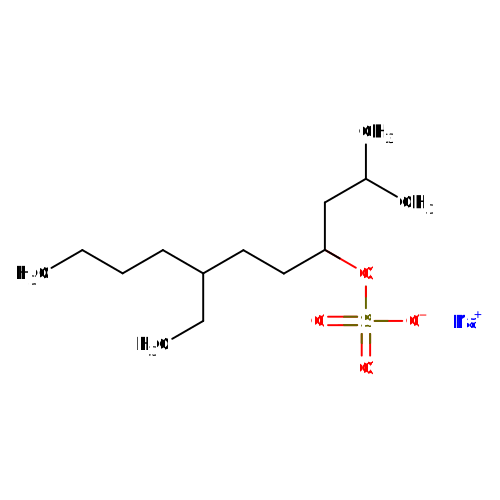
Structure for Sodium tetradecyl sulfate (DB00464)
- Weight
- Average: 316.43
Monoisotopic: 316.16842487 - Chemical Formula
- C14H29NaO4S
- Synonyms
- 7-Ethyl-2-methyl-4-undecanol sulfate sodium salt
- 7-ethyl-2-methyl-4-undecanolsulfate, sodium salt
- Natrii tetradecylis sulfa
- Sodium 2-methyl-7-ethylundecanol-4-sulfate
- Sodium 7-ethyl-2-methyl-4-undecanol sulfate
- Sodium tetradecyl sulfate
- Sodium tetradecyl sulphate
- Sodium tetradecylsulfate
- STS
- Tetradecilsulfato sodico
- Tetradecyl sodium sulfate
- Tetradecyl sulfate de sodium

Pharmacology
- Indication
For the treatment of small uncomplicated varicose veins of the lower extremities that show simple dilation with competent valves.
 Reduce drug development failure ratesBuild, train, & validate machine-learning modelswith evidence-based and structured datasets.Build, train, & validate predictive machine-learning models with structured datasets.
- Associated Conditions
Indication Type Indication Combined Product Details Approval Level Age Group Patient Characteristics Dose Form Management of Uncomplicated competent valves, simple dilation varicose veins of legs •••••••••••• - Contraindications & Blackbox Warnings
 Prevent Adverse Drug Events TodayTap into our Clinical API for life-saving information on contraindications & blackbox warnings, population restrictions, harmful risks, & more.Avoid life-threatening adverse drug events with our Clinical API
- Pharmacodynamics
Sodium tetradecyl sulfate is an anionic surfactant which occurs as a white, waxy solid. It is used as a sclerosing agent in sclerotherapy. Sclerotherapy is an injection of a sclerosing agent directly through the skin into a lesion and is used primarily for slow-flow vascular anomalies, particularly for venous malformation and lymphatic malformation. Intravenous injection causes intima inflammation and thrombus formation. This usually occludes the injected vein. Subsequent formation of fibrous tissue results in partial or complete vein obliteration that may or may not be permanent.
- Mechanism of action
Sodium tetradecyl sulfate is a potent toxin for endothelial cells in that brief exposure to even low concentrations are effective in stripping endothelium over a considerable distance and exposing highly thrombogenic endothelium in the process. Diluted sodium tetradecyl sulfate is also able to induce a hypercoagulable state, possibly by selective inhibition of protein C, and can also promote platelet aggregation.
Target Actions Organism AVitamin K-dependent protein S inhibitorHumans AVitamin K-dependent protein C inhibitorHumans - Absorption
Not Available
- Volume of distribution
Not Available
- Protein binding
Not Available
- Metabolism
- Not Available
- Route of elimination
Not Available
- Half-life
Not Available
- Clearance
Not Available
- Adverse Effects
 Improve decision support & research outcomesWith structured adverse effects data, including: blackbox warnings, adverse reactions, warning & precautions, & incidence rates. View sample adverse effects data in our new Data Library!Improve decision support & research outcomes with our structured adverse effects data.
- Toxicity
LD50=1250 mg/kg (Orally in rat); LD50=3 ml/kg (Skin in rat)
- Pathways
- Not Available
- Pharmacogenomic Effects/ADRs
- Not Available
Interactions
- Drug Interactions
- This information should not be interpreted without the help of a healthcare provider. If you believe you are experiencing an interaction, contact a healthcare provider immediately. The absence of an interaction does not necessarily mean no interactions exist.Not Available
- Food Interactions
- No interactions found.
Products
 Drug product information from 10+ global regionsOur datasets provide approved product information including:dosage, form, labeller, route of administration, and marketing period.Access drug product information from over 10 global regions.
- International/Other Brands
- Fibro-Vein
- Brand Name Prescription Products
Name Dosage Strength Route Labeller Marketing Start Marketing End Region Image Sotradecol Solution 3 % Intravenous Mylan Pharmaceuticals Not applicable Not applicable Canada 
Sotradecol Solution 1 % Intravenous Mylan Pharmaceuticals Not applicable Not applicable Canada Tromboject 1% Solution 10 mg / mL Intravenous Omega Laboratories Limited 1987-12-31 Not applicable Canada Tromboject 3% Solution 30 mg / mL Intravenous Omega Laboratories Limited 1987-12-31 Not applicable Canada Trombovar Inj 1% Solution 1 % Intravenous Therapex Division De E Z Em Canada Inc 1976-12-31 2007-09-04 Canada - Generic Prescription Products
Name Dosage Strength Route Labeller Marketing Start Marketing End Region Image Sodium Tetradecyl Sulfate Injection, solution 30 mg/1mL Intravenous Hikma Pharmaceuticals USA Inc. (dba Leucadia Pharmaceuticals) 2019-12-09 Not applicable US 
Categories
- ATC Codes
- C05BB04 — Sodium tetradecyl sulfate
- Drug Categories
- Acids
- Alcohols
- Alkanesulfonates
- Alkanesulfonic Acids
- Antivaricose Therapy
- Cardiovascular Agents
- Compounds used in a research, industrial, or household setting
- Fatty Alcohols
- Lipids
- Pharmaceutical Preparations
- Pharmaceutical Solutions
- Sclerosing Agents for Local Injection
- Sclerosing Solutions
- Solutions
- Sulfonic Acids
- Sulfur Acids
- Sulfur Compounds
- Surface-Active Agents
- Vasoprotectives
- Chemical TaxonomyProvided by Classyfire
- Description
- This compound belongs to the class of organic compounds known as sulfuric acid monoesters. These are organic compounds containing the sulfuric acid monoester functional group, with the generic structure ROS(O)(=O)=O, (R=organyl group).
- Kingdom
- Organic compounds
- Super Class
- Organic acids and derivatives
- Class
- Organic sulfuric acids and derivatives
- Sub Class
- Sulfuric acid esters
- Direct Parent
- Sulfuric acid monoesters
- Alternative Parents
- Alkyl sulfates / Organooxygen compounds / Organic sodium salts / Organic oxides / Hydrocarbon derivatives
- Substituents
- Aliphatic acyclic compound / Alkyl sulfate / Hydrocarbon derivative / Organic alkali metal salt / Organic oxide / Organic oxygen compound / Organic salt / Organic sodium salt / Organooxygen compound / Sulfate-ester
- Molecular Framework
- Aliphatic acyclic compounds
- External Descriptors
- organic sodium salt (CHEBI:75273)
- Affected organisms
- Humans and other mammals
Chemical Identifiers
- UNII
- Q1SUG5KBD6
- CAS number
- 139-88-8
- InChI Key
- FVEFRICMTUKAML-UHFFFAOYSA-M
- InChI
- InChI=1S/C14H30O4S.Na/c1-5-7-8-13(6-2)9-10-14(11-12(3)4)18-19(15,16)17;/h12-14H,5-11H2,1-4H3,(H,15,16,17);/q;+1/p-1
- IUPAC Name
- sodium 7-ethyl-2-methylundecan-4-yl sulfate
- SMILES
- [Na+].CCCCC(CC)CCC(CC(C)C)OS([O-])(=O)=O
References
- General References
- Not Available
- External Links
- KEGG Drug
- D06882
- PubChem Compound
- 23665772
- PubChem Substance
- 46505919
- ChemSpider
- 8440
- 9913
- ChEBI
- 75273
- ChEMBL
- CHEMBL1200354
- Therapeutic Targets Database
- DAP001276
- PharmGKB
- PA164746759
- RxList
- RxList Drug Page
- Drugs.com
- Drugs.com Drug Page
- Wikipedia
- Sodium_tetradecyl_sulfate
- MSDS
- Download (52.2 KB)
Clinical Trials
- Clinical Trials
Phase Status Purpose Conditions Count 4 Completed Treatment Varicosities of the great saphenous vein 1 4 Withdrawn Treatment Superficial Venous Insufficiency, Varicose Veins 1 3 Recruiting Treatment Gastroesophageal variceal hemorrhage prophylaxis / Liver Decompensation 1 2 Not Yet Recruiting Treatment Epidermoid Cyst 1 2 Terminated Treatment Venous Insufficiency 1
Pharmacoeconomics
- Manufacturers
- Bioniche pharma usa llc
- Elkins sinn div ah robins co inc
- Packagers
- Angiodynamics
- Bioniche Pharma
- Dosage Forms
Form Route Strength Injection, solution Intravenous 0.2 % Injection, solution Intravenous 0.5 % Injection, solution Intravenous 1 % Injection, solution Intravenous 3 % Injection, solution Intravenous 30 mg/1mL Solution Intravenous 10 mg / mL Solution Intravenous 30 mg / mL Injection, solution Intravenous Solution Intravenous 1 % Solution Intravenous 3 % - Prices
Unit description Cost Unit Sotradecol 3% vial 33.0USD ml Sotradecol 1% vial 19.68USD ml Tromboject 3 % 3.77USD ml Tromboject 1 % 3.46USD ml DrugBank does not sell nor buy drugs. Pricing information is supplied for informational purposes only.- Patents
- Not Available
Properties
- State
- Solid
- Experimental Properties
- Not Available
- Predicted Properties
Property Value Source Water Solubility 0.00798 mg/mL ALOGPS logP 3.97 ALOGPS logP 5.04 Chemaxon logS -4.6 ALOGPS pKa (Strongest Acidic) -1.1 Chemaxon Physiological Charge -1 Chemaxon Hydrogen Acceptor Count 3 Chemaxon Hydrogen Donor Count 0 Chemaxon Polar Surface Area 66.43 Å2 Chemaxon Rotatable Bond Count 11 Chemaxon Refractivity 76.65 m3·mol-1 Chemaxon Polarizability 33.26 Å3 Chemaxon Number of Rings 0 Chemaxon Bioavailability 0 Chemaxon Rule of Five No Chemaxon Ghose Filter Yes Chemaxon Veber's Rule No Chemaxon MDDR-like Rule No Chemaxon - Predicted ADMET Features
Property Value Probability Human Intestinal Absorption + 0.9406 Blood Brain Barrier + 0.9525 Caco-2 permeable - 0.6012 P-glycoprotein substrate Non-substrate 0.7254 P-glycoprotein inhibitor I Non-inhibitor 0.7654 P-glycoprotein inhibitor II Non-inhibitor 0.9757 Renal organic cation transporter Non-inhibitor 0.9101 CYP450 2C9 substrate Non-substrate 0.8409 CYP450 2D6 substrate Non-substrate 0.8488 CYP450 3A4 substrate Non-substrate 0.5649 CYP450 1A2 substrate Non-inhibitor 0.8415 CYP450 2C9 inhibitor Non-inhibitor 0.8494 CYP450 2D6 inhibitor Non-inhibitor 0.9019 CYP450 2C19 inhibitor Non-inhibitor 0.8269 CYP450 3A4 inhibitor Non-inhibitor 0.9805 CYP450 inhibitory promiscuity Low CYP Inhibitory Promiscuity 0.926 Ames test Non AMES toxic 0.9133 Carcinogenicity Carcinogens 0.6724 Biodegradation Ready biodegradable 0.7562 Rat acute toxicity 2.2812 LD50, mol/kg Not applicable hERG inhibition (predictor I) Weak inhibitor 0.6277 hERG inhibition (predictor II) Non-inhibitor 0.6966
Spectra
- Mass Spec (NIST)
- Not Available
- Spectra
Spectrum Spectrum Type Splash Key Predicted GC-MS Spectrum - GC-MS Predicted GC-MS splash10-0a4r-6390000000-074e88f1c4a2c0cc983e - Chromatographic Properties
Collision Cross Sections (CCS)
Adduct CCS Value (Å2) Source type Source [M-H]- 184.5079288 predictedDarkChem Lite v0.1.0 [M-H]- 165.86798 predictedDeepCCS 1.0 (2019) [M+H]+ 168.82979 predictedDeepCCS 1.0 (2019) [M+Na]+ 176.43431 predictedDeepCCS 1.0 (2019)
Targets

- Kind
- Protein
- Organism
- Humans
- Pharmacological action
- Yes
- Actions
- Inhibitor
- General Function
- Endopeptidase inhibitor activity
- Specific Function
- Anticoagulant plasma protein; it is a cofactor to activated protein C in the degradation of coagulation factors Va and VIIIa. It helps to prevent coagulation and stimulating fibrinolysis.
- Gene Name
- PROS1
- Uniprot ID
- P07225
- Uniprot Name
- Vitamin K-dependent protein S
- Molecular Weight
- 75121.905 Da
References
- Parsi K, Exner T, Low J, Ma DD, Joseph JE: In vitro effects of detergent sclerosants on antithrombotic mechanisms. Eur J Vasc Endovasc Surg. 2009 Aug;38(2):220-8. doi: 10.1016/j.ejvs.2009.03.026. Epub 2009 May 12. [Article]
- Jacobson BF, Franz RC, Hurly EM, Norman GL, Becker P, Myburgh JA, Mendelow BV: Mechanism of thrombosis caused by sclerotherapy of esophageal varices using sodium tetradecyl sulphate. Surg Endosc. 1992 Jan-Feb;6(1):4-9. [Article]
- Kind
- Protein
- Organism
- Humans
- Pharmacological action
- Yes
- Actions
- Inhibitor
- General Function
- Serine-type endopeptidase activity
- Specific Function
- Protein C is a vitamin K-dependent serine protease that regulates blood coagulation by inactivating factors Va and VIIIa in the presence of calcium ions and phospholipids (PubMed:25618265). Exerts ...
- Gene Name
- PROC
- Uniprot ID
- P04070
- Uniprot Name
- Vitamin K-dependent protein C
- Molecular Weight
- 52070.82 Da
References
- Imming P, Sinning C, Meyer A: Drugs, their targets and the nature and number of drug targets. Nat Rev Drug Discov. 2006 Oct;5(10):821-34. [Article]
- Jacobson BF, Franz RC, Hurly EM, Norman GL, Becker P, Myburgh JA, Mendelow BV: Mechanism of thrombosis caused by sclerotherapy of esophageal varices using sodium tetradecyl sulphate. Surg Endosc. 1992 Jan-Feb;6(1):4-9. [Article]
- Chen X, Ji ZL, Chen YZ: TTD: Therapeutic Target Database. Nucleic Acids Res. 2002 Jan 1;30(1):412-5. [Article]
- Parsi K, Exner T, Low J, Ma DD, Joseph JE: In vitro effects of detergent sclerosants on antithrombotic mechanisms. Eur J Vasc Endovasc Surg. 2009 Aug;38(2):220-8. doi: 10.1016/j.ejvs.2009.03.026. Epub 2009 May 12. [Article]

Drug created at June 13, 2005 13:24 / Updated at April 27, 2024 09:44