Identification
- Generic Name
- Picrotoxin
- DrugBank Accession Number
- DB00466
- Background
A noncompetitive antagonist at GABA-A receptors and thus a convulsant. Picrotoxin blocks the gamma-aminobutyric acid-activated chloride ionophore. Although it is most often used as a research tool, it has been used as a CNS stimulant and an antidote in poisoning by CNS depressants, especially the barbiturates. [PubChem]
- Type
- Small Molecule
- Groups
- Experimental
- Structure
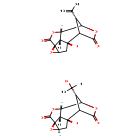
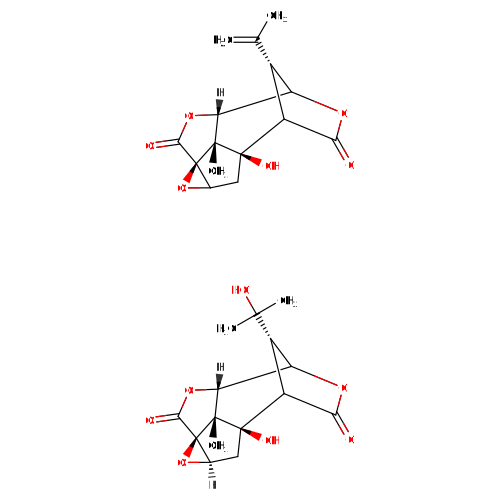
Structure for Picrotoxin (DB00466)
- Weight
- Average: 602.5832
Monoisotopic: 602.199941174 - Chemical Formula
- C30H34O13
- Synonyms
- cocculin

Pharmacology
- Indication
Used internally for relieving respiratory distress. Also for use as an antidote in poisoning by CNS depressants, especially barbiturates.
 Reduce drug development failure ratesBuild, train, & validate machine-learning modelswith evidence-based and structured datasets.Build, train, & validate predictive machine-learning models with structured datasets.
- Contraindications & Blackbox Warnings
 Prevent Adverse Drug Events TodayTap into our Clinical API for life-saving information on contraindications & blackbox warnings, population restrictions, harmful risks, & more.Avoid life-threatening adverse drug events with our Clinical API
- Pharmacodynamics
Picrotoxin is a toxin obtained from the seeds of the shrub Anamirta cocculus. It is used as a central nervous system stimulant, antidote, convulsant, and GABA (gamma aminobutyric acid) antagonist. It is a noncompetitive antagonist at GABAA receptors and thus a convulsant. Picrotoxin blocks the GABAActivated chloride ionophore. Although it is most often used as a research tool, it has been used as a CNS stimulant and an antidote in poisoning by CNS depressants, especially barbiturates.
- Mechanism of action
Picrotoxin antagonizes the GABAA receptor channel directly, which is a ligand-gated ion channel concerned chiefly with the passing of chloride ions across the cell membrane. Therefore picrotoxin prevents Cl- channel permeability and thus promtes an inhibitory influence on the target neuron. Picrotoxin reduces conductance through the channel by reducing not only the opening frequency but also the mean open time. Picrotoxin also antagonizes GABAC receptors (also called GABAA-rho receptors) but the result of this action is not known. The GABAC receptor is also linked to chloride channels, with distinct physiological and pharmacological properties. In contrast to the fast and transient responses elicited from GABAA receptors, GABAC receptors mediate slow and sustained responses.
Target Actions Organism AGamma-aminobutyric acid receptor subunit rho-1 antagonistHumans AGamma-aminobutyric acid receptor subunit alpha-1 antagonistHumans UGlycine receptor subunit alpha-2 antagonistHumans UGlycine receptor subunit alpha-3 antagonistHumans UGlycine receptor subunit alpha-1 antagonistHumans - Absorption
Not Available
- Volume of distribution
Not Available
- Protein binding
Not Available
- Metabolism
- Not Available
- Route of elimination
Not Available
- Half-life
Not Available
- Clearance
Not Available
- Adverse Effects
 Improve decision support & research outcomesWith structured adverse effects data, including: blackbox warnings, adverse reactions, warning & precautions, & incidence rates. View sample adverse effects data in our new Data Library!Improve decision support & research outcomes with our structured adverse effects data.
- Toxicity
Oral, mouse: LD50 = 15 mg/kg. In large doses it is a powerful poison, causing unconsciousness, delirium, convulsions, gastro-enteritis and stimulation of the respiratory centre followed by paralysis, from which death sometimes results.
- Pathways
- Not Available
- Pharmacogenomic Effects/ADRs
- Not Available
Interactions
- Drug Interactions
- This information should not be interpreted without the help of a healthcare provider. If you believe you are experiencing an interaction, contact a healthcare provider immediately. The absence of an interaction does not necessarily mean no interactions exist.Not Available
- Food Interactions
- Not Available
Categories
- Drug Categories
- Antidotes
- Biological Factors
- Biological Products
- Central Nervous System Agents
- Central Nervous System Stimulants
- Complex Mixtures
- Compounds used in a research, industrial, or household setting
- Convulsants
- Cyclohexanes
- Cycloparaffins
- GABA Agents
- GABA Antagonists
- GABA-A Receptor Antagonists
- Lactones
- Neurotransmitter Agents
- Pharmaceutical Preparations
- Plant Extracts
- Plant Preparations
- Protective Agents
- Sesquiterpenes
- Stimulants
- Terpenes
- Toxins, Biological
- Chemical TaxonomyProvided by Classyfire
- Description
- This compound belongs to the class of organic compounds known as furopyrans. These are organic polycyclic compounds containing a furan ring fused to a pyran ring. Furan is a five-membered aromatic ring with four carbon atoms and one oxygen atom. Pyran a six-membered heterocyclic, non-aromatic ring, made up of five carbon atoms and one oxygen atom and containing two double bonds.
- Kingdom
- Organic compounds
- Super Class
- Organoheterocyclic compounds
- Class
- Furopyrans
- Sub Class
- Not Available
- Direct Parent
- Furopyrans
- Alternative Parents
- Oxepanes / Dicarboxylic acids and derivatives / Gamma butyrolactones / Oxanes / Pyrans / Furans / Tetrahydrofurans / Tertiary alcohols / Carboxylic acid esters / Cyclic alcohols and derivatives show 6 more
- Substituents
- Alcohol / Aliphatic heteropolycyclic compound / Caprolactone / Carbonyl group / Carboxylic acid derivative / Carboxylic acid ester / Cyclic alcohol / Dialkyl ether / Dicarboxylic acid or derivatives / Ether show 15 more
- Molecular Framework
- Not Available
- External Descriptors
- Not Available
- Affected organisms
- Humans and other mammals
Chemical Identifiers
- UNII
- ZLT174DL7U
- CAS number
- 124-87-8
- InChI Key
- VJKUPQSHOVKBCO-ZTYBEOBUSA-N
- InChI
- InChI=1S/C15H18O7.C15H16O6/c1-12(2,18)6-7-10(16)20-8(6)9-13(3)14(7,19)4-5-15(13,22-5)11(17)21-9;1-5(2)7-8-11(16)19-9(7)10-13(3)14(8,18)4-6-15(13,21-6)12(17)20-10/h5-9,18-19H,4H2,1-3H3;6-10,18H,1,4H2,2-3H3/t5-,6+,7?,8?,9-,13-,14-,15+;6?,7-,8?,9?,10+,13+,14+,15-/m10/s1
- IUPAC Name
- (1R,3R,5S,8S,13R,14S)-1-hydroxy-14-(2-hydroxypropan-2-yl)-13-methyl-4,7,10-trioxapentacyclo[6.4.1.1^{9,12}.0^{3,5}.0^{5,13}]tetradecane-6,11-dione; (1R,5S,8S,13R,14R)-1-hydroxy-13-methyl-14-(prop-1-en-2-yl)-4,7,10-trioxapentacyclo[6.4.1.1^{9,12}.0^{3,5}.0^{5,13}]tetradecane-6,11-dione
- SMILES
- [H][C@@]12OC(=O)[C@@]34OC3C[C@@](O)(C3[C@@H](C1OC3=O)C(C)=C)[C@@]24C.[H][C@@]12C[C@@]3(O)C4[C@@H](C(OC4=O)[C@@]4([H])OC(=O)[C@]1(O2)[C@@]34C)C(C)(C)O
References
- General References
- External Links
- Human Metabolome Database
- HMDB0014609
- PubChem Compound
- 31304
- PubChem Substance
- 46506796
- ChemSpider
- 29044
- ChEMBL
- CHEMBL1908342
- Therapeutic Targets Database
- DAP000676
- PharmGKB
- PA164777007
- Guide to Pharmacology
- GtP Drug Page
- Wikipedia
- Picrotoxin
- MSDS
- Download (75.2 KB)
Clinical Trials
Pharmacoeconomics
- Manufacturers
- Not Available
- Packagers
- Not Available
- Dosage Forms
- Not Available
- Prices
- Not Available
- Patents
- Not Available
Properties
- State
- Solid
- Experimental Properties
Property Value Source melting point (°C) 203.5 °C PhysProp water solubility 4100 mg/L YALKOWSKY,SH & DANNENFELSER,RM (1992) logP -2.229 Not Available - Predicted Properties
Property Value Source Water Solubility 24.5 mg/mL ALOGPS logP 0.09 ALOGPS logP -1.1 Chemaxon logS -1.1 ALOGPS pKa (Strongest Acidic) 13.6 Chemaxon pKa (Strongest Basic) -2.8 Chemaxon Physiological Charge 0 Chemaxon Hydrogen Acceptor Count 5 Chemaxon Hydrogen Donor Count 2 Chemaxon Polar Surface Area 105.59 Å2 Chemaxon Rotatable Bond Count 2 Chemaxon Refractivity 68.29 m3·mol-1 Chemaxon Polarizability 28.52 Å3 Chemaxon Number of Rings 10 Chemaxon Bioavailability 1 Chemaxon Rule of Five No Chemaxon Ghose Filter No Chemaxon Veber's Rule No Chemaxon MDDR-like Rule No Chemaxon - Predicted ADMET Features
Property Value Probability Human Intestinal Absorption + 0.8434 Blood Brain Barrier + 0.5 Caco-2 permeable - 0.6151 P-glycoprotein substrate Substrate 0.794 P-glycoprotein inhibitor I Inhibitor 0.7418 P-glycoprotein inhibitor II Non-inhibitor 0.9201 Renal organic cation transporter Non-inhibitor 0.8832 CYP450 2C9 substrate Non-substrate 0.8446 CYP450 2D6 substrate Non-substrate 0.866 CYP450 3A4 substrate Substrate 0.6596 CYP450 1A2 substrate Non-inhibitor 0.8981 CYP450 2C9 inhibitor Non-inhibitor 0.9071 CYP450 2D6 inhibitor Non-inhibitor 0.9307 CYP450 2C19 inhibitor Non-inhibitor 0.8809 CYP450 3A4 inhibitor Non-inhibitor 0.5167 CYP450 inhibitory promiscuity Low CYP Inhibitory Promiscuity 0.929 Ames test AMES toxic 0.6089 Carcinogenicity Non-carcinogens 0.9354 Biodegradation Not ready biodegradable 1.0 Rat acute toxicity 3.2615 LD50, mol/kg Not applicable hERG inhibition (predictor I) Weak inhibitor 0.9951 hERG inhibition (predictor II) Non-inhibitor 0.9013
Spectra
- Mass Spec (NIST)
- Not Available
- Spectra
Spectrum Spectrum Type Splash Key Mass Spectrum (Electron Ionization) MS splash10-0a4m-9400000000-4265da630cb3536f0c8d - Chromatographic Properties
Collision Cross Sections (CCS)
Adduct CCS Value (Å2) Source type Source [M-H]- 225.05061 predictedDeepCCS 1.0 (2019) [M+H]+ 226.7743 predictedDeepCCS 1.0 (2019) [M+Na]+ 233.07108 predictedDeepCCS 1.0 (2019)
Targets

- Kind
- Protein
- Organism
- Humans
- Pharmacological action
- Yes
- Actions
- Antagonist
- General Function
- Gaba-a receptor activity
- Specific Function
- GABA, the major inhibitory neurotransmitter in the vertebrate brain, mediates neuronal inhibition by binding to the GABA/benzodiazepine receptor and opening an integral chloride channel. Rho-1 GABA...
- Gene Name
- GABRR1
- Uniprot ID
- P24046
- Uniprot Name
- Gamma-aminobutyric acid receptor subunit rho-1
- Molecular Weight
- 55882.91 Da
References
- Overington JP, Al-Lazikani B, Hopkins AL: How many drug targets are there? Nat Rev Drug Discov. 2006 Dec;5(12):993-6. [Article]
- Imming P, Sinning C, Meyer A: Drugs, their targets and the nature and number of drug targets. Nat Rev Drug Discov. 2006 Oct;5(10):821-34. [Article]
- Law RJ, Lightstone FC: Gaba receptor insecticide non-competitive antagonists may bind at allosteric modulator sites. Int J Neurosci. 2008 May;118(5):705-34. doi: 10.1080/00207450701750216. [Article]
- Richter D, Luhmann HJ, Kilb W: Intrinsic activation of GABA(A) receptors suppresses epileptiform activity in the cerebral cortex of immature mice. Epilepsia. 2010 Aug;51(8):1483-92. doi: 10.1111/j.1528-1167.2010.02591.x. Epub 2010 May 14. [Article]
- Kind
- Protein
- Organism
- Humans
- Pharmacological action
- Yes
- Actions
- Antagonist
- General Function
- Inhibitory extracellular ligand-gated ion channel activity
- Specific Function
- Component of the heteropentameric receptor for GABA, the major inhibitory neurotransmitter in the vertebrate brain. Functions also as histamine receptor and mediates cellular responses to histamine...
- Gene Name
- GABRA1
- Uniprot ID
- P14867
- Uniprot Name
- Gamma-aminobutyric acid receptor subunit alpha-1
- Molecular Weight
- 51801.395 Da
References
- Overington JP, Al-Lazikani B, Hopkins AL: How many drug targets are there? Nat Rev Drug Discov. 2006 Dec;5(12):993-6. [Article]
- Imming P, Sinning C, Meyer A: Drugs, their targets and the nature and number of drug targets. Nat Rev Drug Discov. 2006 Oct;5(10):821-34. [Article]
- Law RJ, Lightstone FC: Gaba receptor insecticide non-competitive antagonists may bind at allosteric modulator sites. Int J Neurosci. 2008 May;118(5):705-34. doi: 10.1080/00207450701750216. [Article]
- Richter D, Luhmann HJ, Kilb W: Intrinsic activation of GABA(A) receptors suppresses epileptiform activity in the cerebral cortex of immature mice. Epilepsia. 2010 Aug;51(8):1483-92. doi: 10.1111/j.1528-1167.2010.02591.x. Epub 2010 May 14. [Article]
- Chen X, Ji ZL, Chen YZ: TTD: Therapeutic Target Database. Nucleic Acids Res. 2002 Jan 1;30(1):412-5. [Article]
- Kind
- Protein
- Organism
- Humans
- Pharmacological action
- Unknown
- Actions
- Antagonist
- General Function
- Transmitter-gated ion channel activity
- Specific Function
- The glycine receptor is a neurotransmitter-gated ion channel. Binding of glycine to its receptor increases the chloride conductance and thus produces hyperpolarization (inhibition of neuronal firing).
- Gene Name
- GLRA2
- Uniprot ID
- P23416
- Uniprot Name
- Glycine receptor subunit alpha-2
- Molecular Weight
- 52001.585 Da
References
- Yang Z, Cromer BA, Harvey RJ, Parker MW, Lynch JW: A proposed structural basis for picrotoxinin and picrotin binding in the glycine receptor pore. J Neurochem. 2007 Oct;103(2):580-9. Epub 2007 Aug 20. [Article]
- Wang DS, Buckinx R, Lecorronc H, Mangin JM, Rigo JM, Legendre P: Mechanisms for picrotoxinin and picrotin blocks of alpha2 homomeric glycine receptors. J Biol Chem. 2007 Jun 1;282(22):16016-35. Epub 2007 Apr 3. [Article]
- Kind
- Protein
- Organism
- Humans
- Pharmacological action
- Unknown
- Actions
- Antagonist
- General Function
- Transmitter-gated ion channel activity
- Specific Function
- The glycine receptor is a neurotransmitter-gated ion channel. Binding of glycine to its receptor increases the chloride conductance and thus produces hyperpolarization (inhibition of neuronal firing).
- Gene Name
- GLRA3
- Uniprot ID
- O75311
- Uniprot Name
- Glycine receptor subunit alpha-3
- Molecular Weight
- 53799.775 Da
References
- Yang Z, Cromer BA, Harvey RJ, Parker MW, Lynch JW: A proposed structural basis for picrotoxinin and picrotin binding in the glycine receptor pore. J Neurochem. 2007 Oct;103(2):580-9. Epub 2007 Aug 20. [Article]
- Kind
- Protein
- Organism
- Humans
- Pharmacological action
- Unknown
- Actions
- Antagonist
- General Function
- Transmitter-gated ion channel activity
- Specific Function
- The glycine receptor is a neurotransmitter-gated ion channel. Binding of glycine to its receptor increases the chloride conductance and thus produces hyperpolarization (inhibition of neuronal firing).
- Gene Name
- GLRA1
- Uniprot ID
- P23415
- Uniprot Name
- Glycine receptor subunit alpha-1
- Molecular Weight
- 52623.35 Da
References
- Jensen AA, Kristiansen U: Functional characterisation of the human alpha1 glycine receptor in a fluorescence-based membrane potential assay. Biochem Pharmacol. 2004 May 1;67(9):1789-99. [Article]
Enzymes
- Kind
- Protein
- Organism
- Humans
- Pharmacological action
- Unknown
- Actions
- Inducer
- General Function
- Vitamin d 24-hydroxylase activity
- Specific Function
- Cytochromes P450 are a group of heme-thiolate monooxygenases. In liver microsomes, this enzyme is involved in an NADPH-dependent electron transport pathway. It oxidizes a variety of structurally un...
- Gene Name
- CYP1A1
- Uniprot ID
- P04798
- Uniprot Name
- Cytochrome P450 1A1
- Molecular Weight
- 58164.815 Da
References
- Sadar MD, Ash R, Andersson TB: Picrotoxin is a CYP1A1 inducer in rainbow trout hepatocytes. Biochem Biophys Res Commun. 1995 Sep 25;214(3):1060-6. [Article]
- Sadar MD, Westlind A, Blomstrand F, Andersson TB: Induction of CYP1A1 by GABA receptor ligands. Biochem Biophys Res Commun. 1996 Dec 4;229(1):231-7. [Article]
- Kind
- Protein
- Organism
- Humans
- Pharmacological action
- Unknown
- Actions
- Inhibitor
- General Function
- Manganese ion binding
- Specific Function
- This enzyme has 2 functions: it catalyzes the production of glutamine and 4-aminobutanoate (gamma-aminobutyric acid, GABA), the latter in a pyridoxal phosphate-independent manner (By similarity). E...
- Gene Name
- GLUL
- Uniprot ID
- P15104
- Uniprot Name
- Glutamine synthetase
- Molecular Weight
- 42064.15 Da
References
- Loscher W, Frey HH: Effect of convulsant and anticonvulsant agents on level and metabolism of gamma-aminobutyric acid in mouse brain. Naunyn Schmiedebergs Arch Pharmacol. 1977 Feb;296(3):263-9. [Article]

Drug created at June 13, 2005 13:24 / Updated at March 03, 2024 02:26