Identification
- Generic Name
- Hexylcaine
- DrugBank Accession Number
- DB00473
- Background
Hexylcaine hydrochloride is also known as cyclaine and osmocaine. It is a short acting local anesthetic that acts through inhibition of sodium channels. Patients experience an overdose may present with headache, tinnitus, numbness and tingling around the mouth and tongue, convulsions, inability to breathe, and decreased heart function. Hexylcaine has been discontinued in the US market.
- Type
- Small Molecule
- Groups
- Approved, Withdrawn
- Structure
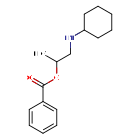
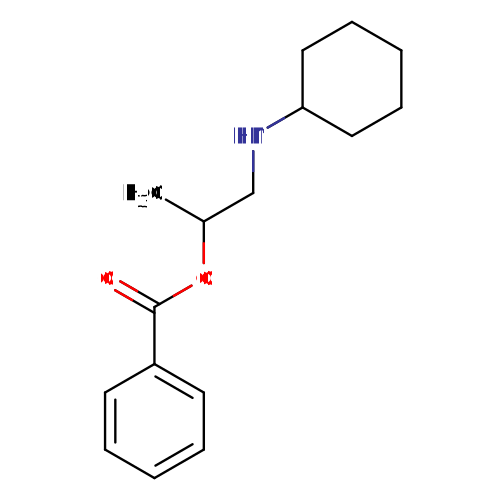
Structure for Hexylcaine (DB00473)
- Weight
- Average: 261.3593
Monoisotopic: 261.172878985 - Chemical Formula
- C16H23NO2
- Synonyms
- Hexilcaina
- Hexylcaine
- Hexylcainum

Pharmacology
- Indication
Used as a local anesthetic for surface application, infiltration or nerve block
 Reduce drug development failure ratesBuild, train, & validate machine-learning modelswith evidence-based and structured datasets.Build, train, & validate predictive machine-learning models with structured datasets.
- Contraindications & Blackbox Warnings
 Prevent Adverse Drug Events TodayTap into our Clinical API for life-saving information on contraindications & blackbox warnings, population restrictions, harmful risks, & more.Avoid life-threatening adverse drug events with our Clinical API
- Pharmacodynamics
Hexylcaine is a local ester-class anesthetic. Local anesthetics produce a transient block of nerve conduction by interfering with sodium channels. This effect of the anesthetic interferes with the development of an action potential across the nerve.
- Mechanism of action
Hexyl caine acts mainly by inhibiting sodium influx through voltage gated sodium channels in the neuronal cell membrane of peripheral nerves. When the influx of sodium is interrupted, an action potential cannot arise and signal conduction is thus inhibited. The receptor site is thought to be located at the cytoplasmic (inner) portion of the sodium channel.
Target Actions Organism ASodium channel protein type 5 subunit alpha inhibitorHumans USodium channel protein type 10 subunit alpha inhibitorHumans - Absorption
Not Available
- Volume of distribution
Not Available
- Protein binding
Not Available
- Metabolism
Hydrolyzed by plasma esterases to benzoic acid and other derivatives
- Route of elimination
Not Available
- Half-life
<10 minutes
- Clearance
Not Available
- Adverse Effects
 Improve decision support & research outcomesWith structured adverse effects data, including: blackbox warnings, adverse reactions, warning & precautions, & incidence rates. View sample adverse effects data in our new Data Library!Improve decision support & research outcomes with our structured adverse effects data.
- Toxicity
Symptoms of anesthetic overdose include headache, tinnitus, circumoral and tongue paresthesias, restlessness, talkativeness, facial twitching, convulsions, respiratory arrest, and cardiac depression
- Pathways
- Not Available
- Pharmacogenomic Effects/ADRs
- Not Available
Interactions
- Drug Interactions
- This information should not be interpreted without the help of a healthcare provider. If you believe you are experiencing an interaction, contact a healthcare provider immediately. The absence of an interaction does not necessarily mean no interactions exist.Not Available
- Food Interactions
- Not Available
Products
 Drug product information from 10+ global regionsOur datasets provide approved product information including:dosage, form, labeller, route of administration, and marketing period.Access drug product information from over 10 global regions.
- Product Ingredients
Ingredient UNII CAS InChI Key Hexylcaine hydrochloride V00NQ7SDYI 532-76-3 MTFCPNHRBINLRQ-UHFFFAOYSA-N - International/Other Brands
- Cyclaine (Merck)
Categories
- Drug Categories
- Chemical TaxonomyProvided by Classyfire
- Description
- This compound belongs to the class of organic compounds known as benzoic acid esters. These are ester derivatives of benzoic acid.
- Kingdom
- Organic compounds
- Super Class
- Benzenoids
- Class
- Benzene and substituted derivatives
- Sub Class
- Benzoic acids and derivatives
- Direct Parent
- Benzoic acid esters
- Alternative Parents
- Benzoyl derivatives / Cyclohexylamines / Carboxylic acid esters / Amino acids and derivatives / Monocarboxylic acids and derivatives / Dialkylamines / Organopnictogen compounds / Organooxygen compounds / Organic oxides / Hydrocarbon derivatives
- Substituents
- Amine / Amino acid or derivatives / Aromatic homomonocyclic compound / Benzoate ester / Benzoyl / Carboxylic acid derivative / Carboxylic acid ester / Cyclohexylamine / Hydrocarbon derivative / Monocarboxylic acid or derivatives
- Molecular Framework
- Aromatic homomonocyclic compounds
- External Descriptors
- benzoate ester (CHEBI:34791)
- Affected organisms
- Humans and other mammals
Chemical Identifiers
- UNII
- 511IU0826Z
- CAS number
- 532-77-4
- InChI Key
- DKLKMKYDWHYZTD-UHFFFAOYSA-N
- InChI
- InChI=1S/C16H23NO2/c1-13(12-17-15-10-6-3-7-11-15)19-16(18)14-8-4-2-5-9-14/h2,4-5,8-9,13,15,17H,3,6-7,10-12H2,1H3
- IUPAC Name
- 1-(cyclohexylamino)propan-2-yl benzoate
- SMILES
- CC(CNC1CCCCC1)OC(=O)C1=CC=CC=C1
References
- Synthesis Reference
U.S. Patent 2,486,374.
US2486374- General References
- Not Available
- External Links
- Human Metabolome Database
- HMDB0014616
- KEGG Compound
- C14172
- PubChem Compound
- 10770
- PubChem Substance
- 46506241
- ChemSpider
- 10315
- BindingDB
- 50225698
- 26879
- ChEBI
- 34791
- ChEMBL
- CHEMBL1197
- Therapeutic Targets Database
- DAP000506
- PharmGKB
- PA164746489
- Wikipedia
- Hexylcaine
Clinical Trials
Pharmacoeconomics
- Manufacturers
- Merck and co inc
- Packagers
- Not Available
- Dosage Forms
- Not Available
- Prices
- Not Available
- Patents
- Not Available
Properties
- State
- Solid
- Experimental Properties
Property Value Source melting point (°C) 177-178.5 U.S. Patent 2,486,374. logP 3.9 Not Available - Predicted Properties
Property Value Source Water Solubility 0.00971 mg/mL ALOGPS logP 3.04 ALOGPS logP 3.83 Chemaxon logS -4.4 ALOGPS pKa (Strongest Basic) 9.87 Chemaxon Physiological Charge 1 Chemaxon Hydrogen Acceptor Count 2 Chemaxon Hydrogen Donor Count 1 Chemaxon Polar Surface Area 38.33 Å2 Chemaxon Rotatable Bond Count 6 Chemaxon Refractivity 76.24 m3·mol-1 Chemaxon Polarizability 30.3 Å3 Chemaxon Number of Rings 2 Chemaxon Bioavailability 1 Chemaxon Rule of Five Yes Chemaxon Ghose Filter Yes Chemaxon Veber's Rule Yes Chemaxon MDDR-like Rule No Chemaxon - Predicted ADMET Features
Property Value Probability Human Intestinal Absorption + 1.0 Blood Brain Barrier + 0.9571 Caco-2 permeable + 0.686 P-glycoprotein substrate Non-substrate 0.5289 P-glycoprotein inhibitor I Inhibitor 0.6342 P-glycoprotein inhibitor II Inhibitor 0.706 Renal organic cation transporter Non-inhibitor 0.6049 CYP450 2C9 substrate Non-substrate 0.7135 CYP450 2D6 substrate Non-substrate 0.6854 CYP450 3A4 substrate Non-substrate 0.5558 CYP450 1A2 substrate Inhibitor 0.6091 CYP450 2C9 inhibitor Non-inhibitor 0.907 CYP450 2D6 inhibitor Inhibitor 0.8932 CYP450 2C19 inhibitor Non-inhibitor 0.9026 CYP450 3A4 inhibitor Non-inhibitor 0.8308 CYP450 inhibitory promiscuity High CYP Inhibitory Promiscuity 0.6452 Ames test Non AMES toxic 0.6997 Carcinogenicity Non-carcinogens 0.8884 Biodegradation Ready biodegradable 0.7395 Rat acute toxicity 2.3873 LD50, mol/kg Not applicable hERG inhibition (predictor I) Weak inhibitor 0.7066 hERG inhibition (predictor II) Non-inhibitor 0.5195
Spectra
- Mass Spec (NIST)
- Not Available
- Spectra
Spectrum Spectrum Type Splash Key Predicted GC-MS Spectrum - GC-MS Predicted GC-MS splash10-0a4i-4910000000-9d078efa75ea2644f15d Predicted MS/MS Spectrum - 10V, Positive (Annotated) Predicted LC-MS/MS splash10-01po-4890000000-f9dc1f85c70f4193fe5b Predicted MS/MS Spectrum - 10V, Negative (Annotated) Predicted LC-MS/MS splash10-000i-1910000000-fcaa26629c0c0b1e4cea Predicted MS/MS Spectrum - 20V, Negative (Annotated) Predicted LC-MS/MS splash10-05di-9610000000-b60f048c7e7ec26943f0 Predicted MS/MS Spectrum - 20V, Positive (Annotated) Predicted LC-MS/MS splash10-0a59-9420000000-2eacbcc2ae784d57852f Predicted MS/MS Spectrum - 40V, Positive (Annotated) Predicted LC-MS/MS splash10-0a59-9420000000-4844a807dbc83696f8d0 Predicted MS/MS Spectrum - 40V, Negative (Annotated) Predicted LC-MS/MS splash10-004i-9200000000-cca8210f82ecd2cf1a0b Predicted 1H NMR Spectrum 1D NMR Not Applicable Predicted 13C NMR Spectrum 1D NMR Not Applicable - Chromatographic Properties
Collision Cross Sections (CCS)
Adduct CCS Value (Å2) Source type Source [M-H]- 166.4217783 predictedDarkChem Lite v0.1.0 [M-H]- 161.46233 predictedDeepCCS 1.0 (2019) [M+H]+ 167.2119783 predictedDarkChem Lite v0.1.0 [M+H]+ 163.82031 predictedDeepCCS 1.0 (2019) [M+Na]+ 167.1180783 predictedDarkChem Lite v0.1.0 [M+Na]+ 169.91345 predictedDeepCCS 1.0 (2019)
Targets

- Kind
- Protein
- Organism
- Humans
- Pharmacological action
- Yes
- Actions
- Inhibitor
- General Function
- Voltage-gated sodium channel activity involved in sa node cell action potential
- Specific Function
- This protein mediates the voltage-dependent sodium ion permeability of excitable membranes. Assuming opened or closed conformations in response to the voltage difference across the membrane, the pr...
- Gene Name
- SCN5A
- Uniprot ID
- Q14524
- Uniprot Name
- Sodium channel protein type 5 subunit alpha
- Molecular Weight
- 226937.475 Da
References
- Chen X, Ji ZL, Chen YZ: TTD: Therapeutic Target Database. Nucleic Acids Res. 2002 Jan 1;30(1):412-5. [Article]
- Kind
- Protein
- Organism
- Humans
- Pharmacological action
- Unknown
- Actions
- Inhibitor
- Curator comments
- This is a potential target for hexylcaine based on the data indicating inhibition in vitro with lidocaine (a local anesthetic) as a proxy.
- General Function
- Voltage-gated sodium channel activity
- Specific Function
- Tetrodotoxin-resistant channel that mediates the voltage-dependent sodium ion permeability of excitable membranes. Assuming opened or closed conformations in response to the voltage difference acro...
- Gene Name
- SCN10A
- Uniprot ID
- Q9Y5Y9
- Uniprot Name
- Sodium channel protein type 10 subunit alpha
- Molecular Weight
- 220623.605 Da
References
- Chevrier P, Vijayaragavan K, Chahine M: Differential modulation of Nav1.7 and Nav1.8 peripheral nerve sodium channels by the local anesthetic lidocaine. Br J Pharmacol. 2004 Jun;142(3):576-84. doi: 10.1038/sj.bjp.0705796. Epub 2004 May 17. [Article]

Drug created at June 13, 2005 13:24 / Updated at March 03, 2024 02:33