Identification
- Summary
Nitazoxanide is a thiazolide anti-infective used to treat infections by protozoa, helminths, anaerobic bacteria, microaerophilic bacteria, and viruses.
- Brand Names
- Alinia, Busulfex
- Generic Name
- Nitazoxanide
- DrugBank Accession Number
- DB00507
- Background
Nitazoxanide belongs to the class of drugs known as thiazolides. Nitazoxanide (NTZ) is a broad-spectrum anti-infective drug that markedly modulates the survival, growth, and proliferation of a range of extracellular and intracellular protozoa, helminths, anaerobic and microaerophilic bacteria, in addition to viruses. This drug is effective in the treatment of gastrointestinal infections including Cryptosporidium parvum or Giardia lamblia in healthy subjects. It is generally well tolerated. Nitazoxanide is a first-line, standard treatment for illness caused by C. parvum or G. lamblia infection in healthy (not immunosuppressed) adults and children and may also be considered in the treatment of illnesses caused by other protozoa or helminths 2. Recently, this drug has been studied as a broad-spectrum antiviral agent due to its ability to inhibit the replication of several RNA and DNA viruses 3.
- Type
- Small Molecule
- Groups
- Approved, Investigational, Vet approved
- Structure
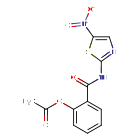
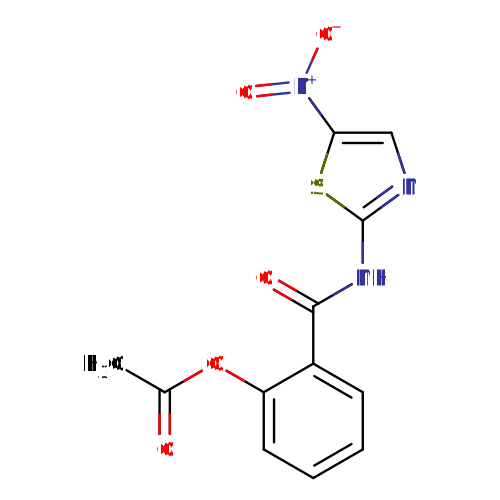
Structure for Nitazoxanide (DB00507)
- Weight
- Average: 307.282
Monoisotopic: 307.026291103 - Chemical Formula
- C12H9N3O5S
- Synonyms
- Nitaxozanid
- Nitaxozanide
- Nitazoxanida
- Nitazoxanide
- Nitazoxanidum
- External IDs
- PH 5776
- PH-5776

Pharmacology
- Indication
For the treatment of diarrhea in adults and children caused by the protozoa Giardia lamblia, and for the treatment of diarrhea in children caused by the protozoan, Cryptosporidium parvum Label.
Nitazoxanide has not been shown to be superior to placebo medication for the management of diarrhea caused by Cryptosporidium parvum in patients with HIV/immunodeficiency Label,1,2.
 Reduce drug development failure ratesBuild, train, & validate machine-learning modelswith evidence-based and structured datasets.Build, train, & validate predictive machine-learning models with structured datasets.
- Associated Conditions
Indication Type Indication Combined Product Details Approval Level Age Group Patient Characteristics Dose Form Treatment of Diarrhea caused by cryptosporidium parvum •••••••••••• •••••••• ••••••••••• •••••• Treatment of Diarrhea caused by giardia lamblia •••••••••••• •••••••• ••••••••••• •••••• - Contraindications & Blackbox Warnings
 Prevent Adverse Drug Events TodayTap into our Clinical API for life-saving information on contraindications & blackbox warnings, population restrictions, harmful risks, & more.Avoid life-threatening adverse drug events with our Clinical API
- Pharmacodynamics
The general effect of this medication is the prevention of microbe activity through disruption of important energy pathways for survival and proliferation Label,2. Nitazoxanide exhibits antiprotozoal activity by interfering with the pyruvate ferredoxin/flavodoxin oxidoreductase dependent electron transfer reaction, an essential reaction need for anaerobic energy metabolism of various microorganisms. Sporozoites of Cryptosporidium parvum and trophozoites of Giardia lamblia are therefore inhibited, relieving symptoms of diahrrea 10. Interference with the PFOR enzyme-dependent electron transfer reaction may only be one of the many pathways by which nitazoxanide exhibits antiprotozoal activity Label,1,10.
- Mechanism of action
The most widely accepted mechanism of NTZ is believed to be the disruption of the energy metabolism in anaerobic microbes by inhibition of the pyruvate: ferredoxin/flavodoxin oxidoreductase (PFOR) cycle 5. In parasitic-protozoa, Nitazoxanide also induces lesions in the cell membranes and depolarizes the mitochondrial membrane while inhibiting quinone oxidoreductase NQO1, nitroreductase-1 and protein disulphide isomerase enzymes. In addition, this drug also inhibits the glutathione-S-transferase (a major detoxifying enzyme) and modulates the Avr-14 gene, encoding for the alpha-type subunit of glutamate-gated chloride ion channel present in nematodes. Aside from its well understood non-competitive inhibition of the PFOR in anaerobic bacteria, NTZ also demonstrates various other antibacterial mechanisms. It inhibits pyruvate dehydrogenase in E Coli, disrupts the membrane potential and pH homeostasis in the Mycobacterium tuberculosis, suppresses the chaperone/usher (CU) pathway of the gram-negative bacteria, and stimulates host macrophage autophagy in tuberculosis patients 2. NTZ also suppresses viral replication by inhibiting the maturation of the viral hemagglutinin and the viral transcription factor immediate early 2 (IE2) as well as by activating the eukaryotic translation initiation factor 2α (an antiviral intracellular protein). Lastly, NTZ exhibits an inhibitory effect on tumor cell progression by altering drug detoxification (glutathione-S-transferase P1), unfolded protein response, autophagy, anti-cytokines activity, and c-Myc inhibition 2.
Target Actions Organism APyruvate-flavodoxin oxidoreductase antagonistinhibitorDesulfovibrio africanus - Absorption
The relative bioavailability of the suspension compared to the tablet was 70%. When administered with food the AUC and Cmax increased by two-fold and 50%, respectively, for the tablet and 45 to 50% and ≤ 10%, respectively, for the oral suspension Label.
- Volume of distribution
Not Available
- Protein binding
Very High (greater than 99%), bound to proteins in the plasma Label,5.
- Metabolism
The active metabolite of this drug is tizoxanide (desacetyl-nitazoxanide). The initial reaction in the metabolic pathway of Nitazoxanide is hydrolysis to tizoxanide, followed by conjugation, primarily by glucuronidation to tizoxanide glucuronide.
The oral suspension bioavailability of this drug is not equivalent to that of the oral tablets. Compared to the to the tablet, the bioavailability of the suspension was 70% Label.
When administered with food, the AUCt of tizoxanide and tizoxanide glucuronide in plasma is increased to almost two-fold and the maximum concentration is increased by almost 50% compared to when ingested without food Label.
When the oral suspension was ingested with food, the AUC of tizoxanide and tizoxanide glucuronide increased by approximately 50% and the Cmax increased by less than 10% Label.
Hover over products below to view reaction partners
- Route of elimination
Tizoxanide is excreted in the urine, bile and feces, and tizoxanide glucuronide is excreted in urine and bile. Approximately 2/3 of the oral dose of nitazoxanide is excreted in the faeces and 1/3 in the urine Label,5.
- Half-life
7.3h 8
- Clearance
Nitazoxanide is cleared in the urine and feces. The metabolite, tizoxanide, is also found in the urine, plasma, and breastmilk 9. The drug is not found unchanged in the urine 9.
- Adverse Effects
 Improve decision support & research outcomesWith structured adverse effects data, including: blackbox warnings, adverse reactions, warning & precautions, & incidence rates. View sample adverse effects data in our new Data Library!Improve decision support & research outcomes with our structured adverse effects data.
- Toxicity
Data on nitazoxanide overdosage is not available Label. In studies in rodents and dogs, the oral LD50 was higher than 10,000 mg/kg. One-time oral doses of up to 4000 mg nitazoxanide have been given to healthy adult volunteers without severe adverse effects. Gastric lavage may be appropriate soon after oral administration if overdose occurs. Supportive and symptomatic treatment should also be administered Label.
According to previous studies Label, less than 1% of the patients age 12 years and older participating in clinical trials with NTZ suffered from the following adverse effects: Systemic: asthenia, fever, pain, allergic reaction, pelvic pain, back pain, chills, fever, flu-like syndrome. Central Nervous System: dizziness, somnolence, insomnia, tremor, hypesthesia. Gastrointestinal System: vomiting, dyspepsia, anorexia, flatulence, constipation, dry mouth, thirst. Urogenital System: discolored urine, dysuria, amenorrhea, metrorrhagia, kidney pain, edema labia. Metabolic & Nutrition: increased SGPT. Hemic & Lymphatic Systems: anemia, leukocytosis. Skin: rash, pruritus. Special Senses: eye discoloration, ear ache. Respiratory System: epistaxis, lung disease, pharyngitis. Cardiovascular System: tachycardia, syncope, hypertension. Muscular System: myalgia, leg cramps, spontaneous bone fracture.
- Pathways
- Not Available
- Pharmacogenomic Effects/ADRs
- Not Available
Interactions
- Drug Interactions
- This information should not be interpreted without the help of a healthcare provider. If you believe you are experiencing an interaction, contact a healthcare provider immediately. The absence of an interaction does not necessarily mean no interactions exist.No interactions found.
- Food Interactions
- Take with food. Food improves oral bioavailability.
Products
 Drug product information from 10+ global regionsOur datasets provide approved product information including:dosage, form, labeller, route of administration, and marketing period.Access drug product information from over 10 global regions.
- International/Other Brands
- Alpex Nizox (Alpex Pharmaceutical) / ANNITA (Alpex Pharmaceutical) / Azoxanid (G&R) / Celectan (Farma) / Colufase (Roemmers) / Coluquim (Quilab) / Daxon (Siegfried) / Dianide (General Pharma) / Diar (ACI) / Famidox (Lafrancol) / Kaside (Lafrancol) / Kazide (Lafrancol) / Larvisol (Armofar) / Lumbris (Farmedic) / Mixel (California) / Niazid (Apex) / Nitax (Delta) / Nitaxide (Beximco) / Nitazet (Glenmark) / Nitazofin (Bussié) / Nodik / Omniparax
- Brand Name Prescription Products
Name Dosage Strength Route Labeller Marketing Start Marketing End Region Image Alinia Powder, for suspension 100 mg/5mL Oral Lupin Pharmaceuticals, Inc. 2013-10-09 Not applicable US 
Alinia Tablet 500 mg/1 Oral Avera McKennan Hospital 2015-05-26 2017-05-24 US Alinia Powder, for suspension 100 mg/5mL Oral Romark Laboratories, L.C. 2002-11-22 Not applicable US Alinia Tablet 500 mg/1 Oral Romark Laboratories, L.C. 2004-07-21 Not applicable US - Generic Prescription Products
Name Dosage Strength Route Labeller Marketing Start Marketing End Region Image N/a Tablet 500 mg/1 Oral Lupin Pharmaceuticals, Inc. 2021-02-17 Not applicable US Nitazoxanide Tablet, film coated 500 mg/1 Oral Rising Pharmaceuticals, Inc. 2020-11-27 Not applicable US
Categories
- ATC Codes
- P01AX11 — Nitazoxanide
- Drug Categories
- Chemical TaxonomyProvided by Classyfire
- Description
- This compound belongs to the class of organic compounds known as acylsalicylamides. These are o-acylated derivatives of salicylamide.
- Kingdom
- Organic compounds
- Super Class
- Benzenoids
- Class
- Benzene and substituted derivatives
- Sub Class
- Benzoic acids and derivatives
- Direct Parent
- Acylsalicylamides
- Alternative Parents
- Phenol esters / Benzamides / Phenoxy compounds / Benzoyl derivatives / Nitroaromatic compounds / Nitrothiazoles / 2,5-disubstituted thiazoles / Heteroaromatic compounds / Secondary carboxylic acid amides / Carboxylic acid esters show 10 more
- Substituents
- 2,5-disubstituted 1,3-thiazole / Acylsalicylamide / Allyl-type 1,3-dipolar organic compound / Aromatic heteromonocyclic compound / Azacycle / Azole / Benzamide / Benzoyl / C-nitro compound / Carbonyl group show 24 more
- Molecular Framework
- Aromatic heteromonocyclic compounds
- External Descriptors
- Not Available
- Affected organisms
- Mycobacterium tuberculosis
- Helminthic Microorganisms
- Bacteria and protozoa
- Escherichia coli
Chemical Identifiers
- UNII
- SOA12P041N
- CAS number
- 55981-09-4
- InChI Key
- YQNQNVDNTFHQSW-UHFFFAOYSA-N
- InChI
- InChI=1S/C12H9N3O5S/c1-7(16)20-9-5-3-2-4-8(9)11(17)14-12-13-6-10(21-12)15(18)19/h2-6H,1H3,(H,13,14,17)
- IUPAC Name
- 2-[(5-nitro-1,3-thiazol-2-yl)carbamoyl]phenyl acetate
- SMILES
- CC(=O)OC1=CC=CC=C1C(=O)NC1=NC=C(S1)[N+]([O-])=O
References
- Synthesis Reference
- US3950351
- General References
- Anderson VR, Curran MP: Nitazoxanide: a review of its use in the treatment of gastrointestinal infections. Drugs. 2007;67(13):1947-67. [Article]
- Shakya A, Bhat HR, Ghosh SK: Update on Nitazoxanide: A Multifunctional Chemotherapeutic Agent. Curr Drug Discov Technol. 2017 Jul 27. pii: CDDT-EPUB-85034. doi: 10.2174/1570163814666170727130003. [Article]
- Rossignol JF: Nitazoxanide: a first-in-class broad-spectrum antiviral agent. Antiviral Res. 2014 Oct;110:94-103. doi: 10.1016/j.antiviral.2014.07.014. Epub 2014 Aug 7. [Article]
- Balamurugan K, Said HM: Role of reduced folate carrier in intestinal folate uptake. Am J Physiol Cell Physiol. 2006 Jul;291(1):C189-93. doi: 10.1152/ajpcell.00594.2005. Epub 2006 Feb 22. [Article]
- Broekhuysen J, Stockis A, Lins RL, De Graeve J, Rossignol JF: Nitazoxanide: pharmacokinetics and metabolism in man. Int J Clin Pharmacol Ther. 2000 Aug;38(8):387-94. [Article]
- Nitazoxanide, Pub Chemistry [Link]
- EPA Chemistry Dashboard: Nitazoxanide [Link]
- Nitazoxanide: A New Thiazolide Antiparasitic Agent [Link]
- Validated and optimized high-performance liquid chromatographic determination of tizoxanide, the main active metabolite of nitazoxanide in human urine, plasma and breast milk. [Link]
- Pharmacology review, Nitazoxanide [Link]
- FDA Approved Drug Products: ALINIA (nitazoxanide) oral [Link]
- External Links
- Human Metabolome Database
- HMDB0014649
- KEGG Drug
- D02486
- PubChem Compound
- 41684
- PubChem Substance
- 46507813
- ChemSpider
- 38037
- BindingDB
- 50075050
- 31819
- ChEBI
- 94807
- ChEMBL
- CHEMBL1401
- ZINC
- ZINC000003956788
- Therapeutic Targets Database
- DAP001293
- PharmGKB
- PA164754874
- PDBe Ligand
- NTI
- RxList
- RxList Drug Page
- Drugs.com
- Drugs.com Drug Page
- PDRhealth
- PDRhealth Drug Page
- Wikipedia
- Nitazoxanide
- PDB Entries
- 3v35
- FDA label
- Download (150 KB)
- MSDS
- Download (57.4 KB)
Clinical Trials
- Clinical Trials
Phase Status Purpose Conditions Count 4 Completed Treatment Chronic Hepatitis C Virus (HCV) Infection / Type 2 Diabetes Mellitus 1 4 Completed Treatment Coronavirus Disease 2019 (COVID‑19) / COVID 1 4 Completed Treatment Coronavirus Disease 2019 (COVID‑19) / Infections, Coronavirus 1 4 Completed Treatment Irritable Bowel Syndrome (IBS) 1 4 Recruiting Prevention Coronavirus Disease 2019 (COVID‑19) / Households Contacts 1
Pharmacoeconomics
- Manufacturers
- Romark laboratories
- Packagers
- Industriale Chimica S.R.L.
- Laboratoria Qualiphar NV SA
- Murfreesboro Pharmaceutical Nursing Supply
- Romark Pharmaceuticals
- Dosage Forms
Form Route Strength Powder, for suspension Oral 100 mg/5mL Tablet Oral 500 mg/1 Powder, for suspension Oral 2000 mg Powder, for suspension Oral 200000000 mg Tablet, coated Oral 50000000 mg Tablet, soluble Oral 100 mg Tablet, soluble Oral 250 mg Suspension Oral 1.2000 g Tablet Oral 200.00 mg Tablet Oral 500.000 mg Tablet Oral 50000000 mg Powder, for solution Oral 200000 g Tablet, coated Oral 200 mg Tablet, soluble Oral 200 mg Powder, for solution Oral 2 g Suspension Oral 600.000 mg Powder, for suspension Oral 200000 g Suspension Oral 600.00 mg Powder, for suspension Oral 1.9999 g Tablet Oral 200 mg Granule Oral 2 g Capsule, liquid filled Oral 500 mg Tablet Oral 500 mg Tablet, coated Oral 500 mg Tablet, film coated Oral 500 mg/1 Powder, for suspension Oral 6 g Powder, for suspension Oral 1.2 g Suspension Oral 0.600 g Tablet Oral 100.00 mg Powder, for suspension Oral 2 g Tablet, film coated Oral 500 mg Suspension Oral 2 g Suspension Oral 400 mg Tablet Oral 500.00 mg - Prices
Unit description Cost Unit Alinia 500 mg tablet 23.22USD tablet DrugBank does not sell nor buy drugs. Pricing information is supplied for informational purposes only.- Patents
Patent Number Pediatric Extension Approved Expires (estimated) Region US5387598 No 1995-02-07 2012-02-07 US US5968961 No 1999-10-19 2017-05-07 US US5965590 No 1999-10-12 2017-07-03 US US6117894 No 2000-09-12 2017-05-07 US
Properties
- State
- Solid
- Experimental Properties
Property Value Source melting point (°C) 202 °C [L1417] boiling point (°C) 394 [L1417] water solubility 1.89e-04 [L1417] logP 1.63 [L1417] - Predicted Properties
Property Value Source Water Solubility 0.00755 mg/mL ALOGPS logP 2.14 ALOGPS logP 2.12 Chemaxon logS -4.6 ALOGPS pKa (Strongest Acidic) 10.62 Chemaxon pKa (Strongest Basic) -4.2 Chemaxon Physiological Charge 0 Chemaxon Hydrogen Acceptor Count 5 Chemaxon Hydrogen Donor Count 1 Chemaxon Polar Surface Area 111.43 Å2 Chemaxon Rotatable Bond Count 5 Chemaxon Refractivity 72.89 m3·mol-1 Chemaxon Polarizability 27.61 Å3 Chemaxon Number of Rings 2 Chemaxon Bioavailability 1 Chemaxon Rule of Five Yes Chemaxon Ghose Filter Yes Chemaxon Veber's Rule No Chemaxon MDDR-like Rule No Chemaxon - Predicted ADMET Features
Property Value Probability Human Intestinal Absorption + 0.9045 Blood Brain Barrier + 0.7175 Caco-2 permeable - 0.5571 P-glycoprotein substrate Non-substrate 0.7978 P-glycoprotein inhibitor I Non-inhibitor 0.8874 P-glycoprotein inhibitor II Non-inhibitor 0.9836 Renal organic cation transporter Non-inhibitor 0.9228 CYP450 2C9 substrate Non-substrate 0.7438 CYP450 2D6 substrate Non-substrate 0.8431 CYP450 3A4 substrate Non-substrate 0.5596 CYP450 1A2 substrate Non-inhibitor 0.6339 CYP450 2C9 inhibitor Inhibitor 0.6655 CYP450 2D6 inhibitor Non-inhibitor 0.9027 CYP450 2C19 inhibitor Non-inhibitor 0.6341 CYP450 3A4 inhibitor Inhibitor 0.6669 CYP450 inhibitory promiscuity High CYP Inhibitory Promiscuity 0.5635 Ames test AMES toxic 0.8322 Carcinogenicity Non-carcinogens 0.7746 Biodegradation Ready biodegradable 0.5458 Rat acute toxicity 1.7902 LD50, mol/kg Not applicable hERG inhibition (predictor I) Weak inhibitor 0.9283 hERG inhibition (predictor II) Non-inhibitor 0.9295
Spectra
- Mass Spec (NIST)
- Not Available
- Spectra
Spectrum Spectrum Type Splash Key Predicted GC-MS Spectrum - GC-MS Predicted GC-MS splash10-006x-9820000000-92fb5445f11125065e46 LC-MS/MS Spectrum - LC-ESI-qTof , Positive LC-MS/MS splash10-01b9-1950000000-3d1aca26d9cbdaaab410 MS/MS Spectrum - , positive LC-MS/MS splash10-01b9-1950000000-3d1aca26d9cbdaaab410 Predicted 1H NMR Spectrum 1D NMR Not Applicable Predicted 13C NMR Spectrum 1D NMR Not Applicable - Chromatographic Properties
Collision Cross Sections (CCS)
Adduct CCS Value (Å2) Source type Source [M-H]- 172.916235 predictedDarkChem Lite v0.1.0 [M-H]- 172.992035 predictedDarkChem Lite v0.1.0 [M-H]- 152.641 predictedDeepCCS 1.0 (2019) [M+H]+ 173.164135 predictedDarkChem Lite v0.1.0 [M+H]+ 174.035635 predictedDarkChem Lite v0.1.0 [M+H]+ 155.47726 predictedDeepCCS 1.0 (2019) [M+Na]+ 173.168935 predictedDarkChem Lite v0.1.0 [M+Na]+ 173.143135 predictedDarkChem Lite v0.1.0 [M+Na]+ 163.70642 predictedDeepCCS 1.0 (2019)
Targets

- Kind
- Protein
- Organism
- Desulfovibrio africanus
- Pharmacological action
- Yes
- Actions
- AntagonistInhibitor
- General Function
- Thiamine pyrophosphate binding
- Specific Function
- Catalyzes the ferredoxin-dependent oxidative decarboxylation of pyruvate. Required for the transfer of electrons from pyruvate to ferredoxin (PubMed:9294422, PubMed:7612653). Ferredoxin I and ferre...
- Gene Name
- por
- Uniprot ID
- P94692
- Uniprot Name
- Pyruvate synthase
- Molecular Weight
- 133679.405 Da
References
- Hoffman PS, Sisson G, Croxen MA, Welch K, Harman WD, Cremades N, Morash MG: Antiparasitic drug nitazoxanide inhibits the pyruvate oxidoreductases of Helicobacter pylori, selected anaerobic bacteria and parasites, and Campylobacter jejuni. Antimicrob Agents Chemother. 2007 Mar;51(3):868-76. Epub 2006 Dec 11. [Article]
- Ballard TE, Wang X, Olekhnovich I, Koerner T, Seymour C, Hoffman PS, Macdonald TL: Biological activity of modified and exchanged 2-amino-5-nitrothiazole amide analogues of nitazoxanide. Bioorg Med Chem Lett. 2010 Jun 15;20(12):3537-9. doi: 10.1016/j.bmcl.2010.04.126. Epub 2010 May 18. [Article]

Drug created at June 13, 2005 13:24 / Updated at March 03, 2024 02:27