Identification
- Summary
Sevelamer is a phosphate binder used to treat hyperphosphatemia.
- Brand Names
- Renagel, Renvela
- Generic Name
- Sevelamer
- DrugBank Accession Number
- DB00658
- Background
Sevelamer is a phosphate binding drug used to prevent hyperphosphataemia in patients with chronic renal failure. It is marketed by Genzyme under the trade name Renagel.
- Type
- Small Molecule
- Groups
- Approved
- Structure
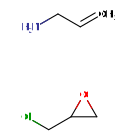
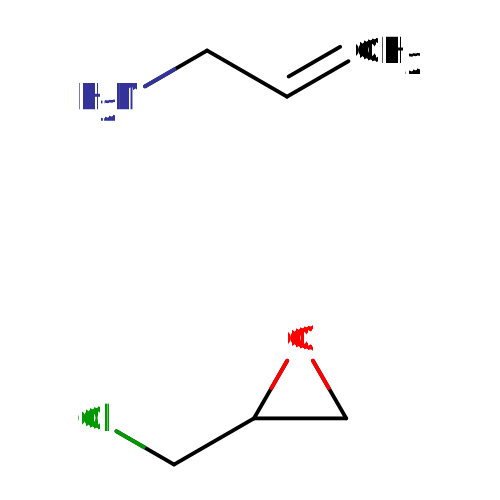
Structure for Sevelamer (DB00658)
- Weight
- Average: 149.619
Monoisotopic: 149.060741718 - Chemical Formula
- C6H12ClNO
- Synonyms
- Sevelamer
- Sévélamer
- Sevelamero
- Sevelamerum
- External IDs
- GT 16026 A
- GT 335-012

Pharmacology
- Indication
For the control of serum phosphorus in patients with Chronic Kidney Disease (CKD) on hemodialysis.
 Reduce drug development failure ratesBuild, train, & validate machine-learning modelswith evidence-based and structured datasets.Build, train, & validate predictive machine-learning models with structured datasets.
- Associated Conditions
Indication Type Indication Combined Product Details Approval Level Age Group Patient Characteristics Dose Form Management of Hyperphosphatemia •••••••••••• - Contraindications & Blackbox Warnings
 Prevent Adverse Drug Events TodayTap into our Clinical API for life-saving information on contraindications & blackbox warnings, population restrictions, harmful risks, & more.Avoid life-threatening adverse drug events with our Clinical API
- Pharmacodynamics
Patients with end-stage renal disease (ESRD) retain phosphorus and can develop hyperphosphatemia. High serum phosphorus can precipitate serum calcium resulting in ectopic calcification. When the product of serum calcium and phosphorus concentrations (Ca x P) exceeds 55 mg2/dL2, there is an increased risk that ectopic calcification will occur. Hyperphosphatemia plays a role in the development of secondary hyperparathyroidism in renal insufficiency. An increase in parathyroid hormone (PTH) levels is characteristic of patients with chronic renal failure. Increased levels of PTH can lead to osteitis fibrosa, a bone disease. A decrease in serum phosphorus may decrease serum PTH levels. Treatment of hyperphosphatemia includes reduction in dietary intake of phosphate, inhibition of intestinal phosphate absorption with phosphate binders, and removal of phosphate with dialysis. Sevelamer taken with meals has been shown to decrease serum phosphorus concentrations in patients with ESRD who are on hemodialysis. In vitro studies have shown that the capsule and tablet formulations bind phosphate to a similar extent. Sevelamer treatment also results in a lowering of low-density lipoprotein (LDL) and total serum cholesterol levels.
- Mechanism of action
Sevelamer prevents hyperphosphatemia by binding to dietary phosphate in the gut, preventing its absorption and thus decreasing serum parathyroid hormone levels.
Target Actions Organism APhosphate binderHumans - Absorption
Not absorbed following oral administration, however no absorption studies have been performed in patients with renal disease. Sevelamer may bind to dietary phosphates and prevent its gastrointestinal absorption when sevelamer is administered in combination with food.
- Volume of distribution
Not Available
- Protein binding
Not Available
- Metabolism
- Not Available
- Route of elimination
Not Available
- Half-life
Not Available
- Clearance
Not Available
- Adverse Effects
 Improve decision support & research outcomesWith structured adverse effects data, including: blackbox warnings, adverse reactions, warning & precautions, & incidence rates. View sample adverse effects data in our new Data Library!Improve decision support & research outcomes with our structured adverse effects data.
- Toxicity
Sevelamer has been given to normal healthy volunteers in doses of up to 14 grams per day for eight days with no adverse effects. Sevelamer has been given in average doses up to 13 grams per day to hemodialysis patients. There are no reported overdosages of sevelamer in patients. Since sevelamer is not absorbed, the risk of systemic toxicity is low.
- Pathways
- Not Available
- Pharmacogenomic Effects/ADRs
- Not Available
Interactions
- Drug Interactions
- This information should not be interpreted without the help of a healthcare provider. If you believe you are experiencing an interaction, contact a healthcare provider immediately. The absence of an interaction does not necessarily mean no interactions exist.
Drug Interaction Integrate drug-drug
interactions in your softwareAceclofenac Sevelamer can cause a decrease in the absorption of Aceclofenac resulting in a reduced serum concentration and potentially a decrease in efficacy. Acemetacin Sevelamer can cause a decrease in the absorption of Acemetacin resulting in a reduced serum concentration and potentially a decrease in efficacy. Acenocoumarol Sevelamer can cause a decrease in the absorption of Acenocoumarol resulting in a reduced serum concentration and potentially a decrease in efficacy. Acetazolamide Sevelamer can cause a decrease in the absorption of Acetazolamide resulting in a reduced serum concentration and potentially a decrease in efficacy. Acetyl sulfisoxazole Sevelamer can cause a decrease in the absorption of Acetyl sulfisoxazole resulting in a reduced serum concentration and potentially a decrease in efficacy. - Food Interactions
- Take with food.
Products
 Drug product information from 10+ global regionsOur datasets provide approved product information including:dosage, form, labeller, route of administration, and marketing period.Access drug product information from over 10 global regions.
- Product Ingredients
Ingredient UNII CAS InChI Key Sevelamer carbonate 9YCX42I8IU 845273-93-0 PADGNZFOVSZIKZ-UHFFFAOYSA-N Sevelamer hydrochloride GLS2PGI8QG 152751-57-0 KHNXRSIBRKBJDI-UHFFFAOYSA-N - Product Images
- International/Other Brands
- Phosblock (Kyowa Hakko Kirin)
- Brand Name Prescription Products
Name Dosage Strength Route Labeller Marketing Start Marketing End Region Image Intelli-sevelamer Tablet 800 mg Oral Intellipharm Inc Not applicable Not applicable Canada 
Renagel Tablet 800 mg/1 Oral Doh Central Pharmacy 2009-07-01 Not applicable US 

Renagel Tablet 800 mg/1 Oral Remedy Repack 2013-05-15 2013-05-16 US Renagel Tablet, film coated 800 mg Oral Sanofi B.V. 2021-02-09 Not applicable EU 
Renagel Tablet 800 mg/1 Oral Atlantic Biologicals Corps. 2008-06-06 Not applicable US 
- Generic Prescription Products
Name Dosage Strength Route Labeller Marketing Start Marketing End Region Image Accel-sevelamer Tablet 800 mg Oral Accel Pharma Inc 2017-11-08 Not applicable Canada Sevelamer carbonate Tablet, film coated 800 mg/1 Oral REMEDYREPACK INC. 2017-12-14 2020-05-07 US Sevelamer carbonate Tablet, film coated 800 mg/1 Oral Cipla USA Inc. 2017-10-26 Not applicable US Sevelamer Carbonate Tablet, film coated 800 mg/1 Oral Marlex Pharmaceuticals Inc 2018-05-01 Not applicable US Sevelamer Carbonate Powder, for suspension 2.4 g/1 Oral Winthrop U.S, a business of sanofi-aventis U.S. LLC 2018-01-01 Not applicable US


Categories
- ATC Codes
- V03AE02 — Sevelamer
- Drug Categories
- Amines
- Bile Acid Sequestrants
- Chelating Agents
- Compounds used in a research, industrial, or household setting
- Drugs for Treatment of Hyperkalemia and Hyperphosphatemia
- Lipid Regulating Agents
- Phosphate Binder
- Phosphate Chelating Activity
- Phosphate-removing Agents
- Polyamines
- Polystyrene Sulfonates
- Sequestering Agents
- Chemical TaxonomyProvided by Classyfire
- Description
- This compound belongs to the class of organic compounds known as epoxides. These are compounds containing a cyclic ether with three ring atoms(one oxygen and two carbon atoms).
- Kingdom
- Organic compounds
- Super Class
- Organoheterocyclic compounds
- Class
- Epoxides
- Sub Class
- Not Available
- Direct Parent
- Epoxides
- Alternative Parents
- Oxacyclic compounds / Dialkyl ethers / Organopnictogen compounds / Organochlorides / Monoalkylamines / Hydrocarbon derivatives / Alkyl chlorides
- Substituents
- Aliphatic heteromonocyclic compound / Alkyl chloride / Alkyl halide / Amine / Dialkyl ether / Ether / Hydrocarbon derivative / Organic nitrogen compound / Organic oxygen compound / Organochloride
- Molecular Framework
- Not Available
- External Descriptors
- Not Available
- Affected organisms
- Humans and other mammals
Chemical Identifiers
- UNII
- 941N5DUU5C
- CAS number
- 52757-95-6
- InChI Key
- ZNSIZMQNQCNRBW-UHFFFAOYSA-N
- InChI
- InChI=1S/C3H5ClO.C3H7N/c4-1-3-2-5-3;1-2-3-4/h3H,1-2H2;2H,1,3-4H2
- IUPAC Name
- 2-(chloromethyl)oxirane; prop-2-en-1-amine
- SMILES
- NCC=C.ClCC1CO1
References
- Synthesis Reference
Deepak Anant Hedge, Varsha Shashank Choudhary, Venkatasubramanian Radhakrjshnan Tarur, Dhananjay Govind Sathe, Harish Kashinath Mondkar, Samadhan Daulat Patil, Sasikumar Mohan Thoovara, Yogesh Sharad Bhide, "Process for the Preparation of Sevelamer Hydrochloride and Formulation Thereof." U.S. Patent US20090280178, issued November 12, 2009.
US20090280178- General References
- Not Available
- External Links
- Human Metabolome Database
- HMDB0014796
- KEGG Drug
- D01983
- PubChem Compound
- 3085017
- PubChem Substance
- 46505951
- ChemSpider
- 2341997
- 214824
- ChEMBL
- CHEMBL1201798
- PharmGKB
- PA164781197
- RxList
- RxList Drug Page
- Drugs.com
- Drugs.com Drug Page
- Wikipedia
- Sevelamer
- FDA label
- Download (36.4 KB)
Clinical Trials
- Clinical Trials
Phase Status Purpose Conditions Count 4 Completed Other Variola Major (Smallpox) 1 4 Completed Prevention Vascular Diseases 1 4 Completed Prevention We Investigated the Relationship Between Plasma FGF23 Levels and Endothelial Dysfunction in a Sizable Series of Incident Stage 3-4 CKD Patients 1 4 Completed Treatment Arteriosclerosis / Calcinosis / Secondary Hyperparathyroidism (SHPT) 1 4 Completed Treatment Cardiovascular Events / Hemodialysis Treatment / Hyperphosphataemia 1
Pharmacoeconomics
- Manufacturers
- Genzyme corp
- Genzyme Corporation
- Packagers
- Atlantic Biologicals Corporation
- Cardinal Health
- Genzyme Inc.
- Heartland Repack Services LLC
- Murfreesboro Pharmaceutical Nursing Supply
- Pharma Pac LLC
- Physicians Total Care Inc.
- Prepak Systems Inc.
- Remedy Repack
- Resource Optimization and Innovation LLC
- Southwood Pharmaceuticals
- Tya Pharmaceuticals
- Vangard Labs Inc.
- Warner Chilcott Co. Inc.
- Watson Pharmaceuticals
- Dosage Forms
Form Route Strength Tablet Oral 800.000 mg Capsule Oral 403 mg Tablet Oral 400 mg/1 Tablet Oral 400 mg Tablet Oral 800 mg/1 Tablet Oral 800 mg Tablet, film coated Oral 400 MG Tablet, film coated 800 mg Powder Oral 0.8 G Powder, for suspension Oral 0.8 g / sachet Powder, for suspension Oral 0.8 G Powder, for suspension Oral 1.6 G Powder, for suspension Oral 2.4 g / sachet Tablet Oral 800.00 mg Tablet, film coated Oral Tablet, film coated Oral 800 mg/1 Powder, for suspension Oral 800 mg/1sachet Tablet, coated Oral 800 mg Powder Oral 2.400 g Tablet, film coated Oral 800 mg For suspension Oral 2400 mg/2790mg For suspension Oral 800 mg/930mg Powder, for suspension Oral 0.8 g/1 Powder, for suspension Oral 2.4 g/1 Powder, for suspension Oral 2400 mg/1 Powder, for suspension Oral 800 mg/1 Powder, for suspension Oral 2.4 G Tablet, film coated Oral 400 mg/1 Tablet, film coated Parenteral 800 mg/1 Tablet, film coated Tablet, film coated 400 MG - Prices
Unit description Cost Unit Renagel 800 mg tablet 2.41USD tablet Renvela 800 mg tablet 2.17USD tablet Renagel 400 mg tablet 1.66USD tablet DrugBank does not sell nor buy drugs. Pricing information is supplied for informational purposes only.- Patents
Patent Number Pediatric Extension Approved Expires (estimated) Region US5496545 No 1996-03-05 2013-08-11 US CA2310960 No 2003-05-27 2014-08-10 Canada CA2169356 No 2000-07-04 2014-08-10 Canada US7985418 No 2011-07-26 2025-10-27 US US6733780 No 2004-05-11 2020-10-18 US US9095509 No 2015-08-04 2030-12-06 US
Properties
- State
- Solid
- Experimental Properties
Property Value Source water solubility Insoluble Not Available logP 0.559 Not Available - Predicted Properties
Property Value Source Water Solubility 71.8 mg/mL ALOGPS logP 0.35 ALOGPS logP 0.68 Chemaxon logS -0.11 ALOGPS pKa (Strongest Basic) -4.2 Chemaxon Physiological Charge 0 Chemaxon Hydrogen Acceptor Count 1 Chemaxon Hydrogen Donor Count 0 Chemaxon Polar Surface Area 12.53 Å2 Chemaxon Rotatable Bond Count 2 Chemaxon Refractivity 20.06 m3·mol-1 Chemaxon Polarizability 8.38 Å3 Chemaxon Number of Rings 1 Chemaxon Bioavailability 1 Chemaxon Rule of Five Yes Chemaxon Ghose Filter No Chemaxon Veber's Rule Yes Chemaxon MDDR-like Rule No Chemaxon - Predicted ADMET Features
Property Value Probability Human Intestinal Absorption + 0.9908 Blood Brain Barrier + 0.9723 Caco-2 permeable + 0.5783 P-glycoprotein substrate Non-substrate 0.7654 P-glycoprotein inhibitor I Non-inhibitor 0.921 P-glycoprotein inhibitor II Non-inhibitor 0.9399 Renal organic cation transporter Non-inhibitor 0.7531 CYP450 2C9 substrate Non-substrate 0.8823 CYP450 2D6 substrate Non-substrate 0.8029 CYP450 3A4 substrate Non-substrate 0.7617 CYP450 1A2 substrate Non-inhibitor 0.5084 CYP450 2C9 inhibitor Non-inhibitor 0.7543 CYP450 2D6 inhibitor Non-inhibitor 0.839 CYP450 2C19 inhibitor Non-inhibitor 0.5583 CYP450 3A4 inhibitor Non-inhibitor 0.8711 CYP450 inhibitory promiscuity Low CYP Inhibitory Promiscuity 0.6708 Ames test AMES toxic 0.9498 Carcinogenicity Carcinogens 0.5468 Biodegradation Not ready biodegradable 0.889 Rat acute toxicity 2.9282 LD50, mol/kg Not applicable hERG inhibition (predictor I) Weak inhibitor 0.7403 hERG inhibition (predictor II) Non-inhibitor 0.8883
Spectra
- Mass Spec (NIST)
- Not Available
- Spectra
Spectrum Spectrum Type Splash Key Predicted 1H NMR Spectrum 1D NMR Not Applicable Predicted 13C NMR Spectrum 1D NMR Not Applicable - Chromatographic Properties
Collision Cross Sections (CCS)
Adduct CCS Value (Å2) Source type Source [M-H]- 126.83152 predictedDeepCCS 1.0 (2019) [M+H]+ 128.85497 predictedDeepCCS 1.0 (2019) [M+Na]+ 137.20592 predictedDeepCCS 1.0 (2019)
Targets

References
- Cannata-Andia JB, Rodriguez-Garcia M, Roman-Garcia P, Tunon-le Poultel D, Lopez-Hernandez F, Rodriguez-Puyol D: New therapies: calcimimetics, phosphate binders and vitamin D receptor activators. Pediatr Nephrol. 2010 Apr;25(4):609-16. doi: 10.1007/s00467-010-1462-9. Epub 2010 Feb 12. [Article]
- Novak JE, Szczech LA: Phosphate binders in chronic kidney disease and end-stage renal disease: a patient-centered approach. Semin Dial. 2009 Jan-Feb;22(1):56-63. doi: 10.1111/j.1525-139X.2008.00514.x. Epub 2008 Oct 16. [Article]
- Salusky IB: A new era in phosphate binder therapy: what are the options? Kidney Int Suppl. 2006 Dec;(105):S10-5. [Article]
- Schucker JJ, Ward KE: Hyperphosphatemia and phosphate binders. Am J Health Syst Pharm. 2005 Nov 15;62(22):2355-61. [Article]

Drug created at June 13, 2005 13:24 / Updated at April 26, 2024 00:45