Identification
- Generic Name
- Methylphenobarbital
- DrugBank Accession Number
- DB00849
- Background
A barbiturate that is metabolized to phenobarbital. It has been used for similar purposes, especially in epilepsy, but there is no evidence mephobarbital offers any advantage over phenobarbital.
- Type
- Small Molecule
- Groups
- Approved
- Structure
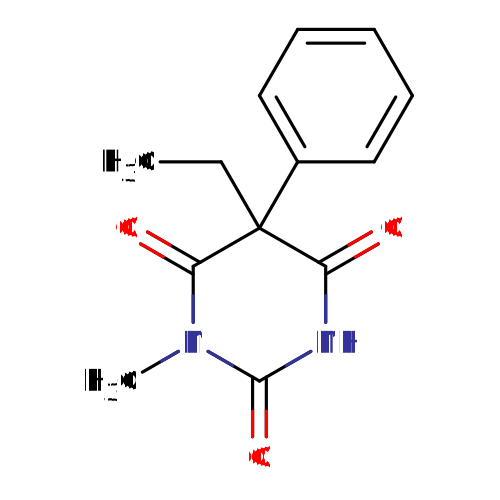
Structure for Methylphenobarbital (DB00849)
- Weight
- Average: 246.2619
Monoisotopic: 246.100442324 - Chemical Formula
- C13H14N2O3
- Synonyms
- 1-Methylphenobarbital
- 5-ethyl-1-methyl-5-phenyl-2,4,6(1H,3H,5H)-pyrimidinetrione
- 5-Ethyl-1-methyl-5-phenyl-pyrimidine-2,4,6-trione
- 5-ethyl-1-methyl-5-phenylbarbituric acid
- Enphenemal
- Mephobarbital
- Mephobarbitone
- Méthylphénobarbital
- Methylphenobarbital
- Methylphenobarbitalum
- Methylphenobarbitone
- Metilfenobarbital
- Metilfenobarbitale
- N-Methylphenobarbital

Pharmacology
- Indication
For the relief of anxiety, tension, and apprehension, also used as an anticonvulsant for the treatment of epilepsy.
 Reduce drug development failure ratesBuild, train, & validate machine-learning modelswith evidence-based and structured datasets.Build, train, & validate predictive machine-learning models with structured datasets.
- Contraindications & Blackbox Warnings
 Prevent Adverse Drug Events TodayTap into our Clinical API for life-saving information on contraindications & blackbox warnings, population restrictions, harmful risks, & more.Avoid life-threatening adverse drug events with our Clinical API
- Pharmacodynamics
Methylphenobarbital, a barbiturate, is used in combination with acetaminophen or aspirin and caffeine for its sedative and relaxant effects in the treatment of tension headaches, migraines, and pain. Barbiturates act as nonselective depressants of the central nervous system (CNS), capable of producing all levels of CNS mood alteration from excitation to mild sedation, hypnosis, and deep coma. In sufficiently high therapeutic doses, barbiturates induce anesthesia.
- Mechanism of action
Methylphenobarbital binds at a distinct binding site associated with a Cl- ionopore at the GABAA receptor, increasing the duration of time for which the Cl- ionopore is open. The post-synaptic inhibitory effect of GABA in the thalamus is, therefore, prolonged.
Target Actions Organism AGamma-aminobutyric acid receptor subunit alpha-2 potentiatorHumans AGamma-aminobutyric acid receptor subunit alpha-3 potentiatorHumans AGamma-aminobutyric acid receptor subunit alpha-4 potentiatorHumans AGamma-aminobutyric acid receptor subunit alpha-5 potentiatorHumans AGamma-aminobutyric acid receptor subunit alpha-6 potentiatorHumans AGamma-aminobutyric acid receptor subunit alpha-1 potentiatorHumans UNeuronal acetylcholine receptor subunit alpha-4 antagonistHumans UNeuronal acetylcholine receptor subunit alpha-7 antagonistHumans UGlutamate receptor 2 antagonistHumans UGlutamate receptor ionotropic, kainate 2 antagonistHumans UNuclear receptor subfamily 1 group I member 2 activatorHumans - Absorption
Approximately 50% of an oral dose of mephobarbital is absorbed from the gastrointestinal tract.
- Volume of distribution
Not Available
- Protein binding
70-76%
- Metabolism
Hepatic, primarily by the hepatic microsomal enzyme system. About 75% of a single oral dose of mephobarbital is metabolized to phenobarbital in 24 hours.
Hover over products below to view reaction partners
- Route of elimination
Not Available
- Half-life
34 (range 11-67) hours
- Clearance
Not Available
- Adverse Effects
 Improve decision support & research outcomesWith structured adverse effects data, including: blackbox warnings, adverse reactions, warning & precautions, & incidence rates. View sample adverse effects data in our new Data Library!Improve decision support & research outcomes with our structured adverse effects data.
- Toxicity
Not Available
- Pathways
- Not Available
- Pharmacogenomic Effects/ADRs
- Not Available
Interactions
- Drug Interactions
- This information should not be interpreted without the help of a healthcare provider. If you believe you are experiencing an interaction, contact a healthcare provider immediately. The absence of an interaction does not necessarily mean no interactions exist.
Drug Interaction Integrate drug-drug
interactions in your software1,2-Benzodiazepine The risk or severity of CNS depression can be increased when Methylphenobarbital is combined with 1,2-Benzodiazepine. Abaloparatide Methylphenobarbital may increase the hypotensive activities of Abaloparatide. Abametapir The serum concentration of Methylphenobarbital can be increased when it is combined with Abametapir. Abatacept The metabolism of Methylphenobarbital can be increased when combined with Abatacept. Abemaciclib The metabolism of Abemaciclib can be increased when combined with Methylphenobarbital. - Food Interactions
- No interactions found.
Products
 Drug product information from 10+ global regionsOur datasets provide approved product information including:dosage, form, labeller, route of administration, and marketing period.Access drug product information from over 10 global regions.
- International/Other Brands
- Mephyltaletten / Phemiton / Phemitone / Phenmiton / Prominal
- Brand Name Prescription Products
Name Dosage Strength Route Labeller Marketing Start Marketing End Region Image Mebaral Tablet 50 mg/1 Oral Lundbeck Inc. 1935-01-15 2012-03-31 US 
Mebaral Tablet 32 mg/1 Oral Lundbeck Inc. 1935-01-15 2012-03-31 US Mebaral Tablet 100 mg/1 Oral Lundbeck Inc. 1935-01-15 2012-03-31 US Mephobarbital Tablet 100 mg/1 Oral Breckenridge Pharmaceutical, Inc. 2009-03-01 2010-11-30 US Mephobarbital Tablet 50 mg/1 Oral Breckenridge Pharmaceutical, Inc. 2009-03-01 2010-11-30 US - Unapproved/Other Products
Name Ingredients Dosage Route Labeller Marketing Start Marketing End Region Image Mebaral Methylphenobarbital (50 mg/1) Tablet Oral Lundbeck Inc. 1935-01-15 2012-03-31 US Mebaral Methylphenobarbital (32 mg/1) Tablet Oral Lundbeck Inc. 1935-01-15 2012-03-31 US Mebaral Methylphenobarbital (100 mg/1) Tablet Oral Lundbeck Inc. 1935-01-15 2012-03-31 US Mephobarbital Methylphenobarbital (100 mg/1) Tablet Oral Breckenridge Pharmaceutical, Inc. 2009-03-01 2010-11-30 US Mephobarbital Methylphenobarbital (50 mg/1) Tablet Oral Breckenridge Pharmaceutical, Inc. 2009-03-01 2010-11-30 US
Categories
- ATC Codes
- N03AA01 — MethylphenobarbitalN05CB01 — Combinations of barbiturates
- Drug Categories
- Anticholinergic Agents
- Anticonvulsants
- Barbiturates
- Barbiturates and Derivatives
- Central Nervous System Agents
- Central Nervous System Depressants
- Cytochrome P-450 CYP2B6 Substrates
- Cytochrome P-450 CYP2C19 Substrates
- Cytochrome P-450 CYP3A Inducers
- Cytochrome P-450 CYP3A4 Inducers
- Cytochrome P-450 CYP3A4 Inducers (strength unknown)
- Cytochrome P-450 Enzyme Inducers
- Cytochrome P-450 Substrates
- GABA Agents
- GABA Modulators
- Hypnotics and Sedatives
- Nervous System
- Neurotransmitter Agents
- Nicotinic Antagonists
- Phenobarbital and similars
- Psycholeptics
- Pyrimidines
- Pyrimidinones
- Chemical TaxonomyProvided by Classyfire
- Description
- This compound belongs to the class of organic compounds known as barbituric acid derivatives. These are compounds containing a perhydropyrimidine ring substituted at C-2, -4 and -6 by oxo groups.
- Kingdom
- Organic compounds
- Super Class
- Organoheterocyclic compounds
- Class
- Diazines
- Sub Class
- Pyrimidines and pyrimidine derivatives
- Direct Parent
- Barbituric acid derivatives
- Alternative Parents
- N-acyl ureas / Diazinanes / Benzene and substituted derivatives / Dicarboximides / Azacyclic compounds / Organopnictogen compounds / Organonitrogen compounds / Organic oxides / Hydrocarbon derivatives / Carbonyl compounds
- Substituents
- 1,3-diazinane / Aromatic heteromonocyclic compound / Azacycle / Barbiturate / Benzenoid / Carbonic acid derivative / Carbonyl group / Carboxylic acid derivative / Dicarboximide / Hydrocarbon derivative
- Molecular Framework
- Aromatic heteromonocyclic compounds
- External Descriptors
- barbiturates (CHEBI:6758)
- Affected organisms
- Humans and other mammals
Chemical Identifiers
- UNII
- 5NC67NU76B
- CAS number
- 115-38-8
- InChI Key
- ALARQZQTBTVLJV-UHFFFAOYSA-N
- InChI
- InChI=1S/C13H14N2O3/c1-3-13(9-7-5-4-6-8-9)10(16)14-12(18)15(2)11(13)17/h4-8H,3H2,1-2H3,(H,14,16,18)
- IUPAC Name
- 5-ethyl-1-methyl-5-phenyl-1,3-diazinane-2,4,6-trione
- SMILES
- CCC1(C(=O)NC(=O)N(C)C1=O)C1=CC=CC=C1
References
- General References
- Not Available
- External Links
- Human Metabolome Database
- HMDB0014987
- KEGG Drug
- D00700
- KEGG Compound
- C07829
- PubChem Compound
- 8271
- PubChem Substance
- 46505197
- ChemSpider
- 7972
- 6758
- ChEBI
- 6758
- ChEMBL
- CHEMBL45029
- Therapeutic Targets Database
- DAP000680
- PharmGKB
- PA450374
- RxList
- RxList Drug Page
- Wikipedia
- Methylphenobarbital
Clinical Trials
Pharmacoeconomics
- Manufacturers
- Not Available
- Packagers
- Bayer Healthcare
- Breckenridge Pharmaceuticals
- Global Pharmaceuticals
- Lehigh Valley Technologies Inc.
- Lundbeck Inc.
- Mylan
- Physicians Total Care Inc.
- Sanofi-Aventis Inc.
- Dosage Forms
Form Route Strength Tablet Oral Tablet Oral 32 mg/1 Tablet Oral 100 mg/1 Tablet Oral 50 mg/1 - Prices
Unit description Cost Unit Mentax 1% cream 4.0USD g Mebaral 100 mg tablet 1.73USD tablet Mebaral 50 mg tablet 1.28USD tablet Mebaral 32 mg tablet 0.87USD tablet DrugBank does not sell nor buy drugs. Pricing information is supplied for informational purposes only.- Patents
- Not Available
Properties
- State
- Solid
- Experimental Properties
Property Value Source melting point (°C) 176 °C PhysProp water solubility Slightly soluble Not Available logP 1.84 HANSCH,C ET AL. (1995) pKa 7.8 Not Available - Predicted Properties
Property Value Source Water Solubility 0.71 mg/mL ALOGPS logP 1.95 ALOGPS logP 1.63 Chemaxon logS -2.5 ALOGPS pKa (Strongest Acidic) 7.4 Chemaxon Physiological Charge -1 Chemaxon Hydrogen Acceptor Count 3 Chemaxon Hydrogen Donor Count 1 Chemaxon Polar Surface Area 66.48 Å2 Chemaxon Rotatable Bond Count 2 Chemaxon Refractivity 64.64 m3·mol-1 Chemaxon Polarizability 24.62 Å3 Chemaxon Number of Rings 2 Chemaxon Bioavailability 1 Chemaxon Rule of Five Yes Chemaxon Ghose Filter Yes Chemaxon Veber's Rule No Chemaxon MDDR-like Rule No Chemaxon - Predicted ADMET Features
Property Value Probability Human Intestinal Absorption + 0.9952 Blood Brain Barrier + 0.9859 Caco-2 permeable + 0.5674 P-glycoprotein substrate Non-substrate 0.6107 P-glycoprotein inhibitor I Non-inhibitor 0.5213 P-glycoprotein inhibitor II Non-inhibitor 0.8987 Renal organic cation transporter Non-inhibitor 0.8913 CYP450 2C9 substrate Non-substrate 0.7897 CYP450 2D6 substrate Non-substrate 0.9138 CYP450 3A4 substrate Non-substrate 0.6613 CYP450 1A2 substrate Non-inhibitor 0.857 CYP450 2C9 inhibitor Non-inhibitor 0.6815 CYP450 2D6 inhibitor Non-inhibitor 0.9404 CYP450 2C19 inhibitor Non-inhibitor 0.7403 CYP450 3A4 inhibitor Non-inhibitor 0.935 CYP450 inhibitory promiscuity Low CYP Inhibitory Promiscuity 0.9254 Ames test Non AMES toxic 0.727 Carcinogenicity Non-carcinogens 0.754 Biodegradation Not ready biodegradable 0.9668 Rat acute toxicity 2.6756 LD50, mol/kg Not applicable hERG inhibition (predictor I) Weak inhibitor 0.9848 hERG inhibition (predictor II) Non-inhibitor 0.8733
Spectra
- Mass Spec (NIST)
- Download (8.57 KB)
- Spectra
- Chromatographic Properties
Collision Cross Sections (CCS)
Adduct CCS Value (Å2) Source type Source [M-H]- 161.9104188 predictedDarkChem Lite v0.1.0 [M-H]- 159.22939 predictedDeepCCS 1.0 (2019) [M+H]+ 162.3684188 predictedDarkChem Lite v0.1.0 [M+H]+ 161.58737 predictedDeepCCS 1.0 (2019) [M+Na]+ 162.0968188 predictedDarkChem Lite v0.1.0 [M+Na]+ 167.68051 predictedDeepCCS 1.0 (2019)
Targets

- Kind
- Protein
- Organism
- Humans
- Pharmacological action
- Yes
- Actions
- Potentiator
- General Function
- Inhibitory extracellular ligand-gated ion channel activity
- Specific Function
- GABA, the major inhibitory neurotransmitter in the vertebrate brain, mediates neuronal inhibition by binding to the GABA/benzodiazepine receptor and opening an integral chloride channel.
- Gene Name
- GABRA2
- Uniprot ID
- P47869
- Uniprot Name
- Gamma-aminobutyric acid receptor subunit alpha-2
- Molecular Weight
- 51325.85 Da
References
- Yamakura T, Bertaccini E, Trudell JR, Harris RA: Anesthetics and ion channels: molecular models and sites of action. Annu Rev Pharmacol Toxicol. 2001;41:23-51. [Article]
- Mehta AK, Ticku MK: An update on GABAA receptors. Brain Res Brain Res Rev. 1999 Apr;29(2-3):196-217. [Article]
- Olsen RW, Li GD: GABA(A) receptors as molecular targets of general anesthetics: identification of binding sites provides clues to allosteric modulation. Can J Anaesth. 2011 Feb;58(2):206-15. doi: 10.1007/s12630-010-9429-7. Epub 2010 Dec 31. [Article]
- Kind
- Protein
- Organism
- Humans
- Pharmacological action
- Yes
- Actions
- Potentiator
- General Function
- Inhibitory extracellular ligand-gated ion channel activity
- Specific Function
- GABA, the major inhibitory neurotransmitter in the vertebrate brain, mediates neuronal inhibition by binding to the GABA/benzodiazepine receptor and opening an integral chloride channel.
- Gene Name
- GABRA3
- Uniprot ID
- P34903
- Uniprot Name
- Gamma-aminobutyric acid receptor subunit alpha-3
- Molecular Weight
- 55164.055 Da
References
- Yamakura T, Bertaccini E, Trudell JR, Harris RA: Anesthetics and ion channels: molecular models and sites of action. Annu Rev Pharmacol Toxicol. 2001;41:23-51. [Article]
- Mehta AK, Ticku MK: An update on GABAA receptors. Brain Res Brain Res Rev. 1999 Apr;29(2-3):196-217. [Article]
- Olsen RW, Li GD: GABA(A) receptors as molecular targets of general anesthetics: identification of binding sites provides clues to allosteric modulation. Can J Anaesth. 2011 Feb;58(2):206-15. doi: 10.1007/s12630-010-9429-7. Epub 2010 Dec 31. [Article]
- Kind
- Protein
- Organism
- Humans
- Pharmacological action
- Yes
- Actions
- Potentiator
- General Function
- Inhibitory extracellular ligand-gated ion channel activity
- Specific Function
- GABA, the major inhibitory neurotransmitter in the vertebrate brain, mediates neuronal inhibition by binding to the GABA/benzodiazepine receptor and opening an integral chloride channel.
- Gene Name
- GABRA4
- Uniprot ID
- P48169
- Uniprot Name
- Gamma-aminobutyric acid receptor subunit alpha-4
- Molecular Weight
- 61622.645 Da
References
- Mehta AK, Ticku MK: An update on GABAA receptors. Brain Res Brain Res Rev. 1999 Apr;29(2-3):196-217. [Article]
- Olsen RW, Li GD: GABA(A) receptors as molecular targets of general anesthetics: identification of binding sites provides clues to allosteric modulation. Can J Anaesth. 2011 Feb;58(2):206-15. doi: 10.1007/s12630-010-9429-7. Epub 2010 Dec 31. [Article]
- Kind
- Protein
- Organism
- Humans
- Pharmacological action
- Yes
- Actions
- Potentiator
- General Function
- Transporter activity
- Specific Function
- GABA, the major inhibitory neurotransmitter in the vertebrate brain, mediates neuronal inhibition by binding to the GABA/benzodiazepine receptor and opening an integral chloride channel.
- Gene Name
- GABRA5
- Uniprot ID
- P31644
- Uniprot Name
- Gamma-aminobutyric acid receptor subunit alpha-5
- Molecular Weight
- 52145.645 Da
References
- Yamakura T, Bertaccini E, Trudell JR, Harris RA: Anesthetics and ion channels: molecular models and sites of action. Annu Rev Pharmacol Toxicol. 2001;41:23-51. [Article]
- Mehta AK, Ticku MK: An update on GABAA receptors. Brain Res Brain Res Rev. 1999 Apr;29(2-3):196-217. [Article]
- Olsen RW, Li GD: GABA(A) receptors as molecular targets of general anesthetics: identification of binding sites provides clues to allosteric modulation. Can J Anaesth. 2011 Feb;58(2):206-15. doi: 10.1007/s12630-010-9429-7. Epub 2010 Dec 31. [Article]
- Kind
- Protein
- Organism
- Humans
- Pharmacological action
- Yes
- Actions
- Potentiator
- General Function
- Inhibitory extracellular ligand-gated ion channel activity
- Specific Function
- GABA, the major inhibitory neurotransmitter in the vertebrate brain, mediates neuronal inhibition by binding to the GABA/benzodiazepine receptor and opening an integral chloride channel.
- Gene Name
- GABRA6
- Uniprot ID
- Q16445
- Uniprot Name
- Gamma-aminobutyric acid receptor subunit alpha-6
- Molecular Weight
- 51023.69 Da
References
- Mehta AK, Ticku MK: An update on GABAA receptors. Brain Res Brain Res Rev. 1999 Apr;29(2-3):196-217. [Article]
- Yamakura T, Bertaccini E, Trudell JR, Harris RA: Anesthetics and ion channels: molecular models and sites of action. Annu Rev Pharmacol Toxicol. 2001;41:23-51. [Article]
- Olsen RW, Li GD: GABA(A) receptors as molecular targets of general anesthetics: identification of binding sites provides clues to allosteric modulation. Can J Anaesth. 2011 Feb;58(2):206-15. doi: 10.1007/s12630-010-9429-7. Epub 2010 Dec 31. [Article]
- Kind
- Protein
- Organism
- Humans
- Pharmacological action
- Yes
- Actions
- Potentiator
- General Function
- Inhibitory extracellular ligand-gated ion channel activity
- Specific Function
- Component of the heteropentameric receptor for GABA, the major inhibitory neurotransmitter in the vertebrate brain. Functions also as histamine receptor and mediates cellular responses to histamine...
- Gene Name
- GABRA1
- Uniprot ID
- P14867
- Uniprot Name
- Gamma-aminobutyric acid receptor subunit alpha-1
- Molecular Weight
- 51801.395 Da
References
- Whiting PJ: The GABAA receptor gene family: new opportunities for drug development. Curr Opin Drug Discov Devel. 2003 Sep;6(5):648-57. [Article]
- Mehta AK, Ticku MK: An update on GABAA receptors. Brain Res Brain Res Rev. 1999 Apr;29(2-3):196-217. [Article]
- Yamakura T, Bertaccini E, Trudell JR, Harris RA: Anesthetics and ion channels: molecular models and sites of action. Annu Rev Pharmacol Toxicol. 2001;41:23-51. [Article]
- Krasowski MD, Harrison NL: General anaesthetic actions on ligand-gated ion channels. Cell Mol Life Sci. 1999 Aug 15;55(10):1278-303. [Article]
- Chen X, Ji ZL, Chen YZ: TTD: Therapeutic Target Database. Nucleic Acids Res. 2002 Jan 1;30(1):412-5. [Article]
- Overington JP, Al-Lazikani B, Hopkins AL: How many drug targets are there? Nat Rev Drug Discov. 2006 Dec;5(12):993-6. [Article]
- Imming P, Sinning C, Meyer A: Drugs, their targets and the nature and number of drug targets. Nat Rev Drug Discov. 2006 Oct;5(10):821-34. [Article]
- Olsen RW, Li GD: GABA(A) receptors as molecular targets of general anesthetics: identification of binding sites provides clues to allosteric modulation. Can J Anaesth. 2011 Feb;58(2):206-15. doi: 10.1007/s12630-010-9429-7. Epub 2010 Dec 31. [Article]
- Roden WH, Peugh LD, Jansen LA: Altered GABA(A) receptor subunit expression and pharmacology in human Angelman syndrome cortex. Neurosci Lett. 2010 Oct 15;483(3):167-72. doi: 10.1016/j.neulet.2010.08.001. Epub 2010 Aug 6. [Article]
- Kind
- Protein
- Organism
- Humans
- Pharmacological action
- Unknown
- Actions
- Antagonist
- General Function
- Ligand-gated ion channel activity
- Specific Function
- After binding acetylcholine, the AChR responds by an extensive change in conformation that affects all subunits and leads to opening of an ion-conducting channel across the plasma membrane permeabl...
- Gene Name
- CHRNA4
- Uniprot ID
- P43681
- Uniprot Name
- Neuronal acetylcholine receptor subunit alpha-4
- Molecular Weight
- 69956.47 Da
References
- Yamakura T, Bertaccini E, Trudell JR, Harris RA: Anesthetics and ion channels: molecular models and sites of action. Annu Rev Pharmacol Toxicol. 2001;41:23-51. [Article]
- Arias HR, Bhumireddy P: Anesthetics as chemical tools to study the structure and function of nicotinic acetylcholine receptors. Curr Protein Pept Sci. 2005 Oct;6(5):451-72. [Article]
- Krasowski MD, Harrison NL: General anaesthetic actions on ligand-gated ion channels. Cell Mol Life Sci. 1999 Aug 15;55(10):1278-303. [Article]
- Kind
- Protein
- Organism
- Humans
- Pharmacological action
- Unknown
- Actions
- Antagonist
- General Function
- Toxic substance binding
- Specific Function
- After binding acetylcholine, the AChR responds by an extensive change in conformation that affects all subunits and leads to opening of an ion-conducting channel across the plasma membrane. The cha...
- Gene Name
- CHRNA7
- Uniprot ID
- P36544
- Uniprot Name
- Neuronal acetylcholine receptor subunit alpha-7
- Molecular Weight
- 56448.925 Da
References
- Yamakura T, Bertaccini E, Trudell JR, Harris RA: Anesthetics and ion channels: molecular models and sites of action. Annu Rev Pharmacol Toxicol. 2001;41:23-51. [Article]
- Arias HR, Bhumireddy P: Anesthetics as chemical tools to study the structure and function of nicotinic acetylcholine receptors. Curr Protein Pept Sci. 2005 Oct;6(5):451-72. [Article]
- Krasowski MD, Harrison NL: General anaesthetic actions on ligand-gated ion channels. Cell Mol Life Sci. 1999 Aug 15;55(10):1278-303. [Article]
- Kind
- Protein
- Organism
- Humans
- Pharmacological action
- Unknown
- Actions
- Antagonist
- General Function
- Ionotropic glutamate receptor activity
- Specific Function
- Receptor for glutamate that functions as ligand-gated ion channel in the central nervous system and plays an important role in excitatory synaptic transmission. L-glutamate acts as an excitatory ne...
- Gene Name
- GRIA2
- Uniprot ID
- P42262
- Uniprot Name
- Glutamate receptor 2
- Molecular Weight
- 98820.32 Da
References
- Yamakura T, Bertaccini E, Trudell JR, Harris RA: Anesthetics and ion channels: molecular models and sites of action. Annu Rev Pharmacol Toxicol. 2001;41:23-51. [Article]
- Krasowski MD, Harrison NL: General anaesthetic actions on ligand-gated ion channels. Cell Mol Life Sci. 1999 Aug 15;55(10):1278-303. [Article]
- Kind
- Protein
- Organism
- Humans
- Pharmacological action
- Unknown
- Actions
- Antagonist
- General Function
- Kainate selective glutamate receptor activity
- Specific Function
- Ionotropic glutamate receptor. L-glutamate acts as an excitatory neurotransmitter at many synapses in the central nervous system. Binding of the excitatory neurotransmitter L-glutamate induces a co...
- Gene Name
- GRIK2
- Uniprot ID
- Q13002
- Uniprot Name
- Glutamate receptor ionotropic, kainate 2
- Molecular Weight
- 102582.475 Da
References
- Yamakura T, Bertaccini E, Trudell JR, Harris RA: Anesthetics and ion channels: molecular models and sites of action. Annu Rev Pharmacol Toxicol. 2001;41:23-51. [Article]
- Krasowski MD, Harrison NL: General anaesthetic actions on ligand-gated ion channels. Cell Mol Life Sci. 1999 Aug 15;55(10):1278-303. [Article]
- Kind
- Protein
- Organism
- Humans
- Pharmacological action
- Unknown
- Actions
- Activator
- General Function
- Zinc ion binding
- Specific Function
- Nuclear receptor that binds and is activated by variety of endogenous and xenobiotic compounds. Transcription factor that activates the transcription of multiple genes involved in the metabolism an...
- Gene Name
- NR1I2
- Uniprot ID
- O75469
- Uniprot Name
- Nuclear receptor subfamily 1 group I member 2
- Molecular Weight
- 49761.245 Da
References
- Kobayashi K, Yamagami S, Higuchi T, Hosokawa M, Chiba K: Key structural features of ligands for activation of human pregnane X receptor. Drug Metab Dispos. 2004 Apr;32(4):468-72. [Article]
Enzymes
- Kind
- Protein
- Organism
- Humans
- Pharmacological action
- Unknown
- Actions
- Substrate
- General Function
- Steroid hydroxylase activity
- Specific Function
- Responsible for the metabolism of a number of therapeutic agents such as the anticonvulsant drug S-mephenytoin, omeprazole, proguanil, certain barbiturates, diazepam, propranolol, citalopram and im...
- Gene Name
- CYP2C19
- Uniprot ID
- P33261
- Uniprot Name
- Cytochrome P450 2C19
- Molecular Weight
- 55930.545 Da
References
- Kind
- Protein
- Organism
- Humans
- Pharmacological action
- Unknown
- Actions
- Substrate
- General Function
- Steroid hydroxylase activity
- Specific Function
- Cytochromes P450 are a group of heme-thiolate monooxygenases. In liver microsomes, this enzyme is involved in an NADPH-dependent electron transport pathway. It oxidizes a variety of structurally un...
- Gene Name
- CYP2B6
- Uniprot ID
- P20813
- Uniprot Name
- Cytochrome P450 2B6
- Molecular Weight
- 56277.81 Da
References
- Hedrich WD, Hassan HE, Wang H: Insights into CYP2B6-mediated drug-drug interactions. Acta Pharm Sin B. 2016 Sep;6(5):413-425. doi: 10.1016/j.apsb.2016.07.016. Epub 2016 Aug 9. [Article]


Drug created at June 13, 2005 13:24 / Updated at February 02, 2024 22:45