Identification
- Summary
Remifentanil is an opioid analgesic used in anesthesia.
- Brand Names
- Ultiva
- Generic Name
- Remifentanil
- DrugBank Accession Number
- DB00899
- Background
Remifentanil (marketed by Abbott as Ultiva) is a potent ultra short-acting synthetic opioid given to patients during surgery for pain relief and adjunctive to an anaesthetic. Remifentanil is a specific mu-type-opioid receptor agonist which means it reduces sympathetic nervous system tone, and causes respiratory depression and analgesia.
- Type
- Small Molecule
- Groups
- Approved
- Structure
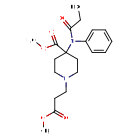
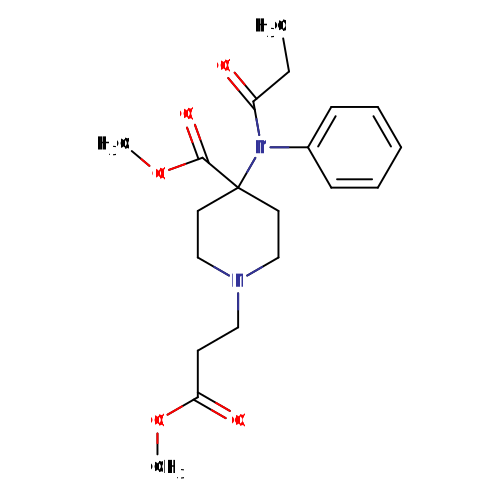
Structure for Remifentanil (DB00899)
- Weight
- Average: 376.4467
Monoisotopic: 376.199822016 - Chemical Formula
- C20H28N2O5
- Synonyms
- Remifentanil
- Remifentanilo
- Remifentanyl
- External IDs
- GI 87084X
- IDS-NR-005

Pharmacology
- Indication
For use during the induction and maintenance of general anesthesia.
 Reduce drug development failure ratesBuild, train, & validate machine-learning modelswith evidence-based and structured datasets.Build, train, & validate predictive machine-learning models with structured datasets.
- Associated Therapies
- Contraindications & Blackbox Warnings
 Prevent Adverse Drug Events TodayTap into our Clinical API for life-saving information on contraindications & blackbox warnings, population restrictions, harmful risks, & more.Avoid life-threatening adverse drug events with our Clinical API
- Pharmacodynamics
Remifentanil is an opioid agonist with rapid onset and peak effect and ultra-short duration of action. The opioid activity of remifentanil is antagonized by opioid antagonists such as naloxone. The analgesic effects of remifentanil are rapid in onset and offset. Its effects and side effects are dose dependent and similar to other opioids. Remifentanil in humans has a rapid blood-brain equilibration half-time of 1 ± 1 minutes (mean ± SD) and a rapid onset of action.
- Mechanism of action
Remifentanil is a µ-opioid agonist with rapid onset and peak effect, and short duration of action. The µ-opioid activity of remifentanil is antagonized by opioid antagonists such as naloxone.
Target Actions Organism AMu-type opioid receptor agonistHumans UDelta-type opioid receptor agonistHumans UKappa-type opioid receptor agonistHumans - Absorption
Not Available
- Volume of distribution
- 350 mL/kg
- 452 ± 144 mL/kg [neonates]
- 223 ± 30.6 mL/kg [adolescents]
- Protein binding
70% (bound to plasma proteins)
- Metabolism
By hydrolysis of the propanoic acid-methyl ester linkage by nonspecific blood and tissue esterases.
- Route of elimination
Remifentanil is an esterase-metabolized opioid. The carboxylic acid metabolite is essentially inactive (1/4600 as potent as remifentanil in dogs) and is excreted by the kidneys with an elimination half-life of approximately 90 minutes.
- Half-life
1-20 minutes
- Clearance
- 40 mL/min/kg [young, healthy adults]
- Adverse Effects
 Improve decision support & research outcomesWith structured adverse effects data, including: blackbox warnings, adverse reactions, warning & precautions, & incidence rates. View sample adverse effects data in our new Data Library!Improve decision support & research outcomes with our structured adverse effects data.
- Toxicity
Not Available
- Pathways
Pathway Category Remifentanil Action Pathway Drug action - Pharmacogenomic Effects/ADRs
- Not Available
Interactions
- Drug Interactions
- This information should not be interpreted without the help of a healthcare provider. If you believe you are experiencing an interaction, contact a healthcare provider immediately. The absence of an interaction does not necessarily mean no interactions exist.
Drug Interaction Integrate drug-drug
interactions in your software1,2-Benzodiazepine The risk or severity of adverse effects can be increased when Remifentanil is combined with 1,2-Benzodiazepine. Abaloparatide The risk or severity of adverse effects can be increased when Remifentanil is combined with Abaloparatide. Acebutolol Remifentanil may decrease the antihypertensive activities of Acebutolol. Aceclofenac The risk or severity of hypertension can be increased when Remifentanil is combined with Aceclofenac. Acemetacin The risk or severity of hypertension can be increased when Remifentanil is combined with Acemetacin. - Food Interactions
- Avoid alcohol. Ingesting alcohol may increase the sedative and CNS depressant effects of remifentanil.
Products
 Drug product information from 10+ global regionsOur datasets provide approved product information including:dosage, form, labeller, route of administration, and marketing period.Access drug product information from over 10 global regions.
- Product Ingredients
Ingredient UNII CAS InChI Key Remifentanil hydrochloride 5V444H5WIC 132539-07-2 WFBMIPUMYUHANP-UHFFFAOYSA-N - Brand Name Prescription Products
Name Dosage Strength Route Labeller Marketing Start Marketing End Region Image Remifentanil for Injection Powder, for solution 2 mg / vial Intravenous TEVA Canada Limited 2014-06-05 2021-07-30 Canada 
Remifentanil for Injection Powder, for solution 1 mg / vial Intravenous Sandoz Canada Incorporated Not applicable Not applicable Canada Remifentanil for Injection Powder, for solution 1 mg / vial Intravenous TEVA Canada Limited 2014-06-05 2021-07-30 Canada Remifentanil for Injection Powder, for solution 2 mg / vial Intravenous Sandoz Canada Incorporated Not applicable Not applicable Canada Remifentanil Hydrochloride for Injection Powder, for solution 2 mg / vial Intravenous Sterimax Inc 2011-09-29 Not applicable Canada - Generic Prescription Products
Name Dosage Strength Route Labeller Marketing Start Marketing End Region Image Remifentanil Hydrochloride Injection, powder, lyophilized, for solution 1 mg/1mL Intravenous Fresenius Kabi USA, LLC 2018-01-19 Not applicable US 
Remifentanil Hydrochloride Injection, powder, lyophilized, for solution 5 mg/5mL Intravenous Hikma Pharmaceuticals USA Inc. 2021-05-15 Not applicable US Remifentanil Hydrochloride Injection, powder, lyophilized, for solution 5 mg/5mL Intravenous Navinta Llc 2021-01-01 Not applicable US Remifentanil Hydrochloride Injection, powder, lyophilized, for solution 1 mg/1mL Intravenous Fresenius Kabi USA, LLC 2018-01-19 Not applicable US Remifentanil Hydrochloride Injection, powder, lyophilized, for solution 2 mg/2mL Intravenous Hikma Pharmaceuticals USA Inc. 2021-05-15 Not applicable US
Categories
- ATC Codes
- N01AH06 — Remifentanil
- Drug Categories
- Acids, Acyclic
- Agents producing tachycardia
- Agents that produce hypertension
- Analgesics
- Anesthetics
- Anesthetics, General
- Anesthetics, Intravenous
- Bradycardia-Causing Agents
- Central Nervous System Agents
- Central Nervous System Depressants
- Fentanyl and fentanyl analogues
- High-risk opioids
- Hypnotics and Sedatives
- Hypotensive Agents
- Narcotics
- Nervous System
- Opiate Agonists
- Opioid Agonist
- Opioid Anesthetics
- Opioids
- Opioids, Anilidopiperidine
- Peripheral Nervous System Agents
- Phenylpiperidine opioids
- Piperidines
- Propionates
- Sensory System Agents
- Serotonergic Drugs Shown to Increase Risk of Serotonin Syndrome
- Chemical TaxonomyProvided by Classyfire
- Description
- This compound belongs to the class of organic compounds known as alpha amino acids and derivatives. These are amino acids in which the amino group is attached to the carbon atom immediately adjacent to the carboxylate group (alpha carbon), or a derivative thereof.
- Kingdom
- Organic compounds
- Super Class
- Organic acids and derivatives
- Class
- Carboxylic acids and derivatives
- Sub Class
- Amino acids, peptides, and analogues
- Direct Parent
- Alpha amino acids and derivatives
- Alternative Parents
- Piperidinecarboxylic acids / Anilides / Dicarboxylic acids and derivatives / Tertiary carboxylic acid amides / Methyl esters / Trialkylamines / Azacyclic compounds / Organopnictogen compounds / Organic oxides / Hydrocarbon derivatives show 1 more
- Substituents
- Alpha-amino acid or derivatives / Amine / Anilide / Aromatic heteromonocyclic compound / Azacycle / Benzenoid / Carbonyl group / Carboxamide group / Carboxylic acid ester / Dicarboxylic acid or derivatives show 15 more
- Molecular Framework
- Aromatic heteromonocyclic compounds
- External Descriptors
- monocarboxylic acid amide, alpha-amino acid ester, anilide, piperidinecarboxylate ester (CHEBI:8802)
- Affected organisms
- Humans and other mammals
Chemical Identifiers
- UNII
- P10582JYYK
- CAS number
- 132875-61-7
- InChI Key
- ZTVQQQVZCWLTDF-UHFFFAOYSA-N
- InChI
- InChI=1S/C20H28N2O5/c1-4-17(23)22(16-8-6-5-7-9-16)20(19(25)27-3)11-14-21(15-12-20)13-10-18(24)26-2/h5-9H,4,10-15H2,1-3H3
- IUPAC Name
- methyl 1-(3-methoxy-3-oxopropyl)-4-(N-phenylpropanamido)piperidine-4-carboxylate
- SMILES
- CCC(=O)N(C1=CC=CC=C1)C1(CCN(CCC(=O)OC)CC1)C(=O)OC
References
- Synthesis Reference
Jacob Mathew, J. Killgore, "New methods for the synthesis of alfentanil, sufentanil, and remifentanil." U.S. Patent US20060149071, issued July 06, 2006.
US20060149071- General References
- FDA Approved Drug Products: ULTIVA® (remifentanil hydrochloride), for injection, for intravenous use, CII [Link]
- External Links
- Human Metabolome Database
- HMDB0015036
- KEGG Drug
- D08473
- KEGG Compound
- C08021
- PubChem Compound
- 60815
- PubChem Substance
- 46504538
- ChemSpider
- 54803
- BindingDB
- 50012491
- 73032
- ChEBI
- 8802
- ChEMBL
- CHEMBL1005
- ZINC
- ZINC000000538283
- Therapeutic Targets Database
- DAP000264
- PharmGKB
- PA451232
- RxList
- RxList Drug Page
- Drugs.com
- Drugs.com Drug Page
- Wikipedia
- Remifentanil
- FDA label
- Download (380 KB)
Clinical Trials
- Clinical Trials
Phase Status Purpose Conditions Count 4 Completed Not Available Anesthesia therapy 1 4 Completed Not Available Intubation, Endotracheal 1 4 Completed Not Available Patients Requiring Ambulatory Surgery Under General Anesthesia 1 4 Completed Basic Science Anesthesia therapy 1 4 Completed Basic Science Anesthetics, Intravenous / General Anesthesia / Hemodynamics Instability 1
Pharmacoeconomics
- Manufacturers
- Bioniche teoranta
- Packagers
- Abbott Laboratories Ltd.
- Bioniche Pharma
- Hospira Inc.
- Dosage Forms
Form Route Strength Injection, solution Intravenous 2 mg Injection, solution Intravenous 5 mg Injection, powder, for solution Intravenous 2 mg Injection, powder, for solution 2 mg Injection, powder, for solution 5 mg Powder Powder, for solution Intravenous 1 mg / vial Powder, for solution Intravenous 2 mg / vial Powder, for solution Intravenous 5 mg / vial Injection, solution, concentrate 1 mg Injection, solution, concentrate 2 mg Injection, solution, concentrate 5 mg Powder 1 MG Powder 2 MG Powder 5 MG Injection, powder, lyophilized, for solution Intravenous 2 mg Injection, powder, for solution Injection Parenteral 2 mg Solution Intravenous 2.190 mg Injection, powder, for solution Intravenous; Parenteral 1 mg Injection, powder, for solution Intravenous; Parenteral 2 mg Injection, powder, for solution Intravenous; Parenteral 5 mg Injection, powder, lyophilized, for solution Intravenous 1 mg/1mL Injection, powder, lyophilized, for solution Intravenous 2 mg/2mL Injection, powder, lyophilized, for solution Intravenous 5 mg/5mL Powder, for solution Intravenous 1 mg Powder, for solution Intravenous 2 mg Powder, for solution Intravenous 5 mg Solution Intravenous 5.500 mg Injection Parenteral 1 mg Injection, solution Intravenous Injection, powder, for solution Intravenous 1 mg Injection, powder, lyophilized, for solution Intravenous 1 mg Injection Parenteral 5 mg Injection, powder, lyophilized, for solution Intravenous 5 mg - Prices
Unit description Cost Unit Ultiva 5 mg vial 118.15USD vial Ultiva 2 mg vial 57.2USD vial Ultiva 1 mg vial 30.19USD vial DrugBank does not sell nor buy drugs. Pricing information is supplied for informational purposes only.- Patents
Patent Number Pediatric Extension Approved Expires (estimated) Region US5019583 No 1991-05-28 2010-07-12 US US5866591 Yes 1999-02-02 2018-03-10 US
Properties
- State
- Solid
- Experimental Properties
Property Value Source logP 1.4 Not Available - Predicted Properties
Property Value Source Water Solubility 0.591 mg/mL ALOGPS logP 1.75 ALOGPS logP 1.52 Chemaxon logS -2.8 ALOGPS pKa (Strongest Basic) 7.51 Chemaxon Physiological Charge 1 Chemaxon Hydrogen Acceptor Count 4 Chemaxon Hydrogen Donor Count 0 Chemaxon Polar Surface Area 76.15 Å2 Chemaxon Rotatable Bond Count 9 Chemaxon Refractivity 100.56 m3·mol-1 Chemaxon Polarizability 40.35 Å3 Chemaxon Number of Rings 2 Chemaxon Bioavailability 1 Chemaxon Rule of Five Yes Chemaxon Ghose Filter Yes Chemaxon Veber's Rule No Chemaxon MDDR-like Rule No Chemaxon - Predicted ADMET Features
Property Value Probability Human Intestinal Absorption + 0.6136 Blood Brain Barrier + 0.9381 Caco-2 permeable - 0.5271 P-glycoprotein substrate Substrate 0.7345 P-glycoprotein inhibitor I Inhibitor 0.8682 P-glycoprotein inhibitor II Non-inhibitor 0.6428 Renal organic cation transporter Non-inhibitor 0.7077 CYP450 2C9 substrate Non-substrate 0.8041 CYP450 2D6 substrate Non-substrate 0.8786 CYP450 3A4 substrate Substrate 0.6963 CYP450 1A2 substrate Non-inhibitor 0.9355 CYP450 2C9 inhibitor Non-inhibitor 0.8788 CYP450 2D6 inhibitor Non-inhibitor 0.8838 CYP450 2C19 inhibitor Non-inhibitor 0.8201 CYP450 3A4 inhibitor Non-inhibitor 0.7827 CYP450 inhibitory promiscuity Low CYP Inhibitory Promiscuity 0.7945 Ames test Non AMES toxic 0.7388 Carcinogenicity Non-carcinogens 0.8554 Biodegradation Not ready biodegradable 0.9428 Rat acute toxicity 2.6994 LD50, mol/kg Not applicable hERG inhibition (predictor I) Weak inhibitor 0.9589 hERG inhibition (predictor II) Inhibitor 0.6126
Spectra
- Mass Spec (NIST)
- Not Available
- Spectra
- Chromatographic Properties
Collision Cross Sections (CCS)
Adduct CCS Value (Å2) Source type Source [M-H]- 200.49447 predictedDarkChem Lite v0.1.0 [M-H]- 200.74317 predictedDarkChem Lite v0.1.0 [M-H]- 190.08281 predictedDeepCCS 1.0 (2019) [M+H]+ 201.05347 predictedDarkChem Lite v0.1.0 [M+H]+ 200.71937 predictedDarkChem Lite v0.1.0 [M+H]+ 192.44081 predictedDeepCCS 1.0 (2019) [M+Na]+ 201.55557 predictedDarkChem Lite v0.1.0 [M+Na]+ 200.98867 predictedDarkChem Lite v0.1.0 [M+Na]+ 199.47182 predictedDeepCCS 1.0 (2019)
Targets

- Kind
- Protein
- Organism
- Humans
- Pharmacological action
- Yes
- Actions
- Agonist
- General Function
- Voltage-gated calcium channel activity
- Specific Function
- Receptor for endogenous opioids such as beta-endorphin and endomorphin. Receptor for natural and synthetic opioids including morphine, heroin, DAMGO, fentanyl, etorphine, buprenorphin and methadone...
- Gene Name
- OPRM1
- Uniprot ID
- P35372
- Uniprot Name
- Mu-type opioid receptor
- Molecular Weight
- 44778.855 Da
References
- Scott LJ, Perry CM: Remifentanil: a review of its use during the induction and maintenance of general anaesthesia. Drugs. 2005;65(13):1793-823. [Article]
- Scott LJ, Perry CM: Spotlight on remifentanil for general anaesthesia. CNS Drugs. 2005;19(12):1069-74. [Article]
- Warner DS, Hindman BJ, Todd MM, Sawin PD, Kirchner J, Roland CL, Jamerson BD: Intracranial pressure and hemodynamic effects of remifentanil versus alfentanil in patients undergoing supratentorial craniotomy. Anesth Analg. 1996 Aug;83(2):348-53. [Article]
- Guy J, Hindman BJ, Baker KZ, Borel CO, Maktabi M, Ostapkovich N, Kirchner J, Todd MM, Fogarty-Mack P, Yancy V, Sokoll MD, McAllister A, Roland C, Young WL, Warner DS: Comparison of remifentanil and fentanyl in patients undergoing craniotomy for supratentorial space-occupying lesions. Anesthesiology. 1997 Mar;86(3):514-24. [Article]
- Chen X, Ji ZL, Chen YZ: TTD: Therapeutic Target Database. Nucleic Acids Res. 2002 Jan 1;30(1):412-5. [Article]
- Hoke JF, Cunningham F, James MK, Muir KT, Hoffman WE: Comparative pharmacokinetics and pharmacodynamics of remifentanil, its principle metabolite (GR90291) and alfentanil in dogs. J Pharmacol Exp Ther. 1997 Apr;281(1):226-32. [Article]
- Patel SS, Spencer CM: Remifentanil. Drugs. 1996 Sep;52(3):417-27; discussion 428. [Article]
- Kind
- Protein
- Organism
- Humans
- Pharmacological action
- Unknown
- Actions
- Agonist
- General Function
- Opioid receptor activity
- Specific Function
- G-protein coupled receptor that functions as receptor for endogenous enkephalins and for a subset of other opioids. Ligand binding causes a conformation change that triggers signaling via guanine n...
- Gene Name
- OPRD1
- Uniprot ID
- P41143
- Uniprot Name
- Delta-type opioid receptor
- Molecular Weight
- 40368.235 Da
References
- Stucke AG, Zuperku EJ, Sanchez A, Tonkovic-Capin M, Tonkovic-Capin V, Mustapic S, Stuth EA: Opioid receptors on bulbospinal respiratory neurons are not activated during neuronal depression by clinically relevant opioid concentrations. J Neurophysiol. 2008 Nov;100(5):2878-88. doi: 10.1152/jn.90620.2008. Epub 2008 Sep 24. [Article]
- Rodrigues AR, Castro MS, Francischi JN, Perez AC, Duarte ID: Participation of ATP-sensitive K+ channels in the peripheral antinociceptive effect of fentanyl in rats. Braz J Med Biol Res. 2005 Jan;38(1):91-7. Epub 2005 Jan 18. [Article]
- Poonawala T, Levay-Young BK, Hebbel RP, Gupta K: Opioids heal ischemic wounds in the rat. Wound Repair Regen. 2005 Mar-Apr;13(2):165-74. [Article]
- Sahin AS, Duman A, Atalik EK, Ogun CO, Sahin TK, Erol A, Ozergin U: The mechanisms of the direct vascular effects of fentanyl on isolated human saphenous veins in vitro. J Cardiothorac Vasc Anesth. 2005 Apr;19(2):197-200. [Article]
- Darwish M, Tempero K, Kirby M, Thompson J: Pharmacokinetics and dose proportionality of fentanyl effervescent buccal tablets in healthy volunteers. Clin Pharmacokinet. 2005;44(12):1279-86. [Article]
- Darwish M, Kirby M, Robertson P Jr, Tracewell W, Jiang JG: Pharmacokinetic properties of fentanyl effervescent buccal tablets: a phase I, open-label, crossover study of single-dose 100, 200, 400, and 800 microg in healthy adult volunteers. Clin Ther. 2006 May;28(5):707-14. [Article]
- Kind
- Protein
- Organism
- Humans
- Pharmacological action
- Unknown
- Actions
- Agonist
- General Function
- Opioid receptor activity
- Specific Function
- G-protein coupled opioid receptor that functions as receptor for endogenous alpha-neoendorphins and dynorphins, but has low affinity for beta-endorphins. Also functions as receptor for various synt...
- Gene Name
- OPRK1
- Uniprot ID
- P41145
- Uniprot Name
- Kappa-type opioid receptor
- Molecular Weight
- 42644.665 Da
References
- Wong GT, Li R, Jiang LL, Irwin MG: Remifentanil post-conditioning attenuates cardiac ischemia-reperfusion injury via kappa or delta opioid receptor activation. Acta Anaesthesiol Scand. 2010 Apr;54(4):510-8. doi: 10.1111/j.1399-6576.2009.02145.x. Epub 2009 Oct 29. [Article]
- Pascoe JE, Williams KL, Mukhopadhyay P, Rice KC, Woods JH, Ko MC: Effects of mu, kappa, and delta opioid receptor agonists on the function of hypothalamic-pituitary-adrenal axis in monkeys. Psychoneuroendocrinology. 2008 May;33(4):478-86. doi: 10.1016/j.psyneuen.2008.01.006. Epub 2008 Mar 5. [Article]

Drug created at June 13, 2005 13:24 / Updated at April 27, 2024 09:44