Identification
- Summary
Tiagabine is an antiepileptic used to treat partial seizures.
- Brand Names
- Gabitril
- Generic Name
- Tiagabine
- DrugBank Accession Number
- DB00906
- Background
Tiagabine is an anti-convulsive medication. It is also used in the treatment for panic disorder as are a few other anticonvulsants. Though the exact mechanism by which tiagabine exerts its effect on the human body is unknown, it does appear to operate as a selective GABA reuptake inhibitor.
- Type
- Small Molecule
- Groups
- Approved, Investigational
- Structure
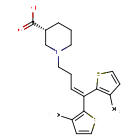
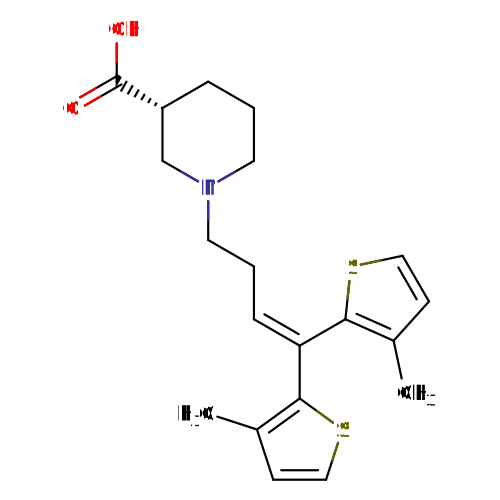
Structure for Tiagabine (DB00906)
- Weight
- Average: 375.548
Monoisotopic: 375.132670429 - Chemical Formula
- C20H25NO2S2
- Synonyms
- Tiagabina
- Tiagabine
- Tiagabinum

Pharmacology
- Indication
For the treatment of partial seizures
 Reduce drug development failure ratesBuild, train, & validate machine-learning modelswith evidence-based and structured datasets.Build, train, & validate predictive machine-learning models with structured datasets.
- Associated Conditions
Indication Type Indication Combined Product Details Approval Level Age Group Patient Characteristics Dose Form Adjunct therapy in treatment of Partial seizures •••••••••••• - Contraindications & Blackbox Warnings
 Prevent Adverse Drug Events TodayTap into our Clinical API for life-saving information on contraindications & blackbox warnings, population restrictions, harmful risks, & more.Avoid life-threatening adverse drug events with our Clinical API
- Pharmacodynamics
Tiagabine is used primarily as an anticonvulsant for the adjunctive treatment of epilepsy. The precise mechanism by which Tiagabine exerts its antiseizure effect is unknown, although it is believed to be related to its ability to enhance the activity of gamma aminobutyric acid (GABA), the major inhibitory neurotransmitter in the central nervous system. Tiagabine binds to recognition sites associated with the GABA uptake carrier. It is thought that, by this action, Tiagabine blocks GABA uptake into presynaptic neurons, permitting more GABA to be available for receptor binding on the surfaces of post-synaptic cells.
- Mechanism of action
Though the exact mechanism by which Tiagabine exerts its effect on the human body is unknown, it does appear to operate as a selective GABA reuptake inhibitor.
Target Actions Organism ASodium- and chloride-dependent GABA transporter 1 inhibitorHumans - Absorption
Tiagabine is nearly completely absorbed (>95%).
- Volume of distribution
Not Available
- Protein binding
96%
- Metabolism
Tiagabine is likely metabolized primarily by the 3A isoform subfamily of hepatic cytochrome P450.
- Route of elimination
Approximately 2% of an oral dose of tiagabine is excreted unchanged, with 25% and 63% of the remaining dose excreted into the urine and feces, respectively, primarily as metabolites.
- Half-life
7-9 hours
- Clearance
- 109 mL/min [Healthy subjects]
- Adverse Effects
 Improve decision support & research outcomesWith structured adverse effects data, including: blackbox warnings, adverse reactions, warning & precautions, & incidence rates. View sample adverse effects data in our new Data Library!Improve decision support & research outcomes with our structured adverse effects data.
- Toxicity
mptoms most often accompanying tiagabine overdose, alone or in combination with other drugs, have included: seizures including status epilepticus in patients with and without underlying seizure disorders, nonconvulsive status epilepticus, coma, ataxia, confusion, somnolence, drowsiness, impaired speech, agitation, lethargy, myoclonus, spike wave stupor, tremors, disorientation, vomiting, hostility, and temporary paralysis. Respiratory depression was seen in a number of patients, including children, in the context of seizures.
- Pathways
- Not Available
- Pharmacogenomic Effects/ADRs
- Not Available
Interactions
- Drug Interactions
- This information should not be interpreted without the help of a healthcare provider. If you believe you are experiencing an interaction, contact a healthcare provider immediately. The absence of an interaction does not necessarily mean no interactions exist.
Drug Interaction Integrate drug-drug
interactions in your software1,2-Benzodiazepine The risk or severity of CNS depression can be increased when Tiagabine is combined with 1,2-Benzodiazepine. Abametapir The serum concentration of Tiagabine can be increased when it is combined with Abametapir. Acetazolamide The risk or severity of CNS depression can be increased when Acetazolamide is combined with Tiagabine. Acetophenazine The risk or severity of CNS depression can be increased when Tiagabine is combined with Acetophenazine. Adenine The metabolism of Tiagabine can be decreased when combined with Adenine. - Food Interactions
- Avoid alcohol. Ingesting alcohol may increase drowsiness and dizziness.
- Take with food.
Products
 Drug product information from 10+ global regionsOur datasets provide approved product information including:dosage, form, labeller, route of administration, and marketing period.Access drug product information from over 10 global regions.
- Product Ingredients
Ingredient UNII CAS InChI Key Tiagabine hydrochloride DQH6T6D8OY 145821-59-6 YUKARLAABCGMCN-PKLMIRHRSA-N - Product Images
- Brand Name Prescription Products
Name Dosage Strength Route Labeller Marketing Start Marketing End Region Image Gabitril Tablet, film coated 16 mg/1 Oral Cephalon, LLC 2001-04-01 2024-03-31 US 

Gabitril Tablet, film coated 2 mg/1 Oral Cephalon, LLC 2001-04-01 2024-04-30 US 
Gabitril Tablet 2 mg/1 Oral Physicians Total Care, Inc. 2004-08-31 2011-06-30 US Gabitril Tablet, film coated 12 mg/1 Oral Cephalon, LLC 2001-04-01 2024-04-30 US Gabitril Tablet 4 mg/1 Oral Lake Erie Medical &Surgical Supply Dba Quality Care Products Llc 2011-11-15 2014-12-31 US - Generic Prescription Products
Name Dosage Strength Route Labeller Marketing Start Marketing End Region Image Tiagabine Hydrochloride Tablet, film coated 4 mg/1 Oral Avera McKennan Hospital 2015-03-10 2017-05-24 US Tiagabine Hydrochloride Tablet 4 mg/1 Oral Wilshire Pharmaceuticals, Inc. 2018-06-01 Not applicable US Tiagabine Hydrochloride Tablet, film coated 12 mg/1 Oral Teva Pharmaceuticals USA, Inc. 2018-03-09 Not applicable US Tiagabine Hydrochloride Tablet 16 mg/1 Oral Amneal Pharmaceuticals NY LLC 2017-12-08 Not applicable US Tiagabine Hydrochloride Tablet 2 mg/1 Oral NorthStar Rx LLC 2021-11-24 Not applicable US


Categories
- ATC Codes
- N03AG06 — Tiagabine
- Drug Categories
- Anti-epileptic Agent
- Anticonvulsants
- Central Nervous System Agents
- Central Nervous System Depressants
- Cytochrome P-450 CYP3A Substrates
- Cytochrome P-450 CYP3A4 Substrates
- Cytochrome P-450 Substrates
- Decreased Central Nervous System Disorganized Electrical Activity
- Fatty Acid Derivatives
- GABA Agents
- GABA Uptake Inhibitors
- Membrane Transport Modulators
- Nervous System
- Neurotransmitter Agents
- Neurotransmitter Uptake Inhibitors
- Nipecotic Acid and Derivatives
- Piperidines
- UGT1A1 Substrates
- Chemical TaxonomyProvided by Classyfire
- Description
- This compound belongs to the class of organic compounds known as piperidinecarboxylic acids. These are compounds containing a piperidine ring which bears a carboxylic acid group.
- Kingdom
- Organic compounds
- Super Class
- Organoheterocyclic compounds
- Class
- Piperidines
- Sub Class
- Piperidinecarboxylic acids and derivatives
- Direct Parent
- Piperidinecarboxylic acids
- Alternative Parents
- Thiophenes / Heteroaromatic compounds / Trialkylamines / Amino acids / Monocarboxylic acids and derivatives / Carboxylic acids / Azacyclic compounds / Organopnictogen compounds / Organic oxides / Hydrocarbon derivatives show 1 more
- Substituents
- Amine / Amino acid / Amino acid or derivatives / Aromatic heteromonocyclic compound / Azacycle / Carbonyl group / Carboxylic acid / Carboxylic acid derivative / Heteroaromatic compound / Hydrocarbon derivative show 11 more
- Molecular Framework
- Aromatic heteromonocyclic compounds
- External Descriptors
- tertiary amino compound, thiophenes, piperidinemonocarboxylic acid, beta-amino acid (CHEBI:9586)
- Affected organisms
- Humans and other mammals
Chemical Identifiers
- UNII
- Z80I64HMNP
- CAS number
- 115103-54-3
- InChI Key
- PBJUNZJWGZTSKL-MRXNPFEDSA-N
- InChI
- InChI=1S/C20H25NO2S2/c1-14-7-11-24-18(14)17(19-15(2)8-12-25-19)6-4-10-21-9-3-5-16(13-21)20(22)23/h6-8,11-12,16H,3-5,9-10,13H2,1-2H3,(H,22,23)/t16-/m1/s1
- IUPAC Name
- (3R)-1-[4,4-bis(3-methylthiophen-2-yl)but-3-en-1-yl]piperidine-3-carboxylic acid
- SMILES
- CC1=C(SC=C1)C(=CCCN1CCC[C@H](C1)C(O)=O)C1=C(C)C=CS1
References
- Synthesis Reference
Henning Petersen, Peter Nielsen, Michael Cain, Subhash Patel, "Crystalline Tiagabine monohydrate, its preparation and use." U.S. Patent US5354760, issued April, 1991.
US5354760- General References
- Not Available
- External Links
- Human Metabolome Database
- HMDB0015042
- KEGG Compound
- C07503
- PubChem Compound
- 60648
- PubChem Substance
- 46505560
- ChemSpider
- 54661
- BindingDB
- 50039251
- 31914
- ChEBI
- 9586
- ChEMBL
- CHEMBL1027
- ZINC
- ZINC000003831531
- Therapeutic Targets Database
- DAP000164
- PharmGKB
- PA451682
- PDBe Ligand
- TGI
- RxList
- RxList Drug Page
- Drugs.com
- Drugs.com Drug Page
- Wikipedia
- Tiagabine
- PDB Entries
- 7sk2 / 7y7z
- FDA label
- Download (251 KB)
Clinical Trials
- Clinical Trials
Phase Status Purpose Conditions Count 4 Completed Treatment Partial Epilepsy 1 4 Completed Treatment Social Anxiety Disorder (SAD) 1 3 Active Not Recruiting Treatment Schizophrenia 1 3 Completed Not Available Anxiety Disorders 1 3 Completed Treatment Anxiety Disorders 1
Pharmacoeconomics
- Manufacturers
- Cephalon inc
- Packagers
- Abbott Laboratories Ltd.
- Cephalon Inc.
- Diversified Healthcare Services Inc.
- Heartland Repack Services LLC
- Innoviant Pharmacy Inc.
- Nucare Pharmaceuticals Inc.
- Physician Partners Ltd.
- Physicians Total Care Inc.
- Rebel Distributors Corp.
- Siegfried Ltd.
- Southwood Pharmaceuticals
- Stat Rx Usa
- Dosage Forms
Form Route Strength Tablet Oral 12 mg/1 Tablet Oral 2 mg/1 Tablet Oral 4 mg/1 Tablet, film coated Oral 10 MG Tablet, film coated Oral 12 mg/1 Tablet, film coated Oral 15 MG Tablet, film coated Oral 16 mg/1 Tablet, film coated Oral 4 mg/1 Tablet, film coated Oral 5 MG Tablet Oral 16 mg/1 Tablet, film coated Oral 2 mg/1 - Prices
Unit description Cost Unit Gabitril 16 mg tablet 12.53USD tablet Gabitril 12 mg tablet 6.4USD tablet Gabitril 2 mg tablet 4.89USD tablet Gabitril 4 mg tablet 3.9USD tablet DrugBank does not sell nor buy drugs. Pricing information is supplied for informational purposes only.- Patents
Patent Number Pediatric Extension Approved Expires (estimated) Region US5010090 No 1991-04-23 2011-09-30 US US5958951 No 1999-09-28 2017-06-10 US US5866590 No 1999-02-02 2016-04-29 US
Properties
- State
- Solid
- Experimental Properties
Property Value Source logP 2.6 Not Available - Predicted Properties
Property Value Source Water Solubility 0.0211 mg/mL ALOGPS logP 4.98 ALOGPS logP 2.6 Chemaxon logS -4.2 ALOGPS pKa (Strongest Acidic) 4.14 Chemaxon pKa (Strongest Basic) 9.26 Chemaxon Physiological Charge 0 Chemaxon Hydrogen Acceptor Count 3 Chemaxon Hydrogen Donor Count 1 Chemaxon Polar Surface Area 40.54 Å2 Chemaxon Rotatable Bond Count 6 Chemaxon Refractivity 115.32 m3·mol-1 Chemaxon Polarizability 41.7 Å3 Chemaxon Number of Rings 3 Chemaxon Bioavailability 1 Chemaxon Rule of Five Yes Chemaxon Ghose Filter Yes Chemaxon Veber's Rule No Chemaxon MDDR-like Rule Yes Chemaxon - Predicted ADMET Features
Property Value Probability Human Intestinal Absorption + 0.9603 Blood Brain Barrier + 0.9382 Caco-2 permeable - 0.5368 P-glycoprotein substrate Substrate 0.6504 P-glycoprotein inhibitor I Non-inhibitor 0.6879 P-glycoprotein inhibitor II Non-inhibitor 0.9609 Renal organic cation transporter Inhibitor 0.5083 CYP450 2C9 substrate Non-substrate 0.7898 CYP450 2D6 substrate Substrate 0.8918 CYP450 3A4 substrate Non-substrate 0.5299 CYP450 1A2 substrate Inhibitor 0.5784 CYP450 2C9 inhibitor Non-inhibitor 0.6727 CYP450 2D6 inhibitor Non-inhibitor 0.812 CYP450 2C19 inhibitor Non-inhibitor 0.5865 CYP450 3A4 inhibitor Non-inhibitor 0.9568 CYP450 inhibitory promiscuity Low CYP Inhibitory Promiscuity 0.7011 Ames test Non AMES toxic 0.7455 Carcinogenicity Non-carcinogens 0.9505 Biodegradation Ready biodegradable 0.5139 Rat acute toxicity 2.5164 LD50, mol/kg Not applicable hERG inhibition (predictor I) Weak inhibitor 0.5333 hERG inhibition (predictor II) Non-inhibitor 0.8672
Spectra
- Mass Spec (NIST)
- Not Available
- Spectra
- Chromatographic Properties
Collision Cross Sections (CCS)
Adduct CCS Value (Å2) Source type Source [M-H]- 199.0135234 predictedDarkChem Lite v0.1.0 [M-H]- 181.14622 predictedDeepCCS 1.0 (2019) [M+H]+ 199.0430234 predictedDarkChem Lite v0.1.0 [M+H]+ 183.50423 predictedDeepCCS 1.0 (2019) [M+Na]+ 199.0041234 predictedDarkChem Lite v0.1.0 [M+Na]+ 190.60649 predictedDeepCCS 1.0 (2019)
Targets

- Kind
- Protein
- Organism
- Humans
- Pharmacological action
- Yes
- Actions
- Inhibitor
- General Function
- Neurotransmitter:sodium symporter activity
- Specific Function
- Terminates the action of GABA by its high affinity sodium-dependent reuptake into presynaptic terminals.
- Gene Name
- SLC6A1
- Uniprot ID
- P30531
- Uniprot Name
- Sodium- and chloride-dependent GABA transporter 1
- Molecular Weight
- 67073.0 Da
References
- Chen X, Ji ZL, Chen YZ: TTD: Therapeutic Target Database. Nucleic Acids Res. 2002 Jan 1;30(1):412-5. [Article]
- Pollack MH, Roy-Byrne PP, Van Ameringen M, Snyder H, Brown C, Ondrasik J, Rickels K: The selective GABA reuptake inhibitor tiagabine for the treatment of generalized anxiety disorder: results of a placebo-controlled study. J Clin Psychiatry. 2005 Nov;66(11):1401-8. [Article]
- Sheehan DV, Sheehan KH, Raj BA, Janavs J: An open-label study of tiagabine in panic disorder. Psychopharmacol Bull. 2007;40(3):32-40. [Article]
- Foster AC, Kemp JA: Glutamate- and GABA-based CNS therapeutics. Curr Opin Pharmacol. 2006 Feb;6(1):7-17. Epub 2005 Dec 22. [Article]
- Sunol C, Babot Z, Cristofol R, Sonnewald U, Waagepetersen HS, Schousboe A: A possible role of the non-GAT1 GABA transporters in transfer of GABA from GABAergic to glutamatergic neurons in mouse cerebellar neuronal cultures. Neurochem Res. 2010 Sep;35(9):1384-90. doi: 10.1007/s11064-010-0196-1. Epub 2010 May 30. [Article]
- Henjum S, Hassel B: High-affinity GABA uptake and GABA-metabolizing enzymes in pig forebrain white matter: a quantitative study. Neurochem Int. 2007 Jan;50(2):365-70. Epub 2006 Oct 27. [Article]
Enzymes
- Kind
- Protein
- Organism
- Humans
- Pharmacological action
- No
- Actions
- Substrate
- General Function
- Steroid binding
- Specific Function
- UDPGT is of major importance in the conjugation and subsequent elimination of potentially toxic xenobiotics and endogenous compounds. This isoform glucuronidates bilirubin IX-alpha to form both the...
- Gene Name
- UGT1A1
- Uniprot ID
- P22309
- Uniprot Name
- UDP-glucuronosyltransferase 1-1
- Molecular Weight
- 59590.91 Da
References
- Interactions [Link]
- Kind
- Protein
- Organism
- Humans
- Pharmacological action
- Unknown
- Actions
- Substrate
- General Function
- Vitamin d3 25-hydroxylase activity
- Specific Function
- Cytochromes P450 are a group of heme-thiolate monooxygenases. In liver microsomes, this enzyme is involved in an NADPH-dependent electron transport pathway. It performs a variety of oxidation react...
- Gene Name
- CYP3A4
- Uniprot ID
- P08684
- Uniprot Name
- Cytochrome P450 3A4
- Molecular Weight
- 57342.67 Da
References
- Pita-Calandre E: [Clinical implications of pharmacology and pharmacokinetics of tiagabine]. Rev Neurol. 1999 Feb 1-15;28(3):337-9. [Article]
- Luer MS, Rhoney DH: Tiagabine: a novel antiepileptic drug. Ann Pharmacother. 1998 Nov;32(11):1173-80. doi: 10.1345/aph.18053. [Article]
- Tiagabine FDA label [Link]

Drug created at June 13, 2005 13:24 / Updated at February 02, 2024 22:52