Identification
- Summary
Diethylpropion is an appetite suppressant used for the short term treatment of exogenous obesity in addition to calorie restriction.
- Brand Names
- Tepanil
- Generic Name
- Diethylpropion
- DrugBank Accession Number
- DB00937
- Background
A appetite depressant considered to produce less central nervous system disturbance than most drugs in this therapeutic category. It is also considered to be among the safest for patients with hypertension. (From AMA Drug Evaluations Annual, 1994, p2290)
- Type
- Small Molecule
- Groups
- Approved, Illicit
- Structure
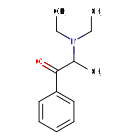
Structure for Diethylpropion (DB00937)
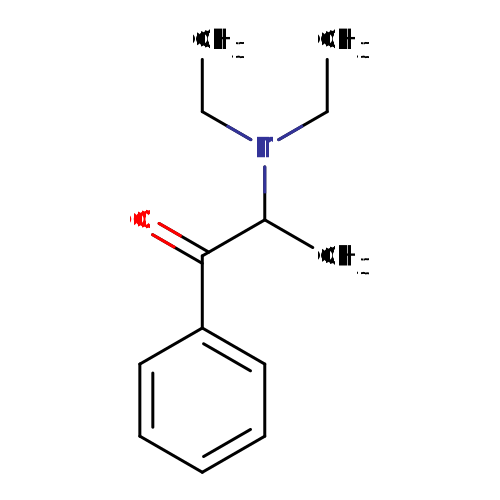
- Weight
- Average: 205.2961
Monoisotopic: 205.146664235 - Chemical Formula
- C13H19NO
- Synonyms
- (±)-diethylpropion
- 1-phenyl-2-diethylamino-1-propanone
- 2-(diethylamino)-1-phenyl-1-propanone
- 2-(diethylamino)propiophenone
- alpha-Benzoyltriethylamine
- alpha-Diethylaminopropiophenone
- Amfepramone
- Amfépramone
- Amfepramonum
- Anfepramona
- Diethylcathinone
- External IDs
- DEA No. 1610

Pharmacology
- Indication
Used in the management of exogenous obesity as a short-term adjunct (a few weeks) in a regimen of weight reduction based on caloric restriction.
 Reduce drug development failure ratesBuild, train, & validate machine-learning modelswith evidence-based and structured datasets.Build, train, & validate predictive machine-learning models with structured datasets.
- Associated Conditions
Indication Type Indication Combined Product Details Approval Level Age Group Patient Characteristics Dose Form Management of Exogenous obesity •••••••••••• - Contraindications & Blackbox Warnings
 Prevent Adverse Drug Events TodayTap into our Clinical API for life-saving information on contraindications & blackbox warnings, population restrictions, harmful risks, & more.Avoid life-threatening adverse drug events with our Clinical API
- Pharmacodynamics
Diethylpropion is a sympathomimetic stimulant drug marketed as an appetite suppressant. Chemically, it is the N,N-diethyl analog of cathinone. Its mechanism of action is similar to other appetite suppressants such as sibutramine, phentermine and dextroamphetamine.
- Mechanism of action
Diethylpropion is an amphetamine that stimulates neurons to release or maintain high levels of a particular group of neurotransmitters known as catecholamines; these include dopamine and norepinephrine. High levels of these catecholamines tend to suppress hunger signals and appetite. Diethylpropion (through catecholamine elevation) may also indirectly affect leptin levels in the brain. It is theorized that diethylpropion can raise levels of leptin which signal satiety. It is also theorized that increased levels of the catecholamines are partially responsible for halting another chemical messenger known as neuropeptide Y. This peptide initiates eating, decreases energy expenditure, and increases fat storage.
Target Actions Organism ASodium-dependent noradrenaline transporter inhibitorHumans ASodium-dependent dopamine transporter inhibitorHumans - Absorption
Diethylpropion is rapidly absorbed from the GI tract after oral administration.
- Volume of distribution
Not Available
- Protein binding
Not Available
- Metabolism
Extensively metabolized through a complex pathway of biotransformation involving N-dealkylation and reduction. Many of these metabolites are biologically active and may participate in the therapeutic action of diethylpropion.
- Route of elimination
Diethylpropion is rapidly absorbed from the GI tract after oral administration and is extensively metabolized through a complex pathway of biotransformation involving N-dealkylation and reduction. Diethylpropion and/or its active metabolites are believed to cross the blood-brain barrier and the placenta. Diethylpropion and its metabolites are excreted mainly by the kidney.
- Half-life
Using a phosphorescence assay that is specific for basic compounds containing benzoyl group, the plasma half-life of the aminoketone metabolites is estimated to be between 4 to 6 hours.
- Clearance
Not Available
- Adverse Effects
 Improve decision support & research outcomesWith structured adverse effects data, including: blackbox warnings, adverse reactions, warning & precautions, & incidence rates. View sample adverse effects data in our new Data Library!Improve decision support & research outcomes with our structured adverse effects data.
- Toxicity
The reported oral LD50 for mice is 600 mg/kg, for rats is 250 mg/kg and for dogs is 225 mg/kg. Manifestation of acute overdosage include restlessness, tremor, hyperreflexia, rapid respiration, confusion, assaultiveness, hallucinations, and panic states.
- Pathways
- Not Available
- Pharmacogenomic Effects/ADRs
- Not Available
Interactions
- Drug Interactions
- This information should not be interpreted without the help of a healthcare provider. If you believe you are experiencing an interaction, contact a healthcare provider immediately. The absence of an interaction does not necessarily mean no interactions exist.
Drug Interaction Integrate drug-drug
interactions in your software1,2-Benzodiazepine The risk or severity of CNS depression can be increased when Diethylpropion is combined with 1,2-Benzodiazepine. Acebutolol The therapeutic efficacy of Acebutolol can be decreased when used in combination with Diethylpropion. Aceclofenac The risk or severity of hypertension can be increased when Diethylpropion is combined with Aceclofenac. Acemetacin The risk or severity of hypertension can be increased when Diethylpropion is combined with Acemetacin. Acetazolamide Acetazolamide may decrease the excretion rate of Diethylpropion which could result in a higher serum level. - Food Interactions
- Take with or without food. The absorption is unaffected by food.
Products
 Drug product information from 10+ global regionsOur datasets provide approved product information including:dosage, form, labeller, route of administration, and marketing period.Access drug product information from over 10 global regions.
- Product Ingredients
Ingredient UNII CAS InChI Key Diethylpropion hydrochloride 19V2PL39NG 134-80-5 ICFXZZFWRWNZMA-UHFFFAOYSA-N - Product Images
- International/Other Brands
- Anorex / Dobesin / Frekentine / Linea / Moderatan / Neobes (Medix) / Nobesine / Prefamone / Regenon (Temmler) / Tylinal
- Brand Name Prescription Products
Name Dosage Strength Route Labeller Marketing Start Marketing End Region Image Diethylpropion HCl Controlled-Release Tablet 75 mg/1 Oral A S Medication Solutions 1960-11-17 Not applicable US 

Diethylpropion HCl Controlled-Release Tablet 75 mg/1 Oral Actavis Pharma, Inc. 1960-11-17 2019-06-30 US 
Diethylpropion HCl Controlled-Release Tablet 75 mg/1 Oral Rebel Distributors 2008-01-01 Not applicable US 
Diethylpropion HCl Controlled-Release Tablet 75 mg/1 Oral A-S Medication Solutions 1960-11-17 Not applicable US 
Diethylpropion HCl Controlled-Release Tablet 75 mg/1 Oral Preferred Pharmaceuticals, Inc. 2014-02-12 2019-08-26 US 
- Generic Prescription Products
Name Dosage Strength Route Labeller Marketing Start Marketing End Region Image Diethylpropion HCl Controlled-Release Tablet 75 mg/1 Oral Blenheim Pharmacal, Inc. 2010-03-30 Not applicable US Diethylpropion HCl Controlled-Release Tablet 75 mg/1 Oral Keltman Pharmaceuticals Inc. 2010-06-07 Not applicable US 
Diethylpropion HCl Immediate-Release Tablet 25 mg/1 Oral Keltman Pharmaceuticals Inc. 2010-06-07 Not applicable US 
Diethylpropion Hydrochloride Tablet 25 mg/1 Oral Martek Pharmacal Co. 2024-03-05 Not applicable US Diethylpropion Hydrochloride Tablet 25 mg/1 Oral Chartwell Rx, Llc. 2011-07-18 Not applicable US


Categories
- ATC Codes
- A08AA03 — Amfepramone
- Drug Categories
- Agents producing tachycardia
- Agents that produce hypertension
- Alimentary Tract and Metabolism
- Amines
- Amphetamines
- Anti-Obesity Agents
- Antiobesity Preparations, Excl. Diet Products
- Appetite Depressants
- Appetite Suppression
- Central Nervous System Depressants
- Centrally Acting Antiobesity Products
- Ethylamines
- Increased Sympathetic Activity
- Serotonergic Drugs Shown to Increase Risk of Serotonin Syndrome
- Stimulants
- Sympathomimetic Amine Anorectic
- Sympathomimetics
- Chemical TaxonomyProvided by Classyfire
- Description
- This compound belongs to the class of organic compounds known as alkyl-phenylketones. These are aromatic compounds containing a ketone substituted by one alkyl group, and a phenyl group.
- Kingdom
- Organic compounds
- Super Class
- Organic oxygen compounds
- Class
- Organooxygen compounds
- Sub Class
- Carbonyl compounds
- Direct Parent
- Alkyl-phenylketones
- Alternative Parents
- Phenylpropanes / Benzoyl derivatives / Aryl alkyl ketones / Alpha-amino ketones / Trialkylamines / Organopnictogen compounds / Organic oxides / Hydrocarbon derivatives
- Substituents
- Alkyl-phenylketone / Alpha-aminoketone / Amine / Aromatic homomonocyclic compound / Aryl alkyl ketone / Benzenoid / Benzoyl / Hydrocarbon derivative / Monocyclic benzene moiety / Organic nitrogen compound
- Molecular Framework
- Aromatic homomonocyclic compounds
- External Descriptors
- tertiary amine, aromatic ketone (CHEBI:4530)
- Affected organisms
- Humans and other mammals
Chemical Identifiers
- UNII
- Q94YYU22B8
- CAS number
- 90-84-6
- InChI Key
- XXEPPPIWZFICOJ-UHFFFAOYSA-N
- InChI
- InChI=1S/C13H19NO/c1-4-14(5-2)11(3)13(15)12-9-7-6-8-10-12/h6-11H,4-5H2,1-3H3
- IUPAC Name
- 2-(diethylamino)-1-phenylpropan-1-one
- SMILES
- CCN(CC)C(C)C(=O)C1=CC=CC=C1
References
- Synthesis Reference
Schutte, J.; U.S. Patent 3,001,910; September 26, 1961; assigned to Firma Ternmler-Werke (W. Germany).
US3001910- General References
- Adan RA, Vanderschuren LJ, la Fleur SE: Anti-obesity drugs and neural circuits of feeding. Trends Pharmacol Sci. 2008 Apr;29(4):208-17. doi: 10.1016/j.tips.2008.01.008. Epub 2008 Mar 18. [Article]
- Arias HR, Santamaria A, Ali SF: Pharmacological and neurotoxicological actions mediated by bupropion and diethylpropion. Int Rev Neurobiol. 2009;88:223-55. doi: 10.1016/S0074-7742(09)88009-4. [Article]
- External Links
- Human Metabolome Database
- HMDB0015072
- KEGG Drug
- D07444
- KEGG Compound
- C06954
- PubChem Compound
- 7029
- PubChem Substance
- 46506622
- ChemSpider
- 6762
- 3389
- ChEBI
- 4530
- ChEMBL
- CHEMBL1194666
- Therapeutic Targets Database
- DAP001452
- PharmGKB
- PA164778098
- RxList
- RxList Drug Page
- Drugs.com
- Drugs.com Drug Page
- PDRhealth
- PDRhealth Drug Page
- Wikipedia
- Amfepramone
- FDA label
- Download (114 KB)
- MSDS
- Download (103 KB)
Clinical Trials
Pharmacoeconomics
- Manufacturers
- Sanofi aventis us llc
- Watson pharmaceuticals
- 3m pharmaceuticals inc
- Corepharma llc
- Sandoz inc
- Teva pharmaceuticals usa inc
- Tg united labs llc
- Ucb inc
- Watson laboratories inc
- Packagers
- Aidarex Pharmacuticals LLC
- Apotheca Inc.
- A-S Medication Solutions LLC
- Bryant Ranch Prepack
- Calvin Scott and Co. Inc.
- Carlisle Laboratories Inc.
- Corepharma LLC
- Darby Dental Supply Co. Inc.
- Dispensing Solutions
- Diversified Healthcare Services Inc.
- Keltman Pharmaceuticals Inc.
- Lake Erie Medical and Surgical Supply
- Landmark Chemical Co.
- Macnary Ltd.
- Merrell Pharmaceuticals Inc.
- Nucare Pharmaceuticals Inc.
- Patheon Inc.
- PD-Rx Pharmaceuticals Inc.
- Physicians Total Care Inc.
- Preferred Pharmaceuticals Inc.
- Prepak Systems Inc.
- Qualitest
- Quality Research Pharmaceutical Inc.
- Rebel Distributors Corp.
- Southwood Pharmaceuticals
- United Research Laboratories Inc.
- Watson Pharmaceuticals
- Dosage Forms
Form Route Strength Tablet, extended release Oral Tablet Oral 75 mg/1 Tablet Oral 25 mg/1 Tablet Oral 88.320 mg Tablet Oral 50.000 mg Capsule, extended release Oral 75 mg Tablet Oral 25 mg Tablet Oral Tablet, extended release Oral 75 mg Tablet, extended release Oral 75 mg/1 - Prices
Unit description Cost Unit Diethylpropion HCl CR 75 mg 24 Hour tablet 1.0USD tablet Tenuate 25 mg tablet 0.67USD tablet Diethylpropion 25 mg tablet 0.52USD tablet Diethylpropion HCl 25 mg tablet 0.29USD tablet DrugBank does not sell nor buy drugs. Pricing information is supplied for informational purposes only.- Patents
- Not Available
Properties
- State
- Solid
- Experimental Properties
Property Value Source melting point (°C) 168 Schutte, J.; U.S. Patent 3,001,910; September 26, 1961; assigned to Firma Ternmler-Werke (W. Germany). logP 2.8 Not Available - Predicted Properties
Property Value Source Water Solubility 1.22 mg/mL ALOGPS logP 2.8 ALOGPS logP 2.7 Chemaxon logS -2.2 ALOGPS pKa (Strongest Acidic) 17.67 Chemaxon pKa (Strongest Basic) 7.44 Chemaxon Physiological Charge 1 Chemaxon Hydrogen Acceptor Count 2 Chemaxon Hydrogen Donor Count 0 Chemaxon Polar Surface Area 20.31 Å2 Chemaxon Rotatable Bond Count 5 Chemaxon Refractivity 63.88 m3·mol-1 Chemaxon Polarizability 24.12 Å3 Chemaxon Number of Rings 1 Chemaxon Bioavailability 1 Chemaxon Rule of Five Yes Chemaxon Ghose Filter Yes Chemaxon Veber's Rule Yes Chemaxon MDDR-like Rule No Chemaxon - Predicted ADMET Features
Property Value Probability Human Intestinal Absorption + 1.0 Blood Brain Barrier + 0.9354 Caco-2 permeable + 0.8532 P-glycoprotein substrate Non-substrate 0.5328 P-glycoprotein inhibitor I Non-inhibitor 0.8859 P-glycoprotein inhibitor II Non-inhibitor 0.9157 Renal organic cation transporter Non-inhibitor 0.6691 CYP450 2C9 substrate Non-substrate 0.8022 CYP450 2D6 substrate Non-substrate 0.6551 CYP450 3A4 substrate Non-substrate 0.6339 CYP450 1A2 substrate Inhibitor 0.7358 CYP450 2C9 inhibitor Non-inhibitor 0.952 CYP450 2D6 inhibitor Non-inhibitor 0.7815 CYP450 2C19 inhibitor Non-inhibitor 0.8088 CYP450 3A4 inhibitor Non-inhibitor 0.9438 CYP450 inhibitory promiscuity Low CYP Inhibitory Promiscuity 0.6602 Ames test Non AMES toxic 0.9326 Carcinogenicity Carcinogens 0.5877 Biodegradation Not ready biodegradable 0.9236 Rat acute toxicity 2.6791 LD50, mol/kg Not applicable hERG inhibition (predictor I) Weak inhibitor 0.8475 hERG inhibition (predictor II) Non-inhibitor 0.8179
Spectra
- Mass Spec (NIST)
- Not Available
- Spectra
- Chromatographic Properties
Collision Cross Sections (CCS)
Adduct CCS Value (Å2) Source type Source [M-H]- 158.2967148 predictedDarkChem Lite v0.1.0 [M-H]- 146.34265 predictedDeepCCS 1.0 (2019) [M+H]+ 159.0285148 predictedDarkChem Lite v0.1.0 [M+H]+ 148.70067 predictedDeepCCS 1.0 (2019) [M+Na]+ 158.2461148 predictedDarkChem Lite v0.1.0 [M+Na]+ 156.05136 predictedDeepCCS 1.0 (2019)
Targets

- Kind
- Protein
- Organism
- Humans
- Pharmacological action
- Yes
- Actions
- Inhibitor
- General Function
- Norepinephrine:sodium symporter activity
- Specific Function
- Amine transporter. Terminates the action of noradrenaline by its high affinity sodium-dependent reuptake into presynaptic terminals.
- Gene Name
- SLC6A2
- Uniprot ID
- P23975
- Uniprot Name
- Sodium-dependent noradrenaline transporter
- Molecular Weight
- 69331.42 Da
References
- Overington JP, Al-Lazikani B, Hopkins AL: How many drug targets are there? Nat Rev Drug Discov. 2006 Dec;5(12):993-6. [Article]
- Imming P, Sinning C, Meyer A: Drugs, their targets and the nature and number of drug targets. Nat Rev Drug Discov. 2006 Oct;5(10):821-34. [Article]
- Arias HR, Santamaria A, Ali SF: Pharmacological and neurotoxicological actions mediated by bupropion and diethylpropion. Int Rev Neurobiol. 2009;88:223-55. doi: 10.1016/S0074-7742(09)88009-4. [Article]
- Kind
- Protein
- Organism
- Humans
- Pharmacological action
- Yes
- Actions
- Inhibitor
- General Function
- Monoamine transmembrane transporter activity
- Specific Function
- Amine transporter. Terminates the action of dopamine by its high affinity sodium-dependent reuptake into presynaptic terminals.
- Gene Name
- SLC6A3
- Uniprot ID
- Q01959
- Uniprot Name
- Sodium-dependent dopamine transporter
- Molecular Weight
- 68494.255 Da
References
- Yu H, Rothman RB, Dersch CM, Partilla JS, Rice KC: Uptake and release effects of diethylpropion and its metabolites with biogenic amine transporters. Bioorg Med Chem. 2000 Dec;8(12):2689-92. [Article]
- Arias HR, Santamaria A, Ali SF: Pharmacological and neurotoxicological actions mediated by bupropion and diethylpropion. Int Rev Neurobiol. 2009;88:223-55. doi: 10.1016/S0074-7742(09)88009-4. [Article]

Drug created at June 13, 2005 13:24 / Updated at March 03, 2024 02:32