Identification
- Summary
Felbamate is an anticonvulsant used to treat severe epilepsy.
- Brand Names
- Felbatol
- Generic Name
- Felbamate
- DrugBank Accession Number
- DB00949
- Background
Felbamate is an anticonvulsant drug used in the treatment of epilepsy. In particular, in the adult patient population, it can be employed to treat partial seizures (with and without generalization). Alternatively, it is used to treat partial and generalized seizures associated with Lennox-Gastaut syndrome in children. It has a weak inhibitory effect on GABA receptor binding sites.
- Type
- Small Molecule
- Groups
- Approved
- Structure
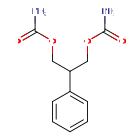
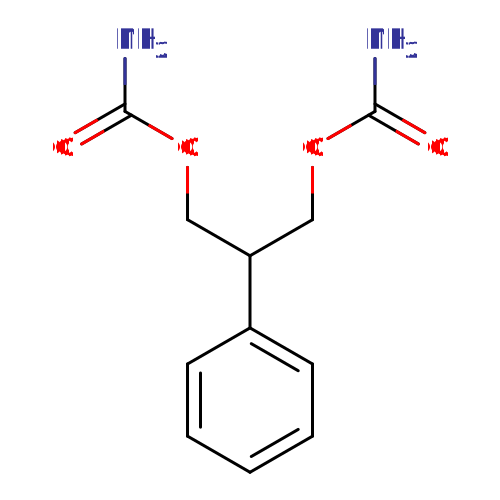
Structure for Felbamate (DB00949)
- Weight
- Average: 238.2399
Monoisotopic: 238.095356946 - Chemical Formula
- C11H14N2O4
- Synonyms
- 2-phenyl-1,3-propanediol dicarbamate
- carbamic acid 2-phenyltrimethylene ester
- Carbamic acid 3-carbamoyloxy-2-phenyl-propyl ester
- Felbamate
- Felbamato
- Felbamatum
- External IDs
- ADD-03055
- W-554

Pharmacology
- Indication
For use only in those patients who respond inadequately to alternative treatments and whose epilepsy is so severe that a substantial risk of aplastic anemia and/or liver failure is deemed acceptable in light of the benefits conferred by its use.
 Reduce drug development failure ratesBuild, train, & validate machine-learning modelswith evidence-based and structured datasets.Build, train, & validate predictive machine-learning models with structured datasets.
- Associated Conditions
Indication Type Indication Combined Product Details Approval Level Age Group Patient Characteristics Dose Form Management of Refractory partial seizures •••••••••••• Adjunct therapy in management of Refractory partial seizures •••••••••••• Adjunct therapy in management of Refractory lennox-gastaut syndrome •••••••••••• Management of Refractory seizure disorders •••••••••••• - Contraindications & Blackbox Warnings
 Prevent Adverse Drug Events TodayTap into our Clinical API for life-saving information on contraindications & blackbox warnings, population restrictions, harmful risks, & more.Avoid life-threatening adverse drug events with our Clinical API
- Pharmacodynamics
Felbamate is an antiepileptic indicated as monotherapy or as an adjunct to other anticonvulsants for the treatment of partial seizures resulting from epilepsy. Receptor-binding studies in vitro indicate that felbamate has weak inhibitory effects on GABA-receptor binding, benzodiazepine receptor binding, and is devoid of activity at the MK-801 receptor binding site of the NMDA receptor-ionophore complex. However, felbamate does interact as an antagonist at the strychnine-insensitive glycine recognition site of the NMDA receptor-ionophore complex.
- Mechanism of action
The mechanism by which felbamate exerts its anticonvulsant activity is unknown, but in animal test systems designed to detect anticonvulsant activity, felbamate has properties in common with other marketed anticonvulsants. In vitro receptor binding studies suggest that felbamate may be an antagonist at the strychnine-insensitive glycine-recognition site of the N-methyl-D-aspartate (NMDA) receptor-ionophore complex. Antagonism of the NMDA receptor glycine binding site may block the effects of the excitatory amino acids and suppress seizure activity. Animal studies indicate that felbamate may increase the seizure threshold and may decrease seizure spread. It is also indicated that felbamate has weak inhibitory effects on GABA-receptor binding, benzodiazepine receptor binding.
Target Actions Organism AGlutamate receptor ionotropic, NMDA 2B antagonistHumans AGlutamate receptor ionotropic, NMDA 2A antagonistHumans - Absorption
>90%
- Volume of distribution
- 756±82 mL/kg
- Protein binding
20-36%
- Metabolism
Hepatic
Hover over products below to view reaction partners
- Route of elimination
Not Available
- Half-life
20-23 hours
- Clearance
- 26 +/- 3 mL/hr/kg [single 1200 mg dose]
- 30 +/- 8 mL/hr/kg [multiple daily doses of 3600 mg]
- Adverse Effects
 Improve decision support & research outcomesWith structured adverse effects data, including: blackbox warnings, adverse reactions, warning & precautions, & incidence rates. View sample adverse effects data in our new Data Library!Improve decision support & research outcomes with our structured adverse effects data.
- Toxicity
LD50=5000 mg/kg (Orally in rats)
- Pathways
Pathway Category Felbamate Metabolism Pathway Drug metabolism - Pharmacogenomic Effects/ADRs
- Not Available
Interactions
- Drug Interactions
- This information should not be interpreted without the help of a healthcare provider. If you believe you are experiencing an interaction, contact a healthcare provider immediately. The absence of an interaction does not necessarily mean no interactions exist.
Drug Interaction Integrate drug-drug
interactions in your software1,2-Benzodiazepine The risk or severity of CNS depression can be increased when Felbamate is combined with 1,2-Benzodiazepine. Abametapir The serum concentration of Felbamate can be increased when it is combined with Abametapir. Abatacept The metabolism of Felbamate can be increased when combined with Abatacept. Abemaciclib The metabolism of Abemaciclib can be increased when combined with Felbamate. Abrocitinib The metabolism of Abrocitinib can be decreased when combined with Felbamate. - Food Interactions
- Avoid alcohol.
Products
 Drug product information from 10+ global regionsOur datasets provide approved product information including:dosage, form, labeller, route of administration, and marketing period.Access drug product information from over 10 global regions.
- International/Other Brands
- Felbamyl / Taloxa
- Brand Name Prescription Products
Name Dosage Strength Route Labeller Marketing Start Marketing End Region Image Felbatol Tablet 600 mg/1 Oral Meda Pharmaceuticals Inc. 1993-07-29 Not applicable US 
Felbatol Tablet 400 mg/1 Oral Meda Pharmaceuticals Inc. 1993-07-29 Not applicable US Felbatol Suspension 600 mg/5mL Oral Meda Pharmaceuticals Inc. 1993-07-29 2026-03-31 US - Generic Prescription Products
Name Dosage Strength Route Labeller Marketing Start Marketing End Region Image Felbamate Tablet 400 mg/1 Oral Zydus Pharmaceuticals (USA) Inc. 2017-08-15 2020-03-03 US Felbamate Tablet 600 mg/1 Oral bryant ranch prepack 2018-09-04 Not applicable US Felbamate Tablet 400 mg/1 Oral Zydus Lifesciences Limited 2017-08-15 Not applicable US Felbamate Suspension 600 mg/5mL Oral Vistapharm, Inc. 2019-06-24 2024-01-31 US Felbamate Suspension 600 mg/5mL Oral Taro Pharmaceuticals U.S.A., Inc. 2017-06-16 Not applicable US
Categories
- ATC Codes
- N03AX10 — Felbamate
- Drug Categories
- Acids, Acyclic
- Alcohols
- Anti-epileptic Agent
- Anticonvulsants
- Carbamates
- Central Nervous System Agents
- Central Nervous System Depressants
- Cytochrome P-450 CYP2C19 Inhibitors
- Cytochrome P-450 CYP2C19 inhibitors (strength unknown)
- Cytochrome P-450 CYP2C9 Inhibitors
- Cytochrome P-450 CYP2C9 Inhibitors (moderate)
- Cytochrome P-450 CYP2E1 Substrates
- Cytochrome P-450 CYP3A Inducers
- Cytochrome P-450 CYP3A Substrates
- Cytochrome P-450 CYP3A4 Inducers
- Cytochrome P-450 CYP3A4 Inducers (weak)
- Cytochrome P-450 CYP3A4 Substrates
- Cytochrome P-450 Enzyme Inducers
- Cytochrome P-450 Enzyme Inhibitors
- Cytochrome P-450 Substrates
- Decreased Central Nervous System Disorganized Electrical Activity
- Excitatory Amino Acid Agents
- Excitatory Amino Acid Antagonists
- Glycols
- Nervous System
- Neurotransmitter Agents
- NMDA Receptor Antagonists
- Phenylcarbamates
- Potential QTc-Prolonging Agents
- Propylene Glycols
- QTc Prolonging Agents
- Chemical TaxonomyProvided by Classyfire
- Description
- This compound belongs to the class of organic compounds known as benzene and substituted derivatives. These are aromatic compounds containing one monocyclic ring system consisting of benzene.
- Kingdom
- Organic compounds
- Super Class
- Benzenoids
- Class
- Benzene and substituted derivatives
- Sub Class
- Not Available
- Direct Parent
- Benzene and substituted derivatives
- Alternative Parents
- Carbamate esters / Organic carbonic acids and derivatives / Organopnictogen compounds / Organonitrogen compounds / Organic oxides / Hydrocarbon derivatives / Carbonyl compounds
- Substituents
- Aromatic homomonocyclic compound / Carbamic acid ester / Carbonic acid derivative / Carbonyl group / Hydrocarbon derivative / Monocyclic benzene moiety / Organic nitrogen compound / Organic oxide / Organic oxygen compound / Organonitrogen compound
- Molecular Framework
- Aromatic homomonocyclic compounds
- External Descriptors
- carbamate ester (CHEBI:4995)
- Affected organisms
- Humans and other mammals
Chemical Identifiers
- UNII
- X72RBB02N8
- CAS number
- 25451-15-4
- InChI Key
- WKGXYQFOCVYPAC-UHFFFAOYSA-N
- InChI
- InChI=1S/C11H14N2O4/c12-10(14)16-6-9(7-17-11(13)15)8-4-2-1-3-5-8/h1-5,9H,6-7H2,(H2,12,14)(H2,13,15)
- IUPAC Name
- 3-(carbamoyloxy)-2-phenylpropyl carbamate
- SMILES
- NC(=O)OCC(COC(N)=O)C1=CC=CC=C1
References
- General References
- Leppik IE, Dreifuss FE, Pledger GW, Graves NM, Santilli N, Drury I, Tsay JY, Jacobs MP, Bertram E, Cereghino JJ, et al.: Felbamate for partial seizures: results of a controlled clinical trial. Neurology. 1991 Nov;41(11):1785-9. [Article]
- External Links
- Human Metabolome Database
- HMDB0015084
- KEGG Drug
- D00536
- KEGG Compound
- C07501
- PubChem Compound
- 3331
- PubChem Substance
- 46506375
- ChemSpider
- 3214
- BindingDB
- 50088430
- 24812
- ChEBI
- 4995
- ChEMBL
- CHEMBL1094
- ZINC
- ZINC000001530803
- Therapeutic Targets Database
- DAP000093
- PharmGKB
- PA449590
- RxList
- RxList Drug Page
- Drugs.com
- Drugs.com Drug Page
- Wikipedia
- Felbamate
- MSDS
- Download (47.1 KB)
Clinical Trials
Pharmacoeconomics
- Manufacturers
- Meda pharmaceuticals inc
- Packagers
- Aptuit Laurus Pvt Ltd.
- Atlantic Biologicals Corporation
- Kaiser Foundation Hospital
- Meda AB
- Dosage Forms
Form Route Strength Suspension Oral 600 mg/5mL Tablet Oral 400 mg/1 Tablet Oral 600 mg/1 Suspension Oral 120 mg/ml Tablet Oral 400 MG Tablet Oral 600 mg - Prices
Unit description Cost Unit Felbatol 600 mg tablet 3.1USD tablet Felbatol 400 mg tablet 2.71USD tablet Felbatol 600 mg/5ml Suspension 1.43USD ml DrugBank does not sell nor buy drugs. Pricing information is supplied for informational purposes only.- Patents
Patent Number Pediatric Extension Approved Expires (estimated) Region US4978680 No 1990-12-18 2009-09-26 US
Properties
- State
- Solid
- Experimental Properties
Property Value Source melting point (°C) 151.5 °C PhysProp water solubility Slightly soluble in water Not Available logP 0.3 Not Available - Predicted Properties
Property Value Source Water Solubility 0.742 mg/mL ALOGPS logP 0.56 ALOGPS logP 0.68 Chemaxon logS -2.5 ALOGPS pKa (Strongest Acidic) 14.98 Chemaxon Physiological Charge 0 Chemaxon Hydrogen Acceptor Count 2 Chemaxon Hydrogen Donor Count 2 Chemaxon Polar Surface Area 104.64 Å2 Chemaxon Rotatable Bond Count 7 Chemaxon Refractivity 59.59 m3·mol-1 Chemaxon Polarizability 23.52 Å3 Chemaxon Number of Rings 1 Chemaxon Bioavailability 1 Chemaxon Rule of Five Yes Chemaxon Ghose Filter Yes Chemaxon Veber's Rule No Chemaxon MDDR-like Rule No Chemaxon - Predicted ADMET Features
Property Value Probability Human Intestinal Absorption + 0.9544 Blood Brain Barrier + 0.9805 Caco-2 permeable - 0.6324 P-glycoprotein substrate Non-substrate 0.783 P-glycoprotein inhibitor I Non-inhibitor 0.9551 P-glycoprotein inhibitor II Non-inhibitor 0.932 Renal organic cation transporter Non-inhibitor 0.9039 CYP450 2C9 substrate Non-substrate 0.9009 CYP450 2D6 substrate Non-substrate 0.9116 CYP450 3A4 substrate Non-substrate 0.7942 CYP450 1A2 substrate Non-inhibitor 0.9045 CYP450 2C9 inhibitor Non-inhibitor 0.9184 CYP450 2D6 inhibitor Inhibitor 0.7126 CYP450 2C19 inhibitor Non-inhibitor 0.9026 CYP450 3A4 inhibitor Non-inhibitor 0.8309 CYP450 inhibitory promiscuity Low CYP Inhibitory Promiscuity 0.9271 Ames test Non AMES toxic 0.7602 Carcinogenicity Non-carcinogens 0.8338 Biodegradation Not ready biodegradable 0.8068 Rat acute toxicity 1.7095 LD50, mol/kg Not applicable hERG inhibition (predictor I) Weak inhibitor 0.9872 hERG inhibition (predictor II) Non-inhibitor 0.9786
Spectra
- Mass Spec (NIST)
- Not Available
- Spectra
- Chromatographic Properties
Collision Cross Sections (CCS)
Adduct CCS Value (Å2) Source type Source [M-H]- 158.1672724 predictedDarkChem Lite v0.1.0 [M-H]- 158.1833724 predictedDarkChem Lite v0.1.0 [M-H]- 158.2536724 predictedDarkChem Lite v0.1.0 [M-H]- 155.53595 predictedDeepCCS 1.0 (2019) [M+H]+ 158.3333724 predictedDarkChem Lite v0.1.0 [M+H]+ 157.9971724 predictedDarkChem Lite v0.1.0 [M+H]+ 157.9332724 predictedDarkChem Lite v0.1.0 [M+H]+ 157.9202 predictedDeepCCS 1.0 (2019) [M+Na]+ 157.8342724 predictedDarkChem Lite v0.1.0 [M+Na]+ 157.5472724 predictedDarkChem Lite v0.1.0 [M+Na]+ 163.9871 predictedDeepCCS 1.0 (2019)
Targets

- Kind
- Protein
- Organism
- Humans
- Pharmacological action
- Yes
- Actions
- Antagonist
- General Function
- Zinc ion binding
- Specific Function
- NMDA receptor subtype of glutamate-gated ion channels with high calcium permeability and voltage-dependent sensitivity to magnesium. Mediated by glycine. In concert with DAPK1 at extrasynaptic site...
- Gene Name
- GRIN2B
- Uniprot ID
- Q13224
- Uniprot Name
- Glutamate receptor ionotropic, NMDA 2B
- Molecular Weight
- 166365.885 Da
References
- Kleckner NW, Glazewski JC, Chen CC, Moscrip TD: Subtype-selective antagonism of N-methyl-D-aspartate receptors by felbamate: insights into the mechanism of action. J Pharmacol Exp Ther. 1999 May;289(2):886-94. [Article]
- Harty TP, Rogawski MA: Felbamate block of recombinant N-methyl-D-aspartate receptors: selectivity for the NR2B subunit. Epilepsy Res. 2000 Mar;39(1):47-55. [Article]
- Chen X, Ji ZL, Chen YZ: TTD: Therapeutic Target Database. Nucleic Acids Res. 2002 Jan 1;30(1):412-5. [Article]
- Chang HR, Kuo CC: Molecular determinants of the anticonvulsant felbamate binding site in the N-methyl-D-aspartate receptor. J Med Chem. 2008 Mar 27;51(6):1534-45. doi: 10.1021/jm0706618. Epub 2008 Feb 27. [Article]
- Luszczki JJ, Danysz W, Czuczwar SJ: Interactions of MRZ 2/576 with felbamate, lamotrigine, oxcarbazepine and topiramate in the mouse maximal electroshock-induced seizure model. Pharmacology. 2008;81(3):259-65. doi: 10.1159/000114870. Epub 2008 Feb 4. [Article]
- Kind
- Protein
- Organism
- Humans
- Pharmacological action
- Yes
- Actions
- Antagonist
- General Function
- Zinc ion binding
- Specific Function
- NMDA receptor subtype of glutamate-gated ion channels possesses high calcium permeability and voltage-dependent sensitivity to magnesium. Activation requires binding of agonist to both types of sub...
- Gene Name
- GRIN2A
- Uniprot ID
- Q12879
- Uniprot Name
- Glutamate receptor ionotropic, NMDA 2A
- Molecular Weight
- 165281.215 Da
References
- Chen X, Ji ZL, Chen YZ: TTD: Therapeutic Target Database. Nucleic Acids Res. 2002 Jan 1;30(1):412-5. [Article]
Enzymes
- Kind
- Protein
- Organism
- Humans
- Pharmacological action
- Unknown
- Actions
- Substrate
- General Function
- Steroid hydroxylase activity
- Specific Function
- Metabolizes several precarcinogens, drugs, and solvents to reactive metabolites. Inactivates a number of drugs and xenobiotics and also bioactivates many xenobiotic substrates to their hepatotoxic ...
- Gene Name
- CYP2E1
- Uniprot ID
- P05181
- Uniprot Name
- Cytochrome P450 2E1
- Molecular Weight
- 56848.42 Da
References
- Glue P, Banfield CR, Perhach JL, Mather GG, Racha JK, Levy RH: Pharmacokinetic interactions with felbamate. In vitro-in vivo correlation. Clin Pharmacokinet. 1997 Sep;33(3):214-24. doi: 10.2165/00003088-199733030-00004. [Article]
- Pietrzak B, Czarnecka E: Influence of felbamate on selected central effects of ethanol in experimental animals. Acta Pol Pharm. 2004 May-Jun;61(3):209-13. [Article]
- Kind
- Protein
- Organism
- Humans
- Pharmacological action
- Unknown
- Actions
- Inhibitor
- General Function
- Steroid hydroxylase activity
- Specific Function
- Cytochromes P450 are a group of heme-thiolate monooxygenases. In liver microsomes, this enzyme is involved in an NADPH-dependent electron transport pathway. It oxidizes a variety of structurally un...
- Gene Name
- CYP2C9
- Uniprot ID
- P11712
- Uniprot Name
- Cytochrome P450 2C9
- Molecular Weight
- 55627.365 Da
References
- Glue P, Banfield CR, Perhach JL, Mather GG, Racha JK, Levy RH: Pharmacokinetic interactions with felbamate. In vitro-in vivo correlation. Clin Pharmacokinet. 1997 Sep;33(3):214-24. doi: 10.2165/00003088-199733030-00004. [Article]
- Drug Interactions & Labeling - FDA [Link]
- UMN Interaction Table, CYP450 [Link]
- Kind
- Protein
- Organism
- Humans
- Pharmacological action
- Unknown
- Actions
- Inhibitor
- General Function
- Steroid hydroxylase activity
- Specific Function
- Responsible for the metabolism of a number of therapeutic agents such as the anticonvulsant drug S-mephenytoin, omeprazole, proguanil, certain barbiturates, diazepam, propranolol, citalopram and im...
- Gene Name
- CYP2C19
- Uniprot ID
- P33261
- Uniprot Name
- Cytochrome P450 2C19
- Molecular Weight
- 55930.545 Da
References
- Levy RH: Cytochrome P450 isozymes and antiepileptic drug interactions. Epilepsia. 1995;36 Suppl 5:S8-13. [Article]
- Turnheim K: [Drug interactions with antiepileptic agents]. Wien Klin Wochenschr. 2004 Feb 28;116(4):112-8. [Article]
- Foye, William O.;Williams, David A.;Lemke, Thomas L. (2002). Foye's Principles of Medicinal Chemistry (5th ed.). Lippincott Williams & Wilkins. [ISBN:0683307371]
- Flockhart Table of Drug Interactions [Link]
- Kind
- Protein
- Organism
- Humans
- Pharmacological action
- Unknown
- Actions
- SubstrateInducer
- General Function
- Vitamin d3 25-hydroxylase activity
- Specific Function
- Cytochromes P450 are a group of heme-thiolate monooxygenases. In liver microsomes, this enzyme is involved in an NADPH-dependent electron transport pathway. It performs a variety of oxidation react...
- Gene Name
- CYP3A4
- Uniprot ID
- P08684
- Uniprot Name
- Cytochrome P450 3A4
- Molecular Weight
- 57342.67 Da
References
- Johannessen SI, Landmark CJ: Antiepileptic drug interactions - principles and clinical implications. Curr Neuropharmacol. 2010 Sep;8(3):254-67. doi: 10.2174/157015910792246254. [Article]
- Glue P, Banfield CR, Perhach JL, Mather GG, Racha JK, Levy RH: Pharmacokinetic interactions with felbamate. In vitro-in vivo correlation. Clin Pharmacokinet. 1997 Sep;33(3):214-24. doi: 10.2165/00003088-199733030-00004. [Article]

Drug created at June 13, 2005 13:24 / Updated at February 02, 2024 22:46