Identification
- Summary
Butenafine is a topical antifungal used to treat tinea versicolor, tinea pedis, tinea cruris, and tinea corporis.
- Brand Names
- Lotrimin Ultra
- Generic Name
- Butenafine
- DrugBank Accession Number
- DB01091
- Background
Butenafine hydrochloride is a synthetic benzylamine antifungal agent. Butenafine's mechanism of action is believed to involve the synthesis inhibition of sterols. In particular, butenafine acts to inhibit the activity of the squalene epoxidase enzyme that is essential in the formation of sterols necessary for fungal cell membranes.
- Type
- Small Molecule
- Groups
- Approved
- Structure

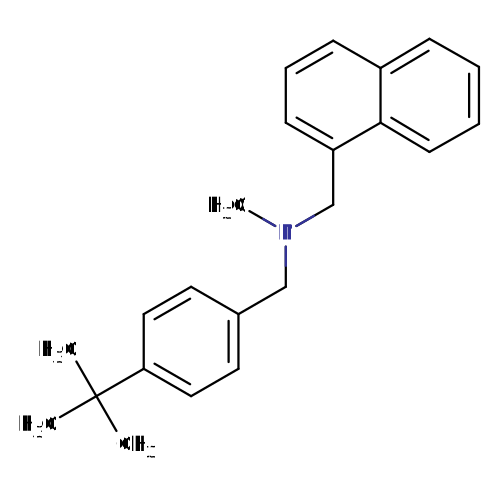
Structure for Butenafine (DB01091)
- Weight
- Average: 317.4672
Monoisotopic: 317.214349869 - Chemical Formula
- C23H27N
- Synonyms
- (4-tert-Butyl-benzyl)-methyl-naphthalen-1-ylmethyl-amine
- (4-tert-butylphenyl)-N-methyl-N-(naphthalen-1-ylmethyl)methanamine
- 4-tert-butylbenzyl(methyl)(1-naphthalenemethyl)amine
- Butenafina
- Butenafine
- Butenafinum
- N-(p-tert-butylbenzyl)-N-methyl-1-naphthalenemethylamine

Pharmacology
- Indication
For the topical treatment of the following dermatologic infections: tinea (pityriasis) versicolor due to M. furfur, interdigital tinea pedis (athlete’s foot), tinea corporis (ringworm) and tinea cruris (jock itch) due to E. floccosum, T. mentagrophytes, T. rubrum, and T. tonsurans.
 Reduce drug development failure ratesBuild, train, & validate machine-learning modelswith evidence-based and structured datasets.Build, train, & validate predictive machine-learning models with structured datasets.
- Associated Conditions
Indication Type Indication Combined Product Details Approval Level Age Group Patient Characteristics Dose Form Treatment of Athlete's foot ••• ••• •••••• ••••••• ••••• Treatment of Jock itch ••• ••• •••••• ••••••• ••••• Treatment of Tinea corporis ••• ••• •••••• ••••••• ••••• Treatment of Tinea versicolor •••••••••••• •••••• ••••••• ••••• - Contraindications & Blackbox Warnings
 Prevent Adverse Drug Events TodayTap into our Clinical API for life-saving information on contraindications & blackbox warnings, population restrictions, harmful risks, & more.Avoid life-threatening adverse drug events with our Clinical API
- Pharmacodynamics
Butenafine is a synthetic antifungal agent that is structurally and pharmacologically related to allylamine antifungals. The exact mechanism of action has not been established, but it is suggested that butenafine's antifungal activity is exerted through the alteration of cellular membranes, which results in increased membrane permeability, and growth inhibition. Butenafine is mainly active against dermatophytes and has superior fungicidal activity against this group of fungi when compared to that of terbinafine, naftifine, tolnaftate, clotrimazole, and bifonazole. It is also active against Candida albicans and this activity is superior to that of terbinafine and naftifine. Butenafine also generates low MICs for Cryptococcus neoformans and Aspergillus spp. as well.
- Mechanism of action
Although the mechanism of action has not been fully established, it has been suggested that butenafine, like allylamines, interferes with sterol biosynthesis (especially ergosterol) by inhibiting squalene monooxygenase, an enzyme responsible for converting squalene to 2,3-oxydo squalene. As ergosterol is an essential component of the fungal cell membrane, inhibition of its synthesis results in increased cellular permeability causing leakage of cellular contents. Blockage of squalene monooxygenase also leads to a subsequent accumulation of squalene. When a high concentration of squalene is reached, it is thought to have an effect of directly kill fungal cells.
Target Actions Organism ASqualene monooxygenase inhibitorHumans - Absorption
The total amount absorbed through the skin into the systemic circulation has not been quantified.
- Volume of distribution
Not Available
- Protein binding
Not Available
- Metabolism
The primary metabolite in urine was formed through hydroxylation at the terminal t-butyl side-chain.
- Route of elimination
Not Available
- Half-life
Following topical application, a biphasic decline of plasma butenafine concentrations was observed with the half-lives estimated to be 35 hours initial and over 150 hours terminal.
- Clearance
Not Available
- Adverse Effects
 Improve decision support & research outcomesWith structured adverse effects data, including: blackbox warnings, adverse reactions, warning & precautions, & incidence rates. View sample adverse effects data in our new Data Library!Improve decision support & research outcomes with our structured adverse effects data.
- Toxicity
Not Available
- Pathways
- Not Available
- Pharmacogenomic Effects/ADRs
- Not Available
Interactions
- Drug Interactions
- This information should not be interpreted without the help of a healthcare provider. If you believe you are experiencing an interaction, contact a healthcare provider immediately. The absence of an interaction does not necessarily mean no interactions exist.Not Available
- Food Interactions
- No interactions found.
Products
 Drug product information from 10+ global regionsOur datasets provide approved product information including:dosage, form, labeller, route of administration, and marketing period.Access drug product information from over 10 global regions.
- Product Ingredients
Ingredient UNII CAS InChI Key Butenafine hydrochloride R8XA2029ZI 101827-46-7 LJBSAUIFGPSHCN-UHFFFAOYSA-N - Brand Name Prescription Products
Name Dosage Strength Route Labeller Marketing Start Marketing End Region Image Mentax Cream 10 mg/1g Topical Mylan Pharmaceuticals Inc. 1996-12-31 2023-07-31 US 
Mentax Cream 10 mg/1g Topical BERTEK PHARMACEUTICALS INC. 2006-01-20 2006-07-18 US - Over the Counter Products
Name Dosage Strength Route Labeller Marketing Start Marketing End Region Image Athletes Foot Cream 10 mg/1g Topical Taro Pharmaceuticals U.S.A., Inc. 2017-11-17 Not applicable US Athletes Foot Cream 10 mg/1g Topical CVS PHARMACY 2017-11-17 Not applicable US Athletes Foot Cream 10 mg/1g Topical Walgreen Company 2017-11-17 Not applicable US Athletes Foot Cream 10 mg/1g Topical Target Corporation. 2017-11-17 Not applicable US Athletes Foot Cream 10 mg/1g Topical Topco Associates LLC 2017-11-17 Not applicable US
Categories
- ATC Codes
- D01AE23 — Butenafine
- Drug Categories
- Chemical TaxonomyProvided by Classyfire
- Description
- This compound belongs to the class of organic compounds known as naphthalenes. These are compounds containing a naphthalene moiety, which consists of two fused benzene rings.
- Kingdom
- Organic compounds
- Super Class
- Benzenoids
- Class
- Naphthalenes
- Sub Class
- Not Available
- Direct Parent
- Naphthalenes
- Alternative Parents
- Phenylpropanes / Phenylmethylamines / Benzylamines / Aralkylamines / Trialkylamines / Organopnictogen compounds / Hydrocarbon derivatives
- Substituents
- Amine / Aralkylamine / Aromatic homopolycyclic compound / Benzylamine / Hydrocarbon derivative / Monocyclic benzene moiety / Naphthalene / Organic nitrogen compound / Organonitrogen compound / Organopnictogen compound
- Molecular Framework
- Aromatic homopolycyclic compounds
- External Descriptors
- tertiary amine, naphthalenes (CHEBI:3238)
- Affected organisms
- Fungi
Chemical Identifiers
- UNII
- 91Y494NL0X
- CAS number
- 101828-21-1
- InChI Key
- ABJKWBDEJIDSJZ-UHFFFAOYSA-N
- InChI
- InChI=1S/C23H27N/c1-23(2,3)21-14-12-18(13-15-21)16-24(4)17-20-10-7-9-19-8-5-6-11-22(19)20/h5-15H,16-17H2,1-4H3
- IUPAC Name
- [(4-tert-butylphenyl)methyl](methyl)[(naphthalen-1-yl)methyl]amine
- SMILES
- CN(CC1=CC=C(C=C1)C(C)(C)C)CC1=CC=CC2=CC=CC=C12
References
- Synthesis Reference
- US5021458
- General References
- McNeely W, Spencer CM: Butenafine. Drugs. 1998 Mar;55(3):405-12; discussion 413. [Article]
- Singal A: Butenafine and superficial mycoses: current status. Expert Opin Drug Metab Toxicol. 2008 Jul;4(7):999-1005. doi: 10.1517/17425255.4.7.999 . [Article]
- Gupta AK: Butenafine: an update of its use in superficial mycoses. Skin Therapy Lett. 2002 Sep;7(7):1-2, 5. [Article]
- Mingeot-Leclercq MP, Gallet X, Flore C, Van Bambeke F, Peuvot J, Brasseur R: Experimental and conformational analyses of interactions between butenafine and lipids. Antimicrob Agents Chemother. 2001 Dec;45(12):3347-54. [Article]
- Syed TA, Maibach HI: Butenafine hydrochloride: for the treatment of interdigital tinea pedis. Expert Opin Pharmacother. 2000 Mar;1(3):467-73. [Article]
- Reyes BA, Beutner KR, Cullen SI, Rosen T, Shupack JL, Weinstein MB: Butenafine, a fungicidal benzylamine derivative, used once daily for the treatment of interdigital tinea pedis. Int J Dermatol. 1998 Jun;37(6):450-3. [Article]
- Iwatani W, Arika T, Yamaguchi H: Two mechanisms of butenafine action in Candida albicans. Antimicrob Agents Chemother. 1993 Apr;37(4):785-8. [Article]
- External Links
- Human Metabolome Database
- HMDB0015223
- KEGG Drug
- D07596
- KEGG Compound
- C08067
- PubChem Compound
- 2484
- PubChem Substance
- 46506191
- ChemSpider
- 2390
- BindingDB
- 50436713
- 47461
- ChEBI
- 3238
- ChEMBL
- CHEMBL990
- ZINC
- ZINC000001530975
- Therapeutic Targets Database
- DAP001236
- PharmGKB
- PA164745478
- RxList
- RxList Drug Page
- Drugs.com
- Drugs.com Drug Page
- Wikipedia
- Butenafine
- FDA label
- Download (1.39 MB)
Clinical Trials
- Clinical Trials
Phase Status Purpose Conditions Count 3 Completed Treatment Allergic Reaction 2 3 Completed Treatment Dermatitis, Photoallergic 1 3 Completed Treatment Dermatitis, Phototoxic 1 2 Unknown Status Treatment Tinea Pedis 1 1 Completed Treatment Tinea Pedis 2
Pharmacoeconomics
- Manufacturers
- Not Available
- Packagers
- Erregierre SPA
- Mylan
- Schering-Plough Inc.
- Dosage Forms
Form Route Strength Lotion Topical Spray Topical Spray Topical 1 % Cream Topical Cream Cutaneous 1.00 g Solution Cutaneous 1.000 g Cream Topical 1 % Cream Topical 1 g/100g Cream Topical 10 mg/1g - Prices
Unit description Cost Unit Mentax 1% Cream 30 gm Tube 124.7USD tube Mentax 1% Cream 15 gm Tube 50.99USD tube Mentax 1% cream 4.0USD g Lotrimin ultra 1% cream 0.68USD g DrugBank does not sell nor buy drugs. Pricing information is supplied for informational purposes only.- Patents
Patent Number Pediatric Extension Approved Expires (estimated) Region US5021458 No 1991-06-04 2010-10-18 US
Properties
- State
- Solid
- Experimental Properties
Property Value Source water solubility Slightly soluble (HCl salt) Not Available logP 6.6 Not Available - Predicted Properties
Property Value Source Water Solubility 7.56e-05 mg/mL ALOGPS logP 5.85 ALOGPS logP 6.17 Chemaxon logS -6.6 ALOGPS pKa (Strongest Basic) 9.06 Chemaxon Physiological Charge 1 Chemaxon Hydrogen Acceptor Count 1 Chemaxon Hydrogen Donor Count 0 Chemaxon Polar Surface Area 3.24 Å2 Chemaxon Rotatable Bond Count 5 Chemaxon Refractivity 104.33 m3·mol-1 Chemaxon Polarizability 38.41 Å3 Chemaxon Number of Rings 3 Chemaxon Bioavailability 1 Chemaxon Rule of Five No Chemaxon Ghose Filter No Chemaxon Veber's Rule Yes Chemaxon MDDR-like Rule No Chemaxon - Predicted ADMET Features
Property Value Probability Human Intestinal Absorption + 0.9904 Blood Brain Barrier + 0.9514 Caco-2 permeable + 0.7822 P-glycoprotein substrate Substrate 0.5855 P-glycoprotein inhibitor I Non-inhibitor 0.8215 P-glycoprotein inhibitor II Inhibitor 0.7052 Renal organic cation transporter Non-inhibitor 0.5078 CYP450 2C9 substrate Non-substrate 0.8124 CYP450 2D6 substrate Non-substrate 0.8686 CYP450 3A4 substrate Substrate 0.6225 CYP450 1A2 substrate Non-inhibitor 0.6056 CYP450 2C9 inhibitor Non-inhibitor 0.9401 CYP450 2D6 inhibitor Inhibitor 0.8189 CYP450 2C19 inhibitor Non-inhibitor 0.666 CYP450 3A4 inhibitor Non-inhibitor 0.7581 CYP450 inhibitory promiscuity Low CYP Inhibitory Promiscuity 0.6169 Ames test Non AMES toxic 0.9008 Carcinogenicity Carcinogens 0.5115 Biodegradation Not ready biodegradable 0.9972 Rat acute toxicity 2.2204 LD50, mol/kg Not applicable hERG inhibition (predictor I) Weak inhibitor 0.8911 hERG inhibition (predictor II) Inhibitor 0.5849
Spectra
- Mass Spec (NIST)
- Not Available
- Spectra
Spectrum Spectrum Type Splash Key Predicted GC-MS Spectrum - GC-MS Predicted GC-MS splash10-0006-2912000000-2c89ed2a27ca719c5093 Predicted MS/MS Spectrum - 10V, Positive (Annotated) Predicted LC-MS/MS splash10-014i-0009000000-f705e497c615c28a4285 Predicted MS/MS Spectrum - 10V, Negative (Annotated) Predicted LC-MS/MS splash10-014i-0009000000-959d0e39f2720a8af51d Predicted MS/MS Spectrum - 20V, Positive (Annotated) Predicted LC-MS/MS splash10-00kf-3906000000-dab4678a6bbb33f9cbe7 Predicted MS/MS Spectrum - 20V, Negative (Annotated) Predicted LC-MS/MS splash10-014i-0009000000-a0c99ba0970c45bd2af1 Predicted MS/MS Spectrum - 40V, Positive (Annotated) Predicted LC-MS/MS splash10-0006-3931000000-eb687d542d78ed109f49 Predicted MS/MS Spectrum - 40V, Negative (Annotated) Predicted LC-MS/MS splash10-004i-0901000000-f38110a2d048c9665484 Predicted 1H NMR Spectrum 1D NMR Not Applicable Predicted 13C NMR Spectrum 1D NMR Not Applicable - Chromatographic Properties
Collision Cross Sections (CCS)
Adduct CCS Value (Å2) Source type Source [M-H]- 196.4468646 predictedDarkChem Lite v0.1.0 [M-H]- 174.64067 predictedDeepCCS 1.0 (2019) [M+H]+ 197.9069646 predictedDarkChem Lite v0.1.0 [M+H]+ 176.9987 predictedDeepCCS 1.0 (2019) [M+Na]+ 197.1502646 predictedDarkChem Lite v0.1.0 [M+Na]+ 183.37291 predictedDeepCCS 1.0 (2019)
Targets

- Kind
- Protein
- Organism
- Humans
- Pharmacological action
- Yes
- Actions
- Inhibitor
- General Function
- Squalene monooxygenase activity
- Specific Function
- Catalyzes the first oxygenation step in sterol biosynthesis and is suggested to be one of the rate-limiting enzymes in this pathway.
- Gene Name
- SQLE
- Uniprot ID
- Q14534
- Uniprot Name
- Squalene monooxygenase
- Molecular Weight
- 63922.505 Da
References
- Mukherjee PK, Leidich SD, Isham N, Leitner I, Ryder NS, Ghannoum MA: Clinical Trichophyton rubrum strain exhibiting primary resistance to terbinafine. Antimicrob Agents Chemother. 2003 Jan;47(1):82-6. [Article]
- Gao PH, Cao YB, Xu Z, Zhang JD, Zhang WN, Wang Y, Gu J, Cao YY, Li RY, Jia XM, Jiang YY: In vitro antifungal activity of ZJ-522, a new triazole restructured from fluconazole and butenafine, against clinically important fungi in comparison with fluconazole and butenafine. Biol Pharm Bull. 2005 Aug;28(8):1414-7. [Article]
- Singal A: Butenafine and superficial mycoses: current status. Expert Opin Drug Metab Toxicol. 2008 Jul;4(7):999-1005. doi: 10.1517/17425255.4.7.999 . [Article]
- Ramam M, Prasad HR, Manchanda Y, Khaitan BK, Banerjee U, Mukhopadhyaya A, Shetty R, Gogtay JA: Randomised controlled trial of topical butenafine in tinea cruris and tinea corporis. Indian J Dermatol Venereol Leprol. 2003 Mar-Apr;69(2):154-8. [Article]
- Iwatani W, Arika T, Yamaguchi H: Two mechanisms of butenafine action in Candida albicans. Antimicrob Agents Chemother. 1993 Apr;37(4):785-8. [Article]
- Chen X, Ji ZL, Chen YZ: TTD: Therapeutic Target Database. Nucleic Acids Res. 2002 Jan 1;30(1):412-5. [Article]

Drug created at June 13, 2005 13:24 / Updated at April 26, 2024 00:46