Identification
- Summary
Proflavine is a topical antiseptic agent used in wound dressings to prevent infections.
- Generic Name
- Proflavine
- DrugBank Accession Number
- DB01123
- Background
3,6-Diaminoacridine. Topical antiseptic used mainly in wound dressings.
- Type
- Small Molecule
- Groups
- Approved
- Structure
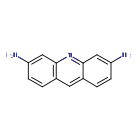
Structure for Proflavine (DB01123)

- Weight
- Average: 209.2465
Monoisotopic: 209.095297367 - Chemical Formula
- C13H11N3
- Synonyms
- 2,8-Diaminoacridine
- 3,6-acridinediamine
- 3,6-diaminoacridine
- Diaminoacridine
- Proflavin
- Proflavina
- Proflavine
- Proflavinum

Pharmacology
- Indication
Topical antiseptic used mainly in wound dressings.
 Reduce drug development failure ratesBuild, train, & validate machine-learning modelswith evidence-based and structured datasets.Build, train, & validate predictive machine-learning models with structured datasets.
- Contraindications & Blackbox Warnings
 Prevent Adverse Drug Events TodayTap into our Clinical API for life-saving information on contraindications & blackbox warnings, population restrictions, harmful risks, & more.Avoid life-threatening adverse drug events with our Clinical API
- Pharmacodynamics
Proflavine is an acriflavine derivative which is a disinfectant bacteriostatic against many gram-positive bacteria. Proflavine is toxic and carcinogenic in mammals and so it is used only as a surface disinfectant or for treating superficial wounds.
- Mechanism of action
Proflavine acts by interchelating DNA (intercalation), thereby disrupting DNA synthesis and leading to high levels of mutation in the copied DNA strands. This prevents bacterial reproduction.
Target Actions Organism ADNA intercalationHumans NProthrombin other/unknownHumans UHTH-type transcriptional regulator QacR Not Available Staphylococcus aureus UTetR family transcriptional repressor LfrR Not Available Mycobacterium smegmatis - Absorption
Not Available
- Volume of distribution
Not Available
- Protein binding
Not Available
- Metabolism
- Not Available
- Route of elimination
Not Available
- Half-life
Not Available
- Clearance
Not Available
- Adverse Effects
 Improve decision support & research outcomesWith structured adverse effects data, including: blackbox warnings, adverse reactions, warning & precautions, & incidence rates. View sample adverse effects data in our new Data Library!Improve decision support & research outcomes with our structured adverse effects data.
- Toxicity
Not Available
- Pathways
- Not Available
- Pharmacogenomic Effects/ADRs
- Not Available
Interactions
- Drug Interactions
- This information should not be interpreted without the help of a healthcare provider. If you believe you are experiencing an interaction, contact a healthcare provider immediately. The absence of an interaction does not necessarily mean no interactions exist.Not Available
- Food Interactions
- No interactions found.
Products
 Drug product information from 10+ global regionsOur datasets provide approved product information including:dosage, form, labeller, route of administration, and marketing period.Access drug product information from over 10 global regions.
- Product Ingredients
Ingredient UNII CAS InChI Key Proflavine hemisulfate 27V8M747VB 1811-28-5 YADYXCVYLIKQJX-UHFFFAOYSA-N - Mixture Products
Name Ingredients Dosage Route Labeller Marketing Start Marketing End Region Image Kerr 100 Triple Dye Dispos-A Proflavine hemisulfate (1.14 mg/1mL) + Brilliant green (2.29 mg/1mL) + Gentian violet (2.2 mg/1mL) Swab Topical VistaPharm, LLC 2004-05-01 Not applicable US 
Perineze Triple Dye Proflavine hemisulfate (1.14 mg/0.61mL) + Brilliant green (2.29 mg/0.61mL) + Gentian violet (2.29 mg/0.61mL) Solution Topical Peace Medical Inc. 2011-09-28 Not applicable US Triple Dye Proflavine hemisulfate (1.14 mg / mL) + Brilliant green (2.29 mg / mL) + Gentian violet (2.29 mg / mL) Liquid Topical Frank W. Kerr Chemical Company 1983-12-31 2004-10-27 Canada 
Categories
- Drug Categories
- Chemical TaxonomyProvided by Classyfire
- Description
- This compound belongs to the class of organic compounds known as acridines. These are organic compounds containing the acridine moiety, a linear tricyclic heterocycle which consists of two benzene rings joined by a pyridine ring.
- Kingdom
- Organic compounds
- Super Class
- Organoheterocyclic compounds
- Class
- Quinolines and derivatives
- Sub Class
- Benzoquinolines
- Direct Parent
- Acridines
- Alternative Parents
- Aminoquinolines and derivatives / Pyridines and derivatives / Benzenoids / Heteroaromatic compounds / Azacyclic compounds / Primary amines / Organopnictogen compounds / Hydrocarbon derivatives
- Substituents
- Acridine / Amine / Aminoquinoline / Aromatic heteropolycyclic compound / Azacycle / Benzenoid / Heteroaromatic compound / Hydrocarbon derivative / Organic nitrogen compound / Organonitrogen compound
- Molecular Framework
- Aromatic heteropolycyclic compounds
- External Descriptors
- aminoacridines (CHEBI:8452)
- Affected organisms
- Enteric bacteria and other eubacteria
Chemical Identifiers
- UNII
- CY3RNB3K4T
- CAS number
- 92-62-6
- InChI Key
- WDVSHHCDHLJJJR-UHFFFAOYSA-N
- InChI
- InChI=1S/C13H11N3/c14-10-3-1-8-5-9-2-4-11(15)7-13(9)16-12(8)6-10/h1-7H,14-15H2
- IUPAC Name
- acridine-3,6-diamine
- SMILES
- NC1=CC2=NC3=C(C=CC(N)=C3)C=C2C=C1
References
- General References
- Not Available
- External Links
- Human Metabolome Database
- HMDB0015255
- KEGG Compound
- C11181
- PubChem Compound
- 7099
- PubChem Substance
- 46505401
- ChemSpider
- 6832
- BindingDB
- 12590
- 8723
- ChEBI
- 8452
- ChEMBL
- CHEMBL55400
- ZINC
- ZINC000003775644
- Therapeutic Targets Database
- DAP000995
- PharmGKB
- PA164748742
- PDBe Ligand
- PRL
- Wikipedia
- Proflavine
- PDB Entries
- 1bcu / 1qvt / 1qvu / 1vtf / 2kd4 / 2v57 / 3ft6 / 3hth / 4zph / 7nt4 … show 1 more
- MSDS
- Download (71.9 KB)
Clinical Trials
- Clinical Trials
Phase Status Purpose Conditions Count 2 Completed Other Prior History of Squamous Cell Dysplasia and /or Neoplasia / Suspected or Known Squamous Cell Neoplasia 1 2 Recruiting Other Barrett's Esophagus 1 2 Recruiting Other Prior History of Squamous Cell Dysplasia and /or Neoplasia / Suspected or Known Squamous Cell Neoplasia 1 2 Withdrawn Treatment Uterine Malignancies 1 1 Terminated Diagnostic Gastric Cancer 1
Pharmacoeconomics
- Manufacturers
- Not Available
- Packagers
- Frank W Kerr Chemical Co.
- William Laboratories Inc.
- Dosage Forms
Form Route Strength Swab Topical Solution Topical Liquid Topical - Prices
- Not Available
- Patents
- Not Available
Properties
- State
- Solid
- Experimental Properties
Property Value Source melting point (°C) 285 °C PhysProp water solubility 5E+005 mg/L (at 20 °C) YALKOWSKY,SH & DANNENFELSER,RM (1992) logP 1.83 HANSCH,C ET AL. (1995) pKa 8.06 (at 20 °C) PERRIN,DD (1972) - Predicted Properties
Property Value Source Water Solubility 0.104 mg/mL ALOGPS logP 2.1 ALOGPS logP 1.85 Chemaxon logS -3.3 ALOGPS pKa (Strongest Basic) 8.32 Chemaxon Physiological Charge 1 Chemaxon Hydrogen Acceptor Count 3 Chemaxon Hydrogen Donor Count 2 Chemaxon Polar Surface Area 64.93 Å2 Chemaxon Rotatable Bond Count 0 Chemaxon Refractivity 65.46 m3·mol-1 Chemaxon Polarizability 23.17 Å3 Chemaxon Number of Rings 3 Chemaxon Bioavailability 1 Chemaxon Rule of Five Yes Chemaxon Ghose Filter Yes Chemaxon Veber's Rule No Chemaxon MDDR-like Rule No Chemaxon - Predicted ADMET Features
Property Value Probability Human Intestinal Absorption + 0.9762 Blood Brain Barrier + 0.9388 Caco-2 permeable + 0.7041 P-glycoprotein substrate Non-substrate 0.7289 P-glycoprotein inhibitor I Non-inhibitor 0.9623 P-glycoprotein inhibitor II Non-inhibitor 0.8593 Renal organic cation transporter Non-inhibitor 0.7993 CYP450 2C9 substrate Non-substrate 0.8805 CYP450 2D6 substrate Non-substrate 0.8649 CYP450 3A4 substrate Non-substrate 0.7682 CYP450 1A2 substrate Inhibitor 0.8698 CYP450 2C9 inhibitor Non-inhibitor 0.758 CYP450 2D6 inhibitor Non-inhibitor 0.8692 CYP450 2C19 inhibitor Non-inhibitor 0.7273 CYP450 3A4 inhibitor Non-inhibitor 0.6799 CYP450 inhibitory promiscuity High CYP Inhibitory Promiscuity 0.7368 Ames test AMES toxic 0.9302 Carcinogenicity Non-carcinogens 0.8204 Biodegradation Not ready biodegradable 0.994 Rat acute toxicity 2.5383 LD50, mol/kg Not applicable hERG inhibition (predictor I) Weak inhibitor 0.9803 hERG inhibition (predictor II) Non-inhibitor 0.7051
Spectra
- Mass Spec (NIST)
- Download (7.48 KB)
- Spectra
Spectrum Spectrum Type Splash Key Predicted GC-MS Spectrum - GC-MS Predicted GC-MS splash10-0a4i-0690000000-03815a906da0db330dec Predicted MS/MS Spectrum - 10V, Positive (Annotated) Predicted LC-MS/MS splash10-03di-0090000000-3f96d325ff8915c27ac7 Predicted MS/MS Spectrum - 10V, Negative (Annotated) Predicted LC-MS/MS splash10-0a4i-0090000000-336a2143f6d5c43fe750 Predicted MS/MS Spectrum - 20V, Positive (Annotated) Predicted LC-MS/MS splash10-03di-0090000000-dbcf1406326a7cd7e1f0 Predicted MS/MS Spectrum - 20V, Negative (Annotated) Predicted LC-MS/MS splash10-0a4i-0290000000-3d3a8b80322b70c19b97 Predicted MS/MS Spectrum - 40V, Positive (Annotated) Predicted LC-MS/MS splash10-02ai-0950000000-078c4b9cd8b43687b7a4 Predicted MS/MS Spectrum - 40V, Negative (Annotated) Predicted LC-MS/MS splash10-001i-0920000000-07b71be93f387e55d81c Predicted 1H NMR Spectrum 1D NMR Not Applicable Predicted 13C NMR Spectrum 1D NMR Not Applicable - Chromatographic Properties
Collision Cross Sections (CCS)
Adduct CCS Value (Å2) Source type Source [M-H]- 154.1464368 predictedDarkChem Lite v0.1.0 [M-H]- 150.5395 predictedDeepCCS 1.0 (2019) [M+H]+ 154.8447368 predictedDarkChem Lite v0.1.0 [M+H]+ 152.93507 predictedDeepCCS 1.0 (2019) [M+Na]+ 154.2952368 predictedDarkChem Lite v0.1.0 [M+Na]+ 158.95036 predictedDeepCCS 1.0 (2019)
Targets

References
- Overington JP, Al-Lazikani B, Hopkins AL: How many drug targets are there? Nat Rev Drug Discov. 2006 Dec;5(12):993-6. [Article]
- Imming P, Sinning C, Meyer A: Drugs, their targets and the nature and number of drug targets. Nat Rev Drug Discov. 2006 Oct;5(10):821-34. [Article]
- Sinha R, Hossain M, Kumar GS: Interaction of small molecules with double-stranded RNA: spectroscopic, viscometric, and calorimetric study of hoechst and proflavine binding to PolyCG structures. DNA Cell Biol. 2009 Apr;28(4):209-19. doi: 10.1089/dna.2008.0838. [Article]
- Berezniak EG, gladkovskaia NA, Khrebtova AS, Dukhopel'nikov EV, Zinchenko AV: [Features of binding of proflavine to DNA at different DNA-ligand concentration ratios]. Biofizika. 2009 Sep-Oct;54(5):805-12. [Article]
- Kind
- Protein
- Organism
- Humans
- Pharmacological action
- No
- Actions
- Other/unknown
- General Function
- Thrombospondin receptor activity
- Specific Function
- Thrombin, which cleaves bonds after Arg and Lys, converts fibrinogen to fibrin and activates factors V, VII, VIII, XIII, and, in complex with thrombomodulin, protein C. Functions in blood homeostas...
- Gene Name
- F2
- Uniprot ID
- P00734
- Uniprot Name
- Prothrombin
- Molecular Weight
- 70036.295 Da
References
- Sie P, Bezeaud A, Dupouy D, Archipoff G, Freyssinet JM, Dugoujon JM, Serre G, Guillin MC, Boneu B: An acquired antithrombin autoantibody directed toward the catalytic center of the enzyme. J Clin Invest. 1991 Jul;88(1):290-6. [Article]
- Koehler KA, Magnusson S: The binding of proflavin to thrombin. Arch Biochem Biophys. 1974 Jan;160(1):175-84. [Article]
- Sonder SA, Fenton JW 2nd: Proflavin binding within the fibrinopeptide groove adjacent to the catalytic site of human alpha-thrombin. Biochemistry. 1984 Apr 10;23(8):1818-23. [Article]
- Valeri AM, Wilson SM, Feinman RD: Reaction of antithrombin with proteases. Evidence for a specific reaction with papain. Biochim Biophys Acta. 1980 Aug 7;614(2):526-33. [Article]
- De Cristofaro R, De Candia E, Picozzi M, Landolfi R: Conformational transitions linked to active site ligation in human thrombin: effect on the interaction with fibrinogen and the cleavable platelet receptor. J Mol Biol. 1995 Jan 27;245(4):447-58. [Article]
- Berman HM, Westbrook J, Feng Z, Gilliland G, Bhat TN, Weissig H, Shindyalov IN, Bourne PE: The Protein Data Bank. Nucleic Acids Res. 2000 Jan 1;28(1):235-42. [Article]
- Kind
- Protein
- Organism
- Staphylococcus aureus
- Pharmacological action
- Unknown
- General Function
- Transcriptional repressor of qacA. Binds to IR1, an unusually long 28 bp operator, which is located downstream from the qacA promoter and overlaps its transcription start site. QacR is induced from its IR1 site by binding to one of many structurally dissimilar cationic lipophilic compounds, which are also substrates of QacA.
- Specific Function
- Dna binding
- Gene Name
- qacR
- Uniprot ID
- P0A0N4
- Uniprot Name
- HTH-type transcriptional regulator QacR
- Molecular Weight
- 22174.175 Da
References
- Berman HM, Westbrook J, Feng Z, Gilliland G, Bhat TN, Weissig H, Shindyalov IN, Bourne PE: The Protein Data Bank. Nucleic Acids Res. 2000 Jan 1;28(1):235-42. [Article]
- Kind
- Protein
- Organism
- Mycobacterium smegmatis
- Pharmacological action
- Unknown
- General Function
- Dna binding
- Specific Function
- Not Available
- Gene Name
- lfrR
- Uniprot ID
- Q58L87
- Uniprot Name
- TetR family transcriptional regulator
- Molecular Weight
- 20618.16 Da
References
- Berman HM, Westbrook J, Feng Z, Gilliland G, Bhat TN, Weissig H, Shindyalov IN, Bourne PE: The Protein Data Bank. Nucleic Acids Res. 2000 Jan 1;28(1):235-42. [Article]


Drug created at June 13, 2005 13:24 / Updated at September 28, 2021 21:54