Identification
- Generic Name
- Thiamylal
- DrugBank Accession Number
- DB01154
- Background
A barbiturate that is administered intravenously for the production of complete anesthesia of short duration, for the induction of general anesthesia, or for inducing a hypnotic state. (From Martindale, The Extra Pharmacopoeia, 30th ed, p919)
- Type
- Small Molecule
- Groups
- Approved, Vet approved
- Structure
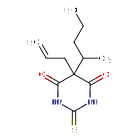
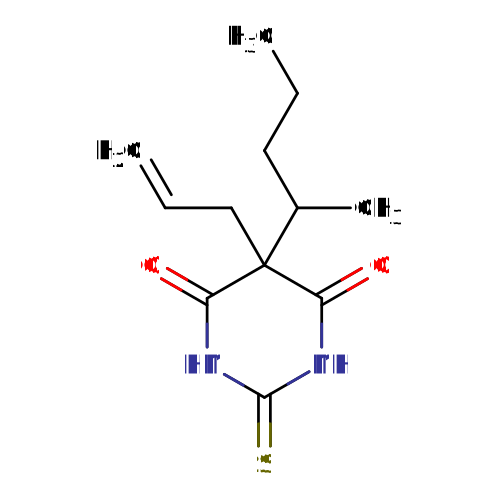
Structure for Thiamylal (DB01154)
- Weight
- Average: 254.349
Monoisotopic: 254.10889852 - Chemical Formula
- C12H18N2O2S
- Synonyms
- 5-Allyl-5-(1-methylbutyl)-2-thiobarbituric acid
- 5-allyl-5-(1-methylbutyl)-2-thioxodihydro-4,6(1H,5H)-pyrimidinedione
- 5-allyl-5-(1-methylbutyl)-2-thioxodihydropyrimidine-4,6(1H,5H)-dione
- dihydro-5-(1-methylbutyl)-5-(2-propenyl)-2-thioxo-4,6(1H,5H)-pyrimidinedione
- Thiamylal

Pharmacology
- Indication
Used for the production of complete anaesthesia of short duration, for the induction of general anaesthesia, and for inducing a hypnotic state.
 Reduce drug development failure ratesBuild, train, & validate machine-learning modelswith evidence-based and structured datasets.Build, train, & validate predictive machine-learning models with structured datasets.
- Contraindications & Blackbox Warnings
 Prevent Adverse Drug Events TodayTap into our Clinical API for life-saving information on contraindications & blackbox warnings, population restrictions, harmful risks, & more.Avoid life-threatening adverse drug events with our Clinical API
- Pharmacodynamics
Thiamylal, a barbiturate, is used in combination with acetaminophen or aspirin and caffeine for its sedative and relaxant effects in the treatment of tension headaches, migraines, and pain. Barbiturates act as nonselective depressants of the central nervous system (CNS), capable of producing all levels of CNS mood alteration from excitation to mild sedation, hypnosis, and deep coma. In sufficiently high therapeutic doses, barbiturates induce anesthesia.
- Mechanism of action
Thiamylal binds at a distinct binding site associated with a Cl- ionopore at the GABAA receptor, increasing the duration of time for which the Cl- ionopore is open. The post-synaptic inhibitory effect of GABA in the thalamus is, therefore, prolonged.
Target Actions Organism AATP-sensitive inward rectifier potassium channel 8 inhibitorHumans AATP-sensitive inward rectifier potassium channel 11 inhibitorHumans AGamma-aminobutyric acid receptor subunit alpha-1 agonistHumans - Absorption
Rapidly absorbed (high lipid solubility).
- Volume of distribution
Not Available
- Protein binding
Not Available
- Metabolism
Hepatic.
- Route of elimination
Not Available
- Half-life
Although no studies have been performed on humans, the half-life in cats is 14.3 hours.
- Clearance
Not Available
- Adverse Effects
 Improve decision support & research outcomesWith structured adverse effects data, including: blackbox warnings, adverse reactions, warning & precautions, & incidence rates. View sample adverse effects data in our new Data Library!Improve decision support & research outcomes with our structured adverse effects data.
- Toxicity
Intravenous LD50 in rat is 51 mg/kg.
- Pathways
- Not Available
- Pharmacogenomic Effects/ADRs
- Not Available
Interactions
- Drug Interactions
- This information should not be interpreted without the help of a healthcare provider. If you believe you are experiencing an interaction, contact a healthcare provider immediately. The absence of an interaction does not necessarily mean no interactions exist.
Drug Interaction Integrate drug-drug
interactions in your software1,2-Benzodiazepine The risk or severity of CNS depression can be increased when Thiamylal is combined with 1,2-Benzodiazepine. Abaloparatide Thiamylal may increase the hypotensive activities of Abaloparatide. Abametapir The serum concentration of Thiamylal can be increased when it is combined with Abametapir. Abatacept The metabolism of Thiamylal can be increased when combined with Abatacept. Abemaciclib The metabolism of Abemaciclib can be increased when combined with Thiamylal. - Food Interactions
- Not Available
Products
 Drug product information from 10+ global regionsOur datasets provide approved product information including:dosage, form, labeller, route of administration, and marketing period.Access drug product information from over 10 global regions.
- Product Ingredients
Ingredient UNII CAS InChI Key Thiamylal sodium T4L2P3KH7K 337-47-3 LYZGJWXNOGIVQA-UHFFFAOYSA-M - International/Other Brands
- Surital / Thioseconal
Categories
- ATC Codes
- N05CB01 — Combinations of barbiturates
- Drug Categories
- Anesthetics
- Anesthetics, General
- Anesthetics, Intravenous
- Anticonvulsants
- Barbiturates
- Central Nervous System Agents
- Central Nervous System Depressants
- Cytochrome P-450 CYP2C9 Substrates
- Cytochrome P-450 CYP2E1 Substrates
- Cytochrome P-450 CYP3A Inducers
- Cytochrome P-450 CYP3A Substrates
- Cytochrome P-450 CYP3A4 Inducers
- Cytochrome P-450 CYP3A4 Inducers (strength unknown)
- Cytochrome P-450 CYP3A4 Substrates
- Cytochrome P-450 Enzyme Inducers
- Cytochrome P-450 Substrates
- GABA Agents
- GABA Modulators
- Hypnotics and Sedatives
- Nervous System
- Neurotransmitter Agents
- Psycholeptics
- Pyrimidines
- Pyrimidinones
- Thiobarbiturates
- Chemical TaxonomyProvided by Classyfire
- Description
- This compound belongs to the class of organic compounds known as thiobarbituric acid derivatives. These are organic compounds containing a 2-thioxodihydropyrimidine-4,6(1H,5H)-dione skeleton.
- Kingdom
- Organic compounds
- Super Class
- Organoheterocyclic compounds
- Class
- Diazines
- Sub Class
- Pyrimidines and pyrimidine derivatives
- Direct Parent
- Thiobarbituric acid derivatives
- Alternative Parents
- Diazinanes / Thioureas / Carboxylic acids and derivatives / Azacyclic compounds / Organopnictogen compounds / Organonitrogen compounds / Organic oxides / Hydrocarbon derivatives / Carbonyl compounds
- Substituents
- 1,3-diazinane / Aliphatic heteromonocyclic compound / Azacycle / Carbonyl group / Carboxylic acid derivative / Hydrocarbon derivative / Organic nitrogen compound / Organic oxide / Organic oxygen compound / Organonitrogen compound
- Molecular Framework
- Aliphatic heteromonocyclic compounds
- External Descriptors
- barbiturates, organosulfur compound (CHEBI:9536)
- Affected organisms
- Humans and other mammals
Chemical Identifiers
- UNII
- 01T23W89FR
- CAS number
- 77-27-0
- InChI Key
- XLOMZPUITCYLMJ-UHFFFAOYSA-N
- InChI
- InChI=1S/C12H18N2O2S/c1-4-6-8(3)12(7-5-2)9(15)13-11(17)14-10(12)16/h5,8H,2,4,6-7H2,1,3H3,(H2,13,14,15,16,17)
- IUPAC Name
- 5-(pentan-2-yl)-5-(prop-2-en-1-yl)-2-sulfanylidene-1,3-diazinane-4,6-dione
- SMILES
- CCCC(C)C1(CC=C)C(=O)NC(=S)NC1=O
References
- General References
- Not Available
- External Links
Clinical Trials
Pharmacoeconomics
- Manufacturers
- Not Available
- Packagers
- Not Available
- Dosage Forms
- Not Available
- Prices
- Not Available
- Patents
- Not Available
Properties
- State
- Solid
- Experimental Properties
Property Value Source melting point (°C) 132-133 °C PhysProp water solubility 49.4 mg/L (at 25 °C) YALKOWSKY,SH & DANNENFELSER,RM (1992) logP 3.23 HANSCH,C ET AL. (1995) logS -3.46 ADME Research, USCD pKa 7.48 SANGSTER (1994) - Predicted Properties
Property Value Source Water Solubility 0.0506 mg/mL ALOGPS logP 3.11 ALOGPS logP 2.92 Chemaxon logS -3.7 ALOGPS pKa (Strongest Acidic) 7.2 Chemaxon pKa (Strongest Basic) -7.8 Chemaxon Physiological Charge -1 Chemaxon Hydrogen Acceptor Count 2 Chemaxon Hydrogen Donor Count 2 Chemaxon Polar Surface Area 58.2 Å2 Chemaxon Rotatable Bond Count 5 Chemaxon Refractivity 70.64 m3·mol-1 Chemaxon Polarizability 26.75 Å3 Chemaxon Number of Rings 1 Chemaxon Bioavailability 1 Chemaxon Rule of Five Yes Chemaxon Ghose Filter Yes Chemaxon Veber's Rule No Chemaxon MDDR-like Rule No Chemaxon - Predicted ADMET Features
Property Value Probability Human Intestinal Absorption + 0.5532 Blood Brain Barrier + 0.9582 Caco-2 permeable - 0.5361 P-glycoprotein substrate Non-substrate 0.5169 P-glycoprotein inhibitor I Inhibitor 0.5544 P-glycoprotein inhibitor II Non-inhibitor 0.9368 Renal organic cation transporter Non-inhibitor 0.8887 CYP450 2C9 substrate Non-substrate 0.8124 CYP450 2D6 substrate Non-substrate 0.8589 CYP450 3A4 substrate Non-substrate 0.7011 CYP450 1A2 substrate Non-inhibitor 0.7869 CYP450 2C9 inhibitor Non-inhibitor 0.5555 CYP450 2D6 inhibitor Non-inhibitor 0.9131 CYP450 2C19 inhibitor Non-inhibitor 0.6101 CYP450 3A4 inhibitor Non-inhibitor 0.8138 CYP450 inhibitory promiscuity Low CYP Inhibitory Promiscuity 0.8282 Ames test Non AMES toxic 0.6521 Carcinogenicity Non-carcinogens 0.9047 Biodegradation Not ready biodegradable 0.9974 Rat acute toxicity 2.7058 LD50, mol/kg Not applicable hERG inhibition (predictor I) Weak inhibitor 0.9781 hERG inhibition (predictor II) Non-inhibitor 0.8205
Spectra
- Mass Spec (NIST)
- Not Available
- Spectra
- Chromatographic Properties
Collision Cross Sections (CCS)
Adduct CCS Value (Å2) Source type Source [M-H]- 164.2313918 predictedDarkChem Lite v0.1.0 [M-H]- 156.91216 predictedDeepCCS 1.0 (2019) [M+H]+ 165.2296918 predictedDarkChem Lite v0.1.0 [M+H]+ 159.27016 predictedDeepCCS 1.0 (2019) [M+Na]+ 164.3783918 predictedDarkChem Lite v0.1.0 [M+Na]+ 166.41484 predictedDeepCCS 1.0 (2019)
Targets

- Kind
- Protein
- Organism
- Humans
- Pharmacological action
- Yes
- Actions
- Inhibitor
- General Function
- Inward rectifier potassium channel activity
- Specific Function
- This potassium channel is controlled by G proteins. Inward rectifier potassium channels are characterized by a greater tendency to allow potassium to flow into the cell rather than out of it. Their...
- Gene Name
- KCNJ8
- Uniprot ID
- Q15842
- Uniprot Name
- ATP-sensitive inward rectifier potassium channel 8
- Molecular Weight
- 47967.455 Da
References
- Eguchi S, Kawano T, Oshita S, Nakajo N: [Effects of propofol and thiamylal on nicorandil induced ATP-sensitive potassium channel activities in cultured rat aortic smooth muscle cells]. Masui. 2005 Apr;54(4):364-9. [Article]
- Kawano T, Oshita S, Takahashi A, Tsutsumi Y, Tomiyama Y, Kitahata H, Kuroda Y, Nakaya Y: Molecular mechanisms of the inhibitory effects of propofol and thiamylal on sarcolemmal adenosine triphosphate-sensitive potassium channels. Anesthesiology. 2004 Feb;100(2):338-46. [Article]
- Tsutsumi Y, Oshita S, Kitahata H, Kuroda Y, Kawano T, Nakaya Y: Blockade of adenosine triphosphate-sensitive potassium channels by thiamylal in rat ventricular myocytes. Anesthesiology. 2000 Apr;92(4):1154-9. [Article]
- Kind
- Protein
- Organism
- Humans
- Pharmacological action
- Yes
- Actions
- Inhibitor
- General Function
- Voltage-gated potassium channel activity
- Specific Function
- This receptor is controlled by G proteins. Inward rectifier potassium channels are characterized by a greater tendency to allow potassium to flow into the cell rather than out of it. Their voltage ...
- Gene Name
- KCNJ11
- Uniprot ID
- Q14654
- Uniprot Name
- ATP-sensitive inward rectifier potassium channel 11
- Molecular Weight
- 43540.375 Da
References
- Kawano T, Oshita S, Takahashi A, Tsutsumi Y, Tomiyama Y, Kitahata H, Kuroda Y, Nakaya Y: Molecular mechanisms of the inhibitory effects of propofol and thiamylal on sarcolemmal adenosine triphosphate-sensitive potassium channels. Anesthesiology. 2004 Feb;100(2):338-46. [Article]
- Tsutsumi Y, Oshita S, Kitahata H, Kuroda Y, Kawano T, Nakaya Y: Blockade of adenosine triphosphate-sensitive potassium channels by thiamylal in rat ventricular myocytes. Anesthesiology. 2000 Apr;92(4):1154-9. [Article]
- Eguchi S, Kawano T, Oshita S, Nakajo N: [Effects of propofol and thiamylal on nicorandil induced ATP-sensitive potassium channel activities in cultured rat aortic smooth muscle cells]. Masui. 2005 Apr;54(4):364-9. [Article]
- Kind
- Protein
- Organism
- Humans
- Pharmacological action
- Yes
- Actions
- Agonist
- General Function
- Inhibitory extracellular ligand-gated ion channel activity
- Specific Function
- Component of the heteropentameric receptor for GABA, the major inhibitory neurotransmitter in the vertebrate brain. Functions also as histamine receptor and mediates cellular responses to histamine...
- Gene Name
- GABRA1
- Uniprot ID
- P14867
- Uniprot Name
- Gamma-aminobutyric acid receptor subunit alpha-1
- Molecular Weight
- 51801.395 Da
References
- Overington JP, Al-Lazikani B, Hopkins AL: How many drug targets are there? Nat Rev Drug Discov. 2006 Dec;5(12):993-6. [Article]
- Imming P, Sinning C, Meyer A: Drugs, their targets and the nature and number of drug targets. Nat Rev Drug Discov. 2006 Oct;5(10):821-34. [Article]
- Sugimura M, Kitayama S, Morita K, Imai Y, Irifune M, Takarada T, Kawahara M, Dohi T: Effects of GABAergic agents on anesthesia induced by halothane, isoflurane, and thiamylal in mice. Pharmacol Biochem Behav. 2002 May;72(1-2):111-6. [Article]
- Whiting PJ: The GABAA receptor gene family: new opportunities for drug development. Curr Opin Drug Discov Devel. 2003 Sep;6(5):648-57. [Article]
- Mehta AK, Ticku MK: An update on GABAA receptors. Brain Res Brain Res Rev. 1999 Apr;29(2-3):196-217. [Article]
- Yamakura T, Bertaccini E, Trudell JR, Harris RA: Anesthetics and ion channels: molecular models and sites of action. Annu Rev Pharmacol Toxicol. 2001;41:23-51. [Article]
- Krasowski MD, Harrison NL: General anaesthetic actions on ligand-gated ion channels. Cell Mol Life Sci. 1999 Aug 15;55(10):1278-303. [Article]
- Grasshoff C, Netzhammer N, Schweizer J, Antkowiak B, Hentschke H: Depression of spinal network activity by thiopental: shift from phasic to tonic GABA(A) receptor-mediated inhibition. Neuropharmacology. 2008 Oct;55(5):793-802. doi: 10.1016/j.neuropharm.2008.06.026. Epub 2008 Jun 21. [Article]
Enzymes
- Kind
- Protein
- Organism
- Humans
- Pharmacological action
- Unknown
- Actions
- Substrate
- General Function
- Steroid hydroxylase activity
- Specific Function
- Cytochromes P450 are a group of heme-thiolate monooxygenases. In liver microsomes, this enzyme is involved in an NADPH-dependent electron transport pathway. It oxidizes a variety of structurally un...
- Gene Name
- CYP2C9
- Uniprot ID
- P11712
- Uniprot Name
- Cytochrome P450 2C9
- Molecular Weight
- 55627.365 Da
References
- Sueyasu M, Fujito K, Shuto H, Mizokoshi T, Kataoka Y, Oishi R: Protein binding and the metabolism of thiamylal enantiomers in vitro. Anesth Analg. 2000 Sep;91(3):736-40. [Article]
- Kind
- Protein
- Organism
- Humans
- Pharmacological action
- No
- Actions
- SubstrateInducer
- General Function
- Vitamin d3 25-hydroxylase activity
- Specific Function
- Cytochromes P450 are a group of heme-thiolate monooxygenases. In liver microsomes, this enzyme is involved in an NADPH-dependent electron transport pathway. It performs a variety of oxidation react...
- Gene Name
- CYP3A4
- Uniprot ID
- P08684
- Uniprot Name
- Cytochrome P450 3A4
- Molecular Weight
- 57342.67 Da
References
- Sueyasu M, Fujito K, Shuto H, Mizokoshi T, Kataoka Y, Oishi R: Protein binding and the metabolism of thiamylal enantiomers in vitro. Anesth Analg. 2000 Sep;91(3):736-40. [Article]
- Brunton LL, Hilal-Dandan R, Knollmann BC. eds (2018). Goodman & Gilman's: The Pharmacological Basis of Therapeutics (13th ed.). McGraw-Hill Education. [ISBN:978-1-25-958473-2]
- Kind
- Protein
- Organism
- Humans
- Pharmacological action
- No
- Actions
- Substrate
- General Function
- Steroid hydroxylase activity
- Specific Function
- Metabolizes several precarcinogens, drugs, and solvents to reactive metabolites. Inactivates a number of drugs and xenobiotics and also bioactivates many xenobiotic substrates to their hepatotoxic ...
- Gene Name
- CYP2E1
- Uniprot ID
- P05181
- Uniprot Name
- Cytochrome P450 2E1
- Molecular Weight
- 56848.42 Da
References
- Tanaka E, Nakamura T, Inomata S, Honda K: Effects of premedication medicines on the formation of the CYP3A4-dependent metabolite of ropivacaine, 2', 6'-Pipecoloxylidide, on human liver microsomes in vitro. Basic Clin Pharmacol Toxicol. 2006 Feb;98(2):181-3. doi: 10.1111/j.1742-7843.2006.pto_265.x. [Article]

Drug created at June 13, 2005 13:24 / Updated at February 02, 2024 22:54