Identification
- Summary
Bretylium is a norepinephrine release inhibitor used for the prophylaxis and therapy of ventricular fibrillation, as well as the treatment of life-threatening ventricular arrhythmias.
- Generic Name
- Bretylium
- DrugBank Accession Number
- DB01158
- Background
Bretylium blocks the release of noradrenaline from the peripheral sympathetic nervous system, and is used in emergency medicine, cardiology, and other specialties for the acute management of ventricular tachycardia and ventricular fibrillation. The primary mode of action for bretylium is thought to be inhibition of voltage-gated K(+) channels. Recent evidence has shown that bretylium may also inhibit the Na,K-ATPase by binding to the extracellular K-site.
- Type
- Small Molecule
- Groups
- Approved
- Structure
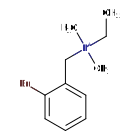
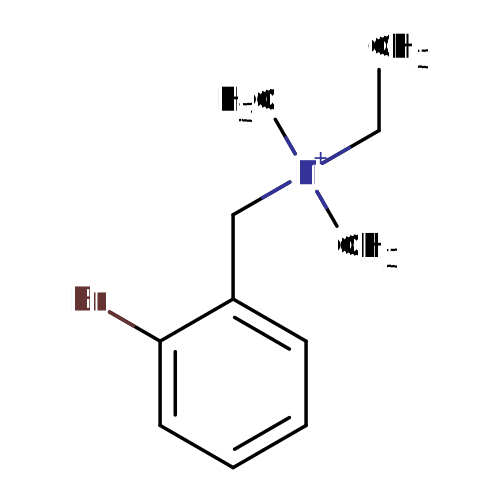
Structure for Bretylium (DB01158)
- Weight
- Average: 243.163
Monoisotopic: 242.054437196 - Chemical Formula
- C11H17BrN
- Synonyms
- (2-bromobenzyl)ethyldimethylaminium
- 2-bromo-N-ethyl-N,N-dimethylbenzenemethanaminium
- Bretylium
- N-ethyl-N,N-dimethyl-2-bromobenzenemethanaminium

Pharmacology
- Indication
For use in the prophylaxis and therapy of ventricular fibrillation. Also used in the treatment of life-threatening ventricular arrhythmias, such as ventricular tachycardia, that have failed to respond to adequate doses of a first-line antiarrhythmic agent, such as lidocaine.
 Reduce drug development failure ratesBuild, train, & validate machine-learning modelswith evidence-based and structured datasets.Build, train, & validate predictive machine-learning models with structured datasets.
- Associated Conditions
Indication Type Indication Combined Product Details Approval Level Age Group Patient Characteristics Dose Form Treatment of Ventricular fibrillation •••••••••••• Treatment of Ventricular tachycardia •••••••••••• - Contraindications & Blackbox Warnings
 Prevent Adverse Drug Events TodayTap into our Clinical API for life-saving information on contraindications & blackbox warnings, population restrictions, harmful risks, & more.Avoid life-threatening adverse drug events with our Clinical API
- Pharmacodynamics
Bretylium is a bromobenzyl quaternary ammonium compound which selectively accumulates in sympathetic ganglia and their postganglionic adrenergic neurons where it inhibits norepinephrine release by depressing adrenergic nerve terminal excitability. Bretylium also suppresses ventricular fibrillation and ventricular arrhythmias.
- Mechanism of action
Bretylium inhibits norepinephrine release by depressing adrenergic nerve terminal excitability. The mechanisms of the antifibrillatory and antiarrhythmic actions of bretylium are not established. In efforts to define these mechanisms, the following electrophysiologic actions of bretylium have been demonstrated in animal experiments: increase in ventricular fibrillation threshold, increase in action potential duration and effective refractory period without changes in heart rate, little effect on the rate of rise or amplitude of the cardiac action potential (Phase 0) or in resting membrane potential (Phase 4) in normal myocardium, decrease in the disparity in action potential duration between normal and infarcted regions, and increase in impulse formation and spontaneous firing rate of pacemaker tissue as well as increase ventricular conduction velocity.
Target Actions Organism ASodium/potassium-transporting ATPase subunit alpha-1 inhibitorHumans - Absorption
Not Available
- Volume of distribution
Not Available
- Protein binding
Not Available
- Metabolism
No metabolites have been identified following administration in man and laboratory animals.
- Route of elimination
Not Available
- Half-life
The terminal half-life in four normal volunteers averaged 7.8±0.6 hours (range 6.9-8.1). During hemodialysis, this patient's arterial and venous bretylium concentrations declined rapidly, resulting in a half-life of 13 hours.
- Clearance
Not Available
- Adverse Effects
 Improve decision support & research outcomesWith structured adverse effects data, including: blackbox warnings, adverse reactions, warning & precautions, & incidence rates. View sample adverse effects data in our new Data Library!Improve decision support & research outcomes with our structured adverse effects data.
- Toxicity
Oral, mouse: LD50 = 400 mg/kg. In the presence of life-threatening arrhythmias, underdosing with bretylium probably presents a greater risk to the patient than potential overdosage. However, one case of accidental overdose has been reported in which a rapidly injected intravenous bolus of 30 mg/kg was given instead of an intended 10 mg/kg dose during an episode of ventricular tachycardia. Marked hypertension resulted, followed by protracted refractory hypotension. The patient expired 18 hours later in asystole, complicated by renal failure and aspiration pneumonitis. Bretylium serum levels were 8000 ng/mL.
- Pathways
- Not Available
- Pharmacogenomic Effects/ADRs
- Not Available
Interactions
- Drug Interactions
- This information should not be interpreted without the help of a healthcare provider. If you believe you are experiencing an interaction, contact a healthcare provider immediately. The absence of an interaction does not necessarily mean no interactions exist.
Drug Interaction Integrate drug-drug
interactions in your softwareAbaloparatide The risk or severity of adverse effects can be increased when Bretylium is combined with Abaloparatide. Acebutolol Bretylium may increase the arrhythmogenic activities of Acebutolol. Aceclofenac The therapeutic efficacy of Bretylium can be decreased when used in combination with Aceclofenac. Acemetacin The therapeutic efficacy of Bretylium can be decreased when used in combination with Acemetacin. Acetyldigitoxin Acetyldigitoxin may increase the arrhythmogenic activities of Bretylium. - Food Interactions
- No interactions found.
Products
 Drug product information from 10+ global regionsOur datasets provide approved product information including:dosage, form, labeller, route of administration, and marketing period.Access drug product information from over 10 global regions.
- Product Ingredients
Ingredient UNII CAS InChI Key Bretylium tosylate 78ZP3YR353 61-75-6 KVWNWTZZBKCOPM-UHFFFAOYSA-M - International/Other Brands
- Anxyrex (Sanofi-Aventis) / Bretylol (ICI) / Bromidem (Nycomed) / Creosedin (AstraZeneca) / Darenthin (Burroughs Wellcome) / Lexotan (Roche) / Xionil (Novartis)
- Brand Name Prescription Products
Name Dosage Strength Route Labeller Marketing Start Marketing End Region Image Bretylate Inj 50mg/ml Liquid 50 mg / mL Intramuscular; Intravenous Glaxo Wellcome 1980-12-31 2000-01-19 Canada 
Bretylium Tosylate Inj 50mg/ml Solution 50 mg / mL Intramuscular; Intravenous Abbott 1991-12-31 2007-07-31 Canada Bretylium Tosylate Injection USP Solution 50 mg / mL Intramuscular; Intravenous Sandoz Canada Incorporated 1995-12-31 2021-04-21 Canada - Generic Prescription Products
Name Dosage Strength Route Labeller Marketing Start Marketing End Region Image Bretylium Tosylate Injection 50 mg/1mL Intramuscular; Intravenous Pharmaceutics International, Inc. (Pii) 2019-06-30 2020-03-12 US 
Bretylium Tosylate Injection 50 mg/1mL Intramuscular; Intravenous ANI Pharmaceuticals, Inc. 2019-12-11 Not applicable US - Mixture Products
Name Ingredients Dosage Route Labeller Marketing Start Marketing End Region Image Bretylium Tosylate 0.2% and Dextrose 5% Inj Bretylium tosylate (2 mg / mL) + Dextrose, unspecified form (50 mg / mL) Solution Intravenous Abbott 1988-12-31 2007-07-31 Canada Bretylium Tosylate 0.4% and Dextrose 5% Inj Bretylium tosylate (4 mg / mL) + Dextrose, unspecified form (50 mg / mL) Solution Intravenous Abbott 1988-12-31 2007-07-31 Canada
Categories
- ATC Codes
- C01BD02 — Bretylium tosilate
- Drug Categories
- Adrenergic Agents
- Adrenergic Antagonists
- Amines
- Antiarrhythmic agents
- Antiarrhythmics, Class III
- Antihypertensive Agents
- Benzylammonium Compounds
- Bradycardia-Causing Agents
- Bretylium Compounds
- Cardiac Therapy
- Cardiovascular Agents
- Hypotensive Agents
- Neurotransmitter Agents
- Potential QTc-Prolonging Agents
- QTc Prolonging Agents
- Quaternary Ammonium Compounds
- Chemical TaxonomyProvided by Classyfire
- Description
- This compound belongs to the class of organic compounds known as phenylmethylamines. These are compounds containing a phenylmethtylamine moiety, which consists of a phenyl group substituted by an methanamine.
- Kingdom
- Organic compounds
- Super Class
- Benzenoids
- Class
- Benzene and substituted derivatives
- Sub Class
- Phenylmethylamines
- Direct Parent
- Phenylmethylamines
- Alternative Parents
- Benzylamines / Bromobenzenes / Aralkylamines / Aryl bromides / Tetraalkylammonium salts / Organopnictogen compounds / Organobromides / Organic salts / Hydrocarbon derivatives / Organic cations
- Substituents
- Amine / Aralkylamine / Aromatic homomonocyclic compound / Aryl bromide / Aryl halide / Benzylamine / Bromobenzene / Halobenzene / Hydrocarbon derivative / Organic cation
- Molecular Framework
- Aromatic homomonocyclic compounds
- External Descriptors
- quaternary ammonium ion (CHEBI:3172)
- Affected organisms
- Humans and other mammals
Chemical Identifiers
- UNII
- RZR75EQ2KJ
- CAS number
- 59-41-6
- InChI Key
- AAQOQKQBGPPFNS-UHFFFAOYSA-N
- InChI
- InChI=1S/C11H17BrN/c1-4-13(2,3)9-10-7-5-6-8-11(10)12/h5-8H,4,9H2,1-3H3/q+1
- IUPAC Name
- [(2-bromophenyl)methyl](ethyl)dimethylazanium
- SMILES
- CC[N+](C)(C)CC1=CC=CC=C1Br
References
- Synthesis Reference
Copp, F.C. and Stephenson, D.; US. Patent 3,038,004; June 5, 1962; assigned to Burroughs Wellcome & Co.
US3038004- General References
- Not Available
- External Links
- Human Metabolome Database
- HMDB0015289
- KEGG Drug
- D00645
- KEGG Compound
- C06855
- PubChem Compound
- 2431
- PubChem Substance
- 46505320
- ChemSpider
- 2337
- BindingDB
- 50239966
- 19685
- ChEBI
- 3172
- ChEMBL
- CHEMBL1199080
- ZINC
- ZINC000000001041
- Therapeutic Targets Database
- DAP000939
- PharmGKB
- PA448662
- RxList
- RxList Drug Page
- Wikipedia
- Bretylium
- MSDS
- Download (73 KB)
Clinical Trials
Pharmacoeconomics
- Manufacturers
- Not Available
- Packagers
- Not Available
- Dosage Forms
Form Route Strength Liquid Intramuscular; Intravenous 50 mg / mL Injection Intramuscular; Intravenous 50 mg/1mL Solution Intravenous Solution Intramuscular; Intravenous 50 mg / mL - Prices
- Not Available
- Patents
- Not Available
Properties
- State
- Solid
- Experimental Properties
Property Value Source melting point (°C) 238 Fryer, R.I., Schmidt, R.A. and Sternbach, L.H.; U.S. Patent 3,100,770; August 13, 1963; assigned to Hoffmann-LaRoche Inc. Fryer, R.I., Schmidt, R.A. and Sternbach, L.H.; U.S. Patent 3,182,065; May 4, 1965; assigned to Hoffmann-LaRoche Inc. Fryer, R.I., Schmidt, R.A. and Sternbach, L.H.; US. Patent 3,182,067; May 4, 1965; assigned to Hoffmann-LaRoche Inc. water solubility Freely soluble Not Available - Predicted Properties
Property Value Source Water Solubility 0.000154 mg/mL ALOGPS logP -1.4 ALOGPS logP -1.1 Chemaxon logS -6.3 ALOGPS pKa (Strongest Acidic) 17.58 Chemaxon Physiological Charge 1 Chemaxon Hydrogen Acceptor Count 0 Chemaxon Hydrogen Donor Count 0 Chemaxon Polar Surface Area 0 Å2 Chemaxon Rotatable Bond Count 3 Chemaxon Refractivity 72.89 m3·mol-1 Chemaxon Polarizability 23.24 Å3 Chemaxon Number of Rings 1 Chemaxon Bioavailability 1 Chemaxon Rule of Five Yes Chemaxon Ghose Filter No Chemaxon Veber's Rule Yes Chemaxon MDDR-like Rule No Chemaxon - Predicted ADMET Features
Property Value Probability Human Intestinal Absorption - 0.8406 Blood Brain Barrier + 0.9484 Caco-2 permeable + 0.6831 P-glycoprotein substrate Substrate 0.5105 P-glycoprotein inhibitor I Non-inhibitor 0.9789 P-glycoprotein inhibitor II Non-inhibitor 0.8742 Renal organic cation transporter Non-inhibitor 0.6279 CYP450 2C9 substrate Non-substrate 0.861 CYP450 2D6 substrate Non-substrate 0.6999 CYP450 3A4 substrate Substrate 0.5132 CYP450 1A2 substrate Non-inhibitor 0.6973 CYP450 2C9 inhibitor Non-inhibitor 0.8505 CYP450 2D6 inhibitor Non-inhibitor 0.8475 CYP450 2C19 inhibitor Non-inhibitor 0.8038 CYP450 3A4 inhibitor Non-inhibitor 0.9752 CYP450 inhibitory promiscuity Low CYP Inhibitory Promiscuity 0.6854 Ames test Non AMES toxic 0.9045 Carcinogenicity Carcinogens 0.5905 Biodegradation Not ready biodegradable 0.9157 Rat acute toxicity 2.6214 LD50, mol/kg Not applicable hERG inhibition (predictor I) Weak inhibitor 0.9291 hERG inhibition (predictor II) Inhibitor 0.6322
Spectra
- Mass Spec (NIST)
- Not Available
- Spectra
Spectrum Spectrum Type Splash Key Predicted GC-MS Spectrum - GC-MS Predicted GC-MS splash10-00or-9660000000-f1a790c5dc75745515bf Predicted 1H NMR Spectrum 1D NMR Not Applicable Predicted 13C NMR Spectrum 1D NMR Not Applicable - Chromatographic Properties
Collision Cross Sections (CCS)
Adduct CCS Value (Å2) Source type Source [M-H]- 130.80302 predictedDeepCCS 1.0 (2019) [M+H]+ 133.19843 predictedDeepCCS 1.0 (2019) [M+Na]+ 141.28175 predictedDeepCCS 1.0 (2019)
Targets

- Kind
- Protein
- Organism
- Humans
- Pharmacological action
- Yes
- Actions
- Inhibitor
- General Function
- Steroid hormone binding
- Specific Function
- This is the catalytic component of the active enzyme, which catalyzes the hydrolysis of ATP coupled with the exchange of sodium and potassium ions across the plasma membrane. This action creates th...
- Gene Name
- ATP1A1
- Uniprot ID
- P05023
- Uniprot Name
- Sodium/potassium-transporting ATPase subunit alpha-1
- Molecular Weight
- 112895.01 Da
References
- Dzimiri N, Almotrefi AA: Inhibition of myocardial Na(+)-K(+)-ATPase activity by bretylium: role of potassium. Arch Int Pharmacodyn Ther. 1992 Jul-Aug;318:76-85. [Article]
- Helms JB, Arnett KL, Gatto C, Milanick MA: Bretylium, an organic quaternary amine, inhibits the Na,K-ATPase by binding to the extracellular K-site. Blood Cells Mol Dis. 2004 May-Jun;32(3):394-400. [Article]
- Dzimiri N, Almotrefi AA: Interaction of bretylium tosylate with guinea-pig myocardial Na(+)-K(+)-ATPase. Gen Pharmacol. 1991;22(5):935-8. [Article]
- Tiku PE, Nowell PT: Selective inhibition of K(+)-stimulation of Na,K-ATPase by bretylium. Br J Pharmacol. 1991 Dec;104(4):895-900. [Article]

Drug created at June 13, 2005 13:24 / Updated at April 27, 2024 09:44