Identification
- Generic Name
- Iophendylate
- DrugBank Accession Number
- DB01187
- Background
Iophendylate is a mixture of isomers used as contrast medium, mainly for brain and spinal cord visualization. Iophendylate is a myelographic oil-ester (U.S. Patent 2,348,231). Iophendylate, which was never shown to be safe, was initially introduced for use in small amounts (1-2cc) for locating spinal tumors. It next appeared on the world scene for high volume (12-15cc), routine use, in diagnosing disc herniations. A number of clinicians have published on the dangers of oil myelography. In 1942 Van Wagenen (a neurosurgical colleague of Warrens, at the University of Rochester) identified Iophendylate as causing chemical meningitis in 30 patients where "space-displacing masses within the spinal canal were suspected".
- Type
- Small Molecule
- Groups
- Approved
- Structure
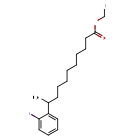
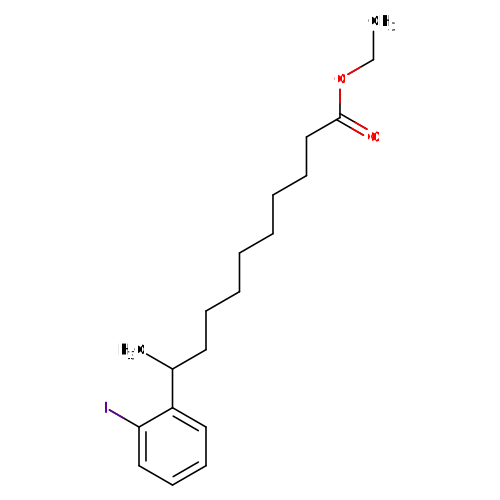
Structure for Iophendylate (DB01187)
- Weight
- Average: 416.3368
Monoisotopic: 416.121223592 - Chemical Formula
- C19H29IO2
- Synonyms
- Ethyl 10-(p-iodophenyl)-undecanoate
- Ethyl 10-(p-iodophenyl)hendecanoate
- Ethyl 10-(p-iodophenyl)undecylate
- Iofendylate

Pharmacology
- Indication
Iophendylate is used as a contrast agent to locate spinal tumors.
 Reduce drug development failure ratesBuild, train, & validate machine-learning modelswith evidence-based and structured datasets.Build, train, & validate predictive machine-learning models with structured datasets.
- Contraindications & Blackbox Warnings
 Prevent Adverse Drug Events TodayTap into our Clinical API for life-saving information on contraindications & blackbox warnings, population restrictions, harmful risks, & more.Avoid life-threatening adverse drug events with our Clinical API
- Pharmacodynamics
Iophendylate is a myelographic oil-ester initially introduced for use in small amounts (1-2cc) for locating spinal tumors. Later, it was found to cause adhesive arachnoiditis. Because these substances are hyperbaric once they were placed in the subarachnoid space they would migrate to the distal portion, where they remained, producing progressive scarring.
- Mechanism of action
Iophendylate has been shown to be both a radiographic and magnetic resonance (MR) contrast agent in patients with suspected cord abnormalities who underwent MR examination following myelography. The iophendylate appears as a linear band of high signal intensity along the dependent portion of the spinal canal on MR images obtained with a repetition time of 500 msec and an echo time of 30 msec.
- Absorption
Not Available
- Volume of distribution
Not Available
- Protein binding
Not Available
- Metabolism
- Not Available
- Route of elimination
Not Available
- Half-life
Not Available
- Clearance
Not Available
- Adverse Effects
 Improve decision support & research outcomesWith structured adverse effects data, including: blackbox warnings, adverse reactions, warning & precautions, & incidence rates. View sample adverse effects data in our new Data Library!Improve decision support & research outcomes with our structured adverse effects data.
- Toxicity
Not Available
- Pathways
- Not Available
- Pharmacogenomic Effects/ADRs
- Not Available
Interactions
- Drug Interactions
- This information should not be interpreted without the help of a healthcare provider. If you believe you are experiencing an interaction, contact a healthcare provider immediately. The absence of an interaction does not necessarily mean no interactions exist.Not Available
- Food Interactions
- Not Available
Products
 Drug product information from 10+ global regionsOur datasets provide approved product information including:dosage, form, labeller, route of administration, and marketing period.Access drug product information from over 10 global regions.
- International/Other Brands
- Ethiodan / Pantopaque
Categories
- ATC Codes
- V08AD04 — Iofendylate
- Drug Categories
- Chemical TaxonomyProvided by Classyfire
- Description
- This compound belongs to the class of organic compounds known as iodobenzenes. These are aromatic compounds containing one or more iodine atoms attached to a benzene.
- Kingdom
- Organic compounds
- Super Class
- Benzenoids
- Class
- Benzene and substituted derivatives
- Sub Class
- Halobenzenes
- Direct Parent
- Iodobenzenes
- Alternative Parents
- Fatty acid esters / Aryl iodides / Carboxylic acid esters / Monocarboxylic acids and derivatives / Organoiodides / Organic oxides / Hydrocarbon derivatives / Carbonyl compounds
- Substituents
- Aromatic homomonocyclic compound / Aryl halide / Aryl iodide / Carbonyl group / Carboxylic acid derivative / Carboxylic acid ester / Fatty acid ester / Fatty acyl / Hydrocarbon derivative / Iodobenzene
- Molecular Framework
- Aromatic homomonocyclic compounds
- External Descriptors
- Not Available
- Affected organisms
- Humans and other mammals
Chemical Identifiers
- UNII
- 5153M06QEA
- CAS number
- 99-79-6
- InChI Key
- IWRUDYQZPTVTPA-UHFFFAOYSA-N
- InChI
- InChI=1S/C19H29IO2/c1-3-22-19(21)15-9-7-5-4-6-8-12-16(2)17-13-10-11-14-18(17)20/h10-11,13-14,16H,3-9,12,15H2,1-2H3
- IUPAC Name
- ethyl 10-(2-iodophenyl)undecanoate
- SMILES
- CCOC(=O)CCCCCCCCC(C)C1=CC=CC=C1I
References
- Synthesis Reference
U.S. Patent 2,348,231.
- General References
- Not Available
- External Links
- Human Metabolome Database
- HMDB0015318
- PubChem Compound
- 3037234
- PubChem Substance
- 46508391
- ChemSpider
- 2301035
- 5968
- ChEMBL
- CHEMBL951
- PharmGKB
- PA164743143
- Wikipedia
- Iofendylate
Clinical Trials
Pharmacoeconomics
- Manufacturers
- Not Available
- Packagers
- Not Available
- Dosage Forms
- Not Available
- Prices
- Not Available
- Patents
- Not Available
Properties
- State
- Liquid
- Experimental Properties
Property Value Source boiling point (°C) 196-198 U.S. Patent 2,348,231. logP 7.7 Not Available - Predicted Properties
Property Value Source Water Solubility 2.52e-05 mg/mL ALOGPS logP 6.79 ALOGPS logP 6.89 Chemaxon logS -7.2 ALOGPS pKa (Strongest Basic) -7 Chemaxon Physiological Charge 0 Chemaxon Hydrogen Acceptor Count 1 Chemaxon Hydrogen Donor Count 0 Chemaxon Polar Surface Area 26.3 Å2 Chemaxon Rotatable Bond Count 12 Chemaxon Refractivity 101.6 m3·mol-1 Chemaxon Polarizability 41.29 Å3 Chemaxon Number of Rings 1 Chemaxon Bioavailability 0 Chemaxon Rule of Five No Chemaxon Ghose Filter No Chemaxon Veber's Rule No Chemaxon MDDR-like Rule No Chemaxon - Predicted ADMET Features
Property Value Probability Human Intestinal Absorption + 0.988 Blood Brain Barrier + 0.9833 Caco-2 permeable + 0.7406 P-glycoprotein substrate Non-substrate 0.6152 P-glycoprotein inhibitor I Non-inhibitor 0.8451 P-glycoprotein inhibitor II Non-inhibitor 0.9207 Renal organic cation transporter Non-inhibitor 0.8298 CYP450 2C9 substrate Non-substrate 0.863 CYP450 2D6 substrate Non-substrate 0.8373 CYP450 3A4 substrate Non-substrate 0.553 CYP450 1A2 substrate Inhibitor 0.7452 CYP450 2C9 inhibitor Non-inhibitor 0.7188 CYP450 2D6 inhibitor Non-inhibitor 0.8414 CYP450 2C19 inhibitor Non-inhibitor 0.6081 CYP450 3A4 inhibitor Non-inhibitor 0.8839 CYP450 inhibitory promiscuity Low CYP Inhibitory Promiscuity 0.5831 Ames test Non AMES toxic 0.9126 Carcinogenicity Non-carcinogens 0.7268 Biodegradation Not ready biodegradable 0.8676 Rat acute toxicity 2.4999 LD50, mol/kg Not applicable hERG inhibition (predictor I) Weak inhibitor 0.8919 hERG inhibition (predictor II) Non-inhibitor 0.6457
Spectra
- Mass Spec (NIST)
- Not Available
- Spectra
Spectrum Spectrum Type Splash Key Predicted GC-MS Spectrum - GC-MS Predicted GC-MS splash10-001i-2393000000-c63b6b1c060a30fc786c Predicted MS/MS Spectrum - 10V, Positive (Annotated) Predicted LC-MS/MS splash10-01bj-3937200000-52534d239c20abf43e4a Predicted MS/MS Spectrum - 10V, Negative (Annotated) Predicted LC-MS/MS splash10-014i-0135900000-e3d42a9d6c055733231d Predicted MS/MS Spectrum - 20V, Negative (Annotated) Predicted LC-MS/MS splash10-00or-2916000000-2e6ebe791054a5a4a165 Predicted MS/MS Spectrum - 20V, Positive (Annotated) Predicted LC-MS/MS splash10-0079-2921000000-bb08106026d6727ac017 Predicted MS/MS Spectrum - 40V, Negative (Annotated) Predicted LC-MS/MS splash10-00ko-1495000000-1cbf9b5343efd185063b Predicted MS/MS Spectrum - 40V, Positive (Annotated) Predicted LC-MS/MS splash10-001i-5970000000-0d02e6c8fdf07ac31917 Predicted 1H NMR Spectrum 1D NMR Not Applicable Predicted 13C NMR Spectrum 1D NMR Not Applicable - Chromatographic Properties
Collision Cross Sections (CCS)
Adduct CCS Value (Å2) Source type Source [M-H]- 203.5463153 predictedDarkChem Lite v0.1.0 [M-H]- 182.60248 predictedDeepCCS 1.0 (2019) [M+H]+ 204.2849153 predictedDarkChem Lite v0.1.0 [M+H]+ 184.96046 predictedDeepCCS 1.0 (2019) [M+Na]+ 203.7823153 predictedDarkChem Lite v0.1.0 [M+Na]+ 191.12912 predictedDeepCCS 1.0 (2019)

Drug created at June 13, 2005 13:24 / Updated at May 07, 2021 21:26