Identification
- Summary
Dantrolene is a direct-acting skeletal muscle relaxant used for the treatment of management of the fulminant hypermetabolism of skeletal muscle leading to malignant hyperthermia crisis.
- Brand Names
- Dantrium, Revonto, Ryanodex
- Generic Name
- Dantrolene
- DrugBank Accession Number
- DB01219
- Background
Chemically, dantrolene is a hydantoin derivative, but does not exhibit antiepileptic activity like other hydantoin derivates such as phenytoin.
- Type
- Small Molecule
- Groups
- Approved, Investigational
- Structure
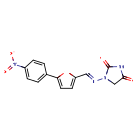
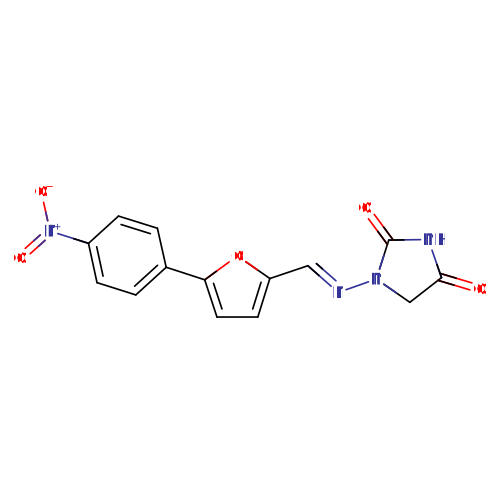
Structure for Dantrolene (DB01219)
- Weight
- Average: 314.257
Monoisotopic: 314.065119438 - Chemical Formula
- C14H10N4O5
- Synonyms
- 1-((5-(p-nitrophenyl)furfurylidene)amino)hydantoin
- Dantrolene
- Dantroleno
- Dantrolenum

Pharmacology
- Indication
For use, along with appropriate supportive measures, for the management of the fulminant hypermetabolism of skeletal muscle characteristic of malignant hyperthermia crises in patients of all ages. Also used preoperatively, and sometimes postoperatively, to prevent or attenuate the development of clinical and laboratory signs of malignant hyperthermia in individuals judged to be malignant hyperthermia susceptible.
 Reduce drug development failure ratesBuild, train, & validate machine-learning modelswith evidence-based and structured datasets.Build, train, & validate predictive machine-learning models with structured datasets.
- Associated Conditions
Indication Type Indication Combined Product Details Approval Level Age Group Patient Characteristics Dose Form Management of Malignant hyperthermia •••••••••••• Prophylaxis of Malignant hyperthermia •••••••••••• Treatment of Spasticity •••••••••••• Treatment of Spasticity •••••••••••• Treatment of Spasticity •••••••••••• - Contraindications & Blackbox Warnings
 Prevent Adverse Drug Events TodayTap into our Clinical API for life-saving information on contraindications & blackbox warnings, population restrictions, harmful risks, & more.Avoid life-threatening adverse drug events with our Clinical API
- Pharmacodynamics
Dantrolene is classified as a direct-acting skeletal muscle relaxant. It is currently the only specific and effective treatment for malignant hyperthermia. In isolated nerve-muscle preparation, Dantrium has been shown to produce relaxation by affecting the contractile response of the muscle at a site beyond the myoneural junction. In skeletal muscle, Dantrium dissociates excitation-contraction coupling, probably by interfering with the release of Ca2+ from the sarcoplasmic reticulum. In the anesthetic-induced malignant hyperthermia syndrome, evidence points to an intrinsic abnormality of skeletal muscle tissue. In selected humans, it has been postulated that “triggering agents” (e.g.,general anesthetics and depolarizing neuromuscular blocking agents) produce a change within the cell which results in an elevated myoplasmic calcium. This elevated myoplasmic calcium activates acute cellular catabolic processes that cascade to the malignant hyperthermia crisis. It is hypothesized that addition of Dantrium to the “triggered” malignant hyperthermic muscle cell reestablishes a normal level of ionized calcium in the myoplasm.
- Mechanism of action
Dantrolene depresses excitation-contraction coupling in skeletal muscle by binding to the ryanodine receptor 1, and decreasing intracellular calcium concentration. Ryanodine receptors mediate the release of calcium from the sarcoplasmic reticulum, an essential step in muscle contraction.
Target Actions Organism ARyanodine receptor 1 antagonistHumans - Absorption
Bioavailability is 70%.
- Volume of distribution
Not Available
- Protein binding
Significant, mostly to albumin.
- Metabolism
Hepatic, most likely by hepatic microsomal enzymes. Its major metabolites in body fluids are 5-hydroxydantrolene and an acetylamino metabolite of dantrolene. Another metabolite with an unknown structure appears related to the latter. Dantrium may also undergo hydrolysis and subsequent oxidation forming nitrophenylfuroic acid.
Hover over products below to view reaction partners
- Route of elimination
Not Available
- Half-life
The mean biologic half-life after intravenous administration is variable, between 4 to 8 hours under most experimental conditions, while oral is 8.7 hours for a 100mg dose.
- Clearance
Not Available
- Adverse Effects
 Improve decision support & research outcomesWith structured adverse effects data, including: blackbox warnings, adverse reactions, warning & precautions, & incidence rates. View sample adverse effects data in our new Data Library!Improve decision support & research outcomes with our structured adverse effects data.
- Toxicity
Oral LD50 in rats is 7400 mg/kg. Symptoms which may occur in case of overdose include, but are not limited to, muscular weakness and alterations in the state of consciousness (e.g., lethargy, coma), vomiting, diarrhea, and crystalluria.
- Pathways
- Not Available
- Pharmacogenomic Effects/ADRs
- Not Available
Interactions
- Drug Interactions
- This information should not be interpreted without the help of a healthcare provider. If you believe you are experiencing an interaction, contact a healthcare provider immediately. The absence of an interaction does not necessarily mean no interactions exist.
Drug Interaction Integrate drug-drug
interactions in your software1,2-Benzodiazepine The risk or severity of CNS depression can be increased when Dantrolene is combined with 1,2-Benzodiazepine. Acebutolol The risk or severity of hyperkalemia can be increased when Acebutolol is combined with Dantrolene. Aceclofenac The risk or severity of hyperkalemia can be increased when Dantrolene is combined with Aceclofenac. Acemetacin The risk or severity of hyperkalemia can be increased when Dantrolene is combined with Acemetacin. Acetazolamide The risk or severity of CNS depression can be increased when Acetazolamide is combined with Dantrolene. - Food Interactions
- Take with or without food. The absorption is unaffected by food.
Products
 Drug product information from 10+ global regionsOur datasets provide approved product information including:dosage, form, labeller, route of administration, and marketing period.Access drug product information from over 10 global regions.
- Product Ingredients
Ingredient UNII CAS InChI Key Dantrolene sodium 287M0347EV 24868-20-0 LTWQNYPDAUSXBC-CDJGKPBYSA-L - Product Images

- International/Other Brands
- Dantamacrin (Spepharm)
- Brand Name Prescription Products
Name Dosage Strength Route Labeller Marketing Start Marketing End Region Image Dantrium Capsule 50 mg/1 Oral Par Pharmaceutical, Inc. 2008-08-01 2022-02-28 US 
Dantrium Injection 20 mg/60mL Intravenous Procter and Gamble Pharmaceuticals 2006-02-06 Not applicable US Dantrium Capsule 25 mg/1 Oral Procter & Gamble Pharmaceuticals 2006-03-28 Not applicable US Dantrium Capsule 25 mg/1 Oral Par Pharmaceutical, Inc. 2008-08-01 Not applicable US Dantrium Capsule 100 mg/1 Oral Procter & Gamble Pharmaceuticals 2006-03-28 Not applicable US - Generic Prescription Products
Name Dosage Strength Route Labeller Marketing Start Marketing End Region Image Dantrolene Injection, powder, for solution 20 mg/1 Intravenous Hikma Pharmaceuticals USA Inc. 2017-06-19 Not applicable US Dantrolene Sodium Capsule 25 mg/1 Oral bryant ranch prepack 2016-03-28 Not applicable US Dantrolene Sodium Capsule 25 mg/1 Oral Amneal Pharmaceuticals of New York Llc 2005-03-01 Not applicable US Dantrolene Sodium Capsule 25 mg/1 Oral bryant ranch prepack 2016-03-28 Not applicable US Dantrolene Sodium Capsule 100 mg/1 Oral bryant ranch prepack 2005-10-26 Not applicable US

Categories
- ATC Codes
- M03CA01 — Dantrolene
- Drug Categories
- Agents causing hyperkalemia
- Agents that produce neuromuscular block (indirect)
- Central Nervous System Agents
- Central Nervous System Depressants
- Dantrolene and Derivatives
- Decreased Striated Muscle Contraction
- Decreased Striated Muscle Tone
- Direct-acting Skeletal Muscle Relaxants
- Hepatotoxic Agents
- Hydantoins
- Imidazoles
- Imidazolidines
- Muscle Relaxants
- Muscle Relaxants, Centrally Acting Agents
- Musculo-Skeletal System
- Neuromuscular Agents
- Peripheral Nervous System Agents
- Thyroxine-binding globulin substrates
- Classification
- Not classified
- Affected organisms
- Humans and other mammals
Chemical Identifiers
- UNII
- F64QU97QCR
- CAS number
- 7261-97-4
- InChI Key
- OZOMQRBLCMDCEG-VIZOYTHASA-N
- InChI
- InChI=1S/C14H10N4O5/c19-13-8-17(14(20)16-13)15-7-11-5-6-12(23-11)9-1-3-10(4-2-9)18(21)22/h1-7H,8H2,(H,16,19,20)/b15-7+
- IUPAC Name
- 1-[(E)-{[5-(4-nitrophenyl)furan-2-yl]methylidene}amino]imidazolidine-2,4-dione
- SMILES
- [O-][N+](=O)C1=CC=C(C=C1)C1=CC=C(O1)\C=N\N1CC(=O)NC1=O
References
- Synthesis Reference
Davis, C.S. and Snyder, H.R. Jr.; US. Patent 3,415,821; December 10, 1968; assigned to The Norwich Pharmacal Company.
- General References
- Krause T, Gerbershagen MU, Fiege M, Weisshorn R, Wappler F: Dantrolene--a review of its pharmacology, therapeutic use and new developments. Anaesthesia. 2004 Apr;59(4):364-73. [Article]
- External Links
- KEGG Drug
- D02347
- KEGG Compound
- C06939
- PubChem Compound
- 6914273
- PubChem Substance
- 46504976
- ChemSpider
- 5290202
- BindingDB
- 50198767
- 3105
- ChEBI
- 4317
- ChEMBL
- CHEMBL1201288
- ZINC
- ZINC000002568036
- Therapeutic Targets Database
- DNC001623
- PharmGKB
- PA449208
- Guide to Pharmacology
- GtP Drug Page
- RxList
- RxList Drug Page
- Drugs.com
- Drugs.com Drug Page
- Wikipedia
- Dantrolene
- MSDS
- Download (43 KB)
Clinical Trials
- Clinical Trials
Phase Status Purpose Conditions Count 2 Completed Treatment Heat Stroke 1 2 Recruiting Basic Science Healthy Volunteers (HV) 1 2 Recruiting Treatment Lumbar Spine Injury 1 2 Terminated Treatment Drug Toxicity Psychotropic Agents Psychostimulants 1 2, 3 Active Not Recruiting Treatment Ventricular Tachycardia (VT) 1
Pharmacoeconomics
- Manufacturers
- Not Available
- Packagers
- Amerisource Health Services Corp.
- DSM Corp.
- Global Pharmaceuticals
- JHP Pharmaceuticals LLC
- Kaiser Foundation Hospital
- Medisca Inc.
- Murfreesboro Pharmaceutical Nursing Supply
- Norwich Pharmaceuticals Inc.
- Southwood Pharmaceuticals
- US WorldMeds
- Warner Chilcott Co. Inc.
- Dosage Forms
Form Route Strength Capsule Oral Capsule Oral 100 mg/1 Capsule Oral 25 mg/1 Capsule Oral 50 mg/1 Injection Intravenous 20 mg/60mL Injection, powder, for solution Intravenous Powder, for solution Intravenous Syrup Capsule Oral 100 mg Capsule Oral 25 mg Powder, for solution Intravenous 20 mg / vial Injection, powder, for solution Parenteral 20 mg Injection, powder, for solution Intravenous 20 mg/1 Injection, solution Intravenous 20 mg/60mL Injection, powder, lyophilized, for solution Intravenous 20 mg/60mL Injection, suspension Intravenous 250 mg/5mL - Prices
Unit description Cost Unit Dantrium 20 mg vial 106.37USD vial Dantrolene sodium 20 mg vial 97.2USD vial Dantrolene sodium powder 17.6USD g Dantrium 100 mg capsule 2.4USD capsule Dantrolene sodium 100 mg capsule 2.03USD capsule Dantrium 50 mg capsule 1.93USD capsule Dantrolene sodium 50 mg capsule 1.63USD capsule Dantrium 25 mg capsule 1.29USD capsule Dantrolene sodium 25 mg capsule 1.09USD capsule Dantrium 100 mg Capsule 0.8USD capsule Dantrium 25 mg Capsule 0.4USD capsule DrugBank does not sell nor buy drugs. Pricing information is supplied for informational purposes only.- Patents
Patent Number Pediatric Extension Approved Expires (estimated) Region US8685460 No 2014-04-01 2023-02-15 US US7758890 No 2010-07-20 2025-07-01 US US8110225 No 2012-02-07 2022-12-24 US US8604072 No 2013-12-10 2022-12-24 US US9884044 No 2018-02-06 2022-06-13 US
Properties
- State
- Solid
- Experimental Properties
Property Value Source melting point (°C) 279-280 °C Davis, C.S. and Snyder, H.R. Jr.; US. Patent 3,415,821; December 10, 1968; assigned to The Norwich Pharmacal Company. water solubility Low (146 mg/L) Not Available logP 1.70 JANSEN,ACA ET AL. (1991) - Predicted Properties
Property Value Source Water Solubility 0.0805 mg/mL ALOGPS logP 1.65 ALOGPS logP 1.26 Chemaxon logS -3.6 ALOGPS pKa (Strongest Acidic) 8.23 Chemaxon pKa (Strongest Basic) -1.3 Chemaxon Physiological Charge 0 Chemaxon Hydrogen Acceptor Count 5 Chemaxon Hydrogen Donor Count 1 Chemaxon Polar Surface Area 118.05 Å2 Chemaxon Rotatable Bond Count 4 Chemaxon Refractivity 77.87 m3·mol-1 Chemaxon Polarizability 30.02 Å3 Chemaxon Number of Rings 3 Chemaxon Bioavailability 1 Chemaxon Rule of Five Yes Chemaxon Ghose Filter Yes Chemaxon Veber's Rule No Chemaxon MDDR-like Rule No Chemaxon - Predicted ADMET Features
Property Value Probability Human Intestinal Absorption + 0.9974 Blood Brain Barrier + 0.9581 Caco-2 permeable - 0.5587 P-glycoprotein substrate Non-substrate 0.6562 P-glycoprotein inhibitor I Non-inhibitor 0.8977 P-glycoprotein inhibitor II Non-inhibitor 0.978 Renal organic cation transporter Non-inhibitor 0.8656 CYP450 2C9 substrate Non-substrate 0.81 CYP450 2D6 substrate Non-substrate 0.8935 CYP450 3A4 substrate Substrate 0.5848 CYP450 1A2 substrate Inhibitor 0.8916 CYP450 2C9 inhibitor Non-inhibitor 0.8808 CYP450 2D6 inhibitor Non-inhibitor 0.9203 CYP450 2C19 inhibitor Non-inhibitor 0.8752 CYP450 3A4 inhibitor Non-inhibitor 0.8985 CYP450 inhibitory promiscuity Low CYP Inhibitory Promiscuity 0.7676 Ames test AMES toxic 0.8925 Carcinogenicity Non-carcinogens 0.8732 Biodegradation Ready biodegradable 0.5901 Rat acute toxicity 2.5390 LD50, mol/kg Not applicable hERG inhibition (predictor I) Weak inhibitor 0.7215 hERG inhibition (predictor II) Non-inhibitor 0.9223
Spectra
- Mass Spec (NIST)
- Not Available
- Spectra
Spectrum Spectrum Type Splash Key Predicted 1H NMR Spectrum 1D NMR Not Applicable Predicted 13C NMR Spectrum 1D NMR Not Applicable - Chromatographic Properties
Collision Cross Sections (CCS)
Adduct CCS Value (Å2) Source type Source [M-H]- 178.78424 predictedDeepCCS 1.0 (2019) [M+H]+ 181.14223 predictedDeepCCS 1.0 (2019) [M+Na]+ 187.53716 predictedDeepCCS 1.0 (2019)
Targets

- Kind
- Protein
- Organism
- Humans
- Pharmacological action
- Yes
- Actions
- Antagonist
- General Function
- Voltage-gated calcium channel activity
- Specific Function
- Calcium channel that mediates the release of Ca(2+) from the sarcoplasmic reticulum into the cytoplasm and thereby plays a key role in triggering muscle contraction following depolarization of T-tu...
- Gene Name
- RYR1
- Uniprot ID
- P21817
- Uniprot Name
- Ryanodine receptor 1
- Molecular Weight
- 565170.715 Da
References
- Britt BA, Scott E, Frodis W, Clements MJ, Endrenyi L: Dantrolene--in vitro studies in malignant hyperthermia susceptible (MHS) and normal skeletal muscle. Can Anaesth Soc J. 1984 Mar;31(2):130-54. [Article]
- Harrison GG: Control of the malignant hyperpyrexic syndrome in MHS swine by dantrolene sodium. 1975. Br J Anaesth. 1998 Oct;81(4):626-9; discussion 625. [Article]
- Flewellen EH, Nelson TE: Dantrolene dose response in malignant hyperthermia-susceptible (MHS) swine: method to obtain prophylaxis and therapeusis. Anesthesiology. 1980 Apr;52(4):303-8. [Article]
- Tonner PH, Scholz J, Richter A, Loscher W, Steinfath M, Wappler F, Wlaz P, Hadji B, Roewer N, Schulte am Esch J: Alterations of inositol polyphosphates in skeletal muscle during porcine malignant hyperthermia. Br J Anaesth. 1995 Oct;75(4):467-71. [Article]
- Zhao X, Weisleder N, Han X, Pan Z, Parness J, Brotto M, Ma J: Azumolene inhibits a component of store-operated calcium entry coupled to the skeletal muscle ryanodine receptor. J Biol Chem. 2006 Nov 3;281(44):33477-86. Epub 2006 Aug 31. [Article]
- Krause T, Gerbershagen MU, Fiege M, Weisshorn R, Wappler F: Dantrolene--a review of its pharmacology, therapeutic use and new developments. Anaesthesia. 2004 Apr;59(4):364-73. [Article]
- Gerbershagen MU, Fiege M, Krause T, Agarwal K, Wappler F: [Dantrolene. Pharmacological and therapeutic aspects]. Anaesthesist. 2003 Mar;52(3):238-45. [Article]
- Paul-Pletzer K, Yamamoto T, Bhat MB, Ma J, Ikemoto N, Jimenez LS, Morimoto H, Williams PG, Parness J: Identification of a dantrolene-binding sequence on the skeletal muscle ryanodine receptor. J Biol Chem. 2002 Sep 20;277(38):34918-23. Epub 2002 Jul 11. [Article]
- Chen X, Ji ZL, Chen YZ: TTD: Therapeutic Target Database. Nucleic Acids Res. 2002 Jan 1;30(1):412-5. [Article]
Carriers
- Kind
- Protein
- Organism
- Humans
- Pharmacological action
- No
- Actions
- Substrate
- General Function
- Serine-type endopeptidase inhibitor activity
- Specific Function
- Major thyroid hormone transport protein in serum.
- Gene Name
- SERPINA7
- Uniprot ID
- P05543
- Uniprot Name
- Thyroxine-binding globulin
- Molecular Weight
- 46324.12 Da
References
- CYTOMEL (liothyronine) FDA label [File]

Drug created at June 13, 2005 13:24 / Updated at April 27, 2024 09:44