Identification
- Summary
Phendimetrazine is a sympathomimetic amine used as adjunct therapy for the short term management of exogenous obesity.
- Brand Names
- Fendique
- Generic Name
- Phendimetrazine
- DrugBank Accession Number
- DB01579
- Background
Phendimetrazine is a weight loss medication. Phendimetrazine is chemically related to amphetamines and is a Schedule III drug under the Convention on Psychotropic Substances and in the US since 1970.
- Type
- Small Molecule
- Groups
- Approved, Illicit
- Structure
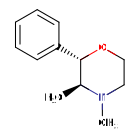
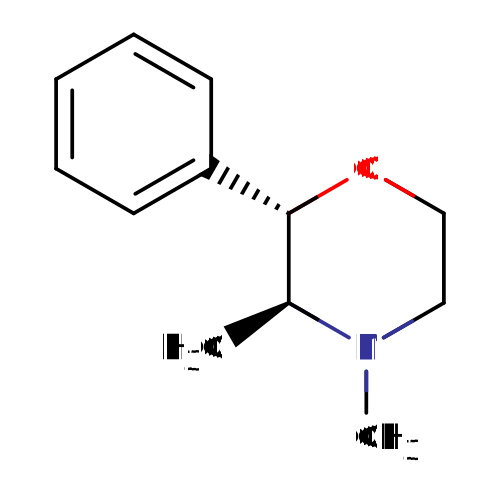
Structure for Phendimetrazine (DB01579)
- Weight
- Average: 191.274
Monoisotopic: 191.131014171 - Chemical Formula
- C12H17NO
- Synonyms
- (2S,3S)-3,4-dimethyl-2-phenylmorpholine
- Phendimetrazine

Pharmacology
- Indication
Used in the management of exogenous obesity as a short term adjunct (a few weeks) in a regimen of weight reduction based on caloric restriction.
 Reduce drug development failure ratesBuild, train, & validate machine-learning modelswith evidence-based and structured datasets.Build, train, & validate predictive machine-learning models with structured datasets.
- Associated Conditions
Indication Type Indication Combined Product Details Approval Level Age Group Patient Characteristics Dose Form Management of Exogenous obesity •••••••••••• - Contraindications & Blackbox Warnings
 Prevent Adverse Drug Events TodayTap into our Clinical API for life-saving information on contraindications & blackbox warnings, population restrictions, harmful risks, & more.Avoid life-threatening adverse drug events with our Clinical API
- Pharmacodynamics
Phendimetrazine is a phenylalkylamine sympathomimetic amine with pharmacological activity similar to the prototype drugs of this class used in obesity, the amphetamines. Actions include central nervous system stimulation and elevation of blood pressure. Tachyphylaxis and tolerance has been demonstrated with all drugs of this class in which these phenomena have been looked for. Drugs of this class used in obesity are commonly known as ''anorectics or anorexigenics." It has not been established, however, that the action of such drugs in treating obesity is primarily one of appetite suppression. Other central nervous system actions or metabolic effects, may be involved.
- Mechanism of action
Phendimetrazine may act in a similar way to amphetamines in that it activates the alpha-adrenergic system to induce an appetite suppressive and metabolic increase effect. The drug also acts as a norepinephrine-dopamine releasing agent (NDRA). It can bind to and reverse the NET.
Target Actions Organism AAlpha-1A adrenergic receptor agonistHumans ASodium-dependent noradrenaline transporter negative modulatorHumans UAlpha-1B adrenergic receptor agonistHumans - Absorption
Peak plasma levels occur within 1 to 3 hours. Absorption is usually complete by 4 to 6 hours.
- Volume of distribution
Not Available
- Protein binding
Not Available
- Metabolism
Approximately 30% of a given dose of phendimetrazine is metabolized into phenmetrazine, which may account for part of its anorectic effect, and probably also influences abuse potential; individuals who metabolise a greater proportion of phendimetrazine into phenmetrazine are more likely to develop problems with dependence and addiction
Hover over products below to view reaction partners
- Route of elimination
The major route of elimination is via the kidneys where most of the drug and metabolites are excreted.
- Half-life
19-24 hours
- Clearance
Not Available
- Adverse Effects
 Improve decision support & research outcomesWith structured adverse effects data, including: blackbox warnings, adverse reactions, warning & precautions, & incidence rates. View sample adverse effects data in our new Data Library!Improve decision support & research outcomes with our structured adverse effects data.
- Toxicity
Acute overdosage of phendimetrazine may manifest itself by the following signs and symptoms: unusual restlessness, confusion, belligerance, hallucinations, and panic states. Fatigue and depression usually follow the central stimulation. Cardiovascular effects include arrhythmias, hypertension, or hypotension and circulatory collapse. Gastrointestinal symptoms include nausea, vomiting, diarrhea, and abdominal cramps. Poisoning may result in convulsions, coma and death.
- Pathways
- Not Available
- Pharmacogenomic Effects/ADRs
- Not Available
Interactions
- Drug Interactions
- This information should not be interpreted without the help of a healthcare provider. If you believe you are experiencing an interaction, contact a healthcare provider immediately. The absence of an interaction does not necessarily mean no interactions exist.
Drug Interaction Integrate drug-drug
interactions in your softwareAcebutolol The therapeutic efficacy of Acebutolol can be decreased when used in combination with Phendimetrazine. Aceclofenac The risk or severity of hypertension can be increased when Phendimetrazine is combined with Aceclofenac. Acemetacin The risk or severity of hypertension can be increased when Phendimetrazine is combined with Acemetacin. Acetazolamide Acetazolamide may decrease the excretion rate of Phendimetrazine which could result in a higher serum level. Acetophenazine Acetophenazine may decrease the stimulatory activities of Phendimetrazine. - Food Interactions
- Take separate from meals. Take phendimetrazine one hour before eating.
Products
 Drug product information from 10+ global regionsOur datasets provide approved product information including:dosage, form, labeller, route of administration, and marketing period.Access drug product information from over 10 global regions.
- Product Ingredients
Ingredient UNII CAS InChI Key Phendimetrazine tartrate 6985IP0T80 50-58-8 VEPOHXYIFQMVHW-PVJVQHJQSA-N - Product Images
- International/Other Brands
- Adipost / Melfiat / Statobex
- Brand Name Prescription Products
Name Dosage Strength Route Labeller Marketing Start Marketing End Region Image Fendique ER Capsule, extended release 105 mg/1 Oral Virtus Pharmaceuticals, LLC 2020-03-18 Not applicable US 
Phendimetrazine Tartrate Capsule, extended release 105 mg/1 Oral PD-Rx Pharmaceuticals, Inc. 2018-07-01 Not applicable US Phendimetrazine Tartrate Capsule, extended release 105 mg/1 Oral Nucare Pharmaceuticals, Inc. 1977-09-06 Not applicable US Phendimetrazine Tartrate Capsule, extended release 105 mg/1 Oral A S Medication Solutions 1977-09-06 Not applicable US 
Phendimetrazine Tartrate Capsule, extended release 105 mg/1 Oral A-S Medication Solutions 1977-09-06 2019-06-30 US 
- Generic Prescription Products
Name Dosage Strength Route Labeller Marketing Start Marketing End Region Image Bontril Capsule 105 mg/1 Oral Valeant Pharmaceuticals 1982-09-21 2012-08-31 US Bontril Capsule 105 mg/1 Oral Apotheca, Inc. 1982-09-21 2012-08-31 US Bontril PDM Tablet 35 mg/1 Oral Valeant Pharmaceuticals 1976-12-22 2015-07-31 US Phendimetrazine Tablet 35 mg/1 Oral Northwind Pharmaceuticals 2015-04-22 Not applicable US Phendimetrazine Tartrate Tablet 35 mg/1 Oral A-S Medication Solutions 2018-07-01 Not applicable US


Categories
- Drug Categories
- Adrenergic Agonists
- Adrenergic alpha-1 Receptor Agonists
- Adrenergic alpha-Agonists
- Agents producing tachycardia
- Agents that produce hypertension
- Amphetamines
- Appetite Suppression
- Central Nervous System Agents
- Central Nervous System Stimulants
- Increased Sympathetic Activity
- Oxazines
- Sympathomimetic Amine Anorectic
- Sympathomimetics
- Chemical TaxonomyProvided by Classyfire
- Description
- This compound belongs to the class of organic compounds known as phenylmorpholines. These are aromatic compounds containing a morpholine ring and a benzene ring linked to each other through a CC or a CN bond.
- Kingdom
- Organic compounds
- Super Class
- Organoheterocyclic compounds
- Class
- Oxazinanes
- Sub Class
- Morpholines
- Direct Parent
- Phenylmorpholines
- Alternative Parents
- Aralkylamines / Benzene and substituted derivatives / Trialkylamines / Oxacyclic compounds / Dialkyl ethers / Azacyclic compounds / Organopnictogen compounds / Hydrocarbon derivatives
- Substituents
- Amine / Aralkylamine / Aromatic heteromonocyclic compound / Azacycle / Benzenoid / Dialkyl ether / Ether / Hydrocarbon derivative / Monocyclic benzene moiety / Organic nitrogen compound
- Molecular Framework
- Aromatic heteromonocyclic compounds
- External Descriptors
- morpholines (CHEBI:8059)
- Affected organisms
- Humans and other mammals
Chemical Identifiers
- UNII
- AB2794W8KV
- CAS number
- 634-03-7
- InChI Key
- MFOCDFTXLCYLKU-CMPLNLGQSA-N
- InChI
- InChI=1S/C12H17NO/c1-10-12(14-9-8-13(10)2)11-6-4-3-5-7-11/h3-7,10,12H,8-9H2,1-2H3/t10-,12+/m0/s1
- IUPAC Name
- (2S,3S)-3,4-dimethyl-2-phenylmorpholine
- SMILES
- C[C@H]1[C@@H](OCCN1C)C1=CC=CC=C1
References
- General References
- Not Available
- External Links
- KEGG Drug
- D08347
- KEGG Compound
- C07904
- PubChem Compound
- 30487
- PubChem Substance
- 46506122
- ChemSpider
- 28295
- 33272
- ChEBI
- 8059
- ChEMBL
- CHEMBL1615439
- ZINC
- ZINC000022010387
- Therapeutic Targets Database
- DAP000574
- PharmGKB
- PA450902
- RxList
- RxList Drug Page
- Drugs.com
- Drugs.com Drug Page
- Wikipedia
- Phendimetrazine
Clinical Trials
- Clinical Trials
Phase Status Purpose Conditions Count 1 Completed Basic Science Cocaine Use Disorders 1
Pharmacoeconomics
- Manufacturers
- Not Available
- Packagers
- Apotheca Inc.
- A-S Medication Solutions LLC
- Bryant Ranch Prepack
- C.O. Truxton Inc.
- Calvin Scott and Co. Inc.
- D.M. Graham Laboratories Inc.
- DispenseXpress Inc.
- Dispensing Solutions
- Diversified Healthcare Services Inc.
- Eon Labs
- H and H Laboratories
- Kraft Pharmaceutical Co. Inc.
- Macnary Ltd.
- Major Pharmaceuticals
- Mckesson Corp.
- Mikart Inc.
- Nexgen Pharma Inc.
- Nucare Pharmaceuticals Inc.
- Numark Laboratories Inc.
- Palmetto Pharmaceuticals Inc.
- PD-Rx Pharmaceuticals Inc.
- Pharma Pac LLC
- Physicians Total Care Inc.
- Preferred Pharmaceuticals Inc.
- Prepak Systems Inc.
- Quality Research Pharmaceutical Inc.
- Rebel Distributors Corp.
- Schering Corp.
- Southwood Pharmaceuticals
- United Research Laboratories Inc.
- Valeant Ltd.
- Dosage Forms
Form Route Strength Capsule Oral 105 mg/1 Capsule, extended release Oral 105 mg/1 Tablet Oral 35 mg/1 - Prices
Unit description Cost Unit Bontril Slow Release 105 mg 24 Hour Capsule 1.67USD capsule Bontril sr 105 mg capsule 1.1USD capsule Phendimetrazine Tartrate 105 mg 24 Hour Capsule 1.07USD capsule Bontril pdm 35 mg tablet 0.83USD tablet Bontril 105 mg capsule sa 0.48USD capsule Phendimetrazine Tartrate 35 mg tablet 0.24USD tablet Phendimetrazine 35 mg tablet 0.21USD tablet DrugBank does not sell nor buy drugs. Pricing information is supplied for informational purposes only.- Patents
- Not Available
Properties
- State
- Solid
- Experimental Properties
Property Value Source boiling point (°C) 134.5 °C at 1.20E+01 mm Hg Not Available - Predicted Properties
Property Value Source Water Solubility 2.43 mg/mL ALOGPS logP 2.01 ALOGPS logP 2.17 Chemaxon logS -1.9 ALOGPS pKa (Strongest Basic) 7.28 Chemaxon Physiological Charge 1 Chemaxon Hydrogen Acceptor Count 2 Chemaxon Hydrogen Donor Count 0 Chemaxon Polar Surface Area 12.47 Å2 Chemaxon Rotatable Bond Count 1 Chemaxon Refractivity 57.76 m3·mol-1 Chemaxon Polarizability 22.18 Å3 Chemaxon Number of Rings 2 Chemaxon Bioavailability 1 Chemaxon Rule of Five Yes Chemaxon Ghose Filter Yes Chemaxon Veber's Rule Yes Chemaxon MDDR-like Rule No Chemaxon - Predicted ADMET Features
Property Value Probability Human Intestinal Absorption + 0.9969 Blood Brain Barrier + 0.9846 Caco-2 permeable + 0.7977 P-glycoprotein substrate Substrate 0.6041 P-glycoprotein inhibitor I Non-inhibitor 0.6769 P-glycoprotein inhibitor II Non-inhibitor 0.9583 Renal organic cation transporter Inhibitor 0.643 CYP450 2C9 substrate Non-substrate 0.8398 CYP450 2D6 substrate Substrate 0.6133 CYP450 3A4 substrate Substrate 0.6142 CYP450 1A2 substrate Non-inhibitor 0.7819 CYP450 2C9 inhibitor Non-inhibitor 0.9346 CYP450 2D6 inhibitor Non-inhibitor 0.6649 CYP450 2C19 inhibitor Non-inhibitor 0.6534 CYP450 3A4 inhibitor Non-inhibitor 0.8458 CYP450 inhibitory promiscuity Low CYP Inhibitory Promiscuity 0.8231 Ames test Non AMES toxic 0.8256 Carcinogenicity Non-carcinogens 0.9313 Biodegradation Not ready biodegradable 0.9087 Rat acute toxicity 2.6514 LD50, mol/kg Not applicable hERG inhibition (predictor I) Weak inhibitor 0.7016 hERG inhibition (predictor II) Non-inhibitor 0.7799
Spectra
- Mass Spec (NIST)
- Download (8.7 KB)
- Spectra
Spectrum Spectrum Type Splash Key Predicted GC-MS Spectrum - GC-MS Predicted GC-MS splash10-01vo-7900000000-100c5e37999d5635273b Predicted MS/MS Spectrum - 10V, Positive (Annotated) Predicted LC-MS/MS splash10-0006-0900000000-10dc40e0621b135cbfc3 Predicted MS/MS Spectrum - 10V, Negative (Annotated) Predicted LC-MS/MS splash10-0006-1900000000-7090bd86e0f123d1fc91 Predicted MS/MS Spectrum - 20V, Positive (Annotated) Predicted LC-MS/MS splash10-0006-6900000000-025a5aa5e232e6a08e57 Predicted MS/MS Spectrum - 20V, Negative (Annotated) Predicted LC-MS/MS splash10-000x-4900000000-a539073beb9e3d64dbfe Predicted MS/MS Spectrum - 40V, Positive (Annotated) Predicted LC-MS/MS splash10-002f-9200000000-3200d839961c44c8c14e Predicted MS/MS Spectrum - 40V, Negative (Annotated) Predicted LC-MS/MS splash10-05ir-1900000000-ef146a3c42a5daec2002 Predicted 1H NMR Spectrum 1D NMR Not Applicable Predicted 13C NMR Spectrum 1D NMR Not Applicable - Chromatographic Properties
Collision Cross Sections (CCS)
Adduct CCS Value (Å2) Source type Source [M-H]- 143.27184 predictedDeepCCS 1.0 (2019) [M+H]+ 145.66739 predictedDeepCCS 1.0 (2019) [M+Na]+ 151.57993 predictedDeepCCS 1.0 (2019)
Targets

- Kind
- Protein
- Organism
- Humans
- Pharmacological action
- Yes
- Actions
- Agonist
- General Function
- Protein heterodimerization activity
- Specific Function
- This alpha-adrenergic receptor mediates its action by association with G proteins that activate a phosphatidylinositol-calcium second messenger system. Its effect is mediated by G(q) and G(11) prot...
- Gene Name
- ADRA1A
- Uniprot ID
- P35348
- Uniprot Name
- Alpha-1A adrenergic receptor
- Molecular Weight
- 51486.005 Da
References
- Overington JP, Al-Lazikani B, Hopkins AL: How many drug targets are there? Nat Rev Drug Discov. 2006 Dec;5(12):993-6. [Article]
- Imming P, Sinning C, Meyer A: Drugs, their targets and the nature and number of drug targets. Nat Rev Drug Discov. 2006 Oct;5(10):821-34. [Article]
- Bray GA: Drug Insight: appetite suppressants. Nat Clin Pract Gastroenterol Hepatol. 2005 Feb;2(2):89-95. [Article]
- Bray GA: A concise review on the therapeutics of obesity. Nutrition. 2000 Oct;16(10):953-60. [Article]
- Rothman RB, Baumann MH: Therapeutic potential of monoamine transporter substrates. Curr Top Med Chem. 2006;6(17):1845-59. [Article]
- Kind
- Protein
- Organism
- Humans
- Pharmacological action
- Yes
- Actions
- Negative modulator
- General Function
- Norepinephrine:sodium symporter activity
- Specific Function
- Amine transporter. Terminates the action of noradrenaline by its high affinity sodium-dependent reuptake into presynaptic terminals.
- Gene Name
- SLC6A2
- Uniprot ID
- P23975
- Uniprot Name
- Sodium-dependent noradrenaline transporter
- Molecular Weight
- 69331.42 Da
References
- Rothman RB, Baumann MH: Therapeutic potential of monoamine transporter substrates. Curr Top Med Chem. 2006;6(17):1845-59. [Article]
- Kind
- Protein
- Organism
- Humans
- Pharmacological action
- Unknown
- Actions
- Agonist
- General Function
- Protein heterodimerization activity
- Specific Function
- This alpha-adrenergic receptor mediates its action by association with G proteins that activate a phosphatidylinositol-calcium second messenger system. Its effect is mediated by G(q) and G(11) prot...
- Gene Name
- ADRA1B
- Uniprot ID
- P35368
- Uniprot Name
- Alpha-1B adrenergic receptor
- Molecular Weight
- 56835.375 Da
References
- Overington JP, Al-Lazikani B, Hopkins AL: How many drug targets are there? Nat Rev Drug Discov. 2006 Dec;5(12):993-6. [Article]
- Imming P, Sinning C, Meyer A: Drugs, their targets and the nature and number of drug targets. Nat Rev Drug Discov. 2006 Oct;5(10):821-34. [Article]
- Bray GA: Drug Insight: appetite suppressants. Nat Clin Pract Gastroenterol Hepatol. 2005 Feb;2(2):89-95. [Article]
- Bray GA: A concise review on the therapeutics of obesity. Nutrition. 2000 Oct;16(10):953-60. [Article]
- Chen X, Ji ZL, Chen YZ: TTD: Therapeutic Target Database. Nucleic Acids Res. 2002 Jan 1;30(1):412-5. [Article]
- Rothman RB, Baumann MH: Therapeutic potential of monoamine transporter substrates. Curr Top Med Chem. 2006;6(17):1845-59. [Article]


Drug created at August 29, 2007 14:52 / Updated at February 02, 2024 22:52