Identification
- Summary
Levonordefrin is a topical sympathomimetic amine found in local anesthetic products that is used for nasal decongestion or vasoconstriction during dental procedures.
- Brand Names
- Carbocaine With Neocobefrin, Isocaine With Levonordefrin, Scandonest L
- Generic Name
- Levonordefrin
- DrugBank Accession Number
- DB06707
- Background
Levonordefrin acts as a topical nasal decongestant and vasoconstrictor, most often used in dentistry.
- Type
- Small Molecule
- Groups
- Approved
- Structure

Structure for Levonordefrin (DB06707)
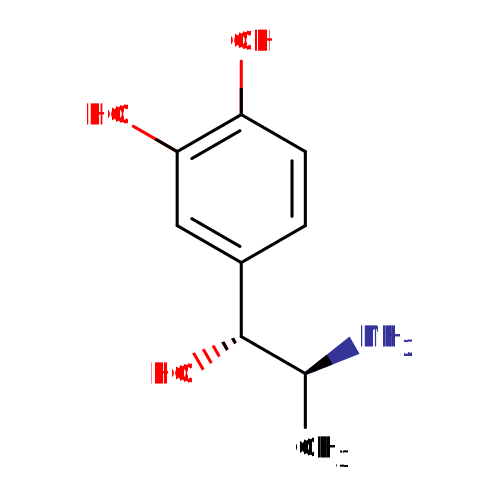
- Weight
- Average: 183.2044
Monoisotopic: 183.089543287 - Chemical Formula
- C9H13NO3
- Synonyms
- (-)-cobefrin
- alpha-Methylnoradrenaline
- Corbadrina
- Corbadrine
- Corbadrinum
- L-alpha-methylnoradrenaline
- L-Nordefrin
- Levonordefrin
- Neo-cobefrin
- External IDs
- BA 2818
- BA-2818

Pharmacology
- Indication
Used as a topical nasal decongestant and vasoconstrictor in dentistry.
 Reduce drug development failure ratesBuild, train, & validate machine-learning modelswith evidence-based and structured datasets.Build, train, & validate predictive machine-learning models with structured datasets.
- Contraindications & Blackbox Warnings
 Prevent Adverse Drug Events TodayTap into our Clinical API for life-saving information on contraindications & blackbox warnings, population restrictions, harmful risks, & more.Avoid life-threatening adverse drug events with our Clinical API
- Pharmacodynamics
Levonordefrin is a sympathomimetic amine used as a vasoconstrictor in local anesthetic solutions. It has pharmacologic activity similar to that of Epinephrine but it is more stable than Epinephrine. In equal concentrations, Levonordefrin is less potent than Epinephrine in raising blood pressure, and as a vasoconstrictor.
- Mechanism of action
It is designed to mimic the molecular shape of adrenaline. It binds to alpha-adrenergic receptors in the nasal mucosa. Here it can, therefore, cause vasoconstriction.
Target Actions Organism AAlpha-2 adrenergic receptors agonistHumans - Absorption
Not Available
- Volume of distribution
Not Available
- Protein binding
Not Available
- Metabolism
- Not Available
- Route of elimination
Not Available
- Half-life
Not Available
- Clearance
Not Available
- Adverse Effects
 Improve decision support & research outcomesWith structured adverse effects data, including: blackbox warnings, adverse reactions, warning & precautions, & incidence rates. View sample adverse effects data in our new Data Library!Improve decision support & research outcomes with our structured adverse effects data.
- Toxicity
Not Available
- Pathways
- Not Available
- Pharmacogenomic Effects/ADRs
- Not Available
Interactions
- Drug Interactions
- This information should not be interpreted without the help of a healthcare provider. If you believe you are experiencing an interaction, contact a healthcare provider immediately. The absence of an interaction does not necessarily mean no interactions exist.
Drug Interaction Integrate drug-drug
interactions in your softwareAcebutolol The therapeutic efficacy of Acebutolol can be increased when used in combination with Levonordefrin. Aceclofenac The risk or severity of hypertension can be increased when Levonordefrin is combined with Aceclofenac. Acemetacin The risk or severity of hypertension can be increased when Levonordefrin is combined with Acemetacin. Acetazolamide The risk or severity of Cardiac Arrhythmia can be increased when Levonordefrin is combined with Acetazolamide. Acetyldigitoxin The risk or severity of Cardiac Arrhythmia can be increased when Levonordefrin is combined with Acetyldigitoxin. - Food Interactions
- No interactions found.
Products
 Drug product information from 10+ global regionsOur datasets provide approved product information including:dosage, form, labeller, route of administration, and marketing period.Access drug product information from over 10 global regions.
- International/Other Brands
- Neo-Cobefrin / Nordefrin
- Mixture Products
Name Ingredients Dosage Route Labeller Marketing Start Marketing End Region Image 2% Polocaine Dental With Levonordefrin 1:20,000 Levonordefrin (0.05 mg / mL) + Mepivacaine hydrochloride (20 mg / mL) Solution Infiltration Dentsply Pharmaceutical 1990-12-31 2011-08-04 Canada 
Carbocaine 2% With Neo-cobefrin Levonordefrin (0.05 mg / mL) + Mepivacaine hydrochloride (20 mg / mL) Solution Infiltration Novocol Inc. 2019-07-30 2023-03-20 Canada Carbocaine 2% With Neo-cobefrin Levonordefrin (0.05 mg / mL) + Mepivacaine hydrochloride (20 mg / mL) Solution Infiltration Kodak Canada Inc. 2005-04-22 2008-07-14 Canada Carbocaine 2% With Neo-cobefrin Levonordefrin (0.05 mg / mL) + Mepivacaine hydrochloride (20 mg / mL) Solution Infiltration Carestream Health Inc. 2006-09-01 2018-09-06 Canada Carbocaine with Neo-Cobefrin Levonordefrin (0.05 mg/1mL) + Mepivacaine hydrochloride (20 mg/1mL) Injection, solution Subcutaneous Caresteam Health, Inc. 2011-01-01 Not applicable US 
Categories
- Drug Categories
- Chemical TaxonomyProvided by Classyfire
- Description
- This compound belongs to the class of organic compounds known as phenylpropanes. These are organic compounds containing a phenylpropane moiety.
- Kingdom
- Organic compounds
- Super Class
- Benzenoids
- Class
- Benzene and substituted derivatives
- Sub Class
- Phenylpropanes
- Direct Parent
- Phenylpropanes
- Alternative Parents
- Catechols / Aralkylamines / 1-hydroxy-4-unsubstituted benzenoids / 1-hydroxy-2-unsubstituted benzenoids / Secondary alcohols / 1,2-aminoalcohols / Organopnictogen compounds / Monoalkylamines / Hydrocarbon derivatives / Aromatic alcohols
- Substituents
- 1,2-aminoalcohol / 1-hydroxy-2-unsubstituted benzenoid / 1-hydroxy-4-unsubstituted benzenoid / Alcohol / Amine / Aralkylamine / Aromatic alcohol / Aromatic homomonocyclic compound / Catechol / Hydrocarbon derivative
- Molecular Framework
- Aromatic homomonocyclic compounds
- External Descriptors
- catecholamine (CHEBI:10304)
- Affected organisms
- Humans and other mammals
Chemical Identifiers
- UNII
- V008L6478D
- CAS number
- 829-74-3
- InChI Key
- GEFQWZLICWMTKF-CDUCUWFYSA-N
- InChI
- InChI=1S/C9H13NO3/c1-5(10)9(13)6-2-3-7(11)8(12)4-6/h2-5,9,11-13H,10H2,1H3/t5-,9-/m0/s1
- IUPAC Name
- 4-[(1R,2S)-2-amino-1-hydroxypropyl]benzene-1,2-diol
- SMILES
- C[C@H](N)[C@H](O)C1=CC(O)=C(O)C=C1
References
- General References
- Not Available
- External Links
- Human Metabolome Database
- HMDB0015652
- KEGG Drug
- D02388
- KEGG Compound
- C11768
- PubChem Compound
- 164739
- PubChem Substance
- 99443259
- ChemSpider
- 144416
- BindingDB
- 50223426
- 132889
- ChEBI
- 10304
- ChEMBL
- CHEMBL677
- ZINC
- ZINC000000034157
- PharmGKB
- PA165958380
- Guide to Pharmacology
- GtP Drug Page
- Wikipedia
- Levonordefrin
Clinical Trials
- Clinical Trials
Phase Status Purpose Conditions Count 3 Completed Treatment Local Anaesthesia therapy 1 Not Available Unknown Status Treatment Edema / Pain / Trismus 1 Not Available Unknown Status Treatment Success of Inferior Alveolar Nerve Block 1
Pharmacoeconomics
- Manufacturers
- Not Available
- Packagers
- Not Available
- Dosage Forms
Form Route Strength Injection Subcutaneous Injection Dental Solution Infiltration Injection, solution Subcutaneous - Prices
- Not Available
- Patents
- Not Available
Properties
- State
- Solid
- Experimental Properties
- Not Available
- Predicted Properties
Property Value Source Water Solubility 14.6 mg/mL ALOGPS logP -0.77 ALOGPS logP -0.39 Chemaxon logS -1.1 ALOGPS pKa (Strongest Acidic) 9.63 Chemaxon pKa (Strongest Basic) 8.96 Chemaxon Physiological Charge 1 Chemaxon Hydrogen Acceptor Count 4 Chemaxon Hydrogen Donor Count 4 Chemaxon Polar Surface Area 86.71 Å2 Chemaxon Rotatable Bond Count 2 Chemaxon Refractivity 48.87 m3·mol-1 Chemaxon Polarizability 18.81 Å3 Chemaxon Number of Rings 1 Chemaxon Bioavailability 1 Chemaxon Rule of Five Yes Chemaxon Ghose Filter Yes Chemaxon Veber's Rule No Chemaxon MDDR-like Rule No Chemaxon - Predicted ADMET Features
Property Value Probability Human Intestinal Absorption + 0.9908 Blood Brain Barrier - 0.9476 Caco-2 permeable - 0.5196 P-glycoprotein substrate Non-substrate 0.6652 P-glycoprotein inhibitor I Non-inhibitor 0.9818 P-glycoprotein inhibitor II Non-inhibitor 0.9946 Renal organic cation transporter Non-inhibitor 0.9341 CYP450 2C9 substrate Non-substrate 0.7936 CYP450 2D6 substrate Non-substrate 0.7668 CYP450 3A4 substrate Non-substrate 0.7456 CYP450 1A2 substrate Non-inhibitor 0.9046 CYP450 2C9 inhibitor Non-inhibitor 0.9466 CYP450 2D6 inhibitor Non-inhibitor 0.9789 CYP450 2C19 inhibitor Non-inhibitor 0.9294 CYP450 3A4 inhibitor Non-inhibitor 0.9229 CYP450 inhibitory promiscuity Low CYP Inhibitory Promiscuity 0.8329 Ames test AMES toxic 0.6857 Carcinogenicity Non-carcinogens 0.8948 Biodegradation Not ready biodegradable 0.7553 Rat acute toxicity 2.0594 LD50, mol/kg Not applicable hERG inhibition (predictor I) Weak inhibitor 0.9705 hERG inhibition (predictor II) Non-inhibitor 0.9117
Spectra
- Mass Spec (NIST)
- Not Available
- Spectra
Spectrum Spectrum Type Splash Key Predicted GC-MS Spectrum - GC-MS Predicted GC-MS splash10-000f-9700000000-97a66276892b2b9a6d84 Predicted MS/MS Spectrum - 10V, Positive (Annotated) Predicted LC-MS/MS splash10-00kb-1900000000-0d3f1b23bb948e7b2c24 Predicted MS/MS Spectrum - 10V, Negative (Annotated) Predicted LC-MS/MS splash10-03di-0900000000-600876d8867e1e320b6f Predicted MS/MS Spectrum - 20V, Positive (Annotated) Predicted LC-MS/MS splash10-0002-1900000000-b8d913aa0fd0d23c339a Predicted MS/MS Spectrum - 20V, Negative (Annotated) Predicted LC-MS/MS splash10-00dr-0900000000-a615208a196b01db6ced Predicted MS/MS Spectrum - 40V, Negative (Annotated) Predicted LC-MS/MS splash10-05fs-3900000000-07fbd2d50ac996fbf41d Predicted MS/MS Spectrum - 40V, Positive (Annotated) Predicted LC-MS/MS splash10-00di-8900000000-e510e84e6f087115f839 Predicted 1H NMR Spectrum 1D NMR Not Applicable Predicted 13C NMR Spectrum 1D NMR Not Applicable - Chromatographic Properties
Collision Cross Sections (CCS)
Adduct CCS Value (Å2) Source type Source [M-H]- 145.4942228 predictedDarkChem Lite v0.1.0 [M-H]- 148.43163 predictedDeepCCS 1.0 (2019) [M+H]+ 146.5656228 predictedDarkChem Lite v0.1.0 [M+H]+ 150.8272 predictedDeepCCS 1.0 (2019) [M+Na]+ 145.8184228 predictedDarkChem Lite v0.1.0 [M+Na]+ 156.73972 predictedDeepCCS 1.0 (2019)
Targets

- Kind
- Protein group
- Organism
- Humans
- Pharmacological action
- Yes
- Actions
- Agonist
- General Function
- Thioesterase binding
- Specific Function
- Alpha-2 adrenergic receptors mediate the catecholamine-induced inhibition of adenylate cyclase through the action of G proteins. The rank order of potency for agonists of this receptor is oxymetazo...
Components:
| Name | UniProt ID |
|---|---|
| Alpha-2A adrenergic receptor | P08913 |
| Alpha-2B adrenergic receptor | P18089 |
| Alpha-2C adrenergic receptor | P18825 |
References
- de Andrade CA, de Andrade GM, De Paula PM, De Luca LA Jr, Menani JV: Involvement of central alpha1-adrenoceptors on renal responses to central moxonidine and alpha-methylnoradrenaline. Eur J Pharmacol. 2009 Apr 1;607(1-3):60-7. [Article]

Drug created at May 16, 2010 01:00 / Updated at June 12, 2020 16:52