Identification
- Generic Name
- Diloxanide
- DrugBank Accession Number
- DB08792
- Background
Diloxanide (as Diloxanide furoate) is an anti-protozoal drug used in the treatment of Entamoeba histolytica and some other protozoal infections. Although it is not currently approved for use in the United States, it was approved by a CDC study in the treatment of 4,371 cases of Entamoeba histolytica from 1977 to 1990.
- Type
- Small Molecule
- Groups
- Experimental
- Structure
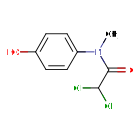
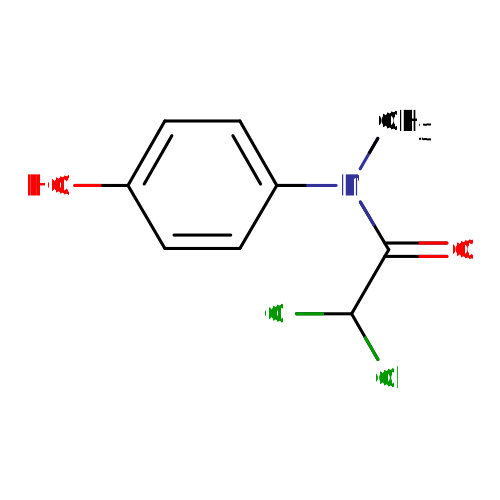
Structure for Diloxanide (DB08792)
- Weight
- Average: 234.08
Monoisotopic: 233.0010339 - Chemical Formula
- C9H9Cl2NO2
- Synonyms
- Diloxanide

Pharmacology
- Indication
Diloxanide is used alone as a primary agent in the treatment of asymptomatic (cyst passers) intestinal amebiasis caused by Entamoeba histolytica. Diloxanide may also be used concurrently, or sequentially, with other agents such as the nitroimidazoles (eg. metronidazole) in the treatment of invasive or extraintestinal forms of amebiasis.
 Reduce drug development failure ratesBuild, train, & validate machine-learning modelswith evidence-based and structured datasets.Build, train, & validate predictive machine-learning models with structured datasets.
- Contraindications & Blackbox Warnings
 Prevent Adverse Drug Events TodayTap into our Clinical API for life-saving information on contraindications & blackbox warnings, population restrictions, harmful risks, & more.Avoid life-threatening adverse drug events with our Clinical API
- Pharmacodynamics
Diloxanide is a luminal amebicide, however the mechanism of action of diloxanide is unknown. Diloxanide destroys the trophozoites of E. histolytica that eventually form into cysts. The cysts are then excreted by persons infected with asymptomatic amebiasis. Diloxanide furoate is a prodrug, and is hydrolyzed in the gastrointestinal tract to produce diloxanide, the active ingredient.
- Mechanism of action
Unknown. Diloxanide may inhibit protein synthesis.
- Absorption
Bioavailability is 90% (in diloxanide parental form), however diloxanide furoate is slowly absorbed from the gastrointestinal tract.
- Volume of distribution
Not Available
- Protein binding
Not Available
- Metabolism
Hydrolyzed to furoic acid and diloxanide, which undergoes extensive glucuronidation (99% of diloxanide occurs as glucuronide and 1% as free diloxanide in the systemic circulation).
- Route of elimination
Renal (90%, rapidly excreted as glucuronide metabolite). 10% is excreted in the feces as diloxanide.
- Half-life
3 hours
- Clearance
Not Available
- Adverse Effects
 Improve decision support & research outcomesWith structured adverse effects data, including: blackbox warnings, adverse reactions, warning & precautions, & incidence rates. View sample adverse effects data in our new Data Library!Improve decision support & research outcomes with our structured adverse effects data.
- Toxicity
Not Available
- Pathways
- Not Available
- Pharmacogenomic Effects/ADRs
- Not Available
Interactions
- Drug Interactions
- This information should not be interpreted without the help of a healthcare provider. If you believe you are experiencing an interaction, contact a healthcare provider immediately. The absence of an interaction does not necessarily mean no interactions exist.Not Available
- Food Interactions
- Not Available
Categories
- ATC Codes
- P01AB52 — Metronidazole and diloxanide
- P01AB — Nitroimidazole derivatives
- P01A — AGENTS AGAINST AMOEBIASIS AND OTHER PROTOZOAL DISEASES
- P01 — ANTIPROTOZOALS
- P — ANTIPARASITIC PRODUCTS, INSECTICIDES AND REPELLENTS
- Drug Categories
- Chemical TaxonomyProvided by Classyfire
- Description
- This compound belongs to the class of organic compounds known as anilides. These are organic heterocyclic compounds derived from oxoacids RkE(=O)l(OH)m (l not 0) by replacing an OH group by the NHPh group or derivative formed by ring substitution.
- Kingdom
- Organic compounds
- Super Class
- Benzenoids
- Class
- Benzene and substituted derivatives
- Sub Class
- Anilides
- Direct Parent
- Anilides
- Alternative Parents
- 1-hydroxy-2-unsubstituted benzenoids / Tertiary carboxylic acid amides / Organopnictogen compounds / Organonitrogen compounds / Organochlorides / Organic oxides / Hydrocarbon derivatives / Carbonyl compounds / Alkyl chlorides
- Substituents
- 1-hydroxy-2-unsubstituted benzenoid / Alkyl chloride / Alkyl halide / Anilide / Aromatic homomonocyclic compound / Carbonyl group / Carboxamide group / Carboxylic acid derivative / Hydrocarbon derivative / Organic nitrogen compound
- Molecular Framework
- Aromatic homomonocyclic compounds
- External Descriptors
- Not Available
- Affected organisms
- Protozoa
Chemical Identifiers
- UNII
- 89134SCM7M
- CAS number
- 579-38-4
- InChI Key
- GZZZSOOGQLOEOB-UHFFFAOYSA-N
- InChI
- InChI=1S/C9H9Cl2NO2/c1-12(9(14)8(10)11)6-2-4-7(13)5-3-6/h2-5,8,13H,1H3
- IUPAC Name
- 2,2-dichloro-N-(4-hydroxyphenyl)-N-methylacetamide
- SMILES
- CN(C(=O)C(Cl)Cl)C1=CC=C(O)C=C1
References
- General References
- McAuley JB, Herwaldt BL, Stokes SL, Becher JA, Roberts JM, Michelson MK, Juranek DD: Diloxanide furoate for treating asymptomatic Entamoeba histolytica cyst passers: 14 years' experience in the United States. Clin Infect Dis. 1992 Sep;15(3):464-8. [Article]
- External Links
- PubChem Compound
- 11367
- PubChem Substance
- 99445263
- ChemSpider
- 10889
- 67182
- ChEMBL
- CHEMBL2103768
- ZINC
- ZINC000000001299
- PharmGKB
- PA165958413
- Drugs.com
- Drugs.com Drug Page
- Wikipedia
- Diloxanide_furoate
Clinical Trials
Pharmacoeconomics
- Manufacturers
- Not Available
- Packagers
- Not Available
- Dosage Forms
- Not Available
- Prices
- Not Available
- Patents
- Not Available
Properties
- State
- Solid
- Experimental Properties
Property Value Source logP 2.24 DUTTA,H ET AL. (1988) - Predicted Properties
Property Value Source Water Solubility 2.31 mg/mL ALOGPS logP 2.01 ALOGPS logP 2.05 Chemaxon logS -2 ALOGPS pKa (Strongest Acidic) 9.39 Chemaxon pKa (Strongest Basic) -5.9 Chemaxon Physiological Charge 0 Chemaxon Hydrogen Acceptor Count 2 Chemaxon Hydrogen Donor Count 1 Chemaxon Polar Surface Area 40.54 Å2 Chemaxon Rotatable Bond Count 2 Chemaxon Refractivity 55.99 m3·mol-1 Chemaxon Polarizability 20.9 Å3 Chemaxon Number of Rings 1 Chemaxon Bioavailability 1 Chemaxon Rule of Five Yes Chemaxon Ghose Filter Yes Chemaxon Veber's Rule No Chemaxon MDDR-like Rule No Chemaxon - Predicted ADMET Features
Property Value Probability Human Intestinal Absorption + 0.9454 Blood Brain Barrier + 0.9784 Caco-2 permeable + 0.5558 P-glycoprotein substrate Non-substrate 0.8705 P-glycoprotein inhibitor I Non-inhibitor 0.9364 P-glycoprotein inhibitor II Non-inhibitor 0.7636 Renal organic cation transporter Non-inhibitor 0.8958 CYP450 2C9 substrate Non-substrate 0.7021 CYP450 2D6 substrate Non-substrate 0.8229 CYP450 3A4 substrate Substrate 0.585 CYP450 1A2 substrate Non-inhibitor 0.9045 CYP450 2C9 inhibitor Non-inhibitor 0.907 CYP450 2D6 inhibitor Non-inhibitor 0.9231 CYP450 2C19 inhibitor Non-inhibitor 0.9025 CYP450 3A4 inhibitor Non-inhibitor 0.8944 CYP450 inhibitory promiscuity High CYP Inhibitory Promiscuity 0.5266 Ames test AMES toxic 0.538 Carcinogenicity Non-carcinogens 0.7816 Biodegradation Not ready biodegradable 0.8478 Rat acute toxicity 2.2608 LD50, mol/kg Not applicable hERG inhibition (predictor I) Weak inhibitor 0.9924 hERG inhibition (predictor II) Non-inhibitor 0.9271
Spectra
- Mass Spec (NIST)
- Not Available
- Spectra
Spectrum Spectrum Type Splash Key Predicted GC-MS Spectrum - GC-MS Predicted GC-MS splash10-00di-3900000000-9b0c7ba2020a88c95f96 Predicted MS/MS Spectrum - 10V, Positive (Annotated) Predicted LC-MS/MS splash10-001i-0190000000-73bc09a8ee3e30deac86 Predicted MS/MS Spectrum - 10V, Negative (Annotated) Predicted LC-MS/MS splash10-001i-1090000000-177a8994aac2275182f8 Predicted MS/MS Spectrum - 20V, Positive (Annotated) Predicted LC-MS/MS splash10-053r-0970000000-0ef677b069391f93e188 Predicted MS/MS Spectrum - 20V, Negative (Annotated) Predicted LC-MS/MS splash10-0ul0-3900000000-9d4e1bda644817c70131 Predicted MS/MS Spectrum - 40V, Positive (Annotated) Predicted LC-MS/MS splash10-0a4i-2900000000-e801ef93fc7c127217e2 Predicted MS/MS Spectrum - 40V, Negative (Annotated) Predicted LC-MS/MS splash10-0fl3-9800000000-993d56cfc76349841497 Predicted 1H NMR Spectrum 1D NMR Not Applicable Predicted 13C NMR Spectrum 1D NMR Not Applicable - Chromatographic Properties
Collision Cross Sections (CCS)
Adduct CCS Value (Å2) Source type Source [M-H]- 144.02618 predictedDeepCCS 1.0 (2019) [M+H]+ 146.42174 predictedDeepCCS 1.0 (2019) [M+Na]+ 152.63806 predictedDeepCCS 1.0 (2019)

Drug created at September 20, 2010 14:58 / Updated at February 21, 2021 18:52