Identification
- Summary
Esmolol is a cardioselective beta-adrenergic blocker used for the short-term control of ventricular rate and heart rate in various types of tachycardia, including perioperative tachycardia and hypertension.
- Brand Names
- Brevibloc
- Generic Name
- Esmolol
- DrugBank Accession Number
- DB00187
- Background
Esmolol, commonly marketed under the trade name Brevibloc, is a cardioselective beta-1 receptor blocker. It has a rapid onset but short duration of action without causing significant intrinsic sympathomimetic or membrane stabilizing activities at recommended therapeutic doses. It works by blocking beta-adrenergic receptors in the heart, which leads to decreased force and rate of heart contractions. Esmolol prevents the action of two naturally occurring substances: epinephrine and norepinephrine.
The FDA withdrew its approval for the use of all parenteral dosage form drug products containing esmolol hydrochloride that supply 250 milligrams/milliliter of concentrated esmolol per 10-milliliter ampule. Other esmolol formulations are still available for use.2
- Type
- Small Molecule
- Groups
- Approved, Withdrawn
- Structure
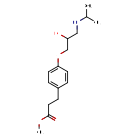
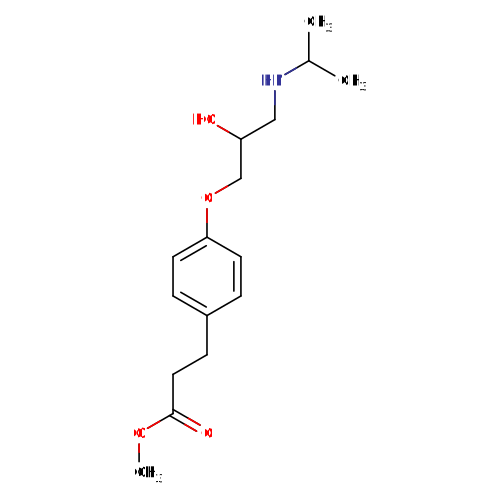
Structure for Esmolol (DB00187)
- Weight
- Average: 295.374
Monoisotopic: 295.178358293 - Chemical Formula
- C16H25NO4
- Synonyms
- (±)-esmolol
- (±)-methyl p-(2-hydroxy-3-(isopropylamino)propoxy)hydrocinnamate
- 3-[4-(2-Hydroxy-3-isopropylamino-propoxy)-phenyl]-propionic acid methyl ester
- Esmolol
- Methyl 4-(2-hydroxy-3-((1-methylethyl)amino)propoxy)benzenepropanoate
- methyl p-(2-hydroxy-3-(isopropylamino)propoxy)hydrocinnamate

Pharmacology
- Indication
For the rapid control of ventricular rate in patients with atrial fibrillation or atrial flutter in perioperative, postoperative, or other emergent circumstances where short term control of ventricular rate with a short-acting agent is desirable. Also used in noncompensatory sinus tachycardia where the rapid heart rate requires specific intervention.
 Reduce drug development failure ratesBuild, train, & validate machine-learning modelswith evidence-based and structured datasets.Build, train, & validate predictive machine-learning models with structured datasets.
- Associated Conditions
Indication Type Indication Combined Product Details Approval Level Age Group Patient Characteristics Dose Form Treatment of High blood pressure (hypertension) •••••••••••• •••••••••• ••••••• •••••••• Treatment of Tachycardia •••••••••••• •••••••••• ••••••• •••••••• Treatment of Abnormal ventricular rate •••••••••••• •••••••••• ••••••• •••••••• Treatment of Abnormal ventricular rate •••••••••••• •••••••••• ••••••• •••••••• Treatment of Abnormal ventricular rate •••••••••••• •••••••••• ••••••• •••••••• - Contraindications & Blackbox Warnings
 Prevent Adverse Drug Events TodayTap into our Clinical API for life-saving information on contraindications & blackbox warnings, population restrictions, harmful risks, & more.Avoid life-threatening adverse drug events with our Clinical API
- Pharmacodynamics
Not Available
- Mechanism of action
Similar to other beta-blockers, esmolol blocks the agonistic effect of the sympathetic neurotransmitters by competing for receptor binding sites. Because it predominantly blocks the beta-1 receptors in cardiac tissue, it is said to be cardioselective. In general, so-called cardioselective beta-blockers are relatively cardioselective; at lower doses they block beta-1 receptors only but begin to block beta-2 receptors as the dose increases. At therapeutic dosages, esmolol does not have intrinsic sympathomimetic activity (ISA) or membrane-stabilizing (quinidine-like) activity. Antiarrhythmic activity is due to blockade of adrenergic stimulation of cardiac pacemaker potentials. In the Vaughan Williams classification of antiarrhythmics, beta-blockers are considered to be class II agents.
Target Actions Organism ABeta-1 adrenergic receptor antagonistHumans - Absorption
Rapidly absorbed, steady-state blood levels for dosages from 50-300 µg/kg/min (0.05-0.3 mg/kg/mm) are obtained within five minutes.
- Volume of distribution
Not Available
- Protein binding
55% bound to human plasma protein, while the acid metabolite is 10% bound.
- Metabolism
Esmolol undergoes rapid hydrolysis of ester linkage which is catalyzed by esterases found in the cytosol of red blood cells (RBCs). The plasma cholinersterases or RBC membrane acetylcholinesterases are not involved in this metabolic reaction. Metabolism of the drug occurs mainly in RBCs to form a free acid metabolite (with 1/1500 the activity of esmolol) and methanol.
Hover over products below to view reaction partners
- Route of elimination
Consistent with the high rate of blood-based metabolism of esmolol hydrochloride, less than 2% of the drug is excreted unchanged in the urine. The acid metabolite has an elimination half-life of about 3.7 hours and is excreted in the urine with a clearance approximately equivalent to the glomerular filtration rate. Excretion of the acid metabolite is significantly decreased in patients with renal disease, with the elimination half-life increased to about ten-fold that of normals, and plasma levels considerably elevated.
- Half-life
Rapid distribution half-life of about 2 minutes and an elimination half-life of about 9 minutes. The acid metabolite has an elimination half-life of about 3.7 hours.
- Clearance
- 20 L/kg/hr [Men]
- Adverse Effects
 Improve decision support & research outcomesWith structured adverse effects data, including: blackbox warnings, adverse reactions, warning & precautions, & incidence rates. View sample adverse effects data in our new Data Library!Improve decision support & research outcomes with our structured adverse effects data.
- Toxicity
Symptoms of overdose include cardiac arrest, bradycardia, hypotension, electromechanical dissociation and loss of consciousness.
- Pathways
Pathway Category Esmolol Action Pathway Drug action - Pharmacogenomic Effects/ADRs
- Not Available
Interactions
- Drug Interactions
- This information should not be interpreted without the help of a healthcare provider. If you believe you are experiencing an interaction, contact a healthcare provider immediately. The absence of an interaction does not necessarily mean no interactions exist.
Drug Interaction Integrate drug-drug
interactions in your softwareAbaloparatide The risk or severity of adverse effects can be increased when Esmolol is combined with Abaloparatide. Abatacept The metabolism of Esmolol can be increased when combined with Abatacept. Abiraterone The metabolism of Esmolol can be decreased when combined with Abiraterone. Acebutolol Esmolol may increase the arrhythmogenic activities of Acebutolol. Aceclofenac Aceclofenac may decrease the antihypertensive activities of Esmolol. - Food Interactions
- No interactions found.
Products
 Drug product information from 10+ global regionsOur datasets provide approved product information including:dosage, form, labeller, route of administration, and marketing period.Access drug product information from over 10 global regions.
- Product Ingredients
Ingredient UNII CAS InChI Key Esmolol hydrochloride V05260LC8D 81161-17-3 GEKNCWBANDDJJL-UHFFFAOYSA-N - Brand Name Prescription Products
Name Dosage Strength Route Labeller Marketing Start Marketing End Region Image Brevibloc Injection 10 mg/1mL Intravenous Henry Schein, Inc 2022-01-09 Not applicable US 
Brevibloc Injection 20 mg/1mL Intravenous Baxter Healthcare Corporation 2007-03-02 2007-03-02 US Brevibloc Injection 10 mg/1mL Intravenous Baxter Healthcare Corporation 1986-12-31 Not applicable US Brevibloc Injection 10 mg/1mL Intravenous Baxter Healthcare Corporation 1986-12-31 Not applicable US Brevibloc Injection, solution, concentrate 250 mg/1mL Intravenous Baxter Healthcare Corporation 2007-03-02 2007-03-02 US - Generic Prescription Products
Name Dosage Strength Route Labeller Marketing Start Marketing End Region Image Esmolol Hydrochloride Injection, solution 10 mg/1mL Intravenous Sagent Pharmaceuticals 2019-07-15 Not applicable US Esmolol Hydrochloride Injection, solution 100 mg/10mL Intravenous Henry Schein, Inc. 2022-01-10 Not applicable US Esmolol Hydrochloride Injection, solution 100 mg/10mL Intravenous Eugia US LLC 2015-07-23 Not applicable US Esmolol Hydrochloride Injection, solution 10 mg/1mL Intravenous HF Acquisition Co LLC, DBA HealthFirst 2018-10-19 Not applicable US Esmolol Hydrochloride Injection, solution 10 mg/1mL Intravenous General Injectables & Vaccines 2012-06-13 2017-07-01 US
Categories
- ATC Codes
- C07AB09 — Esmolol
- Drug Categories
- Adrenergic Agents
- Adrenergic Antagonists
- Adrenergic beta-1 Receptor Antagonists
- Adrenergic beta-Antagonists
- Agents causing hyperkalemia
- Alcohols
- Amines
- Amino Alcohols
- Antiarrhythmic agents
- Antihypertensive Agents
- Antihypertensive Agents Indicated for Hypertension
- Beta Blocking Agents, Selective
- Beta-Blockers (Beta1 Selective)
- Bradycardia-Causing Agents
- Cytochrome P-450 CYP2D6 Substrates
- Cytochrome P-450 Substrates
- Hypotensive Agents
- Neurotransmitter Agents
- Potential QTc-Prolonging Agents
- Propanols
- QTc Prolonging Agents
- Chemical TaxonomyProvided by Classyfire
- Description
- This compound belongs to the class of organic compounds known as phenol ethers. These are aromatic compounds containing an ether group substituted with a benzene ring.
- Kingdom
- Organic compounds
- Super Class
- Benzenoids
- Class
- Phenol ethers
- Sub Class
- Not Available
- Direct Parent
- Phenol ethers
- Alternative Parents
- Phenoxy compounds / Fatty acid esters / Alkyl aryl ethers / Methyl esters / Secondary alcohols / Amino acids and derivatives / 1,2-aminoalcohols / Monocarboxylic acids and derivatives / Dialkylamines / Organopnictogen compounds show 3 more
- Substituents
- 1,2-aminoalcohol / Alcohol / Alkyl aryl ether / Amine / Amino acid or derivatives / Aromatic homomonocyclic compound / Carbonyl group / Carboxylic acid derivative / Carboxylic acid ester / Ether show 17 more
- Molecular Framework
- Aromatic homomonocyclic compounds
- External Descriptors
- aromatic ether, secondary alcohol, secondary amino compound, methyl ester, ethanolamines (CHEBI:4856)
- Affected organisms
- Humans and other mammals
Chemical Identifiers
- UNII
- MDY902UXSR
- CAS number
- 81147-92-4
- InChI Key
- AQNDDEOPVVGCPG-UHFFFAOYSA-N
- InChI
- InChI=1S/C16H25NO4/c1-12(2)17-10-14(18)11-21-15-7-4-13(5-8-15)6-9-16(19)20-3/h4-5,7-8,12,14,17-18H,6,9-11H2,1-3H3
- IUPAC Name
- methyl 3-(4-{2-hydroxy-3-[(propan-2-yl)amino]propoxy}phenyl)propanoate
- SMILES
- COC(=O)CCC1=CC=C(OCC(O)CNC(C)C)C=C1
References
- Synthesis Reference
- US4593119
- General References
- External Links
- Human Metabolome Database
- HMDB0014333
- KEGG Drug
- D07916
- KEGG Compound
- C06980
- PubChem Compound
- 59768
- PubChem Substance
- 46506146
- ChemSpider
- 53916
- BindingDB
- 50404796
- 49737
- ChEBI
- 88206
- ChEMBL
- CHEMBL768
- Therapeutic Targets Database
- DAP000304
- PharmGKB
- PA449500
- RxList
- RxList Drug Page
- Drugs.com
- Drugs.com Drug Page
- Wikipedia
- Esmolol
- MSDS
- Download (56.3 KB)
Clinical Trials
- Clinical Trials
Phase Status Purpose Conditions Count 4 Completed Basic Science Drug Overdose / Overdose of Beta-adrenergic Blocking Drug 1 4 Completed Prevention Postoperative pain 1 4 Completed Prevention Surgery, Cardiac 1 4 Completed Prevention Surgery, Laparoscopic 1 4 Completed Screening Cerebral Oxygen Saturation / Hypotension Drug-Induced 1
Pharmacoeconomics
- Manufacturers
- Baxter healthcare corp anesthesia critical care
- App pharmaceuticals llc
- Bedford laboratories
- Bioniche pharma usa llc
- Packagers
- APP Pharmaceuticals
- Baxter International Inc.
- Bedford Labs
- Ben Venue Laboratories Inc.
- Bioniche Pharma
- Bristol-Myers Squibb Co.
- Draxis Specialty Pharmaceuticals Inc.
- General Injectables and Vaccines Inc.
- Paddock Labs
- Dosage Forms
Form Route Strength Injection Intravenous 20 mg/1mL Injection, solution Parenteral 100 MG/10ML Injection, solution, concentrate Intravenous 250 mg/1mL Solution Intravenous 10 mg/ml Injection, solution Intravenous 10 mg/ml Solution Parenteral 100 mg/10ml Solution Intravenous 10 mg / mL Solution Intravenous 100 mg Liquid Intravenous 10 mg / mL Liquid Intravenous 250 mg / mL Injection Parenteral 10 mg/ml Injection, solution Solution Intravenous Solution, concentrate Intravenous 10 mg Solution, concentrate Intravenous 250 mg Injection, powder, for solution Parenteral 2500 MG Injection, solution 100 MG/10ML Injection Intravenous 10 mg/1mL Injection, solution Intravenous 10 mg/1mL Injection, solution Intravenous 100 mg/10mL Injection, solution Intravenous 20 mg/1mL Injection, solution Parenteral 10 MG/ML Injection, solution Intravenous Injection Parenteral 2500 mg/250ml Solution Intravenous 2500.000 mg Solution Parenteral 2.500 g Solution Intravenous 2.500 g Solution Intravenous 2.50 g Solution 10 mg/1ml - Prices
Unit description Cost Unit Brevibloc 250 mg/ml ampul 13.21USD ml Brevibloc 10 mg/ml vial 2.21USD ml Brevibloc 20 mg/ml iv bag 1.54USD ml Esmolol hcl 10 mg/ml vial 1.26USD ml DrugBank does not sell nor buy drugs. Pricing information is supplied for informational purposes only.- Patents
Patent Number Pediatric Extension Approved Expires (estimated) Region CA2410446 No 2008-08-26 2022-01-02 Canada 
US6528540 Yes 2003-03-04 2021-07-12 US US6310094 Yes 2001-10-30 2021-07-12 US US8835505 No 2014-09-16 2033-03-15 US US8829054 No 2014-09-09 2033-03-15 US
Properties
- State
- Solid
- Experimental Properties
Property Value Source water solubility Very soluble as hydrochloride salt Not Available logP 1.7 Not Available - Predicted Properties
Property Value Source Water Solubility 0.144 mg/mL ALOGPS logP 2.02 ALOGPS logP 1.82 Chemaxon logS -3.3 ALOGPS pKa (Strongest Acidic) 14.09 Chemaxon pKa (Strongest Basic) 9.67 Chemaxon Physiological Charge 1 Chemaxon Hydrogen Acceptor Count 4 Chemaxon Hydrogen Donor Count 2 Chemaxon Polar Surface Area 67.79 Å2 Chemaxon Rotatable Bond Count 10 Chemaxon Refractivity 81.05 m3·mol-1 Chemaxon Polarizability 33.68 Å3 Chemaxon Number of Rings 1 Chemaxon Bioavailability 1 Chemaxon Rule of Five Yes Chemaxon Ghose Filter Yes Chemaxon Veber's Rule No Chemaxon MDDR-like Rule No Chemaxon - Predicted ADMET Features
Property Value Probability Human Intestinal Absorption + 0.7023 Blood Brain Barrier - 0.9645 Caco-2 permeable + 0.5 P-glycoprotein substrate Substrate 0.6511 P-glycoprotein inhibitor I Non-inhibitor 0.8625 P-glycoprotein inhibitor II Non-inhibitor 0.7171 Renal organic cation transporter Non-inhibitor 0.8605 CYP450 2C9 substrate Non-substrate 0.8124 CYP450 2D6 substrate Substrate 0.663 CYP450 3A4 substrate Non-substrate 0.5869 CYP450 1A2 substrate Non-inhibitor 0.864 CYP450 2C9 inhibitor Non-inhibitor 0.8789 CYP450 2D6 inhibitor Non-inhibitor 0.8806 CYP450 2C19 inhibitor Non-inhibitor 0.9585 CYP450 3A4 inhibitor Non-inhibitor 0.8495 CYP450 inhibitory promiscuity Low CYP Inhibitory Promiscuity 0.9761 Ames test Non AMES toxic 0.9066 Carcinogenicity Non-carcinogens 0.9519 Biodegradation Not ready biodegradable 0.6493 Rat acute toxicity 1.9194 LD50, mol/kg Not applicable hERG inhibition (predictor I) Weak inhibitor 0.9556 hERG inhibition (predictor II) Non-inhibitor 0.774
Spectra
- Mass Spec (NIST)
- Not Available
- Spectra
- Chromatographic Properties
Collision Cross Sections (CCS)
Adduct CCS Value (Å2) Source type Source [M-H]- 186.3330716 predictedDarkChem Lite v0.1.0 [M-H]- 169.0862 predictedDeepCCS 1.0 (2019) [M+H]+ 185.7884716 predictedDarkChem Lite v0.1.0 [M+H]+ 171.4442 predictedDeepCCS 1.0 (2019) [M+Na]+ 186.2229716 predictedDarkChem Lite v0.1.0 [M+Na]+ 177.53735 predictedDeepCCS 1.0 (2019)
Targets

- Kind
- Protein
- Organism
- Humans
- Pharmacological action
- Yes
- Actions
- Antagonist
- General Function
- Receptor signaling protein activity
- Specific Function
- Beta-adrenergic receptors mediate the catecholamine-induced activation of adenylate cyclase through the action of G proteins. This receptor binds epinephrine and norepinephrine with approximately e...
- Gene Name
- ADRB1
- Uniprot ID
- P08588
- Uniprot Name
- Beta-1 adrenergic receptor
- Molecular Weight
- 51322.1 Da
References
- Chen X, Ji ZL, Chen YZ: TTD: Therapeutic Target Database. Nucleic Acids Res. 2002 Jan 1;30(1):412-5. [Article]
- Jahn P, Eckrich B, Schneidrowski B, Volz-Zang C, Schulte B, Mutschler E, Palm D: Beta 1-adrenoceptor subtype selective antagonism of esmolol and its major metabolite in vitro and in man. Investigations using tricresylphosphate as red blood cell carboxylesterase inhibitor. Arzneimittelforschung. 1995 May;45(5):536-41. [Article]
- Volz-Zang C, Eckrich B, Jahn P, Schneidrowski B, Schulte B, Palm D: Esmolol, an ultrashort-acting, selective beta 1-adrenoceptor antagonist: pharmacodynamic and pharmacokinetic properties. Eur J Clin Pharmacol. 1994;46(5):399-404. [Article]
- Kirshenbaum JM: Nonthrombolytic intervention in acute myocardial infarction. Am J Cardiol. 1989 Jul 18;64(4):25B-28B. [Article]
- Jacobs JR, Maier GW, Rankin JS, Reves JG: Esmolol and left ventricular function in the awake dog. Anesthesiology. 1988 Mar;68(3):373-8. [Article]
- Howie MB, Black HA, Zvara D, McSweeney TD, Martin DJ, Coffman JA: Esmolol reduces autonomic hypersensitivity and length of seizures induced by electroconvulsive therapy. Anesth Analg. 1990 Oct;71(4):384-8. [Article]
Enzymes
- Kind
- Protein
- Organism
- Humans
- Pharmacological action
- No
- Actions
- Substrate
- General Function
- Steroid hydroxylase activity
- Specific Function
- Responsible for the metabolism of many drugs and environmental chemicals that it oxidizes. It is involved in the metabolism of drugs such as antiarrhythmics, adrenoceptor antagonists, and tricyclic...
- Gene Name
- CYP2D6
- Uniprot ID
- P10635
- Uniprot Name
- Cytochrome P450 2D6
- Molecular Weight
- 55768.94 Da
References
- Sternieri E, Coccia CP, Pinetti D, Guerzoni S, Ferrari A: Pharmacokinetics and interactions of headache medications, part II: prophylactic treatments. Expert Opin Drug Metab Toxicol. 2006 Dec;2(6):981-1007. doi: 10.1517/17425255.2.6.981 . [Article]
- Brodde OE, Kroemer HK: Drug-drug interactions of beta-adrenoceptor blockers. Arzneimittelforschung. 2003;53(12):814-22. [Article]
- Iwaki M, Niwa T, Bandoh S, Itoh M, Hirose H, Kawase A, Komura H: Application of substrate depletion assay to evaluation of CYP isoforms responsible for stereoselective metabolism of carvedilol. Drug Metab Pharmacokinet. 2016 Dec;31(6):425-432. doi: 10.1016/j.dmpk.2016.08.007. Epub 2016 Sep 2. [Article]

Drug created at June 13, 2005 13:24 / Updated at April 26, 2024 00:45