Identification
- Summary
Vidarabine is an antiviral agent used to treat various viral infections.
- Generic Name
- Vidarabine
- DrugBank Accession Number
- DB00194
- Background
A nucleoside antibiotic isolated from Streptomyces antibioticus. It has some antineoplastic properties and has broad spectrum activity against DNA viruses in cell cultures and significant antiviral activity against infections caused by a variety of viruses such as the herpes viruses, the vaccinia VIRUS and varicella zoster virus.
- Type
- Small Molecule
- Groups
- Approved, Investigational
- Structure
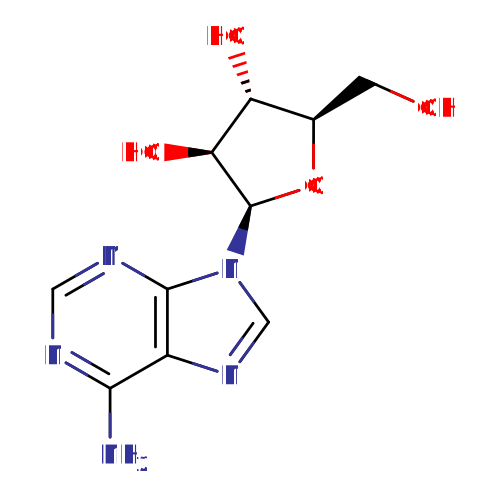
Structure for Vidarabine (DB00194)
- Weight
- Average: 267.2413
Monoisotopic: 267.096753929 - Chemical Formula
- C10H13N5O4
- Synonyms
- 9-beta-D-arabinofuranosyl-9H-purin-6-amine
- 9-beta-D-arabinofuranosyl-adenine
- 9-beta-D-Arabinofuranosyladenine
- 9-β-D-arabinofuranosyl-9H-purin-6-amine
- 9-β-D-arabinofuranosyladenine
- Spongoadenosine
- Vidarabine
- Vidarabinum

Pharmacology
- Indication
For treatment of chickenpox - varicella, herpes zoster and herpes simplex
 Reduce drug development failure ratesBuild, train, & validate machine-learning modelswith evidence-based and structured datasets.Build, train, & validate predictive machine-learning models with structured datasets.
- Contraindications & Blackbox Warnings
 Prevent Adverse Drug Events TodayTap into our Clinical API for life-saving information on contraindications & blackbox warnings, population restrictions, harmful risks, & more.Avoid life-threatening adverse drug events with our Clinical API
- Pharmacodynamics
Vidarabine is a synthetic purine nucleoside analogue with in vitro and in vivo inhibitory activity against herpes simplex virus types 1 (HSV-1), 2 (HSV-2), and varicella-zoster virus (VZV). The inhibitory activity of Vidarabine is highly selective due to its affinity for the enzyme thymidine kinase (TK) encoded by HSV and VZV. This viral enzyme converts Vidarabine into Vidarabine monophosphate, a nucleotide analogue. The monophosphate is further converted into diphosphate by cellular guanylate kinase and into triphosphate by a number of cellular enzymes. In vitro, Vidarabine triphosphate stops the DNA replication of herpes virus by being incorporated into the DNA strand and preventing the formation of phosphodiester bridges between bases. This ultimately leads to destabilization of the viral DNA strands.
- Mechanism of action
Vidarabine stops replication of herpes viral DNA in 2 ways: 1) competitive inhibition of viral DNA polymerase, and consequently 2) incorporation into and termination of the growing viral DNA chain. Vidarabine is sequentially phosphorylated by kinases to the triphosphate ara-ATP, which is the active form of vidarabine that acts as both an inhibitor and a substrate of viral DNA polymerase. By acting as a substrate for viral DNA polymerase, ara-ATP competitively inhibits dATP leading to the formation of ‘faulty’ DNA. Ara-ATP can also be incorporated into the DNA strand to replace many of the adenosine bases, resulting in the disruption of DNA synthesis.
Target Actions Organism ADNA polymerase catalytic subunit inhibitorHHV-1 AThymidine kinase inducerAThymidine kinase inducerHHV-1 - Absorption
Systemetic absorption of vidarabine should not be expected to occur following ocular administration and swallowing lacrimal secretions.
- Volume of distribution
Not Available
- Protein binding
24-38%
- Metabolism
In laboratory animals, vidarabine is rapidly deaminated in the gastrointestinal tract to Ara-Hx.
- Route of elimination
Not Available
- Half-life
Not Available
- Clearance
Not Available
- Adverse Effects
 Improve decision support & research outcomesWith structured adverse effects data, including: blackbox warnings, adverse reactions, warning & precautions, & incidence rates. View sample adverse effects data in our new Data Library!Improve decision support & research outcomes with our structured adverse effects data.
- Toxicity
Acute massive overdosage by oral ingestion of the ophthalmic ointment has not occurred. However, the rapid deamination to arabinosylhypoxanthine should preclude any difficulty. The oral LD50 for vidarabine is greater than 5020 mg/kg in mice and rats. No untoward effects should result from ingestion of the entire contents of the tube. Overdosage by ocular instillation is unlikely because any excess should be quickly expelled from the conjunctival sac.
- Pathways
- Not Available
- Pharmacogenomic Effects/ADRs
- Not Available
Interactions
- Drug Interactions
- This information should not be interpreted without the help of a healthcare provider. If you believe you are experiencing an interaction, contact a healthcare provider immediately. The absence of an interaction does not necessarily mean no interactions exist.
Drug Interaction Integrate drug-drug
interactions in your softwareAllopurinol The metabolism of Vidarabine can be decreased when combined with Allopurinol. - Food Interactions
- Not Available
Products
 Drug product information from 10+ global regionsOur datasets provide approved product information including:dosage, form, labeller, route of administration, and marketing period.Access drug product information from over 10 global regions.
- International/Other Brands
- Arasena-A
- Brand Name Prescription Products
Name Dosage Strength Route Labeller Marketing Start Marketing End Region Image Vira-A Ointment 30 mg/1g Topical Monarch Pharmaceuticals, Inc. 1976-11-26 2001-12-07 US 
Categories
- ATC Codes
- J05AB03 — Vidarabine
- J05AB — Nucleosides and nucleotides excl. reverse transcriptase inhibitors
- J05A — DIRECT ACTING ANTIVIRALS
- J05 — ANTIVIRALS FOR SYSTEMIC USE
- J — ANTIINFECTIVES FOR SYSTEMIC USE
- Drug Categories
- Anti-Infective Agents
- Antiinfectives for Systemic Use
- Antimetabolites
- Antiviral Agents
- Antivirals for Systemic Use
- Arabinonucleosides
- Carbohydrates
- Direct Acting Antivirals
- Glycosides
- Heterocyclic Compounds, Fused-Ring
- Noxae
- Nucleic Acids, Nucleotides, and Nucleosides
- Nucleosides
- Nucleosides and Nucleotides Excl. Reverse Transcriptase Inhibitors
- Ophthalmologicals
- Purine Nucleosides
- Purines
- Ribonucleosides
- Sensory Organs
- Toxic Actions
- Chemical TaxonomyProvided by Classyfire
- Description
- This compound belongs to the class of organic compounds known as purine nucleosides. These are compounds comprising a purine base attached to a ribosyl or deoxyribosyl moiety.
- Kingdom
- Organic compounds
- Super Class
- Nucleosides, nucleotides, and analogues
- Class
- Purine nucleosides
- Sub Class
- Not Available
- Direct Parent
- Purine nucleosides
- Alternative Parents
- Glycosylamines / Pentoses / 6-aminopurines / Aminopyrimidines and derivatives / N-substituted imidazoles / Imidolactams / Tetrahydrofurans / Heteroaromatic compounds / Secondary alcohols / Oxacyclic compounds show 5 more
- Substituents
- 6-aminopurine / Alcohol / Amine / Aminopyrimidine / Aromatic heteropolycyclic compound / Azacycle / Azole / Glycosyl compound / Heteroaromatic compound / Hydrocarbon derivative show 21 more
- Molecular Framework
- Aromatic heteropolycyclic compounds
- External Descriptors
- purine nucleoside, beta-D-arabinoside (CHEBI:45327)
- Affected organisms
- Human Herpes Virus
Chemical Identifiers
- UNII
- 3XQD2MEW34
- CAS number
- 24356-66-9
- InChI Key
- OIRDTQYFTABQOQ-UHTZMRCNSA-N
- InChI
- InChI=1S/C10H13N5O4/c11-8-5-9(13-2-12-8)15(3-14-5)10-7(18)6(17)4(1-16)19-10/h2-4,6-7,10,16-18H,1H2,(H2,11,12,13)/t4-,6-,7+,10-/m1/s1
- IUPAC Name
- (2R,3S,4S,5R)-2-(6-amino-9H-purin-9-yl)-5-(hydroxymethyl)oxolane-3,4-diol
- SMILES
- NC1=NC=NC2=C1N=CN2[C@@H]1O[C@H](CO)[C@@H](O)[C@@H]1O
References
- General References
- Not Available
- External Links
- Human Metabolome Database
- HMDB0014340
- KEGG Drug
- D00406
- KEGG Compound
- C07195
- PubChem Compound
- 21704
- PubChem Substance
- 46506630
- ChemSpider
- 20400
- BindingDB
- 50144936
- 11194
- ChEBI
- 45327
- ChEMBL
- CHEMBL1090
- ZINC
- ZINC000000970363
- Therapeutic Targets Database
- DAP000642
- PharmGKB
- PA451876
- PDBe Ligand
- RAB
- RxList
- RxList Drug Page
- Drugs.com
- Drugs.com Drug Page
- Wikipedia
- Vidarabine
- PDB Entries
- 1pw7
- MSDS
- Download (73.8 KB)
Clinical Trials
- Clinical Trials
Phase Status Purpose Conditions Count 3 Completed Treatment Herpes Simplex / Human Immunodeficiency Virus (HIV) Infections 1
Pharmacoeconomics
- Manufacturers
- Parkedale pharmaceuticals inc
- Packagers
- Medisca Inc.
- Professional Co.
- Dosage Forms
Form Route Strength Ointment Topical 30 mg/1g - Prices
Unit description Cost Unit Vidarabine monohydrate powder 687.0USD g Vidarabine powder 366.59USD g DrugBank does not sell nor buy drugs. Pricing information is supplied for informational purposes only.- Patents
- Not Available
Properties
- State
- Solid
- Experimental Properties
Property Value Source logP -2.115 Not Available - Predicted Properties
Property Value Source Water Solubility 14.0 mg/mL ALOGPS logP -1.2 ALOGPS logP -2.1 Chemaxon logS -1.3 ALOGPS pKa (Strongest Acidic) 12.45 Chemaxon pKa (Strongest Basic) 3.94 Chemaxon Physiological Charge 0 Chemaxon Hydrogen Acceptor Count 8 Chemaxon Hydrogen Donor Count 4 Chemaxon Polar Surface Area 139.54 Å2 Chemaxon Rotatable Bond Count 2 Chemaxon Refractivity 63.2 m3·mol-1 Chemaxon Polarizability 25.2 Å3 Chemaxon Number of Rings 3 Chemaxon Bioavailability 1 Chemaxon Rule of Five Yes Chemaxon Ghose Filter No Chemaxon Veber's Rule No Chemaxon MDDR-like Rule No Chemaxon - Predicted ADMET Features
Property Value Probability Human Intestinal Absorption + 0.9227 Blood Brain Barrier + 0.9383 Caco-2 permeable - 0.8957 P-glycoprotein substrate Non-substrate 0.7026 P-glycoprotein inhibitor I Non-inhibitor 0.966 P-glycoprotein inhibitor II Non-inhibitor 0.9533 Renal organic cation transporter Non-inhibitor 0.9444 CYP450 2C9 substrate Non-substrate 0.8639 CYP450 2D6 substrate Non-substrate 0.8349 CYP450 3A4 substrate Non-substrate 0.5866 CYP450 1A2 substrate Non-inhibitor 0.9667 CYP450 2C9 inhibitor Non-inhibitor 0.9595 CYP450 2D6 inhibitor Non-inhibitor 0.977 CYP450 2C19 inhibitor Non-inhibitor 0.9514 CYP450 3A4 inhibitor Non-inhibitor 0.962 CYP450 inhibitory promiscuity Low CYP Inhibitory Promiscuity 0.9701 Ames test Non AMES toxic 0.9133 Carcinogenicity Non-carcinogens 0.9182 Biodegradation Not ready biodegradable 0.9738 Rat acute toxicity 1.9715 LD50, mol/kg Not applicable hERG inhibition (predictor I) Weak inhibitor 0.989 hERG inhibition (predictor II) Non-inhibitor 0.9102
Spectra
- Mass Spec (NIST)
- Not Available
- Spectra
- Chromatographic Properties
Collision Cross Sections (CCS)
Adduct CCS Value (Å2) Source type Source [M-H]- 168.49392 predictedDarkChem Lite v0.1.0 [M-H]- 168.32812 predictedDarkChem Lite v0.1.0 [M-H]- 152.78458 predictedDeepCCS 1.0 (2019) [M+H]+ 169.38052 predictedDarkChem Lite v0.1.0 [M+H]+ 168.93912 predictedDarkChem Lite v0.1.0 [M+H]+ 155.18015 predictedDeepCCS 1.0 (2019) [M+Na]+ 168.46482 predictedDarkChem Lite v0.1.0 [M+Na]+ 168.77112 predictedDarkChem Lite v0.1.0 [M+Na]+ 162.07405 predictedDeepCCS 1.0 (2019)
Targets

- Kind
- Protein
- Organism
- HHV-1
- Pharmacological action
- Yes
- Actions
- Inhibitor
- General Function
- Rna-dna hybrid ribonuclease activity
- Specific Function
- Replicates viral genomic DNA. The replication complex is composed of six viral proteins: the DNA polymerase, processivity factor, primase, primase-associated factor, helicase, and ssDNA-binding pro...
- Gene Name
- Not Available
- Uniprot ID
- P04293
- Uniprot Name
- DNA polymerase catalytic subunit
- Molecular Weight
- 136419.66 Da
References
- Suzuki M, Okuda T, Shiraki K: Synergistic antiviral activity of acyclovir and vidarabine against herpes simplex virus types 1 and 2 and varicella-zoster virus. Antiviral Res. 2006 Nov;72(2):157-61. Epub 2006 May 30. [Article]
- Sagar S, Kaur M, Minneman KP: Antiviral lead compounds from marine sponges. Mar Drugs. 2010 Oct 11;8(10):2619-38. doi: 10.3390/md8102619. [Article]
- Kind
- Protein
- Organism
- Not Available
- Pharmacological action
- Yes
- Actions
- Inducer
- General Function
- Catalyzes the transfer of the gamma-phospho group of ATP to thymidine to generate dTMP in the salvage pathway of pyrimidine synthesis. The dTMP serves as a substrate for DNA polymerase during viral DNA replication. Allows the virus to be reactivated and to grow in non-proliferative cells lacking a high concentration of phosphorylated nucleic acid precursors.
- Specific Function
- Atp binding
- Gene Name
- TK
- Uniprot ID
- P09250
- Uniprot Name
- Thymidine kinase
- Molecular Weight
- 37816.49 Da
References
- Suzuki M, Okuda T, Shiraki K: Synergistic antiviral activity of acyclovir and vidarabine against herpes simplex virus types 1 and 2 and varicella-zoster virus. Antiviral Res. 2006 Nov;72(2):157-61. Epub 2006 May 30. [Article]
- Henrot A: [Mother-infant and indirect transmission of HSV infection: treatment and prevention]. Ann Dermatol Venereol. 2002 Apr;129(4 Pt 2):533-49. [Article]
- Berman HM, Westbrook J, Feng Z, Gilliland G, Bhat TN, Weissig H, Shindyalov IN, Bourne PE: The Protein Data Bank. Nucleic Acids Res. 2000 Jan 1;28(1):235-42. [Article]
- Kind
- Protein
- Organism
- HHV-1
- Pharmacological action
- Yes
- Actions
- Inducer
- General Function
- Thymidine kinase activity
- Specific Function
- In latent infection, may allow the virus to be reactivated and to grow in cells lacking a high concentration of phosphorylated nucleic acid precursors, such as nerve cells that do not replicate the...
- Gene Name
- TK
- Uniprot ID
- Q9QNF7
- Uniprot Name
- Thymidine kinase
- Molecular Weight
- 40896.475 Da
References
- Suzuki M, Okuda T, Shiraki K: Synergistic antiviral activity of acyclovir and vidarabine against herpes simplex virus types 1 and 2 and varicella-zoster virus. Antiviral Res. 2006 Nov;72(2):157-61. Epub 2006 May 30. [Article]
- Henrot A: [Mother-infant and indirect transmission of HSV infection: treatment and prevention]. Ann Dermatol Venereol. 2002 Apr;129(4 Pt 2):533-49. [Article]
Enzymes
- Kind
- Protein
- Organism
- Humans
- Pharmacological action
- Unknown
- Actions
- Substrate
- General Function
- Zinc ion binding
- Specific Function
- Catalyzes the hydrolytic deamination of adenosine and 2-deoxyadenosine. Plays an important role in purine metabolism and in adenosine homeostasis. Modulates signaling by extracellular adenosine, an...
- Gene Name
- ADA
- Uniprot ID
- P00813
- Uniprot Name
- Adenosine deaminase
- Molecular Weight
- 40764.13 Da
References
- Agarwal RP, Blatt J, Miser J, Sallan S, Lipton JM, Reaman GH, Holcenberg J, Poplack DG: Clinical pharmacology of 9-beta-D-arabinofuranosyladenine in combination with 2'-deoxycoformycin. Cancer Res. 1982 Sep;42(9):3884-6. [Article]
- Balzarini J, De Clercq E: The antiviral activity of 9-beta-D-arabinofuranosyladenine is enhanced by the 2',3'-dideoxyriboside, the 2',3'-didehydro-2',3'-dideoxyriboside and the 3'-azido-2',3'-dideoxyriboside of 2,6-diaminopurine. Biochem Biophys Res Commun. 1989 Feb 28;159(1):61-7. [Article]
- Cristalli G, Franchetti P, Grifantini M, Vittori S, Lupidi G, Riva F, Bordoni T, Geroni C, Verini MA: Adenosine deaminase inhibitors. Synthesis and biological activity of deaza analogues of erythro-9-(2-hydroxy-3-nonyl)adenine. J Med Chem. 1988 Feb;31(2):390-3. [Article]

Drug created at June 13, 2005 13:24 / Updated at April 09, 2024 18:12