Identification
- Summary
Midodrine is an alpha-adrenergic agonist used to treat orthostatic hypotension.
- Brand Names
- Proamatine
- Generic Name
- Midodrine
- DrugBank Accession Number
- DB00211
- Background
An ethanolamine derivative that is an adrenergic alpha agonist. It is used as a vasoconstrictor agent in the treatment of hypotension.
- Type
- Small Molecule
- Groups
- Approved
- Structure
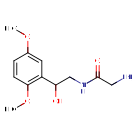
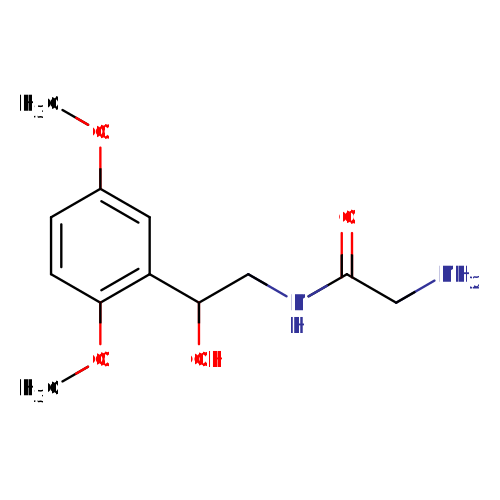
Structure for Midodrine (DB00211)
- Weight
- Average: 254.2823
Monoisotopic: 254.126657074 - Chemical Formula
- C12H18N2O4
- Synonyms
- (±)-2-amino-N-(β-hydroxy-2,5-dimethoxyphenethyl)acetamide
- 1-(2',5'-Dimethoxyphenyl)-2-glycinamidoethanol
- 2-Amino-N-(2,5-dimethoxy-beta-hydroxyphenethyl)acetamide
- DL-N1-(beta-Hydroxy-2,5-dimethoxyphenethyl)glycinamid
- Midodrin
- Midodrina
- Midodrine
- Midodrinum
- External IDs
- ST 1085
- ST-1085

Pharmacology
- Indication
For the treatment of symptomatic orthostatic hypotension (OH).
 Reduce drug development failure ratesBuild, train, & validate machine-learning modelswith evidence-based and structured datasets.Build, train, & validate predictive machine-learning models with structured datasets.
- Associated Conditions
Indication Type Indication Combined Product Details Approval Level Age Group Patient Characteristics Dose Form Management of Symptomatic orthostatic hypotension •••••••••••• - Contraindications & Blackbox Warnings
 Prevent Adverse Drug Events TodayTap into our Clinical API for life-saving information on contraindications & blackbox warnings, population restrictions, harmful risks, & more.Avoid life-threatening adverse drug events with our Clinical API
- Pharmacodynamics
Midodrine is a prodrug, i.e., the therapeutic effect of orally administered midodrine is due to the major metabolite desglymidodrine formed by deglycination of midodrine. Administration of midodrine results in a rise in standing, sitting, and supine systolic and diastolic blood pressure in patients with orthostatic hypotension of various etiologies. Standing systolic blood pressure is elevated by approximately 15 to 30 mmHg at 1 hour after a 10-mg dose of midodrine, with some effect persisting for 2 to 3 hours. Midodrine has no clinically significant effect on standing or supine pulse rates in patients with autonomic failure.
- Mechanism of action
Midodrine undergoes metabolism to form its pharmacologically active metabolite, desglymidodrine. Desglymidodrine acts as an agonist at the alpha1-adrenergic receptors expressed in the arteriolar and venous vasculature. Activation of alpha1-adrenergic receptor signaling pathways lead to an increase in the vascular tone and elevation of blood pressure. Desglymidodrine is reported to have negligible effect on the cardiac beta-adrenergic receptors.
Target Actions Organism AAlpha-1A adrenergic receptor agonistHumans AAlpha-1B adrenergic receptor agonistHumans UAlpha-1D adrenergic receptor agonistHumans - Absorption
Rapidly absorbed following oral administration. The peak plasma concentrations of the prodrug, desglymidodrine, is reached about half an hour following drug administration. The metabolites reach their peak plasma concentrations at about 1 to 2 hours following drug administration. The absolute bioavailability of midodrine (measured as desglymidodrine) is 93% and is not affected by food. As desglymidodrine displays poor diffusibility across the blood-brain barrier, it is expected to have minimal effects on the central nervous system.
- Volume of distribution
Not Available
- Protein binding
Not Available
- Metabolism
Thorough metabolic studies have not been conducted, but it appears that deglycination of midodrine to desglymidodrine takes place in many tissues, and both compounds are metabolized in part by the liver.
Hover over products below to view reaction partners
- Route of elimination
Not Available
- Half-life
The metabolites display a half-life of about 3 to 4 hours.
- Clearance
- Renal cl=385 mL/minute
- Adverse Effects
 Improve decision support & research outcomesWith structured adverse effects data, including: blackbox warnings, adverse reactions, warning & precautions, & incidence rates. View sample adverse effects data in our new Data Library!Improve decision support & research outcomes with our structured adverse effects data.
- Toxicity
Symptoms of overdose could include hypertension, piloerection (goosebumps), a sensation of coldness and urinary retention. The single doses that would be associated with symptoms of overdosage or would be potentially life- threatening are unknown. The oral LD50 is approximately 30 to 50 mg/kg in rats, 675 mg/kg in mice, and 125 to 160 mg/kg in dogs. Desglymidodrine is dialyzable.
- Pathways
- Not Available
- Pharmacogenomic Effects/ADRs
- Not Available
Interactions
- Drug Interactions
- This information should not be interpreted without the help of a healthcare provider. If you believe you are experiencing an interaction, contact a healthcare provider immediately. The absence of an interaction does not necessarily mean no interactions exist.
Drug Interaction Integrate drug-drug
interactions in your softwareAcebutolol The therapeutic efficacy of Midodrine can be decreased when used in combination with Acebutolol. Aceclofenac The risk or severity of hypertension can be increased when Midodrine is combined with Aceclofenac. Acemetacin The risk or severity of hypertension can be increased when Midodrine is combined with Acemetacin. Acetyldigitoxin Acetyldigitoxin may increase the bradycardic, atrioventricular blocking (AV block), and arrhythmogenic activities of Midodrine. Acetylsalicylic acid The risk or severity of hypertension can be increased when Midodrine is combined with Acetylsalicylic acid. - Food Interactions
- Take with or without food. The absorption is unaffected by food.
Products
 Drug product information from 10+ global regionsOur datasets provide approved product information including:dosage, form, labeller, route of administration, and marketing period.Access drug product information from over 10 global regions.
- Product Ingredients
Ingredient UNII CAS InChI Key Midodrine hydrochloride 59JV96YTXV 43218-56-0 MGCQZNBCJBRZDT-UHFFFAOYSA-N - Product Images
- Brand Name Prescription Products
Name Dosage Strength Route Labeller Marketing Start Marketing End Region Image Amatine Tablet 5 mg Oral Shire Pharma Canada Ulc 1992-12-31 2010-10-04 Canada 
Amatine Tablet 2.5 mg Oral Shire Pharma Canada Ulc 1992-12-31 2010-09-30 Canada Midodrine Tablet 5 mg Oral Sanis Health Inc 2023-05-31 Not applicable Canada Midodrine Tablet 2.5 mg Oral Sanis Health Inc 2023-05-31 Not applicable Canada ProAmatine Tablet 5 mg/1 Oral Shire 1996-09-06 2010-12-31 US 
- Generic Prescription Products
Name Dosage Strength Route Labeller Marketing Start Marketing End Region Image Apo-midodrine Tablet 2.5 mg Oral Apotex Corporation 2006-06-13 Not applicable Canada Apo-midodrine Tablet 5 mg Oral Apotex Corporation 2006-06-13 Not applicable Canada Jamp Midodrine Tablet 5 mg Oral Jamp Pharma Corporation 2022-02-21 Not applicable Canada Jamp Midodrine Tablet 2.5 mg Oral Jamp Pharma Corporation 2022-02-21 Not applicable Canada Mar-midodrine Tablet 5 mg Oral Marcan Pharmaceuticals Inc 2018-08-03 Not applicable Canada


Categories
- ATC Codes
- C01CA17 — Midodrine
- Drug Categories
- Adrenergic Agents
- Adrenergic Agonists
- Adrenergic alpha-1 Receptor Agonists
- Adrenergic alpha-Agonists
- Adrenergic and Dopaminergic Agents
- Agents producing tachycardia
- Agents that produce hypertension
- Alcohols
- Amines
- Amino Alcohols
- Autonomic Agents
- Bradycardia-Causing Agents
- Cardiac Stimulants Excl. Cardiac Glycosides
- Cardiac Therapy
- Cardiovascular Agents
- Cytochrome P-450 CYP2D6 Substrates
- Cytochrome P-450 Substrates
- Ethanolamines
- Neurotransmitter Agents
- Peripheral Nervous System Agents
- Sympathomimetics
- Vasoconstrictor Agents
- Chemical TaxonomyProvided by Classyfire
- Description
- This compound belongs to the class of organic compounds known as dimethoxybenzenes. These are organic aromatic compounds containing a monocyclic benzene moiety carrying exactly two methoxy groups.
- Kingdom
- Organic compounds
- Super Class
- Benzenoids
- Class
- Benzene and substituted derivatives
- Sub Class
- Methoxybenzenes
- Direct Parent
- Dimethoxybenzenes
- Alternative Parents
- Phenoxy compounds / Anisoles / Alkyl aryl ethers / Secondary alcohols / Propargyl-type 1,3-dipolar organic compounds / Carboximidic acids / Organopnictogen compounds / Monoalkylamines / Hydrocarbon derivatives / Aromatic alcohols
- Substituents
- Alcohol / Alkyl aryl ether / Amine / Anisole / Aromatic alcohol / Aromatic homomonocyclic compound / Carboximidic acid / Carboximidic acid derivative / Dimethoxybenzene / Ether
- Molecular Framework
- Aromatic homomonocyclic compounds
- External Descriptors
- aromatic ether, amino acid amide, secondary alcohol (CHEBI:6933)
- Affected organisms
- Humans and other mammals
Chemical Identifiers
- UNII
- 6YE7PBM15H
- CAS number
- 42794-76-3
- InChI Key
- PTKSEFOSCHHMPD-UHFFFAOYSA-N
- InChI
- InChI=1S/C12H18N2O4/c1-17-8-3-4-11(18-2)9(5-8)10(15)7-14-12(16)6-13/h3-5,10,15H,6-7,13H2,1-2H3,(H,14,16)
- IUPAC Name
- 2-amino-N-[2-(2,5-dimethoxyphenyl)-2-hydroxyethyl]acetamide
- SMILES
- COC1=CC(C(O)CNC(=O)CN)=C(OC)C=C1
References
- Synthesis Reference
Anup K. Ray, Hiren Patel, Mahendra R. Patel, "Synthesis of midodrine HCI from a novel intermediate 1-(2',5'-dimethoxyphenyl)-2-azidoethanone." U.S. Patent US6201153, issued July, 1965.
US6201153- General References
- Hebenstreit G: [Treatment of hypotension caused by psychopharmacological drugs (author's transl)]. Wien Med Wochenschr. 1981 Feb 28;131(4):109-12. [Article]
- Tsuda M, Terada T, Irie M, Katsura T, Niida A, Tomita K, Fujii N, Inui K: Transport characteristics of a novel peptide transporter 1 substrate, antihypotensive drug midodrine, and its amino acid derivatives. J Pharmacol Exp Ther. 2006 Jul;318(1):455-60. Epub 2006 Apr 5. [Article]
- External Links
- Human Metabolome Database
- HMDB0014356
- KEGG Drug
- D08220
- KEGG Compound
- C07890
- PubChem Compound
- 4195
- PubChem Substance
- 46507373
- ChemSpider
- 4050
- 6963
- ChEBI
- 6933
- ChEMBL
- CHEMBL1201212
- Therapeutic Targets Database
- DAP000229
- PharmGKB
- PA164749381
- RxList
- RxList Drug Page
- Drugs.com
- Drugs.com Drug Page
- Wikipedia
- Midodrine
Clinical Trials
- Clinical Trials
Phase Status Purpose Conditions Count 4 Active Not Recruiting Supportive Care Hypothermia, Accidental / Mild Cognitive Impairment (MCI) / Quadriplegia 1 4 Active Not Recruiting Treatment Vasovagal Syncope 1 4 Completed Not Available Hypothermia, Accidental / Mild Cognitive Impairment (MCI) / Quadriplegia 1 4 Completed Health Services Research Septic Shock 1 4 Completed Prevention Gastrointestinal Hemorrhage / Hepatic Encephalopathy (HE) / Hyponatremia / Kidney Failure / Sepsis 1
Pharmacoeconomics
- Manufacturers
- Apotex inc etobicoke site
- Impax pharmaceuticals
- Mylan pharmaceuticals inc
- Sandoz inc
- Upsher smith laboratories inc
- Shire development inc
- Packagers
- Actavis Group
- Amerisource Health Services Corp.
- Apotex Inc.
- Eon Labs
- Global Pharmaceuticals
- Heartland Repack Services LLC
- Impax Laboratories Inc.
- Kaiser Foundation Hospital
- Murfreesboro Pharmaceutical Nursing Supply
- Mylan
- Nycomed Inc.
- Physicians Total Care Inc.
- Rebel Distributors Corp.
- Resource Optimization and Innovation LLC
- Shire Inc.
- UDL Laboratories
- Upsher Smith Laboratories
- Vangard Labs Inc.
- Dosage Forms
Form Route Strength Tablet Oral 5 mg Injection, solution Solution / drops Oral Tablet Oral Solution / drops Oral 1 % Solution / drops; suspension / drops Oral 10 mg Tablet, coated Oral 5 mg Tablet, coated Oral 500000 mg Tablet Oral 10 mg/1 Tablet Oral 2.5 mg/1 Tablet Oral 2.5 mg Tablet Oral 5 mg/1 - Prices
Unit description Cost Unit Proamatine 10 mg tablet 5.91USD tablet Midodrine hcl 10 mg tablet 4.93USD tablet Proamatine 5 mg tablet 3.08USD tablet Midodrine hcl 5 mg tablet 2.47USD tablet Proamatine 2.5 mg tablet 1.53USD tablet Midodrine hcl 2.5 mg tablet 1.23USD tablet Apo-Midodrine 5 mg Tablet 0.59USD tablet Apo-Midodrine 2.5 mg Tablet 0.35USD tablet DrugBank does not sell nor buy drugs. Pricing information is supplied for informational purposes only.- Patents
- Not Available
Properties
- State
- Solid
- Experimental Properties
Property Value Source melting point (°C) 200 to 203°C Not Available water solubility Soluble Not Available logP -0.5 Not Available pKa 7.8 Not Available - Predicted Properties
Property Value Source Water Solubility 4.45 mg/mL ALOGPS logP -0.49 ALOGPS logP -0.95 Chemaxon logS -1.8 ALOGPS pKa (Strongest Acidic) 13.77 Chemaxon pKa (Strongest Basic) 8.14 Chemaxon Physiological Charge 1 Chemaxon Hydrogen Acceptor Count 5 Chemaxon Hydrogen Donor Count 3 Chemaxon Polar Surface Area 93.81 Å2 Chemaxon Rotatable Bond Count 6 Chemaxon Refractivity 66.22 m3·mol-1 Chemaxon Polarizability 26.65 Å3 Chemaxon Number of Rings 1 Chemaxon Bioavailability 1 Chemaxon Rule of Five Yes Chemaxon Ghose Filter No Chemaxon Veber's Rule No Chemaxon MDDR-like Rule No Chemaxon - Predicted ADMET Features
Property Value Probability Human Intestinal Absorption + 0.7686 Blood Brain Barrier - 0.856 Caco-2 permeable - 0.7382 P-glycoprotein substrate Substrate 0.784 P-glycoprotein inhibitor I Non-inhibitor 0.9781 P-glycoprotein inhibitor II Non-inhibitor 0.9866 Renal organic cation transporter Non-inhibitor 0.8896 CYP450 2C9 substrate Non-substrate 0.8519 CYP450 2D6 substrate Non-substrate 0.7593 CYP450 3A4 substrate Non-substrate 0.5595 CYP450 1A2 substrate Inhibitor 0.8848 CYP450 2C9 inhibitor Non-inhibitor 0.9385 CYP450 2D6 inhibitor Non-inhibitor 0.9231 CYP450 2C19 inhibitor Inhibitor 0.8993 CYP450 3A4 inhibitor Non-inhibitor 0.867 CYP450 inhibitory promiscuity Low CYP Inhibitory Promiscuity 0.9316 Ames test Non AMES toxic 0.774 Carcinogenicity Non-carcinogens 0.8613 Biodegradation Not ready biodegradable 0.9595 Rat acute toxicity 2.3137 LD50, mol/kg Not applicable hERG inhibition (predictor I) Weak inhibitor 0.9772 hERG inhibition (predictor II) Non-inhibitor 0.8604
Spectra
- Mass Spec (NIST)
- Not Available
- Spectra
Spectrum Spectrum Type Splash Key Predicted GC-MS Spectrum - GC-MS Predicted GC-MS splash10-0019-9420000000-7d9c097f5836b8a5fae7 Predicted MS/MS Spectrum - 10V, Positive (Annotated) Predicted LC-MS/MS splash10-000t-0910000000-e550d105839acbb60ad3 Predicted MS/MS Spectrum - 10V, Negative (Annotated) Predicted LC-MS/MS splash10-0007-3900000000-64b9fd3e180615fc1cd9 Predicted MS/MS Spectrum - 20V, Positive (Annotated) Predicted LC-MS/MS splash10-002b-2900000000-c7a005bb253ca6ffdeb7 Predicted MS/MS Spectrum - 20V, Negative (Annotated) Predicted LC-MS/MS splash10-01q0-0900000000-8cdccfe291eb7aa775b4 Predicted MS/MS Spectrum - 40V, Positive (Annotated) Predicted LC-MS/MS splash10-0mb9-6900000000-f21d9dd6bd17659bece2 Predicted MS/MS Spectrum - 40V, Negative (Annotated) Predicted LC-MS/MS splash10-00kf-4910000000-e52d27b07ec619d21e3d Predicted 1H NMR Spectrum 1D NMR Not Applicable Predicted 13C NMR Spectrum 1D NMR Not Applicable - Chromatographic Properties
Collision Cross Sections (CCS)
Adduct CCS Value (Å2) Source type Source [M-H]- 163.5543844 predictedDarkChem Lite v0.1.0 [M-H]- 157.73965 predictedDeepCCS 1.0 (2019) [M+H]+ 163.4477844 predictedDarkChem Lite v0.1.0 [M+H]+ 160.09764 predictedDeepCCS 1.0 (2019) [M+Na]+ 163.3959844 predictedDarkChem Lite v0.1.0 [M+Na]+ 166.1908 predictedDeepCCS 1.0 (2019)
Targets

- Kind
- Protein
- Organism
- Humans
- Pharmacological action
- Yes
- Actions
- Agonist
- General Function
- Protein heterodimerization activity
- Specific Function
- This alpha-adrenergic receptor mediates its action by association with G proteins that activate a phosphatidylinositol-calcium second messenger system. Its effect is mediated by G(q) and G(11) prot...
- Gene Name
- ADRA1A
- Uniprot ID
- P35348
- Uniprot Name
- Alpha-1A adrenergic receptor
- Molecular Weight
- 51486.005 Da
References
- Buckner SA, Milicic I, Daza AV, Meyer MD, Altenbach RJ, Williams M, Sullivan JP, Brioni JD: ABT-866, a novel alpha(1A)-adrenoceptor agonist with antagonist properties at the alpha(1B)- and alpha(1D)-adrenoceptor subtypes. Eur J Pharmacol. 2002 Aug 2;449(1-2):159-65. [Article]
- Taniguchi N, Hamada K, Ogasawara T, Ukai Y, Yoshikuni Y, Kimura K: NS-49, an alpha 1A-adrenoceptor agonist, selectively increases intraurethral pressure in dogs. Eur J Pharmacol. 1996 Dec 27;318(1):117-22. [Article]
- Altenbach RJ, Khilevich A, Kolasa T, Rohde JJ, Bhatia PA, Patel MV, Searle XB, Yang F, Bunnelle WH, Tietje K, Bayburt EK, Carroll WA, Meyer MD, Henry R, Buckner SA, Kuk J, Daza AV, Milicic IV, Cain JC, Kang CH, Ireland LM, Carr TL, Miller TR, Hancock AA, Nakane M, Esbenshade TA, Brune ME, O'Neill AB, Gauvin DM, Katwala SP, Holladay MW, Brioni JD, Sullivan JP: Synthesis and structure-activity studies on N-[5-(1H-imidazol-4-yl)-5,6,7,8-tetrahydro-1-naphthalenyl]methanesulfonamide, an imidazole-containing alpha(1A)-adrenoceptor agonist. J Med Chem. 2004 Jun 3;47(12):3220-35. [Article]
- Kind
- Protein
- Organism
- Humans
- Pharmacological action
- Yes
- Actions
- Agonist
- General Function
- Protein heterodimerization activity
- Specific Function
- This alpha-adrenergic receptor mediates its action by association with G proteins that activate a phosphatidylinositol-calcium second messenger system. Its effect is mediated by G(q) and G(11) prot...
- Gene Name
- ADRA1B
- Uniprot ID
- P35368
- Uniprot Name
- Alpha-1B adrenergic receptor
- Molecular Weight
- 56835.375 Da
References
- Altenbach RJ, Khilevich A, Kolasa T, Rohde JJ, Bhatia PA, Patel MV, Searle XB, Yang F, Bunnelle WH, Tietje K, Bayburt EK, Carroll WA, Meyer MD, Henry R, Buckner SA, Kuk J, Daza AV, Milicic IV, Cain JC, Kang CH, Ireland LM, Carr TL, Miller TR, Hancock AA, Nakane M, Esbenshade TA, Brune ME, O'Neill AB, Gauvin DM, Katwala SP, Holladay MW, Brioni JD, Sullivan JP: Synthesis and structure-activity studies on N-[5-(1H-imidazol-4-yl)-5,6,7,8-tetrahydro-1-naphthalenyl]methanesulfonamide, an imidazole-containing alpha(1A)-adrenoceptor agonist. J Med Chem. 2004 Jun 3;47(12):3220-35. [Article]
- Kind
- Protein
- Organism
- Humans
- Pharmacological action
- Unknown
- Actions
- Agonist
- General Function
- Alpha1-adrenergic receptor activity
- Specific Function
- This alpha-adrenergic receptor mediates its effect through the influx of extracellular calcium.
- Gene Name
- ADRA1D
- Uniprot ID
- P25100
- Uniprot Name
- Alpha-1D adrenergic receptor
- Molecular Weight
- 60462.205 Da
References
- Altenbach RJ, Khilevich A, Meyer MD, Buckner SA, Milicic I, Daza AV, Brune ME, O'Neill AB, Gauvin DM, Cain JC, Nakane M, Holladay MW, Williams M, Brioni JD, Sullivan JP: N-[3-(1H-imidazol-4-ylmethyl)phenyl]ethanesulfonamide (ABT-866, 1),(1) a novel alpha(1)-adrenoceptor ligand with an enhanced in vitro and in vivo profile relative to phenylpropanolamine and midodrine. J Med Chem. 2002 Sep 26;45(20):4395-7. [Article]
Enzymes
- Kind
- Protein
- Organism
- Humans
- Pharmacological action
- Unknown
- Actions
- Substrate
- General Function
- Steroid hydroxylase activity
- Specific Function
- Responsible for the metabolism of many drugs and environmental chemicals that it oxidizes. It is involved in the metabolism of drugs such as antiarrhythmics, adrenoceptor antagonists, and tricyclic...
- Gene Name
- CYP2D6
- Uniprot ID
- P10635
- Uniprot Name
- Cytochrome P450 2D6
- Molecular Weight
- 55768.94 Da
References
Transporters
- Kind
- Protein
- Organism
- Humans
- Pharmacological action
- Unknown
- General Function
- Proton-dependent oligopeptide secondary active transmembrane transporter activity
- Specific Function
- Proton-coupled intake of oligopeptides of 2 to 4 amino acids with a preference for dipeptides. May constitute a major route for the absorption of protein digestion end-products.
- Gene Name
- SLC15A1
- Uniprot ID
- P46059
- Uniprot Name
- Solute carrier family 15 member 1
- Molecular Weight
- 78805.265 Da
References
- Tsuda M, Terada T, Irie M, Katsura T, Niida A, Tomita K, Fujii N, Inui K: Transport characteristics of a novel peptide transporter 1 substrate, antihypotensive drug midodrine, and its amino acid derivatives. J Pharmacol Exp Ther. 2006 Jul;318(1):455-60. Epub 2006 Apr 5. [Article]

Drug created at June 13, 2005 13:24 / Updated at April 27, 2024 09:44