Identification
- Generic Name
- Bethanidine
- DrugBank Accession Number
- DB00217
- Background
A guanidinium antihypertensive agent that acts by blocking adrenergic transmission.
- Type
- Small Molecule
- Groups
- Approved
- Structure
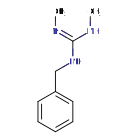
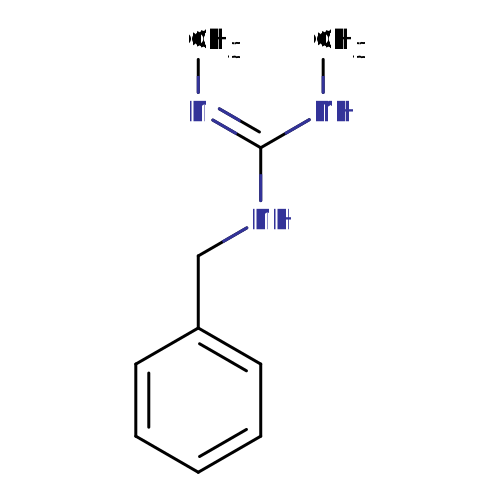
Structure for Bethanidine (DB00217)
- Weight
- Average: 177.2462
Monoisotopic: 177.126597495 - Chemical Formula
- C10H15N3
- Synonyms
- Betanidina
- Betanidine
- Bétanidine
- Betanidinum
- Bethanidine
- N,N'-dimethyl-N''-(phenylmethyl)-guanidine

Pharmacology
- Indication
For the treatment of hypertension.
 Reduce drug development failure ratesBuild, train, & validate machine-learning modelswith evidence-based and structured datasets.Build, train, & validate predictive machine-learning models with structured datasets.
- Contraindications & Blackbox Warnings
 Prevent Adverse Drug Events TodayTap into our Clinical API for life-saving information on contraindications & blackbox warnings, population restrictions, harmful risks, & more.Avoid life-threatening adverse drug events with our Clinical API
- Pharmacodynamics
Bethanidine is a guanidinium antihypertensive agent that acts by blocking adrenergic transmission. The precise mode of action is not clear. Although bethanidine may produce adverse effects, they are beneficial in severe hypertension and produce fewer side effects than guanethidine.
- Mechanism of action
Bethanidine, a guanidine derivative, is a peripherally acting antiadrenergic agent which primarily acts as an alpha2a adrenergic agonist. Bethanidine effectively decreases blood pressure by suppressing renin secretion or interfering with function of the sympathetic nervous system.
Target Actions Organism AATP-sensitive inward rectifier potassium channel 1 inhibitorHumans AAlpha-2 adrenergic receptors agonistHumans UBeta adrenergic receptor antagonistHumans - Absorption
Absorbed rapidly in the gastrointestinal tract following oral administration.
- Volume of distribution
Not Available
- Protein binding
Not Available
- Metabolism
- Not Available
- Route of elimination
Not Available
- Half-life
9 hours (range 7 to 11 hours)
- Clearance
Not Available
- Adverse Effects
 Improve decision support & research outcomesWith structured adverse effects data, including: blackbox warnings, adverse reactions, warning & precautions, & incidence rates. View sample adverse effects data in our new Data Library!Improve decision support & research outcomes with our structured adverse effects data.
- Toxicity
Not Available
- Pathways
- Not Available
- Pharmacogenomic Effects/ADRs
- Not Available
Interactions
- Drug Interactions
- This information should not be interpreted without the help of a healthcare provider. If you believe you are experiencing an interaction, contact a healthcare provider immediately. The absence of an interaction does not necessarily mean no interactions exist.
Drug Interaction Integrate drug-drug
interactions in your softwareAbaloparatide Abaloparatide may increase the hypotensive activities of Bethanidine. Acebutolol The therapeutic efficacy of Bethanidine can be decreased when used in combination with Acebutolol. Aceclofenac The therapeutic efficacy of Bethanidine can be decreased when used in combination with Aceclofenac. Acemetacin The therapeutic efficacy of Bethanidine can be decreased when used in combination with Acemetacin. Acetylsalicylic acid Acetylsalicylic acid may decrease the antihypertensive activities of Bethanidine. - Food Interactions
- Not Available
Products
 Drug product information from 10+ global regionsOur datasets provide approved product information including:dosage, form, labeller, route of administration, and marketing period.Access drug product information from over 10 global regions.
- Product Ingredients
Ingredient UNII CAS InChI Key Bethanidine sulfate J4THI5N7O2 114-85-2 YTIJUXVIZLYQTB-UHFFFAOYSA-N - International/Other Brands
- Esbatal
Categories
- ATC Codes
- C02CC01 — Betanidine
- Drug Categories
- Adrenergic Agents
- Adrenergic Agonists
- Adrenergic alpha-2 Receptor Agonists
- Adrenergic alpha-Agonists
- Agents producing tachycardia
- Agents that produce hypertension
- Amidines
- Antiadrenergic Agents, Peripherally Acting
- Antihypertensive Agents
- Autonomic Agents
- Cardiovascular Agents
- Guanidine Derivatives
- Guanidines
- Neurotransmitter Agents
- Peripheral Nervous System Agents
- Sympatholytics
- Chemical TaxonomyProvided by Classyfire
- Description
- This compound belongs to the class of organic compounds known as benzene and substituted derivatives. These are aromatic compounds containing one monocyclic ring system consisting of benzene.
- Kingdom
- Organic compounds
- Super Class
- Benzenoids
- Class
- Benzene and substituted derivatives
- Sub Class
- Not Available
- Direct Parent
- Benzene and substituted derivatives
- Alternative Parents
- Guanidines / Propargyl-type 1,3-dipolar organic compounds / Carboximidamides / Organopnictogen compounds / Imines / Hydrocarbon derivatives
- Substituents
- Aromatic homomonocyclic compound / Carboximidamide / Guanidine / Hydrocarbon derivative / Imine / Monocyclic benzene moiety / Organic 1,3-dipolar compound / Organic nitrogen compound / Organonitrogen compound / Organopnictogen compound
- Molecular Framework
- Aromatic homomonocyclic compounds
- External Descriptors
- guanidines (CHEBI:37937)
- Affected organisms
- Humans and other mammals
Chemical Identifiers
- UNII
- W8S3YM7AUU
- CAS number
- 55-73-2
- InChI Key
- NIVZHWNOUVJHKV-UHFFFAOYSA-N
- InChI
- InChI=1S/C10H15N3/c1-11-10(12-2)13-8-9-6-4-3-5-7-9/h3-7H,8H2,1-2H3,(H2,11,12,13)
- IUPAC Name
- (E)-N'-benzyl-N,N''-dimethylguanidine
- SMILES
- CN\C(NCC1=CC=CC=C1)=N/C
References
- Synthesis Reference
Khashayar Karimian, Keshava Murthy, Darren Hall, "Methods of making ureas and guanidines, including terazosin, prazosin, doxazosin, tiodazosin, trimazosin, quinazosin, and bunazosin (exemplary of 2-substituted quinazoline compounds), and meobentine, and bethanidine and intermediates thereof." U.S. Patent US5686612, issued November, 1990.
US5686612- General References
- Not Available
- External Links
- Human Metabolome Database
- HMDB0014362
- KEGG Drug
- D01603
- PubChem Compound
- 2368
- PubChem Substance
- 46507605
- ChemSpider
- 2278
- 1523
- ChEBI
- 37937
- ChEMBL
- CHEMBL1201260
- ZINC
- ZINC000002041046
- Therapeutic Targets Database
- DAP000047
- PharmGKB
- PA164743235
- Wikipedia
- Bethanidine
Clinical Trials
Pharmacoeconomics
- Manufacturers
- Ah robins co
- Packagers
- Not Available
- Dosage Forms
- Not Available
- Prices
- Not Available
- Patents
- Not Available
Properties
- State
- Solid
- Experimental Properties
Property Value Source melting point (°C) 196 °C PhysProp logP 0.49 Not Available - Predicted Properties
Property Value Source Water Solubility 1.58 mg/mL ALOGPS logP 1.41 ALOGPS logP 1.27 Chemaxon logS -2 ALOGPS pKa (Strongest Basic) 12.41 Chemaxon Physiological Charge 1 Chemaxon Hydrogen Acceptor Count 3 Chemaxon Hydrogen Donor Count 2 Chemaxon Polar Surface Area 36.42 Å2 Chemaxon Rotatable Bond Count 2 Chemaxon Refractivity 54.5 m3·mol-1 Chemaxon Polarizability 20.43 Å3 Chemaxon Number of Rings 1 Chemaxon Bioavailability 1 Chemaxon Rule of Five Yes Chemaxon Ghose Filter Yes Chemaxon Veber's Rule Yes Chemaxon MDDR-like Rule No Chemaxon - Predicted ADMET Features
Property Value Probability Human Intestinal Absorption + 0.9713 Blood Brain Barrier + 0.85 Caco-2 permeable + 0.5072 P-glycoprotein substrate Non-substrate 0.5681 P-glycoprotein inhibitor I Non-inhibitor 0.9217 P-glycoprotein inhibitor II Non-inhibitor 0.6727 Renal organic cation transporter Inhibitor 0.5516 CYP450 2C9 substrate Non-substrate 0.7952 CYP450 2D6 substrate Non-substrate 0.5 CYP450 3A4 substrate Non-substrate 0.7359 CYP450 1A2 substrate Non-inhibitor 0.7802 CYP450 2C9 inhibitor Non-inhibitor 0.9218 CYP450 2D6 inhibitor Inhibitor 0.5754 CYP450 2C19 inhibitor Non-inhibitor 0.8195 CYP450 3A4 inhibitor Non-inhibitor 0.8329 CYP450 inhibitory promiscuity Low CYP Inhibitory Promiscuity 0.9069 Ames test Non AMES toxic 0.7985 Carcinogenicity Non-carcinogens 0.886 Biodegradation Not ready biodegradable 0.9161 Rat acute toxicity 2.5507 LD50, mol/kg Not applicable hERG inhibition (predictor I) Weak inhibitor 0.9126 hERG inhibition (predictor II) Non-inhibitor 0.9191
Spectra
- Mass Spec (NIST)
- Not Available
- Spectra
Spectrum Spectrum Type Splash Key Predicted GC-MS Spectrum - GC-MS Predicted GC-MS splash10-0006-9400000000-b32a080ebd20af65e7e4 Predicted MS/MS Spectrum - 10V, Positive (Annotated) Predicted LC-MS/MS splash10-0006-9300000000-cee48161b906dfe62e05 Predicted MS/MS Spectrum - 10V, Negative (Annotated) Predicted LC-MS/MS splash10-004i-2900000000-4873eb046b1ecf733d11 Predicted MS/MS Spectrum - 20V, Positive (Annotated) Predicted LC-MS/MS splash10-0006-9100000000-5ce1e1ea7d44c597ae1e Predicted MS/MS Spectrum - 20V, Negative (Annotated) Predicted LC-MS/MS splash10-0a4i-9200000000-96b8b40a0c6a905d3842 Predicted MS/MS Spectrum - 40V, Positive (Annotated) Predicted LC-MS/MS splash10-00kf-9100000000-71d69100c4f8537f9525 Predicted MS/MS Spectrum - 40V, Negative (Annotated) Predicted LC-MS/MS splash10-0a4i-9600000000-44992c84a6193ef0101d Predicted 1H NMR Spectrum 1D NMR Not Applicable Predicted 13C NMR Spectrum 1D NMR Not Applicable - Chromatographic Properties
Collision Cross Sections (CCS)
Adduct CCS Value (Å2) Source type Source [M-H]- 150.651235 predictedDarkChem Lite v0.1.0 [M-H]- 151.418135 predictedDarkChem Lite v0.1.0 [M-H]- 138.26595 predictedDeepCCS 1.0 (2019) [M+H]+ 150.673735 predictedDarkChem Lite v0.1.0 [M+H]+ 151.627735 predictedDarkChem Lite v0.1.0 [M+H]+ 140.6615 predictedDeepCCS 1.0 (2019) [M+Na]+ 149.953235 predictedDarkChem Lite v0.1.0 [M+Na]+ 148.01189 predictedDeepCCS 1.0 (2019)
Targets

- Kind
- Protein
- Organism
- Humans
- Pharmacological action
- Yes
- Actions
- Inhibitor
- General Function
- Phosphatidylinositol-4,5-bisphosphate binding
- Specific Function
- In the kidney, probably plays a major role in potassium homeostasis. Inward rectifier potassium channels are characterized by a greater tendency to allow potassium to flow into the cell rather than...
- Gene Name
- KCNJ1
- Uniprot ID
- P48048
- Uniprot Name
- ATP-sensitive inward rectifier potassium channel 1
- Molecular Weight
- 44794.6 Da
References
- Bkaily G, Caille JP, Payet MD, Peyrow M, Sauve R, Renaud JF, Sperelakis N: Bethanidine increases one type of potassium current and relaxes aortic muscle. Can J Physiol Pharmacol. 1988 Jun;66(6):731-6. [Article]
- Bkaily G: Bethanidine, nitroprusside and atrial natriuretic factor open a cGMP-sensitive K+ channel in aortic muscle. Prog Clin Biol Res. 1990;327:507-15. [Article]
- Kind
- Protein group
- Organism
- Humans
- Pharmacological action
- Yes
- Actions
- Agonist
- General Function
- Thioesterase binding
- Specific Function
- Alpha-2 adrenergic receptors mediate the catecholamine-induced inhibition of adenylate cyclase through the action of G proteins. The rank order of potency for agonists of this receptor is oxymetazo...
Components:
| Name | UniProt ID |
|---|---|
| Alpha-2A adrenergic receptor | P08913 |
| Alpha-2B adrenergic receptor | P18089 |
| Alpha-2C adrenergic receptor | P18825 |
References
- Noshiro T, Miura Y, Kimura S, Meguro Y, Sugawara T, Ohashi H, Takahashi M, Sano N, Watanabe H, Ohzeki T, et al.: Functional relationships between platelet alpha 2-adrenoceptors and sympathetic nerve activity in clinical hypertensive states. J Hypertens. 1990 Dec;8(12):1097-104. [Article]
- Noshiro T, Miura Y, Kimura S, Meguro Y, Sugawara T, Ohashi H, Takahashi M, Sano N, Watanabe H, Ohzeki T, et al.: Functional relationship between platelet alpha 2-adrenoceptors and sympathetic nerve activity in man. Clin Exp Hypertens A. 1989;11 Suppl 1:287-94. [Article]
- Kind
- Protein group
- Organism
- Humans
- Pharmacological action
- Unknown
- Actions
- Antagonist
- General Function
- Receptor signaling protein activity
- Specific Function
- Beta-adrenergic receptors mediate the catecholamine-induced activation of adenylate cyclase through the action of G proteins. This receptor binds epinephrine and norepinephrine with approximately e...
Components:
| Name | UniProt ID |
|---|---|
| Beta-1 adrenergic receptor | P08588 |
| Beta-2 adrenergic receptor | P07550 |
| Beta-3 adrenergic receptor | P13945 |
References
- Hart GR, Anderson RJ: Withdrawal syndromes and the cessation of antihypertensive therapy. Arch Intern Med. 1981 Aug;141(9):1125-7. [Article]
- Chen X, Ji ZL, Chen YZ: TTD: Therapeutic Target Database. Nucleic Acids Res. 2002 Jan 1;30(1):412-5. [Article]
- Bacaner MB, Benditt DG: Antiarrhythmic, antifibrillatory, and hemodynamic actions of bethanidine sulfate: an orally effective analog of bretylium for suppression of ventricular tachyarrhythmias. Am J Cardiol. 1982 Oct;50(4):728-34. [Article]

Drug created at June 13, 2005 13:24 / Updated at April 09, 2024 18:22