Identification
- Summary
Ibutilide is a class III antiarrhythmic agent used to correct atrial fibrillation and atrial flutter, which can be considered as an alternative to cardioversion.
- Brand Names
- Corvert
- Generic Name
- Ibutilide
- DrugBank Accession Number
- DB00308
- Background
Ibutilide is a Class III antiarrhythmic agent available in intravenous formulations. It is indicated for the conversion of acute atrial flutter and recent onset atrial fibrillation to normal sinus rhythm (NSR).
- Type
- Small Molecule
- Groups
- Approved
- Structure
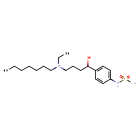
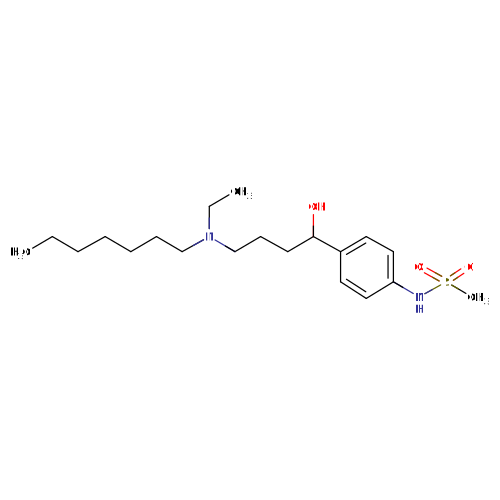
Structure for Ibutilide (DB00308)
- Weight
- Average: 384.576
Monoisotopic: 384.244663718 - Chemical Formula
- C20H36N2O3S
- Synonyms
- Ibutilid
- Ibutilida
- Ibutilide
- Ibutilidum
- N-(4-{4-[ethyl(heptyl)amino]-1-hydroxybutyl}phenyl)methanesulfonamide
- External IDs
- U 70226 E

Pharmacology
- Indication
Indicated for the rapid conversion of atrial fibrillation or atrial flutter of recent onset to sinus rhythm.
 Reduce drug development failure ratesBuild, train, & validate machine-learning modelswith evidence-based and structured datasets.Build, train, & validate predictive machine-learning models with structured datasets.
- Associated Conditions
Indication Type Indication Combined Product Details Approval Level Age Group Patient Characteristics Dose Form Management of Atrial fibrillation •••••••••••• Management of Atrial flutter •••••••••••• - Contraindications & Blackbox Warnings
 Prevent Adverse Drug Events TodayTap into our Clinical API for life-saving information on contraindications & blackbox warnings, population restrictions, harmful risks, & more.Avoid life-threatening adverse drug events with our Clinical API
- Pharmacodynamics
Ibutilide prolongs the action potential duration and increases both atrial and ventricular refractoriness in vivo, i.e., class III electrophysiologic effects. Voltage clamp studies indicate that ibutilide, at nanomolar concentrations, delays repolarization by activation of a slow, inward current (predominantly sodium), rather than by blocking outward potassium currents, which is the mechanism by which most other class III antiarrhythmics act.
- Mechanism of action
Ibutilide is a 'pure' class III antiarrhythmic drug, used intravenously against atrial flutter and fibrillation. At a cellular level it exerts two main actions: induction of a persistent Na+ current sensitive to dihydropyridine Ca2+ channel blockers and potent inhibition of the cardiac rapid delayed rectifier K+ current, by binding within potassium channel pores. In other words, Ibutilide binds to and alters the activity of hERG potassium channels, delayed inward rectifier potassium (IKr) channels and L-type (dihydropyridine sensitive) calcium channels
Target Actions Organism AVoltage-dependent L-type calcium channel subunit alpha-1C activatorHumans AVoltage-dependent L-type calcium channel subunit beta-1 activatorHumans APotassium voltage-gated channel subfamily H member 2 inhibitorHumans UVoltage-dependent calcium channel subunit alpha-2/delta-1 activatorHumans UVoltage-dependent calcium channel gamma-1 subunit activatorHumans UPotassium channel subfamily K member 1 inhibitorHumans UPotassium channel subfamily K member 6 inhibitorHumans UPotassium voltage-gated channel subfamily H member 6 inhibitorHumans UPotassium voltage-gated channel subfamily H member 7 inhibitorHumans UATP-sensitive inward rectifier potassium channel 11 inhibitorHumans - Absorption
Rapid after intravenous injection
- Volume of distribution
- 11 L/kg
- Protein binding
40%
- Metabolism
Primarily hepatic. Eight metabolites of ibutilide were detected in metabolic profiling of urine. These metabolites are thought to be formed primarily by o-oxidation followed by sequential b-oxidation of the heptyl side chain of ibutilide. Of the eight metabolites, only the o-hydroxy metabolite possesses class III electrophysiologic properties similar to that of ibutilide in an in vitro isolated rabbit myocardium model.
- Route of elimination
In healthy male volunteers, about 82% of a 0.01 mg/kg dose of [14C] ibutilide fumarate was excreted in the urine (about 7% of the dose as unchanged ibutilide) and the remainder (about 19%) was recovered in the feces.
- Half-life
6 hours (ranges from 2-12 hours)
- Clearance
- 29 mL/min/kg
- Adverse Effects
 Improve decision support & research outcomesWith structured adverse effects data, including: blackbox warnings, adverse reactions, warning & precautions, & incidence rates. View sample adverse effects data in our new Data Library!Improve decision support & research outcomes with our structured adverse effects data.
- Toxicity
Acute overdose in animals results in CNS toxicity; notably, CNS depression, rapid gasping breathing, and convulsions. The intravenous median lethal dose in the rat was more than 50 mg/kg which is, on a mg/m2 basis, at least 250 times the maximum recommended human dose.
- Pathways
Pathway Category Ibutilide Action Pathway Drug action - Pharmacogenomic Effects/ADRs
- Not Available
Interactions
- Drug Interactions
- This information should not be interpreted without the help of a healthcare provider. If you believe you are experiencing an interaction, contact a healthcare provider immediately. The absence of an interaction does not necessarily mean no interactions exist.
Drug Interaction Integrate drug-drug
interactions in your softwareAbacavir Ibutilide may decrease the excretion rate of Abacavir which could result in a higher serum level. Acebutolol Ibutilide may increase the arrhythmogenic activities of Acebutolol. Aceclofenac Aceclofenac may decrease the excretion rate of Ibutilide which could result in a higher serum level. Acemetacin Acemetacin may decrease the excretion rate of Ibutilide which could result in a higher serum level. Acetaminophen Ibutilide may decrease the excretion rate of Acetaminophen which could result in a higher serum level. - Food Interactions
- No interactions found.
Products
 Drug product information from 10+ global regionsOur datasets provide approved product information including:dosage, form, labeller, route of administration, and marketing period.Access drug product information from over 10 global regions.
- Product Ingredients
Ingredient UNII CAS InChI Key Ibutilide fumarate 9L5X4M5L6I 122647-32-9 PCIOHQNIRPWFMV-WXXKFALUSA-N - Brand Name Prescription Products
Name Dosage Strength Route Labeller Marketing Start Marketing End Region Image Corvert Solution 0.1 mg / mL Intravenous Pfizer Canada Ulc 2000-11-28 Not applicable Canada 
Corvert Injection, solution 0.1 mg/1mL Intravenous Pharmacia & Upjohn Company LLC 1995-12-28 Not applicable US 
- Generic Prescription Products
Name Dosage Strength Route Labeller Marketing Start Marketing End Region Image Ibutilide Fumarate Injection, solution 0.1 mg/1mL Intravenous Mylan Institutional LLC 2010-01-11 Not applicable US Ibutilide Fumarate Injection, solution 0.1 mg/1mL Intravenous Genera Medix Inc. 2010-01-12 2017-12-31 US Ibutilide Fumarate Injection, solution 1 mg/10mL Intravenous Heritage Pharmaceuticals Inc. d/b/a Avet Pharmaceuticals Inc. 2024-04-01 Not applicable US Ibutilide Fumarate Injection, solution 0.1 mg/1mL Intravenous Paddock Laboratories, Inc. 2010-01-13 2014-07-31 US
Categories
- ATC Codes
- C01BD05 — Ibutilide
- Drug Categories
- Chemical TaxonomyProvided by Classyfire
- Description
- This compound belongs to the class of organic compounds known as phenylbutylamines. These are compounds containing a phenylbutylamine moiety, which consists of a phenyl group substituted at the fourth carbon by an butan-1-amine.
- Kingdom
- Organic compounds
- Super Class
- Benzenoids
- Class
- Benzene and substituted derivatives
- Sub Class
- Phenylbutylamines
- Direct Parent
- Phenylbutylamines
- Alternative Parents
- Sulfanilides / Aralkylamines / Organosulfonamides / Organic sulfonamides / Aminosulfonyl compounds / Trialkylamines / Secondary alcohols / Organopnictogen compounds / Organic oxides / Hydrocarbon derivatives show 1 more
- Substituents
- Alcohol / Amine / Aminosulfonyl compound / Aralkylamine / Aromatic alcohol / Aromatic homomonocyclic compound / Hydrocarbon derivative / Organic nitrogen compound / Organic oxide / Organic oxygen compound show 14 more
- Molecular Framework
- Aromatic homomonocyclic compounds
- External Descriptors
- organic amino compound, benzenes (CHEBI:5856)
- Affected organisms
- Humans and other mammals
Chemical Identifiers
- UNII
- 2436VX1U9B
- CAS number
- 122647-31-8
- InChI Key
- ALOBUEHUHMBRLE-UHFFFAOYSA-N
- InChI
- InChI=1S/C20H36N2O3S/c1-4-6-7-8-9-16-22(5-2)17-10-11-20(23)18-12-14-19(15-13-18)21-26(3,24)25/h12-15,20-21,23H,4-11,16-17H2,1-3H3
- IUPAC Name
- N-(4-{4-[ethyl(heptyl)amino]-1-hydroxybutyl}phenyl)methanesulfonamide
- SMILES
- CCCCCCCN(CC)CCCC(O)C1=CC=C(NS(C)(=O)=O)C=C1
References
- Synthesis Reference
- US5155268A
- General References
- Not Available
- External Links
- Human Metabolome Database
- HMDB0014453
- KEGG Drug
- D00648
- KEGG Compound
- C07753
- PubChem Compound
- 60753
- PubChem Substance
- 46507904
- ChemSpider
- 54755
- BindingDB
- 50131432
- 41289
- ChEBI
- 5856
- ChEMBL
- CHEMBL533
- Therapeutic Targets Database
- DAP000279
- PharmGKB
- PA449958
- RxList
- RxList Drug Page
- Drugs.com
- Drugs.com Drug Page
- Wikipedia
- Ibutilide
- FDA label
- Download (878 KB)
Clinical Trials
- Clinical Trials
Phase Status Purpose Conditions Count 4 Active Not Recruiting Prevention Abnormalities, Drug-Induced / Long QT Syndrome (LQTS) 1 4 Completed Prevention Long QT Syndrome (LQTS) 1 4 Completed Treatment Atrial Fibrillation 1 4 Recruiting Treatment Abnormalities, Drug-Induced / Long QT Syndrome (LQTS) 1 2 Completed Prevention Prolonged QT Interval in EKG and Sudden Death 1
Pharmacoeconomics
- Manufacturers
- Pharmacia and upjohn co
- Bioniche pharma usa llc
- Pharmaforce inc
- Packagers
- Bioniche Pharma
- Generamedix Inc.
- Paddock Labs
- Pharmacia Inc.
- Dosage Forms
Form Route Strength Solution Intravenous Solution Intravenous 0.1 mg / mL Solution Parenteral 87 Mikrogramm/ml Injection, solution Intravenous 0.1 mg/1mL Injection, solution Intravenous 1 mg/10mL - Prices
Unit description Cost Unit Corvert 1 mg/10 ml vial 54.27USD ml Ibutilide fum 1 mg/10 ml vial 33.6USD ml DrugBank does not sell nor buy drugs. Pricing information is supplied for informational purposes only.- Patents
Patent Number Pediatric Extension Approved Expires (estimated) Region US5155268 No 1992-10-13 2009-12-28 US
Properties
- State
- Solid
- Experimental Properties
Property Value Source water solubility 100 mg/mL Not Available logP 4.6 Not Available - Predicted Properties
Property Value Source Water Solubility 0.00473 mg/mL ALOGPS logP 4.72 ALOGPS logP 2.54 Chemaxon logS -4.9 ALOGPS pKa (Strongest Acidic) 9.72 Chemaxon pKa (Strongest Basic) 10.4 Chemaxon Physiological Charge 1 Chemaxon Hydrogen Acceptor Count 4 Chemaxon Hydrogen Donor Count 2 Chemaxon Polar Surface Area 69.64 Å2 Chemaxon Rotatable Bond Count 13 Chemaxon Refractivity 109.18 m3·mol-1 Chemaxon Polarizability 46.45 Å3 Chemaxon Number of Rings 1 Chemaxon Bioavailability 1 Chemaxon Rule of Five Yes Chemaxon Ghose Filter Yes Chemaxon Veber's Rule No Chemaxon MDDR-like Rule No Chemaxon - Predicted ADMET Features
Property Value Probability Human Intestinal Absorption + 0.9964 Blood Brain Barrier + 0.9363 Caco-2 permeable - 0.6669 P-glycoprotein substrate Substrate 0.6142 P-glycoprotein inhibitor I Non-inhibitor 0.7689 P-glycoprotein inhibitor II Non-inhibitor 0.8893 Renal organic cation transporter Non-inhibitor 0.8738 CYP450 2C9 substrate Non-substrate 0.8131 CYP450 2D6 substrate Non-substrate 0.9116 CYP450 3A4 substrate Non-substrate 0.5472 CYP450 1A2 substrate Non-inhibitor 0.7721 CYP450 2C9 inhibitor Non-inhibitor 0.8256 CYP450 2D6 inhibitor Non-inhibitor 0.8114 CYP450 2C19 inhibitor Non-inhibitor 0.7115 CYP450 3A4 inhibitor Non-inhibitor 0.7974 CYP450 inhibitory promiscuity Low CYP Inhibitory Promiscuity 0.8467 Ames test Non AMES toxic 0.7092 Carcinogenicity Non-carcinogens 0.6799 Biodegradation Not ready biodegradable 0.9945 Rat acute toxicity 2.5314 LD50, mol/kg Not applicable hERG inhibition (predictor I) Strong inhibitor 0.5736 hERG inhibition (predictor II) Inhibitor 0.7592
Spectra
- Mass Spec (NIST)
- Not Available
- Spectra
Spectrum Spectrum Type Splash Key Predicted GC-MS Spectrum - GC-MS Predicted GC-MS splash10-0udi-3494000000-4216adb870d24524f3f8 Predicted MS/MS Spectrum - 10V, Positive (Annotated) Predicted LC-MS/MS splash10-00kr-0059000000-170d24eab89b19e966d1 Predicted MS/MS Spectrum - 10V, Negative (Annotated) Predicted LC-MS/MS splash10-000x-3449000000-3bdd60704e7309d32975 Predicted MS/MS Spectrum - 20V, Negative (Annotated) Predicted LC-MS/MS splash10-001i-1029000000-6a02de37bf9f549bf522 Predicted MS/MS Spectrum - 20V, Positive (Annotated) Predicted LC-MS/MS splash10-00y0-7697000000-17aa7532d621b4775edb Predicted MS/MS Spectrum - 40V, Negative (Annotated) Predicted LC-MS/MS splash10-0ar0-3397000000-c85b44fc752dee994fd1 Predicted MS/MS Spectrum - 40V, Positive (Annotated) Predicted LC-MS/MS splash10-00b9-3691000000-2a3939f8223953531a66 Predicted 1H NMR Spectrum 1D NMR Not Applicable Predicted 13C NMR Spectrum 1D NMR Not Applicable - Chromatographic Properties
Collision Cross Sections (CCS)
Adduct CCS Value (Å2) Source type Source [M-H]- 215.7252286 predictedDarkChem Lite v0.1.0 [M-H]- 201.94289 predictedDeepCCS 1.0 (2019) [M+H]+ 215.6951286 predictedDarkChem Lite v0.1.0 [M+H]+ 205.27516 predictedDeepCCS 1.0 (2019) [M+Na]+ 216.2254286 predictedDarkChem Lite v0.1.0 [M+Na]+ 213.1913 predictedDeepCCS 1.0 (2019)
Targets

- Kind
- Protein
- Organism
- Humans
- Pharmacological action
- Yes
- Actions
- Activator
- General Function
- Voltage-gated calcium channel activity
- Specific Function
- Voltage-sensitive calcium channels (VSCC) mediate the entry of calcium ions into excitable cells and are also involved in a variety of calcium-dependent processes, including muscle contraction, hor...
- Gene Name
- CACNA1C
- Uniprot ID
- Q13936
- Uniprot Name
- Voltage-dependent L-type calcium channel subunit alpha-1C
- Molecular Weight
- 248974.1 Da
References
- Doggrell SA, Hancox JC: Ibutilide--recent molecular insights and accumulating evidence for use in atrial flutter and fibrillation. Expert Opin Investig Drugs. 2005 May;14(5):655-69. [Article]
- Foster RH, Wilde MI, Markham A: Ibutilide. A review of its pharmacological properties and clinical potential in the acute management of atrial flutter and fibrillation. Drugs. 1997 Aug;54(2):312-30. [Article]
- Chen X, Ji ZL, Chen YZ: TTD: Therapeutic Target Database. Nucleic Acids Res. 2002 Jan 1;30(1):412-5. [Article]
- Kind
- Protein
- Organism
- Humans
- Pharmacological action
- Yes
- Actions
- Activator
- General Function
- Voltage-gated calcium channel activity
- Specific Function
- The beta subunit of voltage-dependent calcium channels contributes to the function of the calcium channel by increasing peak calcium current, shifting the voltage dependencies of activation and ina...
- Gene Name
- CACNB1
- Uniprot ID
- Q02641
- Uniprot Name
- Voltage-dependent L-type calcium channel subunit beta-1
- Molecular Weight
- 65712.995 Da
References
- Doggrell SA, Hancox JC: Ibutilide--recent molecular insights and accumulating evidence for use in atrial flutter and fibrillation. Expert Opin Investig Drugs. 2005 May;14(5):655-69. [Article]
- Foster RH, Wilde MI, Markham A: Ibutilide. A review of its pharmacological properties and clinical potential in the acute management of atrial flutter and fibrillation. Drugs. 1997 Aug;54(2):312-30. [Article]
- Kind
- Protein
- Organism
- Humans
- Pharmacological action
- Yes
- Actions
- Inhibitor
- General Function
- Voltage-gated potassium channel activity involved in ventricular cardiac muscle cell action potential repolarization
- Specific Function
- Pore-forming (alpha) subunit of voltage-gated inwardly rectifying potassium channel. Channel properties are modulated by cAMP and subunit assembly. Mediates the rapidly activating component of the ...
- Gene Name
- KCNH2
- Uniprot ID
- Q12809
- Uniprot Name
- Potassium voltage-gated channel subfamily H member 2
- Molecular Weight
- 126653.52 Da
References
- Perry M, de Groot MJ, Helliwell R, Leishman D, Tristani-Firouzi M, Sanguinetti MC, Mitcheson J: Structural determinants of HERG channel block by clofilium and ibutilide. Mol Pharmacol. 2004 Aug;66(2):240-9. [Article]
- Perry M, Stansfeld PJ, Leaney J, Wood C, de Groot MJ, Leishman D, Sutcliffe MJ, Mitcheson JS: Drug binding interactions in the inner cavity of HERG channels: molecular insights from structure-activity relationships of clofilium and ibutilide analogs. Mol Pharmacol. 2006 Feb;69(2):509-19. Epub 2005 Nov 16. [Article]
- Wolpert C, Schimpf R, Veltmann C, Borggrefe M: [Short QT syndrome]. Herz. 2007 May;32(3):206-10. [Article]
- Wolpert C, Schimpf R, Veltmann C, Giustetto C, Gaita F, Borggrefe M: Clinical characteristics and treatment of short QT syndrome. Expert Rev Cardiovasc Ther. 2005 Jul;3(4):611-7. [Article]
- Yang T, Snyders D, Roden DM: Drug block of I(kr): model systems and relevance to human arrhythmias. J Cardiovasc Pharmacol. 2001 Nov;38(5):737-44. [Article]
- Doggrell SA, Hancox JC: Ibutilide--recent molecular insights and accumulating evidence for use in atrial flutter and fibrillation. Expert Opin Investig Drugs. 2005 May;14(5):655-69. [Article]
- Kind
- Protein
- Organism
- Humans
- Pharmacological action
- Unknown
- Actions
- Activator
- General Function
- Voltage-gated calcium channel activity
- Specific Function
- The alpha-2/delta subunit of voltage-dependent calcium channels regulates calcium current density and activation/inactivation kinetics of the calcium channel. Plays an important role in excitation-...
- Gene Name
- CACNA2D1
- Uniprot ID
- P54289
- Uniprot Name
- Voltage-dependent calcium channel subunit alpha-2/delta-1
- Molecular Weight
- 124566.93 Da
References
- Doggrell SA, Hancox JC: Ibutilide--recent molecular insights and accumulating evidence for use in atrial flutter and fibrillation. Expert Opin Investig Drugs. 2005 May;14(5):655-69. [Article]
- Foster RH, Wilde MI, Markham A: Ibutilide. A review of its pharmacological properties and clinical potential in the acute management of atrial flutter and fibrillation. Drugs. 1997 Aug;54(2):312-30. [Article]
- Kind
- Protein
- Organism
- Humans
- Pharmacological action
- Unknown
- Actions
- Activator
- General Function
- Voltage-gated calcium channel activity
- Specific Function
- This protein is a subunit of the dihydropyridine (DHP) sensitive calcium channel. Plays a role in excitation-contraction coupling. The skeletal muscle DHP-sensitive Ca(2+) channel may function only...
- Gene Name
- CACNG1
- Uniprot ID
- Q06432
- Uniprot Name
- Voltage-dependent calcium channel gamma-1 subunit
- Molecular Weight
- 25028.105 Da
References
- Doggrell SA, Hancox JC: Ibutilide--recent molecular insights and accumulating evidence for use in atrial flutter and fibrillation. Expert Opin Investig Drugs. 2005 May;14(5):655-69. [Article]
- Foster RH, Wilde MI, Markham A: Ibutilide. A review of its pharmacological properties and clinical potential in the acute management of atrial flutter and fibrillation. Drugs. 1997 Aug;54(2):312-30. [Article]
- Kind
- Protein
- Organism
- Humans
- Pharmacological action
- Unknown
- Actions
- Inhibitor
- General Function
- Sodium channel activity
- Specific Function
- Ion channel that contributes to passive transmembrane potassium transport and to the regulation of the resting membrane potential in brain astrocytes, but also in kidney and in other tissues (PubMe...
- Gene Name
- KCNK1
- Uniprot ID
- O00180
- Uniprot Name
- Potassium channel subfamily K member 1
- Molecular Weight
- 38142.775 Da
References
- Doggrell SA, Hancox JC: Ibutilide--recent molecular insights and accumulating evidence for use in atrial flutter and fibrillation. Expert Opin Investig Drugs. 2005 May;14(5):655-69. [Article]
- Foster RH, Wilde MI, Markham A: Ibutilide. A review of its pharmacological properties and clinical potential in the acute management of atrial flutter and fibrillation. Drugs. 1997 Aug;54(2):312-30. [Article]
- Kind
- Protein
- Organism
- Humans
- Pharmacological action
- Unknown
- Actions
- Inhibitor
- General Function
- Potassium ion leak channel activity
- Specific Function
- Exhibits outward rectification in a physiological K(+) gradient and mild inward rectification in symmetrical K(+) conditions.
- Gene Name
- KCNK6
- Uniprot ID
- Q9Y257
- Uniprot Name
- Potassium channel subfamily K member 6
- Molecular Weight
- 33746.8 Da
References
- Doggrell SA, Hancox JC: Ibutilide--recent molecular insights and accumulating evidence for use in atrial flutter and fibrillation. Expert Opin Investig Drugs. 2005 May;14(5):655-69. [Article]
- Foster RH, Wilde MI, Markham A: Ibutilide. A review of its pharmacological properties and clinical potential in the acute management of atrial flutter and fibrillation. Drugs. 1997 Aug;54(2):312-30. [Article]
- Kind
- Protein
- Organism
- Humans
- Pharmacological action
- Unknown
- Actions
- Inhibitor
- General Function
- Voltage-gated potassium channel activity
- Specific Function
- Pore-forming (alpha) subunit of voltage-gated potassium channel. Elicits a slowly activating, rectifying current (By similarity). Channel properties may be modulated by cAMP and subunit assembly.
- Gene Name
- KCNH6
- Uniprot ID
- Q9H252
- Uniprot Name
- Potassium voltage-gated channel subfamily H member 6
- Molecular Weight
- 109923.705 Da
References
- Doggrell SA, Hancox JC: Ibutilide--recent molecular insights and accumulating evidence for use in atrial flutter and fibrillation. Expert Opin Investig Drugs. 2005 May;14(5):655-69. [Article]
- Foster RH, Wilde MI, Markham A: Ibutilide. A review of its pharmacological properties and clinical potential in the acute management of atrial flutter and fibrillation. Drugs. 1997 Aug;54(2):312-30. [Article]
- Kind
- Protein
- Organism
- Humans
- Pharmacological action
- Unknown
- Actions
- Inhibitor
- General Function
- Voltage-gated potassium channel activity
- Specific Function
- Pore-forming (alpha) subunit of voltage-gated potassium channel. Channel properties may be modulated by cAMP and subunit assembly.
- Gene Name
- KCNH7
- Uniprot ID
- Q9NS40
- Uniprot Name
- Potassium voltage-gated channel subfamily H member 7
- Molecular Weight
- 134998.525 Da
References
- Doggrell SA, Hancox JC: Ibutilide--recent molecular insights and accumulating evidence for use in atrial flutter and fibrillation. Expert Opin Investig Drugs. 2005 May;14(5):655-69. [Article]
- Foster RH, Wilde MI, Markham A: Ibutilide. A review of its pharmacological properties and clinical potential in the acute management of atrial flutter and fibrillation. Drugs. 1997 Aug;54(2):312-30. [Article]
- Kind
- Protein
- Organism
- Humans
- Pharmacological action
- Unknown
- Actions
- Inhibitor
- General Function
- Voltage-gated potassium channel activity
- Specific Function
- This receptor is controlled by G proteins. Inward rectifier potassium channels are characterized by a greater tendency to allow potassium to flow into the cell rather than out of it. Their voltage ...
- Gene Name
- KCNJ11
- Uniprot ID
- Q14654
- Uniprot Name
- ATP-sensitive inward rectifier potassium channel 11
- Molecular Weight
- 43540.375 Da
References
- Doggrell SA, Hancox JC: Ibutilide--recent molecular insights and accumulating evidence for use in atrial flutter and fibrillation. Expert Opin Investig Drugs. 2005 May;14(5):655-69. [Article]
- Foster RH, Wilde MI, Markham A: Ibutilide. A review of its pharmacological properties and clinical potential in the acute management of atrial flutter and fibrillation. Drugs. 1997 Aug;54(2):312-30. [Article]

Drug created at June 13, 2005 13:24 / Updated at April 23, 2024 11:38