Identification
- Summary
Nitroprusside is a direct acting vasodilator used to treat hypertension, to induce controlled hypotension to reduce postoperative bleeding, and to manage acute heart failure.
- Brand Names
- Nipride, Nipride RTU, Nitropress
- Generic Name
- Nitroprusside
- DrugBank Accession Number
- DB00325
- Background
Nitroprusside serves as a source of nitric oxide, a potent peripheral vasodilator that affects both arterioles and venules (venules more than arterioles). Nitroprusside is often administered intravenously to patients who are experiencing a hypertensive emergency.
- Type
- Small Molecule
- Groups
- Approved, Investigational
- Structure
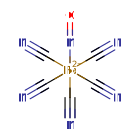
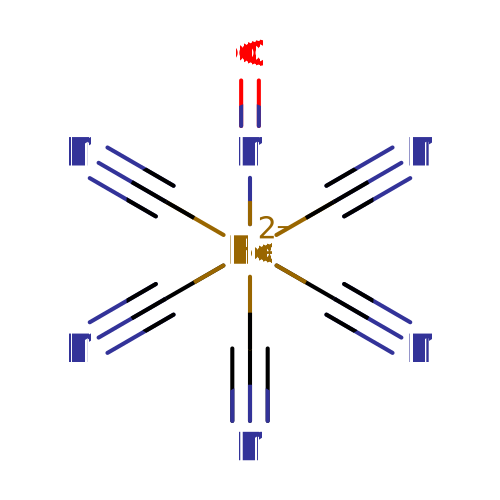
Structure for Nitroprusside (DB00325)
- Weight
- Average: 215.938
Monoisotopic: 215.948300785 - Chemical Formula
- C5FeN6O
- Synonyms
- Nitroferricyanide

Pharmacology
- Indication
For immediate reduction of blood pressure of patients in hypertensive crises, reduce bleeding during surgery, and for the treatment of acute congestive heart failure
 Reduce drug development failure ratesBuild, train, & validate machine-learning modelswith evidence-based and structured datasets.Build, train, & validate predictive machine-learning models with structured datasets.
- Associated Conditions
Indication Type Indication Combined Product Details Approval Level Age Group Patient Characteristics Dose Form Management of Acute heart failure (ahf) •••••••• ••• Management of Hypertensive crisis •••••••••••• Prophylaxis of Intraoperative blood loss •••••••••••• •••••••••• ••••••• - Contraindications & Blackbox Warnings
 Prevent Adverse Drug Events TodayTap into our Clinical API for life-saving information on contraindications & blackbox warnings, population restrictions, harmful risks, & more.Avoid life-threatening adverse drug events with our Clinical API
- Pharmacodynamics
Nitroprusside a powerful vasodilator relaxes the vascular smooth muscle and produce consequent dilatation of peripheral arteries and veins. Other smooth muscle (e.g., uterus, duodenum) is not affected. Sodium nitroprusside is more active on veins than on arteries.
- Mechanism of action
One molecule of sodium nitroprusside is metabolized by combination with hemoglobin to produce one molecule of cyanmethemoglobin and four CN- ions; methemoglobin, obtained from hemoglobin, can sequester cyanide as cyanmethemoglobin; thiosulfate reacts with cyanide to produce thiocyanate; thiocyanate is eliminated in the urine; cyanide not otherwise removed binds to cytochromes. Cyanide ion is normally found in serum; it is derived from dietary substrates and from tobacco smoke. Cyanide binds avidly (but reversibly) to ferric ion (Fe+++), most body stores of which are found in erythrocyte methemoglobin (metHgb) and in mitochondrial cytochromes. When CN is infused or generated within the bloodstream, essentially all of it is bound to methemoglobin until intraerythrocytic methemoglobin has been saturated.
Sodium nitroprusside is further broken down in the circulation to release nitric oxide (NO), which activates guanylate cyclase in the vascular smooth muscle. This leads to increased production of intracellular cGMP, which stimulates calcium ion movement from the cytoplasm to the endoplasmic reticulum, reducing the level of available calcium ions that can bind to calmodulin. This ultimately results in vascular smooth muscle relaxation and vessel dilation.
Target Actions Organism AAtrial natriuretic peptide receptor 1 agonistHumans - Absorption
Not Available
- Volume of distribution
Not Available
- Protein binding
Not Available
- Metabolism
Metabolized by reaction with hemoglobin to produce cyanmethemoglobin and cynide ions
Hover over products below to view reaction partners
- Route of elimination
One molecule of sodium nitroprusside is metabolized by combination with hemoglobin to produce one molecule of cyanmethemoglobin and four CN¯ ions, thiosulfate reacts with cyanide to produce thiocyanate, thiocyanate is eliminated in the urine.
- Half-life
Approximately 2 minutes
- Clearance
Not Available
- Adverse Effects
 Improve decision support & research outcomesWith structured adverse effects data, including: blackbox warnings, adverse reactions, warning & precautions, & incidence rates. View sample adverse effects data in our new Data Library!Improve decision support & research outcomes with our structured adverse effects data.
- Toxicity
Overdosage of nitroprusside can be manifested as excessive hypotension or cyanide toxicity or as thiocyanate toxicity. The acute intravenous mean lethal doses (LD50) of nitroprusside in rabbits, dogs, mice, and rats are 2.8, 5.0, 8.4, and 11.2 mg/kg, respectively.
- Pathways
- Not Available
- Pharmacogenomic Effects/ADRs
- Not Available
Interactions
- Drug Interactions
- This information should not be interpreted without the help of a healthcare provider. If you believe you are experiencing an interaction, contact a healthcare provider immediately. The absence of an interaction does not necessarily mean no interactions exist.
Drug Interaction Integrate drug-drug
interactions in your softwareAbacavir Nitroprusside may decrease the excretion rate of Abacavir which could result in a higher serum level. Abaloparatide The risk or severity of adverse effects can be increased when Nitroprusside is combined with Abaloparatide. Acebutolol Nitroprusside may increase the hypotensive activities of Acebutolol. Aceclofenac The therapeutic efficacy of Nitroprusside can be decreased when used in combination with Aceclofenac. Acemetacin The therapeutic efficacy of Nitroprusside can be decreased when used in combination with Acemetacin. - Food Interactions
- No interactions found.
Products
 Drug product information from 10+ global regionsOur datasets provide approved product information including:dosage, form, labeller, route of administration, and marketing period.Access drug product information from over 10 global regions.
- Product Ingredients
Ingredient UNII CAS InChI Key Sodium nitroprusside EAO03PE1TC 13755-38-9 SPBWMYPZWNFWES-UHFFFAOYSA-N - Brand Name Prescription Products
Name Dosage Strength Route Labeller Marketing Start Marketing End Region Image Nipride Powder, for solution 50 mg / vial Intravenous Hospira Healthcare Ulc 1975-12-31 2011-08-05 Canada 
Nipride Solution 25 mg / mL Intravenous Pfizer Canada Ulc 2011-05-17 Not applicable Canada Nipride Rtu Injection, solution 0.2 mg/1mL Intravenous Exela Pharma Sciences, LLC 2018-02-09 2019-08-30 US 
Nipride Rtu Injection, solution 0.5 mg/1mL Intravenous Exela Pharma Sciences, LLC 2017-03-20 Not applicable US Nipride Rtu Injection, solution 0.2 mg/1mL Intravenous Exela Pharma Sciences, LLC 2018-07-20 Not applicable US - Generic Prescription Products
Name Dosage Strength Route Labeller Marketing Start Marketing End Region Image Nitropress Injection, solution, concentrate 50 mg/2mL Intravenous Hospira, Inc. 2005-06-07 2015-07-01 US Nitropress Injection, solution, concentrate 50 mg/2mL Intravenous Bausch Health US, LLC 2013-12-01 Not applicable US Nitropress Injection, solution, concentrate 50 mg/2mL Intravenous Marathon Pharmaceuticals 2013-12-01 2016-05-31 US Sodium Nitroprusside Injection, solution 50 mg/2mL Intravenous Dr.Reddy's Laboratories Inc., 2019-12-17 Not applicable US Sodium Nitroprusside Injection, solution, concentrate 25 mg/1mL Intravenous Medicure International Inc. 2018-08-10 Not applicable US
Categories
- ATC Codes
- C02DD01 — Nitroprusside
- Drug Categories
- Anions
- Antihypertensive Agents
- Arteriolar Smooth Muscle, Agents Acting On
- Cardiovascular Agents
- Compounds used in a research, industrial, or household setting
- Cyanides
- Direct Vasodilators
- Drugs that are Mainly Renally Excreted
- Electrolytes
- Ferric Compounds
- Ferricyanides
- Hypotensive Agents
- Indicators and Reagents
- Ions
- Iron Compounds
- Laboratory Chemicals
- Methemoglobinemia Associated Agents
- Nitrates and Nitrites
- Nitric Oxide Donors
- Nitroferricyanide Derivatives
- Nitrogen Compounds
- Vasodilating Agents
- Vasodilation
- Chemical TaxonomyProvided by Classyfire
- Description
- This compound belongs to the class of organic compounds known as organic transition metal salts. These are organic salt compounds containing a transition metal atom in its ionic form.
- Kingdom
- Organic compounds
- Super Class
- Organic salts
- Class
- Organic metal salts
- Sub Class
- Organic transition metal salts
- Direct Parent
- Organic transition metal salts
- Alternative Parents
- Organotransition metal compounds / Organopnictogen compounds / Organonitrogen compounds / Organic oxides / Hydrocarbon derivatives / Organic anions
- Substituents
- Aliphatic acyclic compound / Hydrocarbon derivative / Organic anion / Organic nitrogen compound / Organic oxide / Organic oxygen compound / Organic transition metal moeity / Organic transition metal salt / Organometallic compound / Organonitrogen compound
- Molecular Framework
- Aliphatic acyclic compounds
- External Descriptors
- iron coordination entity (CHEBI:7596)
- Affected organisms
- Humans and other mammals
Chemical Identifiers
- UNII
- 169D1260KM
- CAS number
- 15078-28-1
- InChI Key
- ASPOIVQEUUCDQT-UHFFFAOYSA-N
- InChI
- InChI=1S/5CN.Fe.NO/c5*1-2;;1-2/q;;;;;2*-1
- IUPAC Name
- pentacyano(nitroso)irondiuide
- SMILES
- O=N[Fe--](C#N)(C#N)(C#N)(C#N)C#N
References
- General References
- Not Available
- External Links
- Human Metabolome Database
- HMDB0014470
- KEGG Compound
- C07269
- PubChem Compound
- 11963622
- PubChem Substance
- 46508965
- ChemSpider
- 21607452
- BindingDB
- 50377921
- 7476
- ChEBI
- 7596
- ChEMBL
- CHEMBL2097081
- Therapeutic Targets Database
- DNC001351
- PharmGKB
- PA451406
- RxList
- RxList Drug Page
- Drugs.com
- Drugs.com Drug Page
- Wikipedia
- Sodium_nitroprusside
- MSDS
- Download (79 KB)
Clinical Trials
- Clinical Trials
Phase Status Purpose Conditions Count 4 Terminated Prevention Myocardial Infarction 1 4 Terminated Treatment Hemorrhagic Stroke 1 4 Unknown Status Screening Nitroprusside / Thyroid Hormones 1 4 Withdrawn Treatment Acute Heart Failure (AHF) 1 3 Completed Treatment Heart Failure / Hypertension 1
Pharmacoeconomics
- Manufacturers
- Hoffmann la roche inc
- Abbott laboratories
- Abbott laboratories pharmaceutical products div
- Hospira inc
- Abraxis pharmaceutical products
- Baxter healthcare corp anesthesia and critical care
- Teva parenteral medicines inc
- Packagers
- Baxter International Inc.
- Hospira Inc.
- Physicians Total Care Inc.
- Teva Pharmaceutical Industries Ltd.
- Dosage Forms
Form Route Strength Injection Intravenous 25 mg/ml Solution Intravenous 50.000 mg Solution Intravenous 50.00 mg Powder, for solution Intravenous 50 mg / vial Injection, solution Intravenous 0.2 mg/1mL Injection, solution Intravenous 0.5 mg/1mL Injection, powder, lyophilized, for solution Intravenous 50 mg Injection, powder, for solution Parenteral 60 mg Injection, solution Intravenous 60 mg Injection, solution, concentrate Intravenous 50 mg/2mL Injection, powder, for solution Intravenous 50 mg Injection Parenteral 25 mg Solution Intravenous 5000000 mg Solution Intravenous 50 mg Powder 50 mg/1vial Powder, for solution Intravenous Injection Intravenous 25 mg/1mL Injection Intravenous 50 mg/2mL Injection, solution Intravenous 50 mg/2mL Injection, solution, concentrate Intravenous 25 mg/1mL Solution Intravenous 25 mg / mL Injection Intravenous 0.2 mg/1mL Injection Intravenous 0.5 mg/1mL - Prices
- Not Available
- Patents
- Not Available
Properties
- State
- Solid
- Experimental Properties
- Not Available
- Predicted Properties
Property Value Source logP 0.071 Chemaxon pKa (Strongest Basic) -3.3 Chemaxon Physiological Charge -2 Chemaxon Hydrogen Acceptor Count 6 Chemaxon Hydrogen Donor Count 0 Chemaxon Polar Surface Area 148.38 Å2 Chemaxon Rotatable Bond Count 1 Chemaxon Refractivity 39.44 m3·mol-1 Chemaxon Polarizability 16.52 Å3 Chemaxon Number of Rings 0 Chemaxon Bioavailability 1 Chemaxon Rule of Five Yes Chemaxon Ghose Filter No Chemaxon Veber's Rule No Chemaxon MDDR-like Rule No Chemaxon - Predicted ADMET Features
Property Value Probability Human Intestinal Absorption - 0.8308 Blood Brain Barrier + 0.9314 Caco-2 permeable - 0.5269 P-glycoprotein substrate Non-substrate 0.8966 P-glycoprotein inhibitor I Non-inhibitor 0.919 P-glycoprotein inhibitor II Non-inhibitor 0.9767 Renal organic cation transporter Non-inhibitor 0.9109 CYP450 2C9 substrate Non-substrate 0.8573 CYP450 2D6 substrate Non-substrate 0.8353 CYP450 3A4 substrate Non-substrate 0.6675 CYP450 1A2 substrate Non-inhibitor 0.6719 CYP450 2C9 inhibitor Non-inhibitor 0.8599 CYP450 2D6 inhibitor Non-inhibitor 0.9186 CYP450 2C19 inhibitor Non-inhibitor 0.8218 CYP450 3A4 inhibitor Non-inhibitor 0.9763 CYP450 inhibitory promiscuity Low CYP Inhibitory Promiscuity 0.9583 Ames test Non AMES toxic 0.5204 Carcinogenicity Carcinogens 0.6595 Biodegradation Not ready biodegradable 0.5759 Rat acute toxicity 2.9543 LD50, mol/kg Not applicable hERG inhibition (predictor I) Weak inhibitor 0.9345 hERG inhibition (predictor II) Non-inhibitor 0.9596
Spectra
- Mass Spec (NIST)
- Not Available
- Spectra
- Not Available
- Chromatographic Properties
Collision Cross Sections (CCS)
Not Available
Targets

- Kind
- Protein
- Organism
- Humans
- Pharmacological action
- Yes
- Actions
- Agonist
- General Function
- Protein kinase activity
- Specific Function
- Receptor for the atrial natriuretic peptide NPPA/ANP and the brain natriuretic peptide NPPB/BNP which are potent vasoactive hormones playing a key role in cardiovascular homeostasis. Has guanylate ...
- Gene Name
- NPR1
- Uniprot ID
- P16066
- Uniprot Name
- Atrial natriuretic peptide receptor 1
- Molecular Weight
- 118918.11 Da
References
- Fortin Y, De Lean A: Role of cyclic GMP and calcineurin in homologous and heterologous desensitization of natriuretic peptide receptor-A. Can J Physiol Pharmacol. 2006 May;84(5):539-46. [Article]
- Madhani M, Okorie M, Hobbs AJ, MacAllister RJ: Reciprocal regulation of human soluble and particulate guanylate cyclases in vivo. Br J Pharmacol. 2006 Nov;149(6):797-801. Epub 2006 Oct 3. [Article]
- Steinmetz M, Potthast R, Sabrane K, Kuhn M: Diverging vasorelaxing effects of C-type natriuretic peptide in renal resistance arteries and aortas of GC-A-deficient mice. Regul Pept. 2004 Jun 15;119(1-2):31-7. [Article]
Enzymes
- Kind
- Protein
- Organism
- Humans
- Pharmacological action
- Unknown
- Actions
- Inhibitor
- General Function
- Vitamin d 24-hydroxylase activity
- Specific Function
- Cytochromes P450 are a group of heme-thiolate monooxygenases. In liver microsomes, this enzyme is involved in an NADPH-dependent electron transport pathway. It oxidizes a variety of structurally un...
- Gene Name
- CYP1A1
- Uniprot ID
- P04798
- Uniprot Name
- Cytochrome P450 1A1
- Molecular Weight
- 58164.815 Da
References
- Stadler J, Trockfeld J, Schmalix WA, Brill T, Siewert JR, Greim H, Doehmer J: Inhibition of cytochromes P4501A by nitric oxide. Proc Natl Acad Sci U S A. 1994 Apr 26;91(9):3559-63. doi: 10.1073/pnas.91.9.3559. [Article]

Drug created at June 13, 2005 13:24 / Updated at April 27, 2024 09:44