Identification
- Summary
Pimecrolimus is a topical calcineurin inhibitor used in the treatment of mild-moderate atopic dermatitis who are not candidates for other types of therapy due to previous lack of response or other reasons.
- Brand Names
- Elidel
- Generic Name
- Pimecrolimus
- DrugBank Accession Number
- DB00337
- Background
Pimecrolimus is an immunomodulating agent that was first marketed by Novartis under the trade name Elidel. It is now promoted in Canada by Galderma since early 2007. It is currently available as a topic cream used in the treatment of atopic dermatitis (eczema).
- Type
- Small Molecule
- Groups
- Approved, Investigational
- Structure

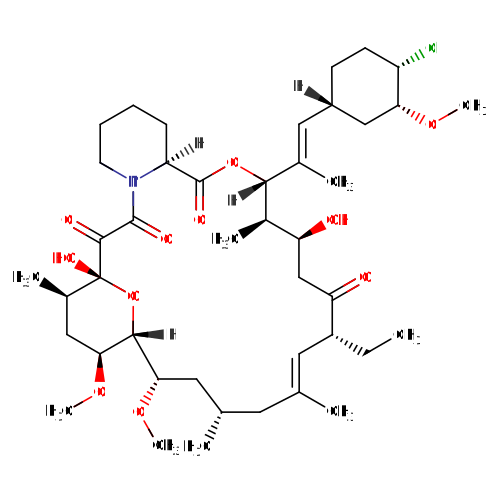
Structure for Pimecrolimus (DB00337)
- Weight
- Average: 810.46
Monoisotopic: 809.4480897 - Chemical Formula
- C43H68ClNO11
- Synonyms
- 33-Epi-chloro-33-desoxyascomycin
- Pimecrolimus
- Pimecrolimusum
- External IDs
- ASM 981
- SDZ ASM 981
- SDZ ASM-981

Pharmacology
- Indication
For treatment of mild to moderate atopic dermatitis.
 Reduce drug development failure ratesBuild, train, & validate machine-learning modelswith evidence-based and structured datasets.Build, train, & validate predictive machine-learning models with structured datasets.
- Associated Conditions
Indication Type Indication Combined Product Details Approval Level Age Group Patient Characteristics Dose Form Treatment of Vitiligo ••• ••••• Management of Intertriginous psoriasis ••• ••••• Management of Mild atopic dermatitis •••••••••••• •••••• •••• •••••••••• ••••••••••••••••••••• Management of Moderate atopic dermatitis •••••••••••• •••••• •••• •••••••••• ••••••••••••••••••••• - Contraindications & Blackbox Warnings
 Prevent Adverse Drug Events TodayTap into our Clinical API for life-saving information on contraindications & blackbox warnings, population restrictions, harmful risks, & more.Avoid life-threatening adverse drug events with our Clinical API
- Pharmacodynamics
Pimecrolimus is a chemical that is used to treat atopic dermatitis (eczema). Atopic dermatitis is a skin condition characterized by redness, itching, scaling and inflammation of the skin. The cause of atopic dermatitis is not known; however, scientists believe that it may be due to activation of the immune system by various environmental or emotional triggers. Scientists do not know exactly how pimecrolimus reduces the manifestations of atopic dermatitis, but pimecrolimus reduces the action of T-cells and mast cells which are part of the immune system and contribute to responses of the immune system. Pimecrolimus prevents the activation of T-cells by blocking the effects of chemicals (cytokines) released by the body that stimulate T-cells. Pimecrolimus also reduces the ability of mast cells to release chemicals that promote inflammation.
- Mechanism of action
Pimecrolimus binds with high affinity to macrophilin-12 (FKBP-12) and inhibits the calcium-dependent phosphatase, calcineurin. As a consequence, it inhibits T cell activation by blocking the transcription of early cytokines. In particular, pimecrolimus inhibits at nanomolar concentrations Interleukin-2 and interferon gamma (Th1-type) and Interleukin-4 and Interleukin-10 (Th2-type) cytokine synthesis in human T cells. Also, pimecrolimus prevents the release of inflammatory cytokines and mediators from mast cells in vitro after stimulation by antigen/lgE.
Target Actions Organism ASerine/threonine-protein kinase mTOR potentiatorHumans UPeptidyl-prolyl cis-trans isomerase FKBP1A potentiatorHumans - Absorption
Because of the low systemic absorption of pimecrolimus following topical application the calculation of standard pharmacokinetic measures such as AUC, Cmax, half-life, etc. cannot be reliably done.
- Volume of distribution
Not Available
- Protein binding
74%-87% (in vitro, bound to plasma proteins)
- Metabolism
No drug metabolism was observed in human skin in vitro. Oral administration yielded metabolites produced from O-demethylation and oxygenation reactions.
- Route of elimination
80% of the drug is excreted in the feces.
- Half-life
Not Available
- Clearance
Not Available
- Adverse Effects
 Improve decision support & research outcomesWith structured adverse effects data, including: blackbox warnings, adverse reactions, warning & precautions, & incidence rates. View sample adverse effects data in our new Data Library!Improve decision support & research outcomes with our structured adverse effects data.
- Toxicity
Side effects include burning sensation, irritation, pruritus, erythema, and skin infections, at the application site.
- Pathways
- Not Available
- Pharmacogenomic Effects/ADRs
- Not Available
Interactions
- Drug Interactions
- This information should not be interpreted without the help of a healthcare provider. If you believe you are experiencing an interaction, contact a healthcare provider immediately. The absence of an interaction does not necessarily mean no interactions exist.
Drug Interaction Integrate drug-drug
interactions in your softwareAbametapir The serum concentration of Pimecrolimus can be increased when it is combined with Abametapir. Abatacept The risk or severity of adverse effects can be increased when Pimecrolimus is combined with Abatacept. Adalimumab The risk or severity of adverse effects can be increased when Pimecrolimus is combined with Adalimumab. Aldesleukin The risk or severity of adverse effects can be increased when Pimecrolimus is combined with Aldesleukin. Alefacept The risk or severity of adverse effects can be increased when Pimecrolimus is combined with Alefacept. - Food Interactions
- No interactions found.
Products
 Drug product information from 10+ global regionsOur datasets provide approved product information including:dosage, form, labeller, route of administration, and marketing period.Access drug product information from over 10 global regions.
- International/Other Brands
- Aregen (Meda Pharm) / Rizan (Esteve)
- Brand Name Prescription Products
Name Dosage Strength Route Labeller Marketing Start Marketing End Region Image Elidel Cream 10 mg/1g Topical Physicians Total Care, Inc. 2003-10-30 Not applicable US 
Elidel Cream 10 mg/1g Topical Bausch Health US, LLC 2001-12-02 Not applicable US Elidel Cream 10 mg/1g Topical Bausch Health US, LLC 2001-12-02 Not applicable US Elidel Cream 10 mg/1g Topical Bausch Health US, LLC 2001-12-02 Not applicable US Elidel Cream 10 mg/1g Topical Novartis 2001-12-02 2013-04-30 US - Generic Prescription Products
Name Dosage Strength Route Labeller Marketing Start Marketing End Region Image Pimecrolimus Cream 10 mg/1g Topical Actavis Pharma, Inc. 2018-12-27 Not applicable US Pimecrolimus Cream 10 mg/1g Topical bryant ranch prepack 2018-11-26 Not applicable US Pimecrolimus Cream 10 mg/1g Topical Oceanside Pharmaceuticals 2018-11-26 Not applicable US Pimecrolimus Cream 10 mg/1g Topical REMEDYREPACK INC. 2019-09-03 Not applicable US Pimecrolimus Cream 10 mg/1g Topical bryant ranch prepack 2018-11-26 Not applicable US
Categories
- ATC Codes
- D11AH02 — Pimecrolimus
- Drug Categories
- Agents for Dermatitis, Excluding Corticosteroids
- Analgesics
- Analgesics, Non-Narcotic
- Anti-Inflammatory Agents
- Calcineurin Inhibitor Immunosuppressant
- Calcineurin Inhibitors
- Cytochrome P-450 CYP3A Substrates
- Cytochrome P-450 CYP3A4 Substrates
- Cytochrome P-450 Substrates
- Dermatologicals
- Enzyme Inhibitors
- Immunologic Factors
- Immunosuppressive Agents
- Lactones
- Misc. Skin and Mucous Membrane Agents
- Peptidylprolyl Isomerase, antagonists & inhibitors
- Peripheral Nervous System Agents
- Sensory System Agents
- Chemical TaxonomyProvided by Classyfire
- Description
- This compound belongs to the class of organic compounds known as macrolide lactams. These are cyclic polyketides containing both a cyclic amide and a cyclic ester group.
- Kingdom
- Organic compounds
- Super Class
- Phenylpropanoids and polyketides
- Class
- Macrolide lactams
- Sub Class
- Not Available
- Direct Parent
- Macrolide lactams
- Alternative Parents
- Alpha amino acid esters / Macrolides and analogues / Cyclohexyl halides / Oxanes / Piperidines / Tertiary carboxylic acid amides / Carboxylic acid esters / Cyclic ketones / Hemiacetals / Lactams show 12 more
- Substituents
- Alcohol / Aliphatic heteropolycyclic compound / Alkyl chloride / Alkyl halide / Alpha-amino acid ester / Alpha-amino acid or derivatives / Azacycle / Carbonyl group / Carboxamide group / Carboxylic acid derivative show 27 more
- Molecular Framework
- Aliphatic heteropolycyclic compounds
- External Descriptors
- Not Available
- Affected organisms
- Humans and other mammals
Chemical Identifiers
- UNII
- 7KYV510875
- CAS number
- 137071-32-0
- InChI Key
- KASDHRXLYQOAKZ-XDSKOBMDSA-N
- InChI
- InChI=1S/C43H68ClNO11/c1-10-30-18-24(2)17-25(3)19-36(53-8)39-37(54-9)21-27(5)43(51,56-39)40(48)41(49)45-16-12-11-13-32(45)42(50)55-38(28(6)33(46)23-34(30)47)26(4)20-29-14-15-31(44)35(22-29)52-7/h18,20,25,27-33,35-39,46,51H,10-17,19,21-23H2,1-9H3/b24-18+,26-20+/t25-,27+,28+,29-,30+,31-,32-,33-,35+,36-,37-,38+,39+,43+/m0/s1
- IUPAC Name
- (1R,9S,12S,13R,14S,17R,18E,21S,23S,24R,25S,27R)-12-[(1E)-1-[(1R,3R,4S)-4-chloro-3-methoxycyclohexyl]prop-1-en-2-yl]-17-ethyl-1,14-dihydroxy-23,25-dimethoxy-13,19,21,27-tetramethyl-11,28-dioxa-4-azatricyclo[22.3.1.0⁴,⁹]octacos-18-ene-2,3,10,16-tetrone
- SMILES
- [H][C@]1(CC[C@H](Cl)[C@@H](C1)OC)\C=C(/C)[C@@]1([H])OC(=O)[C@]2([H])CCCCN2C(=O)C(=O)[C@]2(O)O[C@@]([H])([C@H](C[C@H]2C)OC)[C@H](C[C@@H](C)C\C(C)=C\[C@@H](CC)C(=O)C[C@H](O)[C@H]1C)OC
References
- Synthesis Reference
Viktor Gyollai, Csaba Szabo, "Methods of preparing pimecrolimus." U.S. Patent US20060142564, issued June 29, 2006.
US20060142564- General References
- Grassberger M, Baumruker T, Enz A, Hiestand P, Hultsch T, Kalthoff F, Schuler W, Schulz M, Werner FJ, Winiski A, Wolff B, Zenke G: A novel anti-inflammatory drug, SDZ ASM 981, for the treatment of skin diseases: in vitro pharmacology. Br J Dermatol. 1999 Aug;141(2):264-73. [Article]
- External Links
- PubChem Compound
- 6509979
- PubChem Substance
- 46505748
- ChemSpider
- 21111755
- BindingDB
- 50248356
- 321952
- ChEBI
- 135888
- ChEMBL
- CHEMBL1200686
- ZINC
- ZINC000085536990
- Therapeutic Targets Database
- DAP000594
- PharmGKB
- PA164783790
- RxList
- RxList Drug Page
- Drugs.com
- Drugs.com Drug Page
- PDRhealth
- PDRhealth Drug Page
- Wikipedia
- Pimecrolimus
- FDA label
- Download (230 KB)
Clinical Trials
- Clinical Trials
Phase Status Purpose Conditions Count 4 Completed Prevention Atopic Dermatitis 1 4 Completed Treatment Atopic Dermatitis 19 4 Completed Treatment Mild to Moderate Atopic Dermatitis 1 4 Completed Treatment Oral Lichen Planus 1 4 Completed Treatment Vitiligo 1
Pharmacoeconomics
- Manufacturers
- Novartis pharmaceuticals corp
- Packagers
- Novartis AG
- Physicians Total Care Inc.
- Dosage Forms
Form Route Strength Cream Cutaneous 1.000 g Cream Cutaneous 1 mg/g Cream Topical 1 % w/w Cream Topical 1.000 g Cream Topical 10 mg/1g Cream 1 % Cream 1 %w/w Cream Cutaneous Cream Topical Cream Topical 10 mg/g Cream Topical 1 g Cream - Prices
Unit description Cost Unit Elidel 100 Gram Tube 1% 100 gm Tube 315.76USD tube Elidel 60 Gram Tube 1% 60 gm Tube 200.05USD tube Elidel 30 Gram Tube 1% 30 gm Tube 101.44USD tube Elidel 1% cream 3.21USD g DrugBank does not sell nor buy drugs. Pricing information is supplied for informational purposes only.- Patents
Patent Number Pediatric Extension Approved Expires (estimated) Region CA2200966 No 2006-12-19 2015-10-26 Canada 
US5912238 Yes 1999-06-15 2016-12-15 US US6352998 Yes 2002-03-05 2016-04-26 US US6423722 Yes 2002-07-23 2018-12-26 US
Properties
- State
- Solid
- Experimental Properties
Property Value Source logP 4.4 Not Available - Predicted Properties
Property Value Source Water Solubility 0.00152 mg/mL ALOGPS logP 4.36 ALOGPS logP 6.81 Chemaxon logS -5.7 ALOGPS pKa (Strongest Acidic) 9.96 Chemaxon pKa (Strongest Basic) -2.9 Chemaxon Physiological Charge 0 Chemaxon Hydrogen Acceptor Count 10 Chemaxon Hydrogen Donor Count 2 Chemaxon Polar Surface Area 158.13 Å2 Chemaxon Rotatable Bond Count 6 Chemaxon Refractivity 214.03 m3·mol-1 Chemaxon Polarizability 87.79 Å3 Chemaxon Number of Rings 4 Chemaxon Bioavailability 0 Chemaxon Rule of Five No Chemaxon Ghose Filter No Chemaxon Veber's Rule No Chemaxon MDDR-like Rule Yes Chemaxon - Predicted ADMET Features
Property Value Probability Human Intestinal Absorption + 0.6208 Blood Brain Barrier - 0.9554 Caco-2 permeable - 0.5764 P-glycoprotein substrate Substrate 0.8064 P-glycoprotein inhibitor I Inhibitor 0.8064 P-glycoprotein inhibitor II Inhibitor 0.7014 Renal organic cation transporter Non-inhibitor 0.8556 CYP450 2C9 substrate Non-substrate 0.9117 CYP450 2D6 substrate Non-substrate 0.8856 CYP450 3A4 substrate Substrate 0.7519 CYP450 1A2 substrate Non-inhibitor 0.8678 CYP450 2C9 inhibitor Non-inhibitor 0.8671 CYP450 2D6 inhibitor Non-inhibitor 0.9026 CYP450 2C19 inhibitor Non-inhibitor 0.8248 CYP450 3A4 inhibitor Non-inhibitor 0.8672 CYP450 inhibitory promiscuity Low CYP Inhibitory Promiscuity 0.9326 Ames test Non AMES toxic 0.6495 Carcinogenicity Non-carcinogens 0.9183 Biodegradation Not ready biodegradable 0.9937 Rat acute toxicity 2.6919 LD50, mol/kg Not applicable hERG inhibition (predictor I) Weak inhibitor 0.9787 hERG inhibition (predictor II) Non-inhibitor 0.6886
Spectra
- Mass Spec (NIST)
- Not Available
- Spectra
- Chromatographic Properties
Collision Cross Sections (CCS)
Adduct CCS Value (Å2) Source type Source [M-H]- 272.08328 predictedDeepCCS 1.0 (2019) [M+H]+ 273.807 predictedDeepCCS 1.0 (2019) [M+Na]+ 280.18326 predictedDeepCCS 1.0 (2019)
Targets

- Kind
- Protein
- Organism
- Humans
- Pharmacological action
- Yes
- Actions
- Potentiator
- General Function
- Tfiiic-class transcription factor binding
- Specific Function
- Serine/threonine protein kinase which is a central regulator of cellular metabolism, growth and survival in response to hormones, growth factors, nutrients, energy and stress signals. MTOR directly...
- Gene Name
- MTOR
- Uniprot ID
- P42345
- Uniprot Name
- Serine/threonine-protein kinase mTOR
- Molecular Weight
- 288889.05 Da
References
- Reitamo S, Remitz A, Kyllonen H, Saarikko J: Topical noncorticosteroid immunomodulation in the treatment of atopic dermatitis. Am J Clin Dermatol. 2002;3(6):381-8. [Article]
- Kind
- Protein
- Organism
- Humans
- Pharmacological action
- Unknown
- Actions
- Potentiator
- General Function
- Type i transforming growth factor beta receptor binding
- Specific Function
- Keeps in an inactive conformation TGFBR1, the TGF-beta type I serine/threonine kinase receptor, preventing TGF-beta receptor activation in absence of ligand. Recruites SMAD7 to ACVR1B which prevent...
- Gene Name
- FKBP1A
- Uniprot ID
- P62942
- Uniprot Name
- Peptidyl-prolyl cis-trans isomerase FKBP1A
- Molecular Weight
- 11950.665 Da
References
- Reitamo S, Remitz A, Kyllonen H, Saarikko J: Topical noncorticosteroid immunomodulation in the treatment of atopic dermatitis. Am J Clin Dermatol. 2002;3(6):381-8. [Article]
Enzymes
- Kind
- Protein
- Organism
- Humans
- Pharmacological action
- Unknown
- Actions
- Substrate
- General Function
- Vitamin d3 25-hydroxylase activity
- Specific Function
- Cytochromes P450 are a group of heme-thiolate monooxygenases. In liver microsomes, this enzyme is involved in an NADPH-dependent electron transport pathway. It performs a variety of oxidation react...
- Gene Name
- CYP3A4
- Uniprot ID
- P08684
- Uniprot Name
- Cytochrome P450 3A4
- Molecular Weight
- 57342.67 Da
References
- Zollinger M, Waldmeier F, Hartmann S, Zenke G, Zimmerlin AG, Glaenzel U, Baldeck JP, Schweitzer A, Berthier S, Moenius T, Grassberger MA: Pimecrolimus: absorption, distribution, metabolism, and excretion in healthy volunteers after a single oral dose and supplementary investigations in vitro. Drug Metab Dispos. 2006 May;34(5):765-74. Epub 2006 Feb 7. [Article]
- Kuper JI, D'Aprile M: Drug-Drug interactions of clinical significance in the treatment of patients with Mycobacterium avium complex disease. Clin Pharmacokinet. 2000 Sep;39(3):203-14. doi: 10.2165/00003088-200039030-00003. [Article]

Drug created at June 13, 2005 13:24 / Updated at April 23, 2024 11:38