Identification
- Summary
Methylergometrine is an ergot alkaloid used to prevent and control uterine atony and hemorrhage before and after delivery.
- Brand Names
- Methergine
- Generic Name
- Methylergometrine
- DrugBank Accession Number
- DB00353
- Background
A homolog of ergonovine containing one more CH2 group. (Merck Index, 11th ed)
- Type
- Small Molecule
- Groups
- Approved
- Structure
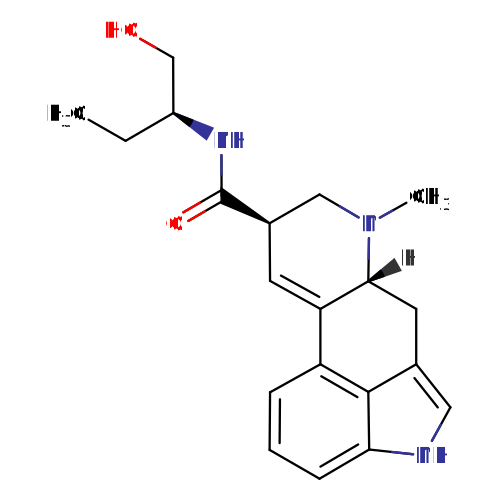
Structure for Methylergometrine (DB00353)
- Weight
- Average: 339.4314
Monoisotopic: 339.194677059 - Chemical Formula
- C20H25N3O2
- Synonyms
- 9,10-Didehydro-N-[1-(hydroxymethyl)-propyl]-D-lysergamide
- D-lysergic acid 1-butanolamide
- Ergotyl
- Methylergobasin
- Methylergometrin
- Méthylergométrine
- Methylergometrine
- Methylergometrinum
- Methylergonovine
- Metilergometrina
- Metilergometrinio
- External IDs
- ME 277

Pharmacology
- Indication
For the prevention and control of excessive bleeding following vaginal childbirth
 Reduce drug development failure ratesBuild, train, & validate machine-learning modelswith evidence-based and structured datasets.Build, train, & validate predictive machine-learning models with structured datasets.
- Associated Conditions
Indication Type Indication Combined Product Details Approval Level Age Group Patient Characteristics Dose Form Diagnostic agent Angina pectoris, variant ••• ••••• Management of Postpartum haemorrhage (pph) •••••••••••• Management of Postpartum uterine subinvolution •••••••••••• Management of Uterine atony •••••••••••• Treatment of Uterine atony •••••••••••• - Contraindications & Blackbox Warnings
 Prevent Adverse Drug Events TodayTap into our Clinical API for life-saving information on contraindications & blackbox warnings, population restrictions, harmful risks, & more.Avoid life-threatening adverse drug events with our Clinical API
- Pharmacodynamics
Methylergometrine is a semisynthetic ergot alkaloid and a derivative of ergonovine and is used for the prevention and control of postpartum and post-abortion hemorrhage. In general, the effects of all the ergot alkaloids appear to results from their actions as partial agonists or antagonists at adrenergic, dopaminergic, and tryptaminergic receptors. The spectrum of effects depends on the agent, dosage, species, tissue, and experimental or physiological conditions. All of the alkaloids of ergot significantly increase the motor activity of the uterus. After small doses contractions are increased in force or frequency, or both, but are followed by a normal degree of relaxation. As the dose is increased, contractions become more forceful and prolonged, resting tonus is markedly increased, and sustained contracture can result.
- Mechanism of action
Methylergometrine acts directly on the smooth muscle of the uterus and increases the tone, rate, and amplitude of rhythmic contractions through binding and the resultant antagonism of the dopamine D1 receptor. Thus, it induces a rapid and sustained tetanic uterotonic effect which shortens the third stage of labor and reduces blood loss.
Target Actions Organism ADopamine D1 receptor antagonistHumans U5-hydroxytryptamine receptor 2B Not Available Humans - Absorption
Absorption is rapid after oral (60% bioavailability) and intramuscular (78% bioavailability) administration.
- Volume of distribution
- 56.1 ± 0 L
- Protein binding
Not Available
- Metabolism
Hepatic, with extensive first-pass metabolism.
- Route of elimination
Ergot alkaloids are mostly eliminated by hepatic metabolism and excretion, and the decrease in bioavailability following oral administration is probably a result of first-pass metabolism in the liver.
- Half-life
3.39 hours
- Clearance
Not Available
- Adverse Effects
 Improve decision support & research outcomesWith structured adverse effects data, including: blackbox warnings, adverse reactions, warning & precautions, & incidence rates. View sample adverse effects data in our new Data Library!Improve decision support & research outcomes with our structured adverse effects data.
- Toxicity
Signs and symptoms of overexposure: hypertension, seizures, headache, hypotension, nausea, and vomiting.
- Pathways
- Not Available
- Pharmacogenomic Effects/ADRs
- Not Available
Interactions
- Drug Interactions
- This information should not be interpreted without the help of a healthcare provider. If you believe you are experiencing an interaction, contact a healthcare provider immediately. The absence of an interaction does not necessarily mean no interactions exist.
Drug Interaction Integrate drug-drug
interactions in your softwareAbametapir The serum concentration of Methylergometrine can be increased when it is combined with Abametapir. Abemaciclib The serum concentration of Abemaciclib can be increased when it is combined with Methylergometrine. Acalabrutinib The serum concentration of Acalabrutinib can be increased when it is combined with Methylergometrine. Acebutolol Acebutolol may increase the vasoconstricting activities of Methylergometrine. Aceclofenac The risk or severity of hypertension can be increased when Methylergometrine is combined with Aceclofenac. - Food Interactions
- Avoid grapefruit products. Grapefruit inhibits the metabolism of methylergometrine through the CYP3A4 pathway and, therefore, may increase serum levels of methylergometrine. Use caution if co-administering.
Products
 Drug product information from 10+ global regionsOur datasets provide approved product information including:dosage, form, labeller, route of administration, and marketing period.Access drug product information from over 10 global regions.
- Product Ingredients
Ingredient UNII CAS InChI Key Methylergometrine maleate IR84JPZ1RK 57432-61-8 NOFOWWRHEPHDCY-DAUURJMHSA-N Methylergometrine tartrate 5EDH242U9O 6209-37-6 KUTMUWFMKWZQBW-UQJJQXDBSA-N - Product Images
- International/Other Brands
- Basofortina (Novartis) / Bledstop (Caprifarmindo) / Demergin (Demo) / Ergogin (Cipla) / Ergomed (Medlink) / Ergomin (Alico Impex) / Ergotyl (Sandoz) / Expogin (L.B.S.) / Glomethyl (Metiska) / Ingagen-M (Inga) / Mem (Elin) / Mergot (Lloyd) / Mergotrex (Rotexmedica) / Metenarin / Metermin (Cadila) / Méthergin (Novartis) / Methergin (Novartis) / Metherinal (Landson) / Metherspan (Opsonin) / Methovin (Kimia Farma) / Methylergobrevin (Hemofarm) / Methylergometrin (Spofa) / Metilat (Metiska) / Metiler (Adeka) / Metilergometrina (Hospira Italia) / Metrine (T P Drug) / Metrol (Simed) / Metvell (Novell) / Myomergin (Ethica Industri Farmasi) / Myometril (Oriental Chemical Works) / Neo-ergo (Oriental) / Partan M (Mochida) / Pospargin (Kalbe) / Satergin (Tablets) / Usamema (Icon) / Utergin (Svizera) / Uterine (LBS) / Uterjin (Münir Sahin) / Uterowin (Bestochem) / Utesel (Osel)
- Brand Name Prescription Products
Name Dosage Strength Route Labeller Marketing Start Marketing End Region Image Methergine Injection, solution 0.2 mg/1mL Intramuscular; Intravenous Novartis 2002-01-28 2015-03-01 US 
Methergine Tablet, coated 0.2 mg/1 Oral Apotheca, Inc. 2006-12-27 Not applicable US 
Methergine Tablet, coated 0.2 mg/1 Oral Pd Rx Pharmaceuticals, Inc. 1946-11-19 2016-04-13 US 
Methergine Tablet, coated 0.2 mg/1 Oral Physicians Total Care, Inc. 1946-11-19 2007-06-30 US Methergine Tablet, coated 0.2 mg/1 Oral Novartis 1946-11-19 2013-04-01 US 
- Generic Prescription Products
Name Dosage Strength Route Labeller Marketing Start Marketing End Region Image Methergine Tablet 0.2 mg/1 Oral Lupin Pharmaceuticals,Inc. 2016-04-04 Not applicable US Methergine Tablet 0.2 mg/1 Oral Avera McKennan Hospital 2016-06-23 2017-05-24 US Methylergonovine Maleate Tablet 0.2 mg/1 Oral Granules Pharmaceuticals Inc. 2018-05-25 Not applicable US Methylergonovine Maleate Tablet 0.2 mg/1 Oral Novel Laboratories, Inc. 2011-06-15 Not applicable US Methylergonovine Maleate Tablet 0.2 mg/1 Oral Pharmacist Pharmaceutical, LLC 2011-08-01 Not applicable US


Categories
- ATC Codes
- G02AC01 — Methylergometrine and oxytocin
- G02AC — Ergot alkaloids and oxytocin incl. analogues, in combination
- G02A — UTEROTONICS
- G02 — OTHER GYNECOLOGICALS
- G — GENITO URINARY SYSTEM AND SEX HORMONES
- Drug Categories
- Agents that produce hypertension
- Alkaloids
- Cytochrome P-450 CYP3A Inhibitors
- Cytochrome P-450 CYP3A Substrates
- Cytochrome P-450 CYP3A4 Inhibitors
- Cytochrome P-450 CYP3A4 Inhibitors (strength unknown)
- Cytochrome P-450 CYP3A4 Substrates
- Cytochrome P-450 Enzyme Inhibitors
- Cytochrome P-450 Substrates
- Dopamine Antagonists
- Ergolines
- Ergonovine
- Ergot Alkaloids and Derivatives
- Genito Urinary System and Sex Hormones
- Heterocyclic Compounds, Fused-Ring
- Reproductive Control Agents
- Uterotonic agents
- Chemical TaxonomyProvided by Classyfire
- Description
- This compound belongs to the class of organic compounds known as lysergamides. These are amides of Lysergic acids.
- Kingdom
- Organic compounds
- Super Class
- Alkaloids and derivatives
- Class
- Ergoline and derivatives
- Sub Class
- Lysergic acids and derivatives
- Direct Parent
- Lysergamides
- Alternative Parents
- Indoloquinolines / Benzoquinolines / Quinoline-3-carboxamides / Pyrroloquinolines / 3-alkylindoles / Isoindoles and derivatives / Aralkylamines / Benzenoids / Heteroaromatic compounds / Pyrroles show 9 more
- Substituents
- 3-alkylindole / Alcohol / Amine / Amino acid or derivatives / Aralkylamine / Aromatic heteropolycyclic compound / Azacycle / Benzenoid / Benzoquinoline / Carbonyl group show 24 more
- Molecular Framework
- Aromatic heteropolycyclic compounds
- External Descriptors
- Not Available
- Affected organisms
- Humans and other mammals
Chemical Identifiers
- UNII
- W53L6FE61V
- CAS number
- 113-42-8
- InChI Key
- UNBRKDKAWYKMIV-QWQRMKEZSA-N
- InChI
- InChI=1S/C20H25N3O2/c1-3-14(11-24)22-20(25)13-7-16-15-5-4-6-17-19(15)12(9-21-17)8-18(16)23(2)10-13/h4-7,9,13-14,18,21,24H,3,8,10-11H2,1-2H3,(H,22,25)/t13-,14+,18-/m1/s1
- IUPAC Name
- (4R,7R)-N-[(2S)-1-hydroxybutan-2-yl]-6-methyl-6,11-diazatetracyclo[7.6.1.0^{2,7}.0^{12,16}]hexadeca-1(16),2,9,12,14-pentaene-4-carboxamide
- SMILES
- [H][C@@]12CC3=CNC4=CC=CC(=C34)C1=C[C@H](CN2C)C(=O)N[C@@H](CC)CO
References
- General References
- Not Available
- External Links
- Human Metabolome Database
- HMDB0014497
- KEGG Drug
- D00680
- PubChem Compound
- 8226
- PubChem Substance
- 46507746
- ChemSpider
- 7933
- BindingDB
- 50330860
- 6883
- ChEBI
- 92607
- ChEMBL
- CHEMBL1201356
- ZINC
- ZINC000095619105
- Therapeutic Targets Database
- DAP000978
- PharmGKB
- PA450461
- PDBe Ligand
- H8D
- RxList
- RxList Drug Page
- Drugs.com
- Drugs.com Drug Page
- PDRhealth
- PDRhealth Drug Page
- Wikipedia
- Methylergometrine
- PDB Entries
- 6dry / 7um7
- MSDS
- Download (42.8 KB)
Clinical Trials
- Clinical Trials
Phase Status Purpose Conditions Count 4 Active Not Recruiting Treatment Postpartum Haemorrhage (PPH) / Uterine Atony 1 4 Completed Prevention Bloodloss / Postpartum Haemorrhage (PPH) 1 4 Completed Prevention Hemorrhage 1 4 Completed Prevention Uterine Atony With Hemorrhage 1 4 Completed Treatment Anemia / Bleeding 1
Pharmacoeconomics
- Manufacturers
- Novartis pharmaceuticals corp
- Pharmaforce inc
- Packagers
- American Regent
- Apotheca Inc.
- A-S Medication Solutions LLC
- C.B. Fleet Co. Inc.
- Cardinal Health
- Dispensing Solutions
- Diversified Healthcare Services Inc.
- Kaiser Foundation Hospital
- Murfreesboro Pharmaceutical Nursing Supply
- Novartis AG
- Pharmaforce Inc.
- Physicians Total Care Inc.
- Redpharm Drug
- Remedy Repack
- Resource Optimization and Innovation LLC
- Dosage Forms
Form Route Strength Injection Tablet, sugar coated Oral Injection, solution Intramuscular Solution 0.2 mg/1ml Injection, solution Parenteral 0.2 MG/ML Solution / drops Oral 0.25 MG/ML Tablet, coated Oral 0125 MG Solution Intramuscular; Intravenous 0.2 mg Injection, solution Intramuscular; Intravenous 0.2 mg/1mL Tablet, coated Oral 0.2 mg/1 Injection Intramuscular; Intravenous 0.2 mg/1mL Injection Intravenous 0.2 mg/1mL Tablet Oral 0.2 mg/1 Injection, solution 0.2 mg/ml Solution / drops Oral Solution Oral Tablet, coated Oral Injection, solution Tablet, coated Oral 0.125 mg Tablet, film coated Oral Tablet, film coated Oral 0.125 MG Solution Intramuscular; Intravenous Solution Intramuscular 0.2 mg/ml Tablet, sugar coated Oral 0125 MG - Prices
Unit description Cost Unit Methergine 0.2 mg/ml ampul 7.81USD ml Methylergonovine 0.2 mg/ml vial 5.28USD ml Methergine 0.2 mg tablet 1.42USD tablet Norforms fem deodorant suppository 0.29USD suppository DrugBank does not sell nor buy drugs. Pricing information is supplied for informational purposes only.- Patents
- Not Available
Properties
- State
- Solid
- Experimental Properties
Property Value Source melting point (°C) 172 °C PhysProp water solubility 25 mg/mL Not Available logP 1.2 Not Available - Predicted Properties
Property Value Source Water Solubility 0.204 mg/mL ALOGPS logP 1.74 ALOGPS logP 1.59 Chemaxon logS -3.2 ALOGPS pKa (Strongest Acidic) 15 Chemaxon pKa (Strongest Basic) 7.93 Chemaxon Physiological Charge 1 Chemaxon Hydrogen Acceptor Count 3 Chemaxon Hydrogen Donor Count 3 Chemaxon Polar Surface Area 68.36 Å2 Chemaxon Rotatable Bond Count 4 Chemaxon Refractivity 99.58 m3·mol-1 Chemaxon Polarizability 38.73 Å3 Chemaxon Number of Rings 4 Chemaxon Bioavailability 1 Chemaxon Rule of Five Yes Chemaxon Ghose Filter Yes Chemaxon Veber's Rule No Chemaxon MDDR-like Rule No Chemaxon - Predicted ADMET Features
Property Value Probability Human Intestinal Absorption + 1.0 Blood Brain Barrier + 0.6556 Caco-2 permeable - 0.8726 P-glycoprotein substrate Substrate 0.8604 P-glycoprotein inhibitor I Non-inhibitor 0.874 P-glycoprotein inhibitor II Non-inhibitor 0.8959 Renal organic cation transporter Non-inhibitor 0.7798 CYP450 2C9 substrate Non-substrate 0.8316 CYP450 2D6 substrate Non-substrate 0.8979 CYP450 3A4 substrate Substrate 0.664 CYP450 1A2 substrate Non-inhibitor 0.9046 CYP450 2C9 inhibitor Non-inhibitor 0.9071 CYP450 2D6 inhibitor Inhibitor 0.8931 CYP450 2C19 inhibitor Non-inhibitor 0.9025 CYP450 3A4 inhibitor Non-inhibitor 0.8641 CYP450 inhibitory promiscuity Low CYP Inhibitory Promiscuity 0.8959 Ames test Non AMES toxic 0.5734 Carcinogenicity Non-carcinogens 0.9182 Biodegradation Not ready biodegradable 0.8422 Rat acute toxicity 3.5304 LD50, mol/kg Not applicable hERG inhibition (predictor I) Weak inhibitor 0.9614 hERG inhibition (predictor II) Inhibitor 0.5889
Spectra
- Mass Spec (NIST)
- Not Available
- Spectra
Spectrum Spectrum Type Splash Key Predicted GC-MS Spectrum - GC-MS Predicted GC-MS splash10-0002-3914000000-d6349f005e3253821421 Predicted MS/MS Spectrum - 10V, Positive (Annotated) Predicted LC-MS/MS splash10-0006-0009000000-3cd6c56148c42970fceb Predicted MS/MS Spectrum - 10V, Negative (Annotated) Predicted LC-MS/MS splash10-000i-0009000000-ed6995369cd27be6ce95 Predicted MS/MS Spectrum - 20V, Positive (Annotated) Predicted LC-MS/MS splash10-00di-2098000000-1b84d5f0e2bc2984ba4c Predicted MS/MS Spectrum - 20V, Negative (Annotated) Predicted LC-MS/MS splash10-0a4i-1079000000-e191e5c7d03c60ad1277 Predicted MS/MS Spectrum - 40V, Positive (Annotated) Predicted LC-MS/MS splash10-00fr-0190000000-8251cd19c812840057db Predicted MS/MS Spectrum - 40V, Negative (Annotated) Predicted LC-MS/MS splash10-052f-9082000000-2379bc9be7204f30662f Predicted 1H NMR Spectrum 1D NMR Not Applicable Predicted 13C NMR Spectrum 1D NMR Not Applicable - Chromatographic Properties
Collision Cross Sections (CCS)
Adduct CCS Value (Å2) Source type Source [M-H]- 185.8494245 predictedDarkChem Lite v0.1.0 [M-H]- 187.6007245 predictedDarkChem Lite v0.1.0 [M-H]- 183.59665 predictedDeepCCS 1.0 (2019) [M+H]+ 184.7243245 predictedDarkChem Lite v0.1.0 [M+H]+ 185.5956245 predictedDarkChem Lite v0.1.0 [M+H]+ 185.95467 predictedDeepCCS 1.0 (2019) [M+Na]+ 184.4271245 predictedDarkChem Lite v0.1.0 [M+Na]+ 186.0456245 predictedDarkChem Lite v0.1.0 [M+Na]+ 192.19948 predictedDeepCCS 1.0 (2019)
Targets

- Kind
- Protein
- Organism
- Humans
- Pharmacological action
- Yes
- Actions
- Antagonist
- General Function
- G-protein coupled amine receptor activity
- Specific Function
- Dopamine receptor whose activity is mediated by G proteins which activate adenylyl cyclase.
- Gene Name
- DRD1
- Uniprot ID
- P21728
- Uniprot Name
- D(1A) dopamine receptor
- Molecular Weight
- 49292.765 Da
References
- Overington JP, Al-Lazikani B, Hopkins AL: How many drug targets are there? Nat Rev Drug Discov. 2006 Dec;5(12):993-6. [Article]
- Imming P, Sinning C, Meyer A: Drugs, their targets and the nature and number of drug targets. Nat Rev Drug Discov. 2006 Oct;5(10):821-34. [Article]
- Reyes FD, Mozzachiodi R, Baxter DA, Byrne JH: Reinforcement in an in vitro analog of appetitive classical conditioning of feeding behavior in Aplysia: blockade by a dopamine antagonist. Learn Mem. 2005 May-Jun;12(3):216-20. [Article]
- Nargeot R, Baxter DA, Patterson GW, Byrne JH: Dopaminergic synapses mediate neuronal changes in an analogue of operant conditioning. J Neurophysiol. 1999 Apr;81(4):1983-7. [Article]
- Chen X, Ji ZL, Chen YZ: TTD: Therapeutic Target Database. Nucleic Acids Res. 2002 Jan 1;30(1):412-5. [Article]
- Kind
- Protein
- Organism
- Humans
- Pharmacological action
- Unknown
- General Function
- Serotonin receptor activity
- Specific Function
- G-protein coupled receptor for 5-hydroxytryptamine (serotonin). Also functions as a receptor for various ergot alkaloid derivatives and psychoactive substances. Ligand binding causes a conformation...
- Gene Name
- HTR2B
- Uniprot ID
- P41595
- Uniprot Name
- 5-hydroxytryptamine receptor 2B
- Molecular Weight
- 54297.41 Da
References
- Rothman RB, Baumann MH, Savage JE, Rauser L, McBride A, Hufeisen SJ, Roth BL: Evidence for possible involvement of 5-HT(2B) receptors in the cardiac valvulopathy associated with fenfluramine and other serotonergic medications. Circulation. 2000 Dec 5;102(23):2836-41. [Article]
Enzymes
- Kind
- Protein
- Organism
- Humans
- Pharmacological action
- Unknown
- Actions
- SubstrateInhibitor
- General Function
- Vitamin d3 25-hydroxylase activity
- Specific Function
- Cytochromes P450 are a group of heme-thiolate monooxygenases. In liver microsomes, this enzyme is involved in an NADPH-dependent electron transport pathway. It performs a variety of oxidation react...
- Gene Name
- CYP3A4
- Uniprot ID
- P08684
- Uniprot Name
- Cytochrome P450 3A4
- Molecular Weight
- 57342.67 Da
References
- Moubarak AS, Rosenkrans CF Jr, Johnson ZB: Modulation of cytochrome P450 metabolism by ergonovine and dihydroergotamine. Vet Hum Toxicol. 2003 Feb;45(1):6-9. [Article]

Drug created at June 13, 2005 13:24 / Updated at March 03, 2024 02:24