Identification
- Summary
Thiethylperazine is a drug used for the treatment of nausea and vomiting.
- Generic Name
- Thiethylperazine
- DrugBank Accession Number
- DB00372
- Background
A dopamine antagonist that is particularly useful in treating the nausea and vomiting associated with anesthesia, mildly emetic cancer chemotherapy agents, radiation therapy, and toxins. This piperazine phenothiazine does not prevent vertigo or motion sickness. (From AMA Drug Evaluations Annual, 1994, p457)
- Type
- Small Molecule
- Groups
- Approved, Withdrawn
- Structure

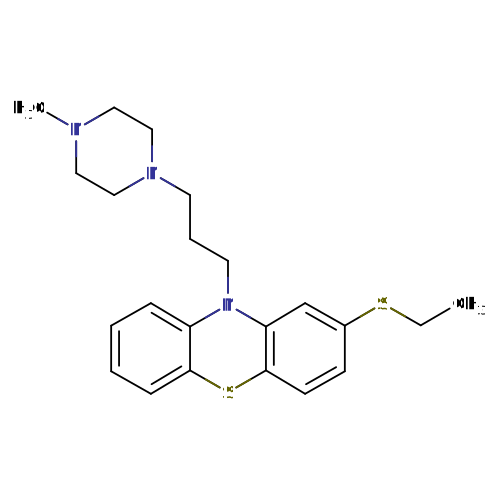
Structure for Thiethylperazine (DB00372)
- Weight
- Average: 399.616
Monoisotopic: 399.180289323 - Chemical Formula
- C22H29N3S2
- Synonyms
- 2-(ethylthio)-10-[3-(4-methylpiperazin-1-yl)propyl]-10H-phenothiazine
- Norzine
- Thiethylperazin
- Thiéthylpérazine
- Thiethylperazine
- Thiethylperazinum
- Tietilperazina
- External IDs
- GS 95
- NSC 130044

Pharmacology
- Indication
For the treatment or relief of nausea and vomiting.
 Reduce drug development failure ratesBuild, train, & validate machine-learning modelswith evidence-based and structured datasets.Build, train, & validate predictive machine-learning models with structured datasets.
- Associated Conditions
Indication Type Indication Combined Product Details Approval Level Age Group Patient Characteristics Dose Form Treatment of Nausea and vomiting •••••••••••• Treatment of Nausea and vomiting •••••••••••• Treatment of Nausea and vomiting •••••••••••• Treatment of Nausea and vomiting •••••••••••• - Contraindications & Blackbox Warnings
 Prevent Adverse Drug Events TodayTap into our Clinical API for life-saving information on contraindications & blackbox warnings, population restrictions, harmful risks, & more.Avoid life-threatening adverse drug events with our Clinical API
- Pharmacodynamics
Thiethylperazine, an atypical antipsychotic agent, is used to treat both negative and positive symptoms of schizophrenia, acute mania with bipolar disorder, agitation, and psychotic symptoms in dementia. Future uses may include the treatment of obsessive-compulsive disorder and severe behavioral disorders in autism. Structurally and pharmacologically similar to clozapine, Thiethylperazine binds to alpha(1), dopamine, histamine H1, muscarinic, and serotonin type 2 (5-HT2) receptors.
- Mechanism of action
Thiethylperazine is an antagonist at types 1, 2, and 4 dopamine receptors, 5-HT receptor types 2A and 2C, muscarinic receptors 1 through 5, alpha(1)-receptors, and histamine H1-receptors. Thiethylperazine's antipsychotic effect is due to antagonism at dopamine and serotonin type 2 receptors, with greater activity at serotonin 5-HT2 receptors than at dopamine type-2 receptors. This may explain the lack of extrapyramidal effects. Thiethylperazine does not appear to block dopamine within the tubero-infundibular tract, explaining the lower incidence of hyperprolactinemia than with typical antipsychotic agents or risperidone. Antagonism at muscarinic receptors, H1-receptors, and alpha(1)-receptors also occurs with thiethylperazine.
Target Actions Organism UDopamine D2 receptor antagonistHumans - Absorption
Not Available
- Volume of distribution
Not Available
- Protein binding
60%
- Metabolism
- Not Available
- Route of elimination
Thiethylperazine is eliminated in the urine.
- Half-life
Not Available
- Clearance
Not Available
- Adverse Effects
 Improve decision support & research outcomesWith structured adverse effects data, including: blackbox warnings, adverse reactions, warning & precautions, & incidence rates. View sample adverse effects data in our new Data Library!Improve decision support & research outcomes with our structured adverse effects data.
- Toxicity
Manifestations of acute overdosage of TORECAN (thiethylperazine) can be expected to reflect the CNS effects of the drug and include extrapyramidal symptoms (E.P.S), confusion and convulsions with reduced or absent reflexes, respiratory depression and hypotension.
- Pathways
- Not Available
- Pharmacogenomic Effects/ADRs
- Not Available
Interactions
- Drug Interactions
- This information should not be interpreted without the help of a healthcare provider. If you believe you are experiencing an interaction, contact a healthcare provider immediately. The absence of an interaction does not necessarily mean no interactions exist.
Drug Interaction Integrate drug-drug
interactions in your software1,2-Benzodiazepine The risk or severity of CNS depression can be increased when Thiethylperazine is combined with 1,2-Benzodiazepine. Abacavir Thiethylperazine may decrease the excretion rate of Abacavir which could result in a higher serum level. Acebutolol The serum concentration of Acebutolol can be increased when it is combined with Thiethylperazine. Aceclofenac Aceclofenac may decrease the excretion rate of Thiethylperazine which could result in a higher serum level. Acemetacin Acemetacin may decrease the excretion rate of Thiethylperazine which could result in a higher serum level. - Food Interactions
- Avoid excessive or chronic alcohol consumption. Additive CNS depression may occur if alcohol is consumed with thiethylperazine.
Products
 Drug product information from 10+ global regionsOur datasets provide approved product information including:dosage, form, labeller, route of administration, and marketing period.Access drug product information from over 10 global regions.
- Product Ingredients
Ingredient UNII CAS InChI Key Thiethylperazine malate HP46XK89XB 52239-63-1 GTHHLZDYRHLACN-UHFFFAOYSA-N Thiethylperazine maleate RUK64CF26E 1179-69-7 RVBRTNPNFYFDMZ-SPIKMXEPSA-N - Brand Name Prescription Products
Name Dosage Strength Route Labeller Marketing Start Marketing End Region Image Torecan Injection, solution 10 mg/2mL Intramuscular UNSPECIFIED 2006-05-11 2006-10-13 US 
Torecan Tablet 10 mg/1 Oral UNSPECIFIED 2006-05-11 2006-10-13 US
Categories
- ATC Codes
- R06AD03 — Thiethylperazine
- Drug Categories
- Antiemetics
- Antihistamines for Systemic Use
- Antipsychotic Agents
- Autonomic Agents
- Central Nervous System Agents
- Central Nervous System Depressants
- Dopamine Agents
- Dopamine Antagonists
- Dopamine D2 Receptor Antagonists
- Drugs that are Mainly Renally Excreted
- Gastrointestinal Agents
- Heterocyclic Compounds, Fused-Ring
- Neurotoxic agents
- Neurotransmitter Agents
- Peripheral Nervous System Agents
- Phenothiazine Derivatives
- Phenothiazines
- Piperazines
- Sulfur Compounds
- Chemical TaxonomyProvided by Classyfire
- Description
- This compound belongs to the class of organic compounds known as phenothiazines. These are polycyclic aromatic compounds containing a phenothiazine moiety, which is a linear tricyclic system that consists of a two benzene rings joined by a para-thiazine ring.
- Kingdom
- Organic compounds
- Super Class
- Organoheterocyclic compounds
- Class
- Benzothiazines
- Sub Class
- Phenothiazines
- Direct Parent
- Phenothiazines
- Alternative Parents
- Alkyldiarylamines / Diarylthioethers / Thiophenol ethers / N-methylpiperazines / Alkylarylthioethers / 1,4-thiazines / Trialkylamines / Sulfenyl compounds / Azacyclic compounds / Organopnictogen compounds show 1 more
- Substituents
- 1,4-diazinane / Alkylarylthioether / Alkyldiarylamine / Amine / Aromatic heteropolycyclic compound / Aryl thioether / Azacycle / Benzenoid / Diarylthioether / Hydrocarbon derivative show 15 more
- Molecular Framework
- Aromatic heteropolycyclic compounds
- External Descriptors
- phenothiazines, N-methylpiperazine (CHEBI:9544)
- Affected organisms
- Humans and other mammals
Chemical Identifiers
- UNII
- 8ETK1WAF6R
- CAS number
- 1420-55-9
- InChI Key
- XCTYLCDETUVOIP-UHFFFAOYSA-N
- InChI
- InChI=1S/C22H29N3S2/c1-3-26-18-9-10-22-20(17-18)25(19-7-4-5-8-21(19)27-22)12-6-11-24-15-13-23(2)14-16-24/h4-5,7-10,17H,3,6,11-16H2,1-2H3
- IUPAC Name
- 2-(ethylsulfanyl)-10-[3-(4-methylpiperazin-1-yl)propyl]-10H-phenothiazine
- SMILES
- CCSC1=CC2=C(SC3=CC=CC=C3N2CCCN2CCN(C)CC2)C=C1
References
- General References
- Maurer H, Pfleger K: Identification of phenothiazine antihistamines and their metabolites in urine. Arch Toxicol. 1988;62(2-3):185-91. [Article]
- External Links
- Human Metabolome Database
- HMDB0014516
- KEGG Drug
- D02354
- KEGG Compound
- C07132
- PubChem Compound
- 5440
- PubChem Substance
- 46506502
- ChemSpider
- 5245
- BindingDB
- 78436
- 10471
- ChEBI
- 9544
- ChEMBL
- CHEMBL1378
- ZINC
- ZINC000022446674
- Therapeutic Targets Database
- DAP000315
- PharmGKB
- PA164748882
- RxList
- RxList Drug Page
- Drugs.com
- Drugs.com Drug Page
- Wikipedia
- Thiethylperazine
Clinical Trials
- Clinical Trials
Phase Status Purpose Conditions Count 2 Completed Treatment Alzheimer's Disease (AD) 1
Pharmacoeconomics
- Manufacturers
- Novartis pharmaceuticals corp
- Packagers
- Novartis AG
- Dosage Forms
Form Route Strength Injection, solution Intramuscular 10 mg/2mL Pill Oral 6.5 mg Suppository Rectal 6.5 MG Tablet Oral 10 mg/1 Tablet, coated Oral 6.5 MG - Prices
- Not Available
- Patents
- Not Available
Properties
- State
- Liquid
- Experimental Properties
Property Value Source melting point (°C) 62-64 °C PhysProp boiling point (°C) 227 °C at 1.00E-02 mm Hg PhysProp water solubility 0.0584 mg/L Not Available logP 5.41 HANSCH,C ET AL. (1995) - Predicted Properties
Property Value Source Water Solubility 0.00487 mg/mL ALOGPS logP 5.12 ALOGPS logP 4.66 Chemaxon logS -4.9 ALOGPS pKa (Strongest Basic) 8 Chemaxon Physiological Charge 1 Chemaxon Hydrogen Acceptor Count 3 Chemaxon Hydrogen Donor Count 0 Chemaxon Polar Surface Area 9.72 Å2 Chemaxon Rotatable Bond Count 6 Chemaxon Refractivity 122.56 m3·mol-1 Chemaxon Polarizability 46.53 Å3 Chemaxon Number of Rings 4 Chemaxon Bioavailability 1 Chemaxon Rule of Five Yes Chemaxon Ghose Filter Yes Chemaxon Veber's Rule Yes Chemaxon MDDR-like Rule Yes Chemaxon - Predicted ADMET Features
Property Value Probability Human Intestinal Absorption + 0.9558 Blood Brain Barrier + 0.9847 Caco-2 permeable + 0.748 P-glycoprotein substrate Substrate 0.8705 P-glycoprotein inhibitor I Inhibitor 0.8683 P-glycoprotein inhibitor II Inhibitor 0.6434 Renal organic cation transporter Inhibitor 0.715 CYP450 2C9 substrate Non-substrate 0.8381 CYP450 2D6 substrate Substrate 0.7491 CYP450 3A4 substrate Non-substrate 0.607 CYP450 1A2 substrate Inhibitor 0.9159 CYP450 2C9 inhibitor Non-inhibitor 0.8968 CYP450 2D6 inhibitor Inhibitor 0.943 CYP450 2C19 inhibitor Non-inhibitor 0.5565 CYP450 3A4 inhibitor Non-inhibitor 0.7657 CYP450 inhibitory promiscuity High CYP Inhibitory Promiscuity 0.684 Ames test Non AMES toxic 0.885 Carcinogenicity Non-carcinogens 0.9366 Biodegradation Not ready biodegradable 1.0 Rat acute toxicity 2.5624 LD50, mol/kg Not applicable hERG inhibition (predictor I) Weak inhibitor 0.9258 hERG inhibition (predictor II) Inhibitor 0.8292
Spectra
- Mass Spec (NIST)
- Not Available
- Spectra
- Chromatographic Properties
Collision Cross Sections (CCS)
Adduct CCS Value (Å2) Source type Source [M-H]- 212.8526228 predictedDarkChem Lite v0.1.0 [M-H]- 212.9522228 predictedDarkChem Lite v0.1.0 [M-H]- 195.15514 predictedDeepCCS 1.0 (2019) [M+H]+ 212.8353228 predictedDarkChem Lite v0.1.0 [M+H]+ 212.0895228 predictedDarkChem Lite v0.1.0 [M+H]+ 197.51314 predictedDeepCCS 1.0 (2019) [M+Na]+ 213.0632228 predictedDarkChem Lite v0.1.0 [M+Na]+ 213.0555228 predictedDarkChem Lite v0.1.0 [M+Na]+ 204.59999 predictedDeepCCS 1.0 (2019)
Targets

- Kind
- Protein
- Organism
- Humans
- Pharmacological action
- Unknown
- Actions
- Antagonist
- General Function
- Potassium channel regulator activity
- Specific Function
- Dopamine receptor whose activity is mediated by G proteins which inhibit adenylyl cyclase.
- Gene Name
- DRD2
- Uniprot ID
- P14416
- Uniprot Name
- D(2) dopamine receptor
- Molecular Weight
- 50618.91 Da
References
- Overington JP, Al-Lazikani B, Hopkins AL: How many drug targets are there? Nat Rev Drug Discov. 2006 Dec;5(12):993-6. [Article]
- Imming P, Sinning C, Meyer A: Drugs, their targets and the nature and number of drug targets. Nat Rev Drug Discov. 2006 Oct;5(10):821-34. [Article]
- Briani C, Cagnin A, Chierichetti F, Tiberio M, Battistin L, Pizzolato G: Thiethylperazine-induced parkinsonism: in vivo demonstration of dopamine D2 receptors blockade. Eur J Neurol. 2004 Oct;11(10):709-10. [Article]

Drug created at June 13, 2005 13:24 / Updated at May 03, 2024 10:13