Identification
- Summary
Griseofulvin is an antifungal agent used to treat a variety of superficial tinea infections and fungal infections of the fingernails and toes.
- Brand Names
- Gris-peg
- Generic Name
- Griseofulvin
- DrugBank Accession Number
- DB00400
- Background
An antifungal antibiotic. Griseofulvin may be given by mouth in the treatment of tinea infections.
- Type
- Small Molecule
- Groups
- Approved, Investigational, Vet approved
- Structure
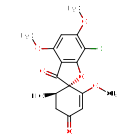
Structure for Griseofulvin (DB00400)

- Weight
- Average: 352.766
Monoisotopic: 352.071365983 - Chemical Formula
- C17H17ClO6
- Synonyms
- (+)-griseofulvin
- Amudane
- Griseofulvin
- Griseofulvin, microcrystalline
- Griseofulvin, ultramicrosize
- Griseofulvina
- Griséofulvine
- Griseofulvinum

Pharmacology
- Indication
For the treatment of ringworm infections of the skin, hair, and nails, namely: tinea corporis, tinea pedis, tinea cruris, tinea barbae, cradle cap or other conditions caused by Trichophyton or Microsporum fungi.
 Reduce drug development failure ratesBuild, train, & validate machine-learning modelswith evidence-based and structured datasets.Build, train, & validate predictive machine-learning models with structured datasets.
- Associated Conditions
Indication Type Indication Combined Product Details Approval Level Age Group Patient Characteristics Dose Form Treatment of Tinea capitis •••••••••••• ••••••••••• •••••• Treatment of Tinea corporis •••••••••••• ••••••••••• •••••• Treatment of Tinea cruris •••••••••••• ••••••••••• •••••• Treatment of Tinea pedis •••••••••••• ••••••••••• •••••• Treatment of Tinea unguium •••••••••••• ••••••••••• •••••• - Contraindications & Blackbox Warnings
 Prevent Adverse Drug Events TodayTap into our Clinical API for life-saving information on contraindications & blackbox warnings, population restrictions, harmful risks, & more.Avoid life-threatening adverse drug events with our Clinical API
- Pharmacodynamics
Griseofulvin is a mycotoxic metabolic product of Penicillium spp. It was the first available oral agent for the treatment of dermatophytoses and has now been used for more than forty years. Griseofulvin is fungistatic with in vitro activity against various species of Microsporum Epidermophyton, and Trichophyton. It has no effect on bacteria or on other genera of fungi. Following oral administration, griseofulvin is deposited in the keratin precursor cells and has a greater affinity for diseased tissue. The drug is tightly bound to the new keratin which becomes highly resistant to fungal invasions. Once the keratin-Griseofulvin complex reaches the skin site of action, it binds to fungal microtubules (tubulin) thus altering fungal mitosis.
- Mechanism of action
Griseofulvin is fungistatic, however the exact mechanism by which it inhibits the growth of dermatophytes is not clear. It is thought to inhibit fungal cell mitosis and nuclear acid synthesis. It also binds to and interferes with the function of spindle and cytoplasmic microtubules by binding to alpha and beta tubulin. It binds to keratin in human cells, then once it reaches the fungal site of action, it binds to fungal microtubes thus altering the fungal process of mitosis.
Target Actions Organism ATubulin beta chain inhibitorTrichophyton rubrum UKeratin, type I cytoskeletal 12 other/unknownHumans - Absorption
Poorly absorbed from GI ranging from 25 to 70% of an oral dose. Absorption is significantly enhanced by administration with or after a fatty meal.
- Volume of distribution
Not Available
- Protein binding
Not Available
- Metabolism
Primarily hepatic with major metabolites being 6-methyl-griseofulvin and its glucuronide conjugate.
Hover over products below to view reaction partners
- Route of elimination
Not Available
- Half-life
9-21 hours
- Clearance
Not Available
- Adverse Effects
 Improve decision support & research outcomesWith structured adverse effects data, including: blackbox warnings, adverse reactions, warning & precautions, & incidence rates. View sample adverse effects data in our new Data Library!Improve decision support & research outcomes with our structured adverse effects data.
- Toxicity
Side effects are minor: headaches, gastrointestinal reactions and cutaneous eruptions.
- Pathways
- Not Available
- Pharmacogenomic Effects/ADRs
- Not Available
Interactions
- Drug Interactions
- This information should not be interpreted without the help of a healthcare provider. If you believe you are experiencing an interaction, contact a healthcare provider immediately. The absence of an interaction does not necessarily mean no interactions exist.
Drug Interaction Integrate drug-drug
interactions in your softwareAbemaciclib The metabolism of Abemaciclib can be increased when combined with Griseofulvin. Acalabrutinib The metabolism of Acalabrutinib can be increased when combined with Griseofulvin. Acenocoumarol The metabolism of Acenocoumarol can be increased when combined with Griseofulvin. Albendazole The metabolism of Albendazole can be increased when combined with Griseofulvin. Alectinib The metabolism of Alectinib can be increased when combined with Griseofulvin. - Food Interactions
- Avoid alcohol.
- Take with a high fat meal.
Products
 Drug product information from 10+ global regionsOur datasets provide approved product information including:dosage, form, labeller, route of administration, and marketing period.Access drug product information from over 10 global regions.
- Product Images
- International/Other Brands
- Crivicin / Curling factor / Fulcin (Cepharma) / Fulvicin (Schering-Plough) / Grifulvin (McNeil) / Grisactin / Grison-250 / Grisovin (Fujisawa) / Lamoryl (Lovens) / Likuden (Sanofi) / Poncyl (Takeda) / S-Fulvin / Spirofulvin / Sporostatin (Schering)
- Brand Name Prescription Products
Name Dosage Strength Route Labeller Marketing Start Marketing End Region Image Fulvicin Pg Tab 330mg Tablet 330 mg / tab Oral Schering Plough 1982-12-31 1998-11-17 Canada 
Fulvicin U/f Tab 250mg Tablet 250 mg Oral Schering Plough 1966-12-31 2004-07-21 Canada Fulvicin Uf Tab 500mg Tablet 500 mg Oral Schering Plough 1966-12-31 2004-07-21 Canada Gris-PEG Tablet, film coated 125 mg/1 Oral Pedinol Pharmacal, Inc. 2016-07-26 Not applicable US 
Gris-PEG Tablet, film coated 250 mg/1 Oral Physicians Total Care, Inc. 2000-06-01 2004-06-30 US - Generic Prescription Products
Name Dosage Strength Route Labeller Marketing Start Marketing End Region Image Grifulvin V Tablet 500 mg/1 Oral Ortho Mc Neil Pharmaceuticals 1980-06-02 2014-05-31 US 
Grifulvin V Tablet 500 mg/1 Oral Physicians Total Care, Inc. 2005-09-01 2011-06-30 US Griseofulviin (microsize) Suspension 125 mg/5mL Oral Rebel Distributors 2007-07-26 Not applicable US Griseofulvin Suspension 125 mg/5mL Oral Cosette Pharmaceuticals, Inc. 2022-11-01 Not applicable US Griseofulvin Suspension 125 mg/5mL Oral Physicians Total Care, Inc. 2006-01-16 Not applicable US


Categories
- ATC Codes
- D01BA01 — Griseofulvin
- D01BA — Antifungals for systemic use
- D01B — ANTIFUNGALS FOR SYSTEMIC USE
- D01 — ANTIFUNGALS FOR DERMATOLOGICAL USE
- D — DERMATOLOGICALS
- Drug Categories
- Anti-Infective Agents
- Antifungal Agents
- Antifungals for Dermatological Use
- Antifungals for Systemic Use
- Antifungals for Topical Use
- Benzofurans
- Cytochrome P-450 CYP1A2 Inducers
- Cytochrome P-450 CYP1A2 Inducers (strength unknown)
- Cytochrome P-450 CYP3A Inducers
- Cytochrome P-450 CYP3A4 Inducers
- Cytochrome P-450 CYP3A4 Inducers (strength unknown)
- Cytochrome P-450 Enzyme Inducers
- Decreased Mitosis
- Dermatologicals
- Heterocyclic Compounds, Fused-Ring
- Microtubule Inhibition
- Tubulin Inhibiting Agent
- Chemical TaxonomyProvided by Classyfire
- Description
- This compound belongs to the class of organic compounds known as benzofurans. These are organic compounds containing a benzene ring fused to a furan. Furan is a five-membered aromatic ring with four carbon atoms and one oxygen atom.
- Kingdom
- Organic compounds
- Super Class
- Organoheterocyclic compounds
- Class
- Benzofurans
- Sub Class
- Not Available
- Direct Parent
- Benzofurans
- Alternative Parents
- Coumarans / Aryl alkyl ketones / Anisoles / Cyclohexenones / Alkyl aryl ethers / Aryl chlorides / Vinylogous esters / Oxacyclic compounds / Organochlorides / Organic oxides show 1 more
- Substituents
- Alkyl aryl ether / Anisole / Aromatic heteropolycyclic compound / Aryl alkyl ketone / Aryl chloride / Aryl halide / Aryl ketone / Benzenoid / Benzofuran / Carbonyl group show 13 more
- Molecular Framework
- Aromatic heteropolycyclic compounds
- External Descriptors
- antibiotic antifungal drug, organochlorine compound, 1-benzofurans, oxaspiro compound, benzofuran antifungal drug (CHEBI:27779) / Other Polyketides, Dibenzofurans, griseofulvins, dibenzopyrans and xanthones, Antibiotic fungicides (C06686) / Dibenzofurans, griseofulvins, dibenzopyrans and xanthones (LMPK13060001)
- Affected organisms
- Yeast and other Trichophyton or Microsporum fungi
- Dermatophytic fungi including Trichophyton, Microsporum and Epidermophyton
Chemical Identifiers
- UNII
- 32HRV3E3D5
- CAS number
- 126-07-8
- InChI Key
- DDUHZTYCFQRHIY-RBHXEPJQSA-N
- InChI
- InChI=1S/C17H17ClO6/c1-8-5-9(19)6-12(23-4)17(8)16(20)13-10(21-2)7-11(22-3)14(18)15(13)24-17/h6-8H,5H2,1-4H3/t8-,17+/m1/s1
- IUPAC Name
- (2S,6'R)-7-chloro-2',4,6-trimethoxy-6'-methyl-3H-spiro[1-benzofuran-2,1'-cyclohexan]-2'-ene-3,4'-dione
- SMILES
- COC1=CC(OC)=C(Cl)C2=C1C(=O)[C@]1(O2)[C@H](C)CC(=O)C=C1OC
References
- Synthesis Reference
Gary Liversidge, "Methods of making and using novel griseofulvin compositions." U.S. Patent US20070098805, issued May 03, 2007.
US20070098805- General References
- FDA Approved Drug Products: Gris-Peg (ultramicrosize griseofulvin) tablets for oral use [Link]
- External Links
- Human Metabolome Database
- HMDB0014544
- KEGG Drug
- D00209
- KEGG Compound
- C06686
- PubChem Compound
- 441140
- PubChem Substance
- 46508437
- ChemSpider
- 389934
- BindingDB
- 31775
- 5021
- ChEBI
- 27779
- ChEMBL
- CHEMBL562
- ZINC
- ZINC000000622123
- Therapeutic Targets Database
- DAP000539
- PharmGKB
- PA449814
- RxList
- RxList Drug Page
- Drugs.com
- Drugs.com Drug Page
- PDRhealth
- PDRhealth Drug Page
- Wikipedia
- Griseofulvin
- FDA label
- Download (131 KB)
- MSDS
- Download (75.7 KB)
Clinical Trials
- Clinical Trials
Phase Status Purpose Conditions Count 3 Completed Treatment Tinea Capitis 1 1 Completed Not Available Healthy Volunteers (HV) 2 1 Completed Treatment Antifungal Agents 1 1 Completed Treatment Diabetes / Healthy Volunteers (HV) 1 Not Available Completed Treatment Tinea Capitis 1
Pharmacoeconomics
- Manufacturers
- Wyeth ayerst laboratories
- Johnson and johnson consumer companies inc
- Orthoneutrogena
- Actavis mid atlantic llc
- Ivax pharmaceuticals inc sub teva pharmaceuticals usa
- Perrigo co tennessee inc
- Elorac inc
- Johnson and johnson consumer products inc
- Schering corp sub schering plough corp
- Pedinol pharmacal inc
- Pliva inc
- Packagers
- Actavis Group
- Amerisource Health Services Corp.
- Cipla Ltd.
- Dept Health Central Pharmacy
- Dispensing Solutions
- Diversified Healthcare Services Inc.
- Medisca Inc.
- Murfreesboro Pharmaceutical Nursing Supply
- Novartis AG
- Nucare Pharmaceuticals Inc.
- Ortho Mcneil Janssen Pharmaceutical Inc.
- Ortho-McNeil-Janssen Pharmaceuticals Inc.
- Patriot Pharmaceuticals
- PD-Rx Pharmaceuticals Inc.
- PEDiNOL
- Perrigo Co.
- Pharmaceutical Utilization Management Program VA Inc.
- Pharmedix
- Physicians Total Care Inc.
- Pliva Inc.
- Remedy Repack
- Teva Pharmaceutical Industries Ltd.
- Dosage Forms
Form Route Strength Tablet Oral 330 mg / tab Tablet, film coated Oral 500 MG Tablet Oral 500 mg/1 Tablet, film coated Oral 125 mg/1 Tablet, film coated Oral 250 mg/1 Powder Not applicable 1 g/1g Suspension Oral 125 mg/5mL Tablet Oral 125 mg/1 Tablet Oral 250 mg/1 Tablet Oral 125 mg / tab Tablet Oral 250 mg / tab Tablet Oral 500 mg / tab Tablet, film coated Oral 500.00 mg Tablet Oral 500 MG Tablet Oral Tablet, coated Oral 125 mg/1 Tablet, coated Oral 250 mg/1 Tablet, coated Oral 500 mg Tablet Oral 250 mg Tablet Oral 125 mg - Prices
Unit description Cost Unit Griseofulvin Microsize 125 mg/5ml Suspension 120ml Bottle 43.0USD bottle Grifulvin v 500 mg tablet 4.78USD tablet Gris-peg 250 mg tablet 2.75USD tablet Gris-peg 125 mg tablet 2.24USD tablet Griseofulvin powder 2.2USD g DrugBank does not sell nor buy drugs. Pricing information is supplied for informational purposes only.- Patents
- Not Available
Properties
- State
- Solid
- Experimental Properties
Property Value Source melting point (°C) 220 °C PhysProp water solubility 8.64 mg/L (at 25 °C) YALKOWSKY,SH & DANNENFELSER,RM (1992) logP 2.18 HANSCH,C ET AL. (1995) logS -4.61 ADME Research, USCD Caco2 permeability -4.44 ADME Research, USCD - Predicted Properties
Property Value Source Water Solubility 0.0504 mg/mL ALOGPS logP 2.71 ALOGPS logP 2.17 Chemaxon logS -3.8 ALOGPS pKa (Strongest Acidic) 19.62 Chemaxon pKa (Strongest Basic) -4.3 Chemaxon Physiological Charge 0 Chemaxon Hydrogen Acceptor Count 6 Chemaxon Hydrogen Donor Count 0 Chemaxon Polar Surface Area 71.06 Å2 Chemaxon Rotatable Bond Count 3 Chemaxon Refractivity 87.85 m3·mol-1 Chemaxon Polarizability 34.25 Å3 Chemaxon Number of Rings 3 Chemaxon Bioavailability 1 Chemaxon Rule of Five Yes Chemaxon Ghose Filter Yes Chemaxon Veber's Rule No Chemaxon MDDR-like Rule No Chemaxon - Predicted ADMET Features
Property Value Probability Human Intestinal Absorption + 1.0 Blood Brain Barrier + 0.9208 Caco-2 permeable + 0.8867 P-glycoprotein substrate Substrate 0.612 P-glycoprotein inhibitor I Inhibitor 0.8183 P-glycoprotein inhibitor II Inhibitor 0.5133 Renal organic cation transporter Non-inhibitor 0.882 CYP450 2C9 substrate Non-substrate 0.7921 CYP450 2D6 substrate Non-substrate 0.9117 CYP450 3A4 substrate Substrate 0.6249 CYP450 1A2 substrate Non-inhibitor 0.9046 CYP450 2C9 inhibitor Non-inhibitor 0.9071 CYP450 2D6 inhibitor Non-inhibitor 0.9231 CYP450 2C19 inhibitor Non-inhibitor 0.9026 CYP450 3A4 inhibitor Inhibitor 0.7043 CYP450 inhibitory promiscuity High CYP Inhibitory Promiscuity 0.8235 Ames test Non AMES toxic 0.9133 Carcinogenicity Non-carcinogens 0.8544 Biodegradation Not ready biodegradable 0.9964 Rat acute toxicity 1.5788 LD50, mol/kg Not applicable hERG inhibition (predictor I) Weak inhibitor 0.938 hERG inhibition (predictor II) Non-inhibitor 0.8869
Spectra
- Mass Spec (NIST)
- Not Available
- Spectra
- Chromatographic Properties
Collision Cross Sections (CCS)
Adduct CCS Value (Å2) Source type Source [M-H]- 189.3693133 predictedDarkChem Lite v0.1.0 [M-H]- 188.9972133 predictedDarkChem Lite v0.1.0 [M-H]- 188.5803133 predictedDarkChem Lite v0.1.0 [M-H]- 177.21696 predictedDeepCCS 1.0 (2019) [M+H]+ 189.9297133 predictedDarkChem Lite v0.1.0 [M+H]+ 190.2279133 predictedDarkChem Lite v0.1.0 [M+H]+ 189.1893133 predictedDarkChem Lite v0.1.0 [M+H]+ 179.61253 predictedDeepCCS 1.0 (2019) [M+Na]+ 189.1258133 predictedDarkChem Lite v0.1.0 [M+Na]+ 189.3465133 predictedDarkChem Lite v0.1.0 [M+Na]+ 188.9343133 predictedDarkChem Lite v0.1.0 [M+Na]+ 185.75139 predictedDeepCCS 1.0 (2019)
Targets

- Kind
- Protein
- Organism
- Trichophyton rubrum
- Pharmacological action
- Yes
- Actions
- Inhibitor
- Curator comments
- Trichophyton rubrum has been chosen as a representative organism susceptible to griseofulvin. It is also active against several other types of dermatophytic fungi, including Trichophyton and Microsporum spp.
- General Function
- Tubulin is the major constituent of microtubules, a cylinder consisting of laterally associated linear protofilaments composed of alpha- and beta-tubulin heterodimers. Microtubules grow by the addition of GTP-tubulin dimers to the microtubule end, where a stabilizing cap forms. Below the cap, tubulin dimers are in GDP-bound state, owing to GTPase activity of alpha-tubulin.
- Specific Function
- Gtp binding
- Gene Name
- Not Available
- Uniprot ID
- Q5UBX3
- Uniprot Name
- Tubulin beta chain
- Molecular Weight
- 49669.63 Da
References
- S Al-Janabi AAH, Matrood Bashi A: Synthesis and antifungal activity of novel griseofulvin nanoparticles with zinc oxide against dermatophytic fungi: Trichophyton mentagrophytes and Trichophyton verrucosum: A primary study. Curr Med Mycol. 2022 Jun;8(2):40-44. doi: 10.18502/cmm.8.2.10331. [Article]
- FDA Approved Drug Products: Gris-Peg (ultramicrosize griseofulvin) tablets for oral use [Link]
- Kind
- Protein
- Organism
- Humans
- Pharmacological action
- Unknown
- Actions
- Other/unknown
- General Function
- Structural molecule activity
- Specific Function
- May play a unique role in maintaining the normal corneal epithelial function. Together with KRT3, essential for the maintenance of corneal epithelium integrity (By similarity).
- Gene Name
- KRT12
- Uniprot ID
- Q99456
- Uniprot Name
- Keratin, type I cytoskeletal 12
- Molecular Weight
- 53510.935 Da
References
- Nakamichi I, Hatakeyama S, Nakayama KI: Formation of Mallory body-like inclusions and cell death induced by deregulated expression of keratin 18. Mol Biol Cell. 2002 Oct;13(10):3441-51. [Article]
- Sobue S, Sekiguchi K, Nabeshima T: Intracutaneous distributions of fluconazole, itraconazole, and griseofulvin in Guinea pigs and binding to human stratum corneum. Antimicrob Agents Chemother. 2004 Jan;48(1):216-23. [Article]
Enzymes
- Kind
- Protein
- Organism
- Humans
- Pharmacological action
- Unknown
- Actions
- Inducer
- General Function
- Oxidoreductase activity, acting on paired donors, with incorporation or reduction of molecular oxygen, reduced flavin or flavoprotein as one donor, and incorporation of one atom of oxygen
- Specific Function
- Cytochromes P450 are a group of heme-thiolate monooxygenases. In liver microsomes, this enzyme is involved in an NADPH-dependent electron transport pathway. It oxidizes a variety of structurally un...
- Gene Name
- CYP1A2
- Uniprot ID
- P05177
- Uniprot Name
- Cytochrome P450 1A2
- Molecular Weight
- 58293.76 Da
References
- Rasmussen BB, Jeppesen U, Gaist D, Brosen K: Griseofulvin and fluvoxamine interactions with the metabolism of theophylline. Ther Drug Monit. 1997 Feb;19(1):56-62. [Article]
- Kind
- Protein
- Organism
- Humans
- Pharmacological action
- Unknown
- Actions
- Inducer
- General Function
- Vitamin d3 25-hydroxylase activity
- Specific Function
- Cytochromes P450 are a group of heme-thiolate monooxygenases. In liver microsomes, this enzyme is involved in an NADPH-dependent electron transport pathway. It performs a variety of oxidation react...
- Gene Name
- CYP3A4
- Uniprot ID
- P08684
- Uniprot Name
- Cytochrome P450 3A4
- Molecular Weight
- 57342.67 Da
References
- Yasuda K, Ranade A, Venkataramanan R, Strom S, Chupka J, Ekins S, Schuetz E, Bachmann K: A comprehensive in vitro and in silico analysis of antibiotics that activate pregnane X receptor and induce CYP3A4 in liver and intestine. Drug Metab Dispos. 2008 Aug;36(8):1689-97. doi: 10.1124/dmd.108.020701. Epub 2008 May 27. [Article]
- Griseofulvin drug summary [Link]

Drug created at June 13, 2005 13:24 / Updated at March 03, 2024 02:25