Identification
- Summary
Nisoldipine is a calcium channel blocker used as monotherapy or combined with other drugs for the treatment of hypertension.
- Brand Names
- Sular
- Generic Name
- Nisoldipine
- DrugBank Accession Number
- DB00401
- Background
Nisoldipine is a 1,4-dihydropyridine calcium channel blocker. It acts primarily on vascular smooth muscle cells by stabilizing voltage-gated L-type calcium channels in their inactive conformation. By inhibiting the influx of calcium in smooth muscle cells, nisoldipine prevents calcium-dependent smooth muscle contraction and subsequent vasoconstriction. Nisoldipine may be used in alone or in combination with other agents in the management of hypertension.
- Type
- Small Molecule
- Groups
- Approved
- Structure
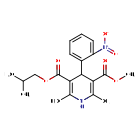
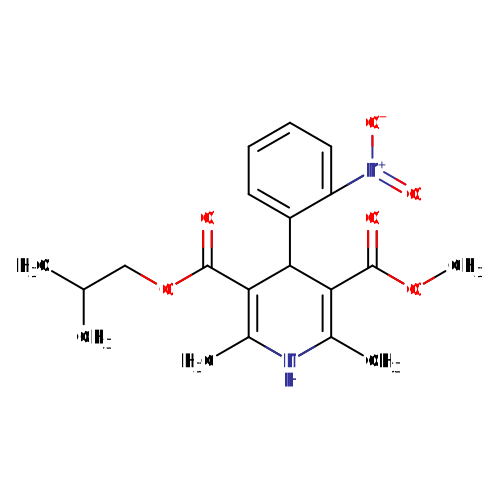
Structure for Nisoldipine (DB00401)
- Weight
- Average: 388.4144
Monoisotopic: 388.16343651 - Chemical Formula
- C20H24N2O6
- Synonyms
- isobutyl methyl 2,6-dimethyl-4-(2-nitrophenyl)-1,4-dihydropyridine-3,5-dicarboxylate
- Nisoldipin
- Nisoldipina
- Nisoldipine
- Nisoldipino
- Nisoldipinum
- External IDs
- BAY K 5552
- BAY-K-5552

Pharmacology
- Indication
For the treatment of hypertension. It may be used alone or in combination with other antihypertensive agents.
 Reduce drug development failure ratesBuild, train, & validate machine-learning modelswith evidence-based and structured datasets.Build, train, & validate predictive machine-learning models with structured datasets.
- Associated Conditions
Indication Type Indication Combined Product Details Approval Level Age Group Patient Characteristics Dose Form Management of Hypertension •••••••••••• ••••••• •••••••• ••••••• - Contraindications & Blackbox Warnings
 Prevent Adverse Drug Events TodayTap into our Clinical API for life-saving information on contraindications & blackbox warnings, population restrictions, harmful risks, & more.Avoid life-threatening adverse drug events with our Clinical API
- Pharmacodynamics
Nisoldipine, a dihydropyridine calcium-channel blocker, is used alone or with an angiotensin-converting enzyme inhibitor, to treat hypertension, chronic stable angina pectoris, and Prinzmetal's variant angina. Nisoldipine is similar to other peripheral vasodilators. Nisoldipine inhibits the influx of extra cellular calcium across the myocardial and vascular smooth muscle cell membranes possibly by deforming the channel, inhibiting ion-control gating mechanisms, and/or interfering with the release of calcium from the sarcoplasmic reticulum. The decrease in intracellular calcium inhibits the contractile processes of the myocardial smooth muscle cells, causing dilation of the coronary and systemic arteries, increased oxygen delivery to the myocardial tissue, decreased total peripheral resistance, decreased systemic blood pressure, and decreased afterload.
- Mechanism of action
By deforming the channel, inhibiting ion-control gating mechanisms, and/or interfering with the release of calcium from the sarcoplasmic reticulum, Nisoldipine inhibits the influx of extracellular calcium across the myocardial and vascular smooth muscle cell membranes The decrease in intracellular calcium inhibits the contractile processes of the myocardial smooth muscle cells, causing dilation of the coronary and systemic arteries, increased oxygen delivery to the myocardial tissue, decreased total peripheral resistance, decreased systemic blood pressure, and decreased afterload.
Target Actions Organism AVoltage-dependent L-type calcium channel subunit alpha-1C inhibitorHumans AVoltage-dependent calcium channel subunit alpha-2/delta-1 inhibitorHumans AVoltage-dependent L-type calcium channel subunit beta-2 inhibitorHumans AVoltage-dependent L-type calcium channel subunit alpha-1D inhibitorHumans AVoltage-dependent L-type calcium channel subunit alpha-1S inhibitorHumans - Absorption
Relatively well absorbed into the systemic circulation with 87% of the radiolabeled drug recovered in urine and feces. The absolute bioavailability of nisoldipine is about 5%.
- Volume of distribution
Not Available
- Protein binding
99%
- Metabolism
Pre-systemic metabolism in the gut wall, and this metabolism decreases from the proximal to the distal parts of the intestine. Nisoldipine is highly metabolized; 5 major urinary metabolites have been identified. The major biotransformation pathway appears to be the hydroxylation of the isobutyl ester. A hydroxylated derivative of the side chain, present in plasma at concentrations approximately equal to the parent compound, appears to be the only active metabolite and has about 10% of the activity of the parent compound. Cytochrome P450 enzymes are believed to play a major role in the metabolism of nisoldipine. The particular isoenzyme system responsible for its metabolism has not been identified, but other dihydropyridines are metabolized by cytochrome P450 IIIA4.
- Route of elimination
Although 60-80% of an oral dose undergoes urinary excretion, only traces of unchanged nisoldipine are found in urine.
- Half-life
7-12 hours
- Clearance
Not Available
- Adverse Effects
 Improve decision support & research outcomesWith structured adverse effects data, including: blackbox warnings, adverse reactions, warning & precautions, & incidence rates. View sample adverse effects data in our new Data Library!Improve decision support & research outcomes with our structured adverse effects data.
- Toxicity
Not Available
- Pathways
Pathway Category Nisoldipine Action Pathway Drug action - Pharmacogenomic Effects/ADRs
- Not Available
Interactions
- Drug Interactions
- This information should not be interpreted without the help of a healthcare provider. If you believe you are experiencing an interaction, contact a healthcare provider immediately. The absence of an interaction does not necessarily mean no interactions exist.
Drug Interaction Integrate drug-drug
interactions in your softwareAbacavir Nisoldipine may decrease the excretion rate of Abacavir which could result in a higher serum level. Abaloparatide The risk or severity of adverse effects can be increased when Nisoldipine is combined with Abaloparatide. Abametapir The serum concentration of Nisoldipine can be increased when it is combined with Abametapir. Abatacept The metabolism of Nisoldipine can be increased when combined with Abatacept. Acalabrutinib The metabolism of Nisoldipine can be decreased when combined with Acalabrutinib. - Food Interactions
- Avoid grapefruit products.
Products
 Drug product information from 10+ global regionsOur datasets provide approved product information including:dosage, form, labeller, route of administration, and marketing period.Access drug product information from over 10 global regions.
- Product Images
- International/Other Brands
- Baymycard (Bayer) / Baymycard RR (Bayer) / Bo Ping (Rui Yang Pharm) / Di Yi Xin (Tasly) / Ji Ni Le Er (Jiankang Pharmaceutical) / Ninobarucin (Choseido Pharmaceutical) / Nisomynard (Yoshindo) / Riohard (Taiyo Pharmaceutical) / Ruidi (Nanjing Sanrui Pharmaceutical Co.) / Syscor (Bayer)
- Brand Name Prescription Products
Name Dosage Strength Route Labeller Marketing Start Marketing End Region Image Sular Tablet, film coated, extended release 17 mg/1 Oral SHIONOGI INC. 1995-02-02 2018-10-31 US 
Sular Tablet, film coated, extended release 17 mg/1 Oral Covis Pharma US, Inc 2017-02-03 Not applicable US Sular Tablet, film coated, extended release 25.5 mg/1 Oral Physicians Total Care, Inc. 2009-02-24 Not applicable US Sular Tablet, film coated, extended release 8.5 mg/1 Oral SHIONOGI INC. 1995-02-02 2018-10-31 US Sular Tablet, film coated, extended release 8.5 mg/1 Oral Covis Pharma US, Inc 2017-02-03 Not applicable US - Generic Prescription Products
Name Dosage Strength Route Labeller Marketing Start Marketing End Region Image Nisoldipine Tablet, film coated, extended release 34 mg/1 Oral Prasco Laboratories 2012-02-27 Not applicable US 
Nisoldipine Tablet, film coated, extended release 40 mg/1 Oral Mylan Pharmaceuticals Inc. 2008-07-25 2030-01-01 US Nisoldipine Tablet, film coated, extended release 17 mg/1 Oral Mylan Pharmaceuticals Inc. 2011-01-28 Not applicable US 
Nisoldipine Tablet, film coated, extended release 34 mg/1 Oral United Research Laboratories, Inc. 2009-09-01 Not applicable US Nisoldipine Tablet, film coated, extended release 8.5 mg/1 Oral United Research Laboratories, Inc. 2009-09-01 Not applicable US


Categories
- ATC Codes
- C08CA07 — Nisoldipine
- Drug Categories
- Agents causing hyperkalemia
- Antiarrhythmic agents
- Antihypertensive Agents
- Antihypertensive Agents Indicated for Hypertension
- Bradycardia-Causing Agents
- Calcium Channel Blockers
- Calcium Channel Blockers (Dihydropyridine)
- Calcium-Regulating Hormones and Agents
- Cardiovascular Agents
- Cytochrome P-450 CYP3A Substrates
- Cytochrome P-450 CYP3A4 Substrates
- Cytochrome P-450 CYP3A5 Substrates
- Cytochrome P-450 CYP3A7 Substrates
- Cytochrome P-450 Substrates
- Decreased Blood Pressure
- Dihydropyridine Derivatives
- Dihydropyridines
- Drugs causing inadvertant photosensitivity
- Drugs that are Mainly Renally Excreted
- Hypotensive Agents
- Membrane Transport Modulators
- P-glycoprotein inhibitors
- Photosensitizing Agents
- Pyridines
- Selective Calcium Channel Blockers With Mainly Vascular Effects
- Vasodilating Agents
- Chemical TaxonomyProvided by Classyfire
- Description
- This compound belongs to the class of organic compounds known as dihydropyridinecarboxylic acids and derivatives. These are compounds containing a dihydropyridine moiety bearing a carboxylic acid group.
- Kingdom
- Organic compounds
- Super Class
- Organoheterocyclic compounds
- Class
- Pyridines and derivatives
- Sub Class
- Hydropyridines
- Direct Parent
- Dihydropyridinecarboxylic acids and derivatives
- Alternative Parents
- Nitrobenzenes / Nitroaromatic compounds / Dicarboxylic acids and derivatives / Vinylogous amides / Enoate esters / Methyl esters / Amino acids and derivatives / Propargyl-type 1,3-dipolar organic compounds / Azacyclic compounds / Enamines show 6 more
- Substituents
- Allyl-type 1,3-dipolar organic compound / Alpha,beta-unsaturated carboxylic ester / Amine / Amino acid or derivatives / Aromatic heteromonocyclic compound / Azacycle / Benzenoid / C-nitro compound / Carbonyl group / Carboxylic acid derivative show 23 more
- Molecular Framework
- Aromatic heteromonocyclic compounds
- External Descriptors
- C-nitro compound, diester, methyl ester, dihydropyridine (CHEBI:76917)
- Affected organisms
- Humans and other mammals
Chemical Identifiers
- UNII
- 4I8HAB65SZ
- CAS number
- 63675-72-9
- InChI Key
- VKQFCGNPDRICFG-UHFFFAOYSA-N
- InChI
- InChI=1S/C20H24N2O6/c1-11(2)10-28-20(24)17-13(4)21-12(3)16(19(23)27-5)18(17)14-8-6-7-9-15(14)22(25)26/h6-9,11,18,21H,10H2,1-5H3
- IUPAC Name
- 3-methyl 5-(2-methylpropyl) 2,6-dimethyl-4-(2-nitrophenyl)-1,4-dihydropyridine-3,5-dicarboxylate
- SMILES
- COC(=O)C1=C(C)NC(C)=C(C1C1=CC=CC=C1[N+]([O-])=O)C(=O)OCC(C)C
References
- Synthesis Reference
Massimo Ferrari, Marcello Ghezzi, Manuel Alberelli, Alberto Ambrosini, "Industrial process for the synthesis of isobutyl methyl 1,4-dihydro-2,6-dimethyl-4-(2-nitrophenyl)-3,5-pyridine dicarboxylate (nisoldipine)." U.S. Patent US20050240022, issued October 27, 2005.
US20050240022- General References
- Mielcarek J, Grobelny P, Szamburska O: The effect of beta-carotene on the photostability of nisoldipine. Methods Find Exp Clin Pharmacol. 2005 Apr;27(3):167-71. [Article]
- Missan S, Zhabyeyev P, Dyachok O, Jones SE, McDonald TF: Block of cardiac delayed-rectifier and inward-rectifier K+ currents by nisoldipine. Br J Pharmacol. 2003 Nov;140(5):863-70. Epub 2003 Oct 6. [Article]
- Hamilton SF, Houle LM, Thadani U: Rapid-release and coat-core formulations of nisoldipine in treatment of hypertension, angina, and heart failure. Heart Dis. 1999 Nov-Dec;1(5):279-88. [Article]
- External Links
- Human Metabolome Database
- HMDB0014545
- KEGG Drug
- D00618
- KEGG Compound
- C07699
- PubChem Compound
- 4499
- PubChem Substance
- 46504546
- ChemSpider
- 4343
- BindingDB
- 50101963
- 7435
- ChEBI
- 76917
- ChEMBL
- CHEMBL1726
- Therapeutic Targets Database
- DAP000595
- PharmGKB
- PA450634
- Guide to Pharmacology
- GtP Drug Page
- RxList
- RxList Drug Page
- Drugs.com
- Drugs.com Drug Page
- Wikipedia
- Nisoldipine
Clinical Trials
- Clinical Trials
Phase Status Purpose Conditions Count 4 Completed Treatment Diabetic Nephropathy 1 1 Completed Not Available Healthy Volunteers (HV) 2 Not Available Completed Not Available Coronavirus Disease 2019 (COVID‑19) / COVID / Hypertension 1
Pharmacoeconomics
- Manufacturers
- Mylan pharmaceuticals inc
- Shionogi pharma inc
- Packagers
- A-S Medication Solutions LLC
- Atlantic Biologicals Corporation
- Bayer Healthcare
- Bryant Ranch Prepack
- Heartland Repack Services LLC
- Murfreesboro Pharmaceutical Nursing Supply
- Mylan
- Physicians Total Care Inc.
- Quality Care
- Remedy Repack
- Sciele Pharma Inc.
- Shionogi Pharma Inc.
- Skyepharma Production Sas
- United Research Laboratories Inc.
- Dosage Forms
Form Route Strength Tablet, film coated, extended release Oral 17 mg/1 Tablet, film coated, extended release Oral 20 mg/1 Tablet, film coated, extended release Oral 25.5 mg/1 Tablet, film coated, extended release Oral 30 mg/1 Tablet, film coated, extended release Oral 34 mg/1 Tablet, film coated, extended release Oral 40 mg/1 Tablet, film coated, extended release Oral 8.5 mg/1 Tablet Oral 10 MG Tablet, coated Oral 10 MG Tablet, coated Oral 20 MG Tablet, coated Oral 30 MG Tablet, coated Oral 40 MG Tablet Oral Tablet, film coated - Prices
Unit description Cost Unit Sular 25.5 mg 24 Hour tablet 6.84USD tablet Sular 34 mg 24 Hour tablet 6.84USD tablet Sular 17 mg 24 Hour tablet 6.48USD tablet Sular 34 mg tablet 5.64USD tablet Sular 17 mg tablet 5.17USD tablet Nisoldipine er 30 mg tablet 5.07USD tablet Nisoldipine er 40 mg tablet 5.07USD tablet Sular 10 mg tablet 5.04USD tablet Sular 8.5 mg 24 Hour tablet 5.04USD tablet Nisoldipine er 20 mg tablet 4.65USD tablet Sular 25.5 mg tablet 4.35USD tablet Sular 8.5 mg tablet 4.13USD tablet Sular 20 mg tablet 3.37USD tablet Sular 30 mg 24 Hour tablet 3.23USD tablet Sular 40 mg 24 Hour tablet 3.23USD tablet Sular 30 mg tablet 3.1USD tablet Sular 40 mg tablet 2.61USD tablet Sular 10 mg 24 Hour tablet 2.36USD tablet DrugBank does not sell nor buy drugs. Pricing information is supplied for informational purposes only.- Patents
Patent Number Pediatric Extension Approved Expires (estimated) Region US5626874 No 1997-05-06 2014-11-30 US US5422123 No 1995-06-06 2012-06-06 US
Properties
- State
- Solid
- Experimental Properties
Property Value Source logP 3.26 MASUMOTO,K ET AL. (1995) - Predicted Properties
Property Value Source Water Solubility 0.00577 mg/mL ALOGPS logP 3.63 ALOGPS logP 3.06 Chemaxon logS -4.8 ALOGPS pKa (Strongest Acidic) 16.94 Chemaxon pKa (Strongest Basic) -6.6 Chemaxon Physiological Charge 0 Chemaxon Hydrogen Acceptor Count 5 Chemaxon Hydrogen Donor Count 1 Chemaxon Polar Surface Area 107.77 Å2 Chemaxon Rotatable Bond Count 8 Chemaxon Refractivity 104.9 m3·mol-1 Chemaxon Polarizability 39.7 Å3 Chemaxon Number of Rings 2 Chemaxon Bioavailability 1 Chemaxon Rule of Five Yes Chemaxon Ghose Filter Yes Chemaxon Veber's Rule No Chemaxon MDDR-like Rule No Chemaxon - Predicted ADMET Features
Property Value Probability Human Intestinal Absorption + 0.9357 Blood Brain Barrier - 0.947 Caco-2 permeable + 0.6928 P-glycoprotein substrate Substrate 0.5548 P-glycoprotein inhibitor I Inhibitor 0.8824 P-glycoprotein inhibitor II Inhibitor 0.9239 Renal organic cation transporter Non-inhibitor 0.8925 CYP450 2C9 substrate Non-substrate 0.7874 CYP450 2D6 substrate Non-substrate 0.8929 CYP450 3A4 substrate Substrate 0.7366 CYP450 1A2 substrate Inhibitor 0.8782 CYP450 2C9 inhibitor Inhibitor 0.7826 CYP450 2D6 inhibitor Non-inhibitor 0.9141 CYP450 2C19 inhibitor Inhibitor 0.7804 CYP450 3A4 inhibitor Inhibitor 0.8414 CYP450 inhibitory promiscuity High CYP Inhibitory Promiscuity 0.8982 Ames test Non AMES toxic 0.778 Carcinogenicity Non-carcinogens 0.5782 Biodegradation Not ready biodegradable 0.9335 Rat acute toxicity 2.6277 LD50, mol/kg Not applicable hERG inhibition (predictor I) Weak inhibitor 0.8882 hERG inhibition (predictor II) Non-inhibitor 0.9175
Spectra
- Mass Spec (NIST)
- Not Available
- Spectra
Spectrum Spectrum Type Splash Key Predicted GC-MS Spectrum - GC-MS Predicted GC-MS splash10-0adl-5059000000-15c76c3553190c789d84 Predicted 1H NMR Spectrum 1D NMR Not Applicable Predicted 13C NMR Spectrum 1D NMR Not Applicable - Chromatographic Properties
Collision Cross Sections (CCS)
Adduct CCS Value (Å2) Source type Source [M-H]- 201.6168765 predictedDarkChem Lite v0.1.0 [M-H]- 189.22067 predictedDeepCCS 1.0 (2019) [M+H]+ 201.7821765 predictedDarkChem Lite v0.1.0 [M+H]+ 192.48073 predictedDeepCCS 1.0 (2019) [M+Na]+ 201.5324765 predictedDarkChem Lite v0.1.0 [M+Na]+ 200.13496 predictedDeepCCS 1.0 (2019)
Targets

- Kind
- Protein
- Organism
- Humans
- Pharmacological action
- Yes
- Actions
- Inhibitor
- General Function
- Voltage-gated calcium channel activity
- Specific Function
- Voltage-sensitive calcium channels (VSCC) mediate the entry of calcium ions into excitable cells and are also involved in a variety of calcium-dependent processes, including muscle contraction, hor...
- Gene Name
- CACNA1C
- Uniprot ID
- Q13936
- Uniprot Name
- Voltage-dependent L-type calcium channel subunit alpha-1C
- Molecular Weight
- 248974.1 Da
References
- Chen X, Ji ZL, Chen YZ: TTD: Therapeutic Target Database. Nucleic Acids Res. 2002 Jan 1;30(1):412-5. [Article]
- Hu H, Marban E: Isoform-specific inhibition of L-type calcium channels by dihydropyridines is independent of isoform-specific gating properties. Mol Pharmacol. 1998 May;53(5):902-7. [Article]
- Morel N, Buryi V, Feron O, Gomez JP, Christen MO, Godfraind T: The action of calcium channel blockers on recombinant L-type calcium channel alpha1-subunits. Br J Pharmacol. 1998 Nov;125(5):1005-12. [Article]
- Wei X, Pan S, Lang W, Kim H, Schneider T, Perez-Reyes E, Birnbaumer L: Molecular determinants of cardiac Ca2+ channel pharmacology. Subunit requirement for the high affinity and allosteric regulation of dihydropyridine binding. J Biol Chem. 1995 Nov 10;270(45):27106-11. [Article]
- Striessnig, J. (2004). Ca 2+ channel blockers. In Encyclopedic reference of molecular pharmacology (pp. 201-207). Berlin: Springer. [ISBN:9783540298328]
- Kind
- Protein
- Organism
- Humans
- Pharmacological action
- Yes
- Actions
- Inhibitor
- General Function
- Voltage-gated calcium channel activity
- Specific Function
- The alpha-2/delta subunit of voltage-dependent calcium channels regulates calcium current density and activation/inactivation kinetics of the calcium channel. Plays an important role in excitation-...
- Gene Name
- CACNA2D1
- Uniprot ID
- P54289
- Uniprot Name
- Voltage-dependent calcium channel subunit alpha-2/delta-1
- Molecular Weight
- 124566.93 Da
References
- Chen X, Ji ZL, Chen YZ: TTD: Therapeutic Target Database. Nucleic Acids Res. 2002 Jan 1;30(1):412-5. [Article]
- Striessnig, J. (2004). Ca 2+ channel blockers. In Encyclopedic reference of molecular pharmacology (pp. 201-207). Berlin: Springer. [ISBN:9783540298328]
- Kind
- Protein
- Organism
- Humans
- Pharmacological action
- Yes
- Actions
- Inhibitor
- General Function
- Voltage-gated calcium channel activity
- Specific Function
- The beta subunit of voltage-dependent calcium channels contributes to the function of the calcium channel by increasing peak calcium current, shifting the voltage dependencies of activation and ina...
- Gene Name
- CACNB2
- Uniprot ID
- Q08289
- Uniprot Name
- Voltage-dependent L-type calcium channel subunit beta-2
- Molecular Weight
- 73579.925 Da
References
- Chen X, Ji ZL, Chen YZ: TTD: Therapeutic Target Database. Nucleic Acids Res. 2002 Jan 1;30(1):412-5. [Article]
- Striessnig, J. (2004). Ca 2+ channel blockers. In Encyclopedic reference of molecular pharmacology (pp. 201-207). Berlin: Springer. [ISBN:9783540298328]
- Kind
- Protein
- Organism
- Humans
- Pharmacological action
- Yes
- Actions
- Inhibitor
- General Function
- Voltage-gated calcium channel activity involved sa node cell action potential
- Specific Function
- Voltage-sensitive calcium channels (VSCC) mediate the entry of calcium ions into excitable cells and are also involved in a variety of calcium-dependent processes, including muscle contraction, hor...
- Gene Name
- CACNA1D
- Uniprot ID
- Q01668
- Uniprot Name
- Voltage-dependent L-type calcium channel subunit alpha-1D
- Molecular Weight
- 245138.75 Da
References
- Sinnegger-Brauns MJ, Huber IG, Koschak A, Wild C, Obermair GJ, Einzinger U, Hoda JC, Sartori SB, Striessnig J: Expression and 1,4-dihydropyridine-binding properties of brain L-type calcium channel isoforms. Mol Pharmacol. 2009 Feb;75(2):407-14. doi: 10.1124/mol.108.049981. Epub 2008 Nov 24. [Article]
- Kind
- Protein
- Organism
- Humans
- Pharmacological action
- Yes
- Actions
- Inhibitor
- General Function
- Voltage-gated calcium channel activity
- Specific Function
- Voltage-sensitive calcium channels (VSCC) mediate the entry of calcium ions into excitable cells and are also involved in a variety of calcium-dependent processes, including muscle contraction, hor...
- Gene Name
- CACNA1S
- Uniprot ID
- Q13698
- Uniprot Name
- Voltage-dependent L-type calcium channel subunit alpha-1S
- Molecular Weight
- 212348.1 Da
References
- Peterson BZ, Catterall WA: Allosteric interactions required for high-affinity binding of dihydropyridine antagonists to Ca(V)1.1 Channels are modulated by calcium in the pore. Mol Pharmacol. 2006 Aug;70(2):667-75. Epub 2006 May 4. [Article]
Enzymes
- Kind
- Protein
- Organism
- Humans
- Pharmacological action
- Unknown
- Actions
- Substrate
- General Function
- Vitamin d3 25-hydroxylase activity
- Specific Function
- Cytochromes P450 are a group of heme-thiolate monooxygenases. In liver microsomes, this enzyme is involved in an NADPH-dependent electron transport pathway. It performs a variety of oxidation react...
- Gene Name
- CYP3A4
- Uniprot ID
- P08684
- Uniprot Name
- Cytochrome P450 3A4
- Molecular Weight
- 57342.67 Da
References
- Ohno Y, Hisaka A, Suzuki H: General framework for the quantitative prediction of CYP3A4-mediated oral drug interactions based on the AUC increase by coadministration of standard drugs. Clin Pharmacokinet. 2007;46(8):681-96. doi: 10.2165/00003088-200746080-00005. [Article]
- Yuan L, Jia P, Sun Y, Zhao C, Zhi X, Sheng N, Zhang L: Study of in vitro metabolism of m-nisoldipine in human liver microsomes and recombinant cytochrome P450 enzymes by liquid chromatography-mass spectrometry. J Pharm Biomed Anal. 2014 Aug;97:65-71. doi: 10.1016/j.jpba.2014.03.030. Epub 2014 Mar 28. [Article]
- Flockhart Table of Drug Interactions [Link]
- Kind
- Protein
- Organism
- Humans
- Pharmacological action
- Unknown
- Actions
- Substrate
- General Function
- Oxygen binding
- Specific Function
- Cytochromes P450 are a group of heme-thiolate monooxygenases. In liver microsomes, this enzyme is involved in an NADPH-dependent electron transport pathway. It oxidizes a variety of structurally un...
- Gene Name
- CYP3A5
- Uniprot ID
- P20815
- Uniprot Name
- Cytochrome P450 3A5
- Molecular Weight
- 57108.065 Da
References
- Flockhart Table of Drug Interactions [Link]
- Kind
- Protein
- Organism
- Humans
- Pharmacological action
- Unknown
- Actions
- Substrate
- General Function
- Oxygen binding
- Specific Function
- Cytochromes P450 are a group of heme-thiolate monooxygenases. In liver microsomes, this enzyme is involved in an NADPH-dependent electron transport pathway. It oxidizes a variety of structurally un...
- Gene Name
- CYP3A7
- Uniprot ID
- P24462
- Uniprot Name
- Cytochrome P450 3A7
- Molecular Weight
- 57525.03 Da
References
- Flockhart Table of Drug Interactions [Link]
Transporters
- Kind
- Protein
- Organism
- Humans
- Pharmacological action
- Unknown
- Actions
- Inhibitor
- General Function
- Xenobiotic-transporting atpase activity
- Specific Function
- Energy-dependent efflux pump responsible for decreased drug accumulation in multidrug-resistant cells.
- Gene Name
- ABCB1
- Uniprot ID
- P08183
- Uniprot Name
- Multidrug resistance protein 1
- Molecular Weight
- 141477.255 Da
References
- Takara K, Sakaeda T, Tanigawara Y, Nishiguchi K, Ohmoto N, Horinouchi M, Komada F, Ohnishi N, Yokoyama T, Okumura K: Effects of 12 Ca2+ antagonists on multidrug resistance, MDR1-mediated transport and MDR1 mRNA expression. Eur J Pharm Sci. 2002 Aug;16(3):159-65. [Article]

Drug created at June 13, 2005 13:24 / Updated at March 03, 2024 02:25