Identification
- Summary
Gentian Violet is an antiseptic violet dye used to prevent various infections, including fungal and bacterial infections.
- Generic Name
- Gentian violet cation
Commonly known or available as Gentian Violet - DrugBank Accession Number
- DB00406
- Background
A dye that is a mixture of violet rosanilinis with antibacterial, antifungal, and anthelmintic properties.
- Type
- Small Molecule
- Groups
- Approved
- Structure
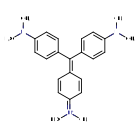
Structure for Gentian violet cation (DB00406)

- Weight
- Average: 372.5258
Monoisotopic: 372.243972975 - Chemical Formula
- C25H30N3
- Synonyms
- Crystal Violet
- Crystal violet carbocation
- Crystal violet ion(1)
- Crystal violet(1+)
- Gentian violet carbocation
- Gentian violet cation
- Gentian violet(1+)
- Methylrosaniline
- Methylrosanilinium

Pharmacology
- Indication
For the treatment of bacterial and fungal infections inside the mouth (thrush) and skin, also for the prevention of transmission of Chagas' disease (as a blood additive).
 Reduce drug development failure ratesBuild, train, & validate machine-learning modelswith evidence-based and structured datasets.Build, train, & validate predictive machine-learning models with structured datasets.
- Associated Conditions
Indication Type Indication Combined Product Details Approval Level Age Group Patient Characteristics Dose Form Used in combination for prophylaxis of Bacterial infection of the umbilical cord area Combination Product in combination with: Proflavine (DB01123), Brilliant green cation (DB11279) ••• ••• •••••••• Treatment of Fungal infection ••• ••• Used in combination for prophylaxis of Fungal infection of the umbilical cord area Combination Product in combination with: Brilliant green cation (DB11279), Proflavine (DB01123) ••• ••• •••••••• Prophylaxis of Infection •••••••••••• - Contraindications & Blackbox Warnings
 Prevent Adverse Drug Events TodayTap into our Clinical API for life-saving information on contraindications & blackbox warnings, population restrictions, harmful risks, & more.Avoid life-threatening adverse drug events with our Clinical API
- Pharmacodynamics
Gentian violet is a mutagen, a mitotic poison, and a clastogen. Gentian violet has been used in medicine for almost 100 years: as an antiseptic for external use, as a topical antibiotic, as a topical antifungal agent, as an antihelminthic agent by oral administration, and more recently, as a blood additive to prevent transmission of Chagas' disease. It is thought to work by binding to the DNA of target organisms and causing disruption, mutation or inhibition of DNA replication.
- Mechanism of action
In aqueous solutions Gentian violet (GV) dissociates into positive (GV+)and negative ions (Cl-) that penetrate through the wall and membrane of both gram-positive and gram-negative bacterial cells. The GV+ interacts with negatively charged components of bacterial cells including the lipopolysaccharide (on the cell wall), the peptidoglycan and DNA. A similar cell penetration and DNA binding process is thought to take place for fungal cells as well. Because Gentian violet is a mutagen and mitotic poison, cell growth is consequently inhibited. A photodynamic action of gentian violet, apparently mediated by a free-radical mechanism, has recently been described in bacteria and in the protozoan T. cruzi. Evidence also suggests that gentian violet dissipates the bacterial (and mitochondrial) membrane potential by inducing permeability. This is followed by respiratory inhibition. This anti-mitochondrial activity might explain gentian violet's efficacy towards both bacteria and yeast with relatively mild effects on mammalian cells.
Target Actions Organism ADNA intercalationHumans - Absorption
Not Available
- Volume of distribution
Not Available
- Protein binding
Not Available
- Metabolism
Primarily hepatic, mostly demethylation
- Route of elimination
Not Available
- Half-life
Not Available
- Clearance
Not Available
- Adverse Effects
 Improve decision support & research outcomesWith structured adverse effects data, including: blackbox warnings, adverse reactions, warning & precautions, & incidence rates. View sample adverse effects data in our new Data Library!Improve decision support & research outcomes with our structured adverse effects data.
- Toxicity
LD50=420 mg/kg (rat, oral). Oral administration can cause gastrointestinal irritation, and intravenous injection can cause depression in the white blood cell count.
- Pathways
- Not Available
- Pharmacogenomic Effects/ADRs
- Not Available
Interactions
- Drug Interactions
- This information should not be interpreted without the help of a healthcare provider. If you believe you are experiencing an interaction, contact a healthcare provider immediately. The absence of an interaction does not necessarily mean no interactions exist.Not Available
- Food Interactions
- No interactions found.
Products
 Drug product information from 10+ global regionsOur datasets provide approved product information including:dosage, form, labeller, route of administration, and marketing period.Access drug product information from over 10 global regions.
- Product Ingredients
Ingredient UNII CAS InChI Key Gentian violet J4Z741D6O5 548-62-9 ZXJXZNDDNMQXFV-UHFFFAOYSA-M - Over the Counter Products
Name Dosage Strength Route Labeller Marketing Start Marketing End Region Image De LA Cruz Gentian Violet Tincture 1 g/100mL Topical DLC Laboratories, Inc. 2012-11-01 Not applicable US 
El Valle Gentian Violet Liquid 10 mg/1mL Topical Pharmadel LLC 2023-05-31 Not applicable US Gentian Violet Liquid 0.1 g/100g Topical SANVALL ENTERPRISES, INC 2021-09-02 Not applicable US Gentian Violet 1% Liquid 10 mg/1mL Topical Humco Holding Group, Inc. 2008-01-01 Not applicable US Gentian Violet 1% Liquid 10 mg/1mL Topical Pharma Nobis, LLC 2008-01-01 Not applicable US - Mixture Products
Name Ingredients Dosage Route Labeller Marketing Start Marketing End Region Image AMARO MEDICINALE GIULIANI Gentian violet cation (111 mg/100g) + Boldo leaf extract (100 mg/100g) + Frangula purshiana bark (121 mg/100g) + Rhubarb (356 mg/100g) Solution Oral Giuliani Spa 2014-07-08 Not applicable Italy 
AMARO MEDICINALE GIULIANI Gentian violet cation (111 mg/100g) + Boldo leaf extract (100 mg/100g) + Frangula purshiana bark (121 mg/100g) + Rhubarb (356 mg/100g) Solution Oral Giuliani Spa 2014-07-08 Not applicable Italy AMARO MEDICINALE GIULIANI Gentian violet cation (111 mg/100g) + Boldo leaf extract (100 mg/100g) + Frangula purshiana bark (121 mg/100g) + Rhubarb (356 mg/100g) Solution Oral Giuliani Spa 2014-07-08 Not applicable Italy AMARO MEDICINALE GIULIANI Gentian violet cation (111 mg/100g) + Boldo leaf extract (100 mg/100g) + Frangula purshiana bark (121 mg/100g) + Rhubarb (356 mg/100g) Solution Oral Giuliani Spa 2014-07-08 Not applicable Italy AMARO MEDICINALE GIULIANI Gentian violet cation (111 mg/100g) + Boldo leaf extract (100 mg/100g) + Frangula purshiana bark (121 mg/100g) + Rhubarb (356 mg/100g) Solution Oral Giuliani Spa 2014-07-08 Not applicable Italy
Categories
- ATC Codes
- G01AX09 — Methylrosaniline
- G01AX — Other antiinfectives and antiseptics
- G01A — ANTIINFECTIVES AND ANTISEPTICS, EXCL. COMBINATIONS WITH CORTICOSTEROIDS
- G01 — GYNECOLOGICAL ANTIINFECTIVES AND ANTISEPTICS
- G — GENITO URINARY SYSTEM AND SEX HORMONES
- Drug Categories
- Chemical TaxonomyProvided by Classyfire
- Description
- This compound belongs to the class of organic compounds known as diphenylmethanes. These are compounds containing a diphenylmethane moiety, which consists of a methane wherein two hydrogen atoms are replaced by two phenyl groups.
- Kingdom
- Organic compounds
- Super Class
- Benzenoids
- Class
- Benzene and substituted derivatives
- Sub Class
- Diphenylmethanes
- Direct Parent
- Diphenylmethanes
- Alternative Parents
- Dialkylarylamines / Aniline and substituted anilines / Secondary ketimines / Azomethines / Organopnictogen compounds / Hydrocarbon derivatives / Organic cations
- Substituents
- Amine / Aniline or substituted anilines / Aromatic homomonocyclic compound / Azomethine / Dialkylarylamine / Diphenylmethane / Hydrocarbon derivative / Organic cation / Organic nitrogen compound / Organonitrogen compound
- Molecular Framework
- Aromatic homomonocyclic compounds
- External Descriptors
- iminium ion (CHEBI:77181)
- Affected organisms
- Yeast and other fungi
- Bacteria and protozoa
Chemical Identifiers
- UNII
- 3GVJ31T6YY
- CAS number
- 7438-46-2
- InChI Key
- LGLFFNDHMLKUMI-UHFFFAOYSA-N
- InChI
- InChI=1S/C25H30N3/c1-26(2)22-13-7-19(8-14-22)25(20-9-15-23(16-10-20)27(3)4)21-11-17-24(18-12-21)28(5)6/h7-18H,1-6H3/q+1
- IUPAC Name
- 4-{bis[4-(dimethylamino)phenyl]methylidene}-N,N-dimethylcyclohexa-2,5-dien-1-iminium
- SMILES
- CN(C)C1=CC=C(C=C1)C(C1=CC=C(C=C1)N(C)C)=C1C=CC(C=C1)=[N+](C)C
References
- Synthesis Reference
Hiep Do, Daniel J. Spangler, Joel Rosenblatt, Barrett Remington, Onajite Okoh, "High concentration gentian violet containing medical devices and methods of making same." U.S. Patent US20090130171, issued May 21, 2009.
US20090130171- General References
- Not Available
- External Links
- Human Metabolome Database
- HMDB0014550
- KEGG Drug
- D01046
- PubChem Compound
- 3468
- PubChem Substance
- 46505353
- ChemSpider
- 3349
- BindingDB
- 50052802
- 1546369
- ChEBI
- 77181
- ChEMBL
- CHEMBL459265
- ZINC
- ZINC000013763987
- PharmGKB
- PA449755
- PDBe Ligand
- CVI
- Drugs.com
- Drugs.com Drug Page
- Wikipedia
- Gentian_Violet
- PDB Entries
- 1jtx / 3vw1 / 5ov9 / 5vlm / 6pub
- MSDS
- Download (77.1 KB)
Clinical Trials
- Clinical Trials
Phase Status Purpose Conditions Count 3 Completed Treatment Human Immunodeficiency Virus Type 1 (HIV-1) Infection 1 3 Completed Treatment Oral Candidiasis 1 2 Active Not Recruiting Treatment Hidradenitis Suppurativa (HS) 1 2 Not Yet Recruiting Treatment Hidradenitis Suppurativa (HS) 1
Pharmacoeconomics
- Manufacturers
- Savage laboratories inc div altana inc
- Key pharmaceuticals inc sub schering plough corp
- Packagers
- Humco
- Dosage Forms
Form Route Strength Solution Oral Tincture Topical 1 g/100mL Liquid Topical 0.1 g/100g Solution Topical 2 g/100mL Liquid Topical 1 g/100mL Liquid Topical 1 % Liquid Topical 10 mg/1mL Liquid Topical 20 mg/1mL Swab Topical Solution Topical Liquid Topical Solution Topical 10 ml Solution Topical 1 g/100ml Solution Topical 0.5 g/100ml - Prices
Unit description Cost Unit Gentian violet 2% solution 0.16USD ml Gentian violet 1% solution 0.08USD ml DrugBank does not sell nor buy drugs. Pricing information is supplied for informational purposes only.- Patents
- Not Available
Properties
- State
- Solid
- Experimental Properties
Property Value Source melting point (°C) 215 °C Not Available water solubility 4 mg/mL Not Available logP 3.18 Not Available - Predicted Properties
Property Value Source Water Solubility 0.00193 mg/mL ALOGPS logP 0.87 ALOGPS logP 1.4 Chemaxon logS -5.3 ALOGPS pKa (Strongest Basic) 4.83 Chemaxon Physiological Charge 1 Chemaxon Hydrogen Acceptor Count 2 Chemaxon Hydrogen Donor Count 0 Chemaxon Polar Surface Area 9.49 Å2 Chemaxon Rotatable Bond Count 4 Chemaxon Refractivity 146 m3·mol-1 Chemaxon Polarizability 45.6 Å3 Chemaxon Number of Rings 3 Chemaxon Bioavailability 1 Chemaxon Rule of Five Yes Chemaxon Ghose Filter No Chemaxon Veber's Rule Yes Chemaxon MDDR-like Rule No Chemaxon - Predicted ADMET Features
Property Value Probability Human Intestinal Absorption + 0.5643 Blood Brain Barrier + 0.7198 Caco-2 permeable + 0.6321 P-glycoprotein substrate Non-substrate 0.5936 P-glycoprotein inhibitor I Non-inhibitor 0.6474 P-glycoprotein inhibitor II Non-inhibitor 0.5747 Renal organic cation transporter Non-inhibitor 0.5959 CYP450 2C9 substrate Non-substrate 0.7272 CYP450 2D6 substrate Non-substrate 0.7573 CYP450 3A4 substrate Substrate 0.5753 CYP450 1A2 substrate Inhibitor 0.5787 CYP450 2C9 inhibitor Non-inhibitor 0.8225 CYP450 2D6 inhibitor Non-inhibitor 0.5732 CYP450 2C19 inhibitor Non-inhibitor 0.8028 CYP450 3A4 inhibitor Non-inhibitor 0.667 CYP450 inhibitory promiscuity High CYP Inhibitory Promiscuity 0.7973 Ames test Non AMES toxic 0.9132 Carcinogenicity Carcinogens 0.8444 Biodegradation Not ready biodegradable 0.9944 Rat acute toxicity 2.5102 LD50, mol/kg Not applicable hERG inhibition (predictor I) Weak inhibitor 0.9172 hERG inhibition (predictor II) Non-inhibitor 0.7075
Spectra
- Mass Spec (NIST)
- Not Available
- Spectra
Spectrum Spectrum Type Splash Key Predicted GC-MS Spectrum - GC-MS Predicted GC-MS splash10-0pi0-3049000000-80f825970014ad316343 Predicted 1H NMR Spectrum 1D NMR Not Applicable Predicted 13C NMR Spectrum 1D NMR Not Applicable - Chromatographic Properties
Collision Cross Sections (CCS)
Adduct CCS Value (Å2) Source type Source [M-H]- 225.2231279 predictedDarkChem Lite v0.1.0 [M-H]- 224.4998279 predictedDarkChem Lite v0.1.0 [M-H]- 203.25902 predictedDeepCCS 1.0 (2019) [M+H]+ 225.3893279 predictedDarkChem Lite v0.1.0 [M+H]+ 225.7925279 predictedDarkChem Lite v0.1.0 [M+H]+ 205.65459 predictedDeepCCS 1.0 (2019) [M+Na]+ 224.4933279 predictedDarkChem Lite v0.1.0 [M+Na]+ 224.9508279 predictedDarkChem Lite v0.1.0 [M+Na]+ 211.68385 predictedDeepCCS 1.0 (2019)
Targets

References
- Overington JP, Al-Lazikani B, Hopkins AL: How many drug targets are there? Nat Rev Drug Discov. 2006 Dec;5(12):993-6. [Article]
- Imming P, Sinning C, Meyer A: Drugs, their targets and the nature and number of drug targets. Nat Rev Drug Discov. 2006 Oct;5(10):821-34. [Article]
- Docampo R, Moreno SN: The metabolism and mode of action of gentian violet. Drug Metab Rev. 1990;22(2-3):161-78. [Article]
- Si WH, Zi YQ: [Studies on the interaction between RNA with methyl violet and determination of RNA by spectrophotometry]. Guang Pu Xue Yu Guang Pu Fen Xi. 2005 Nov;25(11):1846-9. [Article]
Transporters
- Kind
- Protein
- Organism
- Humans
- Pharmacological action
- Unknown
- General Function
- Secondary active organic cation transmembrane transporter activity
- Specific Function
- Translocates a broad array of organic cations with various structures and molecular weights including the model compounds 1-methyl-4-phenylpyridinium (MPP), tetraethylammonium (TEA), N-1-methylnico...
- Gene Name
- SLC22A1
- Uniprot ID
- O15245
- Uniprot Name
- Solute carrier family 22 member 1
- Molecular Weight
- 61153.345 Da

Drug created at June 13, 2005 13:24 / Updated at April 27, 2024 09:44