Identification
- Generic Name
- Acetohexamide
- DrugBank Accession Number
- DB00414
- Background
A sulfonylurea hypoglycemic agent that is metabolized in the liver to 1-hydrohexamide. Acetohexamide has been discontinued in the US market.
- Type
- Small Molecule
- Groups
- Approved, Investigational, Withdrawn
- Structure
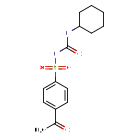
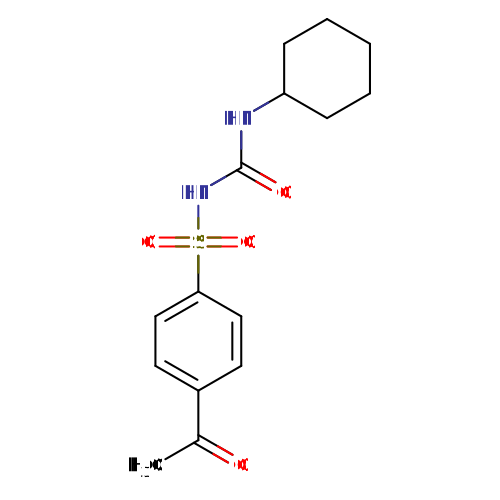
Structure for Acetohexamide (DB00414)
- Weight
- Average: 324.395
Monoisotopic: 324.114377828 - Chemical Formula
- C15H20N2O4S
- Synonyms
- 1-((p-Acetylphenyl)sulfonyl)-3-cyclohexylurea
- 1-[(4-acetylbenzene)sulfonyl]-3-cyclohexylurea 4-acetyl-N-(cyclohexylcarbamoyl)benzenesulfonamide
- Acetohexamid
- Acetohexamida
- Acétohexamide
- Acetohexamide
- Acetohexamidum
- N-(p-Acetylphenylsulfonyl)-N'-cyclohexylurea
- External IDs
- 33006

Pharmacology
- Indication
Used in the management of diabetes mellitus type 2 (adult-onset).
 Reduce drug development failure ratesBuild, train, & validate machine-learning modelswith evidence-based and structured datasets.Build, train, & validate predictive machine-learning models with structured datasets.
- Contraindications & Blackbox Warnings
 Prevent Adverse Drug Events TodayTap into our Clinical API for life-saving information on contraindications & blackbox warnings, population restrictions, harmful risks, & more.Avoid life-threatening adverse drug events with our Clinical API
- Pharmacodynamics
Acetohexamide is an intermediate-acting, first-generation oral sulfonylurea. It lowers blood sugar by stimulating the pancreatic beta cells to secrete insulin and by helping the body use insulin efficiently. Due to its primary action on the pancreatic beta cells, the drug is only effective when there are functional pancreatic beta cells that can produce insulin granules. Acetohexamide has one-third the potency of chlorpropamide, and twice the potency of tolbutamide; however, similar hypoglycemic efficacy occurs with equipotent dosage of sulfonylureas.
- Mechanism of action
Sulfonylureas such as acetohexamide bind to an ATP-dependent K+ channel on the cell membrane of pancreatic beta cells. This inhibits a tonic, hyperpolarizing outflux of potassium, which causes the electric potential over the membrane to become more positive. This depolarization opens voltage-gated Ca2+ channels. The rise in intracellular calcium leads to increased fusion of insulin granulae with the cell membrane, and therefore increased secretion of (pro)insulin.
Target Actions Organism AATP-sensitive inward rectifier potassium channel 1 inhibitorHumans - Absorption
Rapidly absorbed from the GI tract.
- Volume of distribution
Not Available
- Protein binding
90%
- Metabolism
Extensively metabolized in the liver to the active metabolite hydroxyhexamide, which exhibits greater hypoglycemic potency than acetohexamide. Hydroxyhexamide is believed to be responsible for prolonged hypoglycemic effects.
Hover over products below to view reaction partners
- Route of elimination
Not Available
- Half-life
Elimination half-life of the parent compound is 1.3 hours and the elimination half-life of the active metabolite is approximately 5-6 hours.
- Clearance
Not Available
- Adverse Effects
 Improve decision support & research outcomesWith structured adverse effects data, including: blackbox warnings, adverse reactions, warning & precautions, & incidence rates. View sample adverse effects data in our new Data Library!Improve decision support & research outcomes with our structured adverse effects data.
- Toxicity
Oral, rat LD50: 5 gm/kg; Oral, mouse LD50: >2500 mg/kg. Symptoms of an acetohexamide overdose include hunger, nausea, anxiety, cold sweats, weakness, drowsiness, unconsciousness, and coma.
- Pathways
- Not Available
- Pharmacogenomic Effects/ADRs
- Not Available
Interactions
- Drug Interactions
- This information should not be interpreted without the help of a healthcare provider. If you believe you are experiencing an interaction, contact a healthcare provider immediately. The absence of an interaction does not necessarily mean no interactions exist.
Drug Interaction Integrate drug-drug
interactions in your softwareAbatacept The metabolism of Acetohexamide can be increased when combined with Abatacept. Abrocitinib The metabolism of Abrocitinib can be decreased when combined with Acetohexamide. Acarbose The risk or severity of hypoglycemia can be increased when Acarbose is combined with Acetohexamide. Acebutolol The therapeutic efficacy of Acetohexamide can be increased when used in combination with Acebutolol. Aceclofenac The protein binding of Acetohexamide can be decreased when combined with Aceclofenac. - Food Interactions
- Avoid alcohol.
- Take with or without food. The absorption is unaffected by food.
Products
 Drug product information from 10+ global regionsOur datasets provide approved product information including:dosage, form, labeller, route of administration, and marketing period.Access drug product information from over 10 global regions.
- International/Other Brands
- Acetohexamide (Watson) / Dimelin (Shionogi Seiyaku) / Dymelor (Lilly) / Gamadiabet (Salvat)
- Brand Name Prescription Products
Name Dosage Strength Route Labeller Marketing Start Marketing End Region Image Dimelor Tablet 1843 500mg Tablet 500 mg / tab Oral Eli Lilly & Co. Ltd. 1963-12-31 1998-08-04 Canada 
Categories
- ATC Codes
- G01AE10 — Combinations of sulfonamides
- G01AE — Sulfonamides
- G01A — ANTIINFECTIVES AND ANTISEPTICS, EXCL. COMBINATIONS WITH CORTICOSTEROIDS
- G01 — GYNECOLOGICAL ANTIINFECTIVES AND ANTISEPTICS
- G — GENITO URINARY SYSTEM AND SEX HORMONES
- Drug Categories
- Alimentary Tract and Metabolism
- Amides
- Benzene Derivatives
- Benzenesulfonamides
- Blood Glucose Lowering Agents
- Cytochrome P-450 CYP2C9 Substrates
- Cytochrome P-450 Substrates
- Drugs Used in Diabetes
- Genito Urinary System and Sex Hormones
- Gynecological Antiinfectives and Antiseptics
- Insulin Secretagogues
- Oral Hypoglycemics
- Sulfonamides
- Sulfones
- Sulfonylureas
- Sulfur Compounds
- Chemical TaxonomyProvided by Classyfire
- Description
- This compound belongs to the class of organic compounds known as alkyl-phenylketones. These are aromatic compounds containing a ketone substituted by one alkyl group, and a phenyl group.
- Kingdom
- Organic compounds
- Super Class
- Organic oxygen compounds
- Class
- Organooxygen compounds
- Sub Class
- Carbonyl compounds
- Direct Parent
- Alkyl-phenylketones
- Alternative Parents
- Benzenesulfonamides / Benzenesulfonyl compounds / Acetophenones / Benzoyl derivatives / Aryl alkyl ketones / Sulfonylureas / Organosulfonic acids and derivatives / Aminosulfonyl compounds / Propargyl-type 1,3-dipolar organic compounds / Carboximidic acids and derivatives show 3 more
- Substituents
- Acetophenone / Alkyl-phenylketone / Aminosulfonyl compound / Aromatic homomonocyclic compound / Aryl alkyl ketone / Benzenesulfonamide / Benzenesulfonyl group / Benzenoid / Benzoyl / Carboximidic acid derivative show 13 more
- Molecular Framework
- Aromatic homomonocyclic compounds
- External Descriptors
- N-sulfonylurea, acetophenones (CHEBI:28052)
- Affected organisms
- Humans and other mammals
Chemical Identifiers
- UNII
- QGC8W08I6I
- CAS number
- 968-81-0
- InChI Key
- VGZSUPCWNCWDAN-UHFFFAOYSA-N
- InChI
- InChI=1S/C15H20N2O4S/c1-11(18)12-7-9-14(10-8-12)22(20,21)17-15(19)16-13-5-3-2-4-6-13/h7-10,13H,2-6H2,1H3,(H2,16,17,19)
- IUPAC Name
- 1-(4-acetylbenzenesulfonyl)-3-cyclohexylurea
- SMILES
- CC(=O)C1=CC=C(C=C1)S(=O)(=O)NC(=O)NC1CCCCC1
References
- General References
- Not Available
- External Links
- Human Metabolome Database
- HMDB0014558
- KEGG Drug
- D00219
- KEGG Compound
- C06806
- PubChem Compound
- 1989
- PubChem Substance
- 46505821
- ChemSpider
- 1912
- 173
- ChEBI
- 28052
- ChEMBL
- CHEMBL1589
- ZINC
- ZINC000018067894
- Therapeutic Targets Database
- DAP000922
- PharmGKB
- PA164777011
- Drugs.com
- Drugs.com Drug Page
- Wikipedia
- Acetohexamide
Clinical Trials
- Clinical Trials
Phase Status Purpose Conditions Count 2 Completed Treatment Impaired Glucose Tolerance / Type 2 Diabetes Mellitus 1 Not Available Completed Not Available Type 2 Diabetes Mellitus 3
Pharmacoeconomics
- Manufacturers
- Barr laboratories inc
- Usl pharma inc
- Watson laboratories inc
- Eli lilly industries inc
- Packagers
- Barr Pharmaceuticals
- Murfreesboro Pharmaceutical Nursing Supply
- Dosage Forms
Form Route Strength Tablet Oral Tablet Oral 500 mg / tab - Prices
- Not Available
- Patents
- Not Available
Properties
- State
- Solid
- Experimental Properties
Property Value Source melting point (°C) 188-190 °C Sigal,M.V.,Jr.andVanArendonk,A.M.; US.Patent3,320,312;May16,1967;assigned to Eli Lilly and Company. water solubility 3430 mg/L (at 37 °C) YALKOWSKY,SH & DANNENFELSER,RM (1992) logP 2.44 SANGSTER (1993) logS -2.06 ADME Research, USCD - Predicted Properties
Property Value Source Water Solubility 0.0483 mg/mL ALOGPS logP 1.72 ALOGPS logP 1.81 Chemaxon logS -3.8 ALOGPS pKa (Strongest Acidic) 4.31 Chemaxon pKa (Strongest Basic) -7.4 Chemaxon Physiological Charge -1 Chemaxon Hydrogen Acceptor Count 4 Chemaxon Hydrogen Donor Count 2 Chemaxon Polar Surface Area 92.34 Å2 Chemaxon Rotatable Bond Count 3 Chemaxon Refractivity 82.77 m3·mol-1 Chemaxon Polarizability 33.97 Å3 Chemaxon Number of Rings 2 Chemaxon Bioavailability 1 Chemaxon Rule of Five Yes Chemaxon Ghose Filter Yes Chemaxon Veber's Rule No Chemaxon MDDR-like Rule No Chemaxon - Predicted ADMET Features
Property Value Probability Human Intestinal Absorption + 0.9425 Blood Brain Barrier + 0.8308 Caco-2 permeable - 0.6272 P-glycoprotein substrate Non-substrate 0.6406 P-glycoprotein inhibitor I Non-inhibitor 0.8731 P-glycoprotein inhibitor II Non-inhibitor 0.8808 Renal organic cation transporter Non-inhibitor 0.8538 CYP450 2C9 substrate Substrate 0.6473 CYP450 2D6 substrate Non-substrate 0.8795 CYP450 3A4 substrate Non-substrate 0.7171 CYP450 1A2 substrate Non-inhibitor 0.9045 CYP450 2C9 inhibitor Non-inhibitor 0.9071 CYP450 2D6 inhibitor Non-inhibitor 0.9231 CYP450 2C19 inhibitor Non-inhibitor 0.9025 CYP450 3A4 inhibitor Non-inhibitor 0.8309 CYP450 inhibitory promiscuity Low CYP Inhibitory Promiscuity 0.5913 Ames test Non AMES toxic 0.9133 Carcinogenicity Non-carcinogens 0.8447 Biodegradation Not ready biodegradable 0.8033 Rat acute toxicity 2.1793 LD50, mol/kg Not applicable hERG inhibition (predictor I) Weak inhibitor 0.8799 hERG inhibition (predictor II) Non-inhibitor 0.8982
Spectra
- Mass Spec (NIST)
- Not Available
- Spectra
- Chromatographic Properties
Collision Cross Sections (CCS)
Adduct CCS Value (Å2) Source type Source [M-H]- 190.6097 predictedDarkChem Lite v0.1.0 [M-H]- 177.3457124 predictedDarkChem Lite v0.1.0 [M-H]- 190.8133 predictedDarkChem Lite v0.1.0 [M-H]- 170.24959 predictedDeepCCS 1.0 (2019) [M+H]+ 192.1965 predictedDarkChem Lite v0.1.0 [M+H]+ 184.3668994 predictedDarkChem Lite v0.1.0 [M+H]+ 190.9431 predictedDarkChem Lite v0.1.0 [M+H]+ 172.6452 predictedDeepCCS 1.0 (2019) [M+Na]+ 191.0533 predictedDarkChem Lite v0.1.0 [M+Na]+ 195.1728 predictedDarkChem Lite v0.1.0 [M+Na]+ 178.83746 predictedDeepCCS 1.0 (2019)
Targets

- Kind
- Protein
- Organism
- Humans
- Pharmacological action
- Yes
- Actions
- Inhibitor
- Curator comments
- This target action is based on the drug class of sulfonylureas.
- General Function
- Phosphatidylinositol-4,5-bisphosphate binding
- Specific Function
- In the kidney, probably plays a major role in potassium homeostasis. Inward rectifier potassium channels are characterized by a greater tendency to allow potassium to flow into the cell rather than...
- Gene Name
- KCNJ1
- Uniprot ID
- P48048
- Uniprot Name
- ATP-sensitive inward rectifier potassium channel 1
- Molecular Weight
- 44794.6 Da
References
- Tanemoto M, Vanoye CG, Dong K, Welch R, Abe T, Hebert SC, Xu JZ: Rat homolog of sulfonylurea receptor 2B determines glibenclamide sensitivity of ROMK2 in Xenopus laevis oocyte. Am J Physiol Renal Physiol. 2000 Apr;278(4):F659-66. doi: 10.1152/ajprenal.2000.278.4.F659. [Article]
- Bednarczyk P, Kicinska A, Laskowski M, Kulawiak B, Kampa R, Walewska A, Krajewska M, Jarmuszkiewicz W, Szewczyk A: Evidence for a mitochondrial ATP-regulated potassium channel in human dermal fibroblasts. Biochim Biophys Acta Bioenerg. 2018 May;1859(5):309-318. doi: 10.1016/j.bbabio.2018.02.005. Epub 2018 Feb 16. [Article]
- Konstas AA, Dabrowski M, Korbmacher C, Tucker SJ: Intrinsic sensitivity of Kir1.1 (ROMK) to glibenclamide in the absence of SUR2B. Implications for the identity of the renal ATP-regulated secretory K+ channel. J Biol Chem. 2002 Jun 14;277(24):21346-51. doi: 10.1074/jbc.M202005200. Epub 2002 Apr 1. [Article]
Enzymes
- Kind
- Protein
- Organism
- Humans
- Pharmacological action
- Unknown
- Actions
- Substrate
- General Function
- Steroid hydroxylase activity
- Specific Function
- Cytochromes P450 are a group of heme-thiolate monooxygenases. In liver microsomes, this enzyme is involved in an NADPH-dependent electron transport pathway. It oxidizes a variety of structurally un...
- Gene Name
- CYP2C9
- Uniprot ID
- P11712
- Uniprot Name
- Cytochrome P450 2C9
- Molecular Weight
- 55627.365 Da
References
- May M, Schindler C: Clinically and pharmacologically relevant interactions of antidiabetic drugs. Ther Adv Endocrinol Metab. 2016 Apr;7(2):69-83. doi: 10.1177/2042018816638050. Epub 2016 Mar 31. [Article]
- Kind
- Protein
- Organism
- Humans
- Pharmacological action
- Unknown
- Actions
- Substrate
- General Function
- Prostaglandin-e2 9-reductase activity
- Specific Function
- NADPH-dependent reductase with broad substrate specificity. Catalyzes the reduction of a wide variety of carbonyl compounds including quinones, prostaglandins, menadione, plus various xenobiotics. ...
- Gene Name
- CBR1
- Uniprot ID
- P16152
- Uniprot Name
- Carbonyl reductase [NADPH] 1
- Molecular Weight
- 30374.73 Da
References
- Imamura Y, Shimada H: Differential pharmacokinetics of acetohexamide in male Wistar-Imamichi and Sprague-Dawley rats: role of microsomal carbonyl reductase. Biol Pharm Bull. 2005 Jan;28(1):185-7. [Article]
- Imamura Y, Koga T, Higuchi T, Otagiri M, Sugino E, Hibino S: Inhibitory effect of drugs with a ketone group on reduction of acetohexamide catalyzed by carbonyl reductase from rabbit kidney. J Enzyme Inhib. 1997 Feb;11(4):285-92. [Article]
- Kishimoto M, Kawamori R, Kamada T, Inaba T: Carbonyl reductase activity for acetohexamide in human erythrocytes. Drug Metab Dispos. 1994 May-Jun;22(3):367-70. [Article]
Carriers
- Kind
- Protein
- Organism
- Humans
- Pharmacological action
- Unknown
- General Function
- Toxic substance binding
- Specific Function
- Serum albumin, the main protein of plasma, has a good binding capacity for water, Ca(2+), Na(+), K(+), fatty acids, hormones, bilirubin and drugs. Its main function is the regulation of the colloid...
- Gene Name
- ALB
- Uniprot ID
- P02768
- Uniprot Name
- Serum albumin
- Molecular Weight
- 69365.94 Da
References
- Joseph KS, Hage DS: Characterization of the binding of sulfonylurea drugs to HSA by high-performance affinity chromatography. J Chromatogr B Analyt Technol Biomed Life Sci. 2010 Jun 1;878(19):1590-8. doi: 10.1016/j.jchromb.2010.04.019. [Article]
- Joseph KS, Anguizola J, Jackson AJ, Hage DS: Chromatographic analysis of acetohexamide binding to glycated human serum albumin. J Chromatogr B Analyt Technol Biomed Life Sci. 2010 Oct 15;878(28):2775-81. doi: 10.1016/j.jchromb.2010.08.021. Epub 2010 Aug 21. [Article]
- Yoo MJ, Hage DS: Use of peak decay analysis and affinity microcolumns containing silica monoliths for rapid determination of drug-protein dissociation rates. J Chromatogr A. 2011 Apr 15;1218(15):2072-8. doi: 10.1016/j.chroma.2010.09.070. Epub 2010 Oct 16. [Article]
- Basiaga SB, Hage DS: Chromatographic studies of changes in binding of sulfonylurea drugs to human serum albumin due to glycation and fatty acids. J Chromatogr B Analyt Technol Biomed Life Sci. 2010 Nov 15;878(30):3193-7. doi: 10.1016/j.jchromb.2010.09.033. Epub 2010 Oct 23. [Article]
- Tong Z, Joseph KS, Hage DS: Detection of heterogeneous drug-protein binding by frontal analysis and high-performance affinity chromatography. J Chromatogr A. 2011 Dec 9;1218(49):8915-24. doi: 10.1016/j.chroma.2011.04.078. Epub 2011 May 6. [Article]

Drug created at June 13, 2005 13:24 / Updated at March 03, 2024 02:25