Identification
- Summary
Nitric Oxide is a vasodilating agent used in the treatment of hypoxic respiratory failure in premature neonates.
- Brand Names
- Inomax, Kinox, Noxivent
- Generic Name
- Nitric Oxide
- DrugBank Accession Number
- DB00435
- Background
Nitric oxide or Nitrogen monoxide is a chemical compound with chemical formula NO. This gas is an important signaling molecule in the body of mammals including humans and is an extremely important intermediate in the chemical industry. It is also a toxic air pollutant produced by automobile engines and power plants.
Nitric oxide (NO) should not be confused with nitrous oxide (N2O), a general anaesthetic, or with nitrogen dioxide (NO2) which is another poisonous air pollutant.
The nitric oxide molecule is a free radical, which is relevant to understanding its high reactivity. It reacts with the ozone in air to form nitrogen dioxide, signalled by the appearance of the reddish-brown color.
- Type
- Small Molecule
- Groups
- Approved
- Structure
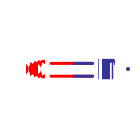
Structure for Nitric Oxide (DB00435)

- Weight
- Average: 30.0061
Monoisotopic: 29.997988627 - Chemical Formula
- NO
- Synonyms
- EDRF
- endothelium-derived relaxing factor
- Mononitrogen monoxide
- Monóxido de nitrógeno
- Monoxyde d'azote
- Nitric Oxide
- Nitrogen monooxide
- Nitrogen monoxide
- Nitrosyl
- NO
- óxido de nitrógeno(II)
- óxido nítrico
- Oxyde azotique
- Oxyde nitrique
- Stickstoff(II)-oxid
- Stickstoffmonoxid
- External IDs
- OHM-11771

Pharmacology
- Indication
For the treatment of term and near-term (>34 weeks) neonates with hypoxic respiratory failure
 Reduce drug development failure ratesBuild, train, & validate machine-learning modelswith evidence-based and structured datasets.Build, train, & validate predictive machine-learning models with structured datasets.
- Associated Conditions
Indication Type Indication Combined Product Details Approval Level Age Group Patient Characteristics Dose Form Management of Hypoxic respiratory failure •••••••••••• •••••••• ••• - Contraindications & Blackbox Warnings
 Prevent Adverse Drug Events TodayTap into our Clinical API for life-saving information on contraindications & blackbox warnings, population restrictions, harmful risks, & more.Avoid life-threatening adverse drug events with our Clinical API
- Pharmacodynamics
Persistent pulmonary hypertension of the newborn (PPHN) occurs as a primary developmental defect or as a condition secondary to other diseases such as meconium aspiration syndrome (MAS), pneumonia, sepsis, hyaline membrane disease, congenital diaphragmatic hernia (CDH), and pulmonary hypoplasia. In these states, pulmonary vascular resistance (PVR) is high, which results in hypoxemia secondary to right-to-left shunting of blood through the patent ductus arteriosus and foramen ovale. In neonates with PPHN, Nitric oxide improves oxygenation (as indicated by significant increases in PaO2). Nitric oxide appears to increase the partial pressure of arterial oxygen (PaO2) by dilating pulmonary vessels in better entilated areas of the lung, redistributing pulmonary blood flow away from lung regions with low ventilation/perfusion (V/Q) ratios toward regions with normal ratios.
- Mechanism of action
Nitric oxide is a compound produced by many cells of the body. It relaxes vascular smooth muscle by binding to the heme moiety of cytosolic guanylate cyclase, activating guanylate cyclase and increasing intracellular levels of cyclic guanosine 3',5'-monophosphate, which then leads to vasodilation. When inhaled, nitric oxide produces pulmonary vasodilation.
Target Actions Organism AGuanylate cyclase soluble subunit alpha-2 inducerHumans UMetallothionein-1A Not Available Humans UIndoleamine 2,3-dioxygenase 1 Not Available Humans UNitric oxide synthase, endothelial product ofHumans - Absorption
Nitric oxide is absorbed systemically after inhalation.
- Volume of distribution
Not Available
- Protein binding
Not Available
- Metabolism
via pulmonary capillary bed
- Route of elimination
Nitrate has been identified as the predominant nitric oxide metabolite excreted in the urine, accounting for >70% of the nitric oxide dose inhaled.
- Half-life
2–6 seconds
- Clearance
Not Available
- Adverse Effects
 Improve decision support & research outcomesWith structured adverse effects data, including: blackbox warnings, adverse reactions, warning & precautions, & incidence rates. View sample adverse effects data in our new Data Library!Improve decision support & research outcomes with our structured adverse effects data.
- Toxicity
Not Available
- Pathways
- Pharmacogenomic Effects/ADRs
- Not Available
Interactions
- Drug Interactions
- This information should not be interpreted without the help of a healthcare provider. If you believe you are experiencing an interaction, contact a healthcare provider immediately. The absence of an interaction does not necessarily mean no interactions exist.
Drug Interaction Integrate drug-drug
interactions in your softwareAbacavir Nitric Oxide may decrease the excretion rate of Abacavir which could result in a higher serum level. Abaloparatide The risk or severity of adverse effects can be increased when Nitric Oxide is combined with Abaloparatide. Acebutolol The risk or severity of adverse effects can be increased when Nitric Oxide is combined with Acebutolol. Aceclofenac Aceclofenac may decrease the excretion rate of Nitric Oxide which could result in a higher serum level. Acemetacin Acemetacin may decrease the excretion rate of Nitric Oxide which could result in a higher serum level. - Food Interactions
- No interactions found.
Products
 Drug product information from 10+ global regionsOur datasets provide approved product information including:dosage, form, labeller, route of administration, and marketing period.Access drug product information from over 10 global regions.
- Brand Name Prescription Products
Name Dosage Strength Route Labeller Marketing Start Marketing End Region Image Genosyl Gas 0.98 mg/1L Respiratory (inhalation) VERO BIOTECH, INC. 2022-12-28 Not applicable US 
Genosyl Gas 0.98 mg/1L Respiratory (inhalation) VERO BIOTECH, INC. 2019-12-20 Not applicable US Inomax Inhalant 400 ppm Respiratory (inhalation) Linde Healthcare Ab 2016-09-08 Not applicable EU 
Inomax Gas 100 ppm / cylr Respiratory (inhalation) INO Therapeutics 2005-11-23 2015-07-31 Canada 
Inomax Gas 0.98 mg/1L Respiratory (inhalation) INO THERAPEUTICS LLC 1999-12-23 Not applicable US - Generic Prescription Products
Name Dosage Strength Route Labeller Marketing Start Marketing End Region Image Noxivent 101 Gas 100 mg/1L Respiratory (inhalation) Linde Gas & Equipment Inc 2018-10-04 Not applicable US Noxivent 102 Gas 800 mg/1L Respiratory (inhalation) Linde Gas & Equipment Inc 2018-10-04 Not applicable US Ulspira Gas 0.8 mL/100L Respiratory (inhalation) Airgas Therapeutics, LLC 2023-08-04 Not applicable US - Over the Counter Products
Name Dosage Strength Route Labeller Marketing Start Marketing End Region Image 695801540 Liquid 400 mg/500mg Topical HumanEnos LLC 2023-02-14 2024-02-13 US Bio NO Brain Care (Helps improve Brain blood flow and body temperature, Fermented Garlic powder) Capsule 400 mg/500mg Topical HumanEnos LLC 2024-02-13 2025-02-12 US Bio NO more Joint Pain (Helps improve osteoarthritis and Immunity, Soybean and oplopanax elatus Nakai fermented powder) Capsule 100 mg/800mg Topical HumanEnos LLC 2023-02-14 2024-02-13 US Bio NO more Joint Pain (Helps improve osteoarthritis and immunity, Soybean fermented powder and Oplopanax elatus nakai extract powder) Capsule 100 mg/800mg Topical HumanEnos LLC 2024-02-13 2025-02-12 US Bio NO more Menopause (Helps improve menopouse and Immunity, Soybean fermented powder) Capsule 100 mg/480mg Topical HumanEnos LLC 2024-02-13 2025-02-12 US - Unapproved/Other Products
Name Ingredients Dosage Route Labeller Marketing Start Marketing End Region Image 695801540 Nitric Oxide (400 mg/500mg) Liquid Topical HumanEnos LLC 2023-02-14 2024-02-13 US Bio NO Brain Care (Helps improve Brain blood flow and body temperature, Fermented Garlic powder) Nitric Oxide (400 mg/500mg) Capsule Topical HumanEnos LLC 2024-02-13 2025-02-12 US Bio NO more Joint Pain (Helps improve osteoarthritis and Immunity, Soybean and oplopanax elatus Nakai fermented powder) Nitric Oxide (100 mg/800mg) Capsule Topical HumanEnos LLC 2023-02-14 2024-02-13 US Bio NO more Joint Pain (Helps improve osteoarthritis and immunity, Soybean fermented powder and Oplopanax elatus nakai extract powder) Nitric Oxide (100 mg/800mg) Capsule Topical HumanEnos LLC 2024-02-13 2025-02-12 US Bio NO more Menopause (Helps improve menopouse and Immunity, Soybean fermented powder) Nitric Oxide (100 mg/480mg) Capsule Topical HumanEnos LLC 2024-02-13 2025-02-12 US
Categories
- ATC Codes
- R07AX01 — Nitric oxide
- Drug Categories
- Anti-Asthmatic Agents
- Antioxidants
- Autonomic Agents
- Bronchodilator Agents
- Cardiovascular Agents
- Compounds used in a research, industrial, or household setting
- Cytochrome P-450 CYP1A2 Inhibitors
- Cytochrome P-450 CYP1A2 Inhibitors (strength unknown)
- Cytochrome P-450 CYP2B6 Inhibitors
- Cytochrome P-450 CYP2B6 Inhibitors (strength unknown)
- Cytochrome P-450 CYP3A Inhibitors
- Cytochrome P-450 CYP3A4 Inhibitors
- Cytochrome P-450 CYP3A4 Inhibitors (strength unknown)
- Cytochrome P-450 Enzyme Inhibitors
- Drugs that are Mainly Renally Excreted
- Endothelium-Dependent Relaxing Factors
- Free Radical Scavengers
- Free Radicals
- Gases
- Gasotransmitters
- Hypotensive Agents
- Methemoglobinemia Associated Agents
- Neurotransmitter Agents
- Nitrates and Nitrites
- Nitrogen Compounds
- Nitrogen Oxides
- Oxides
- Oxygen Compounds
- Peripheral Nervous System Agents
- Reactive Nitrogen Species
- Respiratory System Agents
- Vasodilating Agents
- Vasodilation
- Chemical TaxonomyProvided by Classyfire
- Description
- This compound belongs to the class of inorganic compounds known as other non-metal oxides. These are inorganic compounds containing an oxygen atom of an oxidation state of -2, in which the heaviest atom bonded to the oxygen belongs to the class of 'other non-metals'.
- Kingdom
- Inorganic compounds
- Super Class
- Homogeneous non-metal compounds
- Class
- Other non-metal organides
- Sub Class
- Other non-metal oxides
- Direct Parent
- Other non-metal oxides
- Alternative Parents
- Inorganic oxides
- Substituents
- Inorganic oxide / Other non-metal oxide
- Molecular Framework
- Not Available
- External Descriptors
- reactive nitrogen species, reactive oxygen species, nitrogen oxide, inorganic radical (CHEBI:16480)
- Affected organisms
- Humans and other mammals
Chemical Identifiers
- UNII
- 31C4KY9ESH
- CAS number
- 10102-43-9
- InChI Key
- MWUXSHHQAYIFBG-UHFFFAOYSA-N
- InChI
- InChI=1S/NO/c1-2
- IUPAC Name
- nitroso
- SMILES
- [N]=O
References
- Synthesis Reference
Stephen M. Campbell, Chen-Youn Sue, "Nitric oxide for vapor phase elimination of styrene and acrylonitrile popcorn polymer in bulk SAN production." U.S. Patent US5272231, issued November, 1968.
US5272231- General References
- External Links
- Human Metabolome Database
- HMDB0003378
- KEGG Drug
- D00074
- KEGG Compound
- C00533
- PubChem Compound
- 145068
- PubChem Substance
- 46506897
- ChemSpider
- 127983
- 7442
- ChEBI
- 16480
- ChEMBL
- CHEMBL1200689
- Therapeutic Targets Database
- DAP001056
- PharmGKB
- PA450635
- RxList
- RxList Drug Page
- Drugs.com
- Drugs.com Drug Page
- Wikipedia
- Nitric_oxide
- MSDS
- Download (52.8 KB)
Clinical Trials
- Clinical Trials
Phase Status Purpose Conditions Count 4 Completed Diagnostic Premature Births 1 4 Completed Other Heart Transplant Surgery / Lung Transplant Surgery 1 4 Completed Treatment Heart Failure 1 4 Completed Treatment Infants / Persistent foetal circulation disorders / Respiratory Failure 1 4 Not Yet Recruiting Treatment Hernias, Diaphragmatic, Congenital 1
Pharmacoeconomics
- Manufacturers
- Ino therapeutics inc
- Packagers
- Ino Therapeutics Inc.
- Pulmonox Gas Corporation
- Dosage Forms
Form Route Strength Liquid Topical 400 mg/500mg Capsule Topical 400 mg/500mg Capsule Topical 100 mg/800mg Capsule Topical 100 mg/480mg Tablet Topical 100 mg/900mg Capsule Topical 100 mg/350mg Gas Respiratory (inhalation) 99 % Soap Topical 50 mg/100mg Liquid Topical 100 mg/200mg Liquid Topical 40 mg/50mg Liquid Topical 100 mg/300mg Liquid Topical 12 mg/14mg Liquid Topical 10 mg/100mg Liquid Topical 30 mg/50mg Liquid Topical 12 mg/120mg Liquid Topical 10 mg/50mg Liquid Topical 30 mg/40mg Liquid Topical 8 mg/10mg Liquid Topical 50 mg/100mg Liquid Topical 15 mg/150mg Liquid Topical 20 mg/30mg Capsule Topical 100 mg/250mg Gas Respiratory (inhalation) 2.52 g Capsule Topical 500 mg/500mg Gas Respiratory (inhalation) 0.08 % v/v Gas Gas Respiratory (inhalation) 0.123 mg/1L Gas Respiratory (inhalation) 0.98 mg/1L Gas Respiratory (inhalation) 100 ppm / cylr Gas Respiratory (inhalation) 6 mg/1L Gas Respiratory (inhalation) 800 ppm / cylr Inhalant Respiratory (inhalation) 400 ppm Inhalant Respiratory (inhalation) 800 ppm Gas Respiratory (inhalation) 1000 ppm Gas Respiratory (inhalation) 225 ppm Gas Respiratory (inhalation) 450 ppm Gas Respiratory (inhalation) Liquid Topical 100 mg/150mg Capsule Topical 100 mg/400mg Capsule Topical 100 mg/420mg Liquid Topical 10 mg/20mg Liquid Topical 5 mg/10mg Liquid Topical 1.1157 g/100mL Gas Respiratory (inhalation) 0.02 % Gas Respiratory (inhalation) 0.8 mL Gas Respiratory (inhalation) 100 mg/1L Gas Respiratory (inhalation) 800 mg/1L Gas Respiratory (inhalation) 100 g Liquid Topical 100 mg/500mg Gas Respiratory (inhalation) Gas Respiratory (inhalation) 800 ppm Tablet Topical 100 mg/500mg Gas Respiratory (inhalation) 0.8 mL/100L Gas Endotracheal - Prices
- Not Available
- Patents
Patent Number Pediatric Extension Approved Expires (estimated) Region US5485827 No 1996-01-23 2013-01-23 US CA2186892 No 2007-11-27 2015-04-03 Canada US5732693 Yes 1998-03-31 2017-06-13 US US5752504 Yes 1998-05-19 2017-06-13 US US8282966 Yes 2012-10-09 2029-12-30 US US8291904 Yes 2012-10-23 2031-07-06 US US8293284 Yes 2012-10-23 2029-12-30 US US8431163 Yes 2013-04-30 2029-12-30 US US8776794 Yes 2014-07-15 2031-07-06 US US8776795 Yes 2014-07-15 2031-07-06 US US8573210 Yes 2013-11-05 2031-07-06 US US8795741 Yes 2014-08-05 2029-12-30 US US8846112 Yes 2014-09-30 2029-12-30 US US6125846 Yes 2000-10-03 2017-11-16 US US9265911 Yes 2016-02-23 2031-07-06 US US9295802 Yes 2016-03-29 2031-07-06 US US9279794 Yes 2016-03-08 2034-08-19 US US8573209 Yes 2013-11-05 2031-07-06 US US9408993 Yes 2016-08-09 2031-07-06 US US9770570 Yes 2017-09-26 2036-11-03 US US9604028 No 2017-03-28 2029-08-13 US US10213572 No 2019-02-26 2036-02-12 US US7618594 No 2009-11-17 2026-10-17 US US7560076 No 2009-07-14 2027-04-21 US US6758214 No 2004-07-06 2022-02-23 US US10737051 No 2020-08-11 2035-10-20 US US8609028 No 2013-12-17 2025-08-18 US US9956373 No 2018-05-01 2025-08-18 US US10814092 No 2020-10-27 2025-10-17 US US7947227 No 2011-05-24 2026-10-17 US US8057742 No 2011-11-15 2026-01-18 US US8226916 No 2012-07-24 2025-08-18 US US10124142 No 2018-11-13 2025-08-18 US US8821801 No 2014-09-02 2025-08-18 US US8607785 No 2013-12-17 2030-07-14 US US9522249 No 2016-12-20 2025-08-18 US US9701538 No 2017-07-11 2029-01-28 US US8944049 No 2015-02-03 2029-08-13 US US10926054 No 2021-02-23 2029-08-13 US US11103669 No 2021-08-31 2030-06-21 US US11291793 No 2005-08-18 2025-08-18 US US11383059 No 2005-08-18 2025-08-18 US US11511252 No 2009-09-21 2029-09-21 US US11554241 No 2005-08-18 2025-08-18 US US11672938 No 2020-07-22 2040-07-22 US
Properties
- State
- Liquid
- Experimental Properties
Property Value Source melting point (°C) -163.6 °C PhysProp boiling point (°C) -151.7 °C PhysProp water solubility 9.49E+004 mg/L Not Available logP 0 Not Available - Predicted Properties
Property Value Source logP -0.35 Chemaxon pKa (Strongest Basic) -2.9 Chemaxon Physiological Charge 0 Chemaxon Hydrogen Acceptor Count 1 Chemaxon Hydrogen Donor Count 0 Chemaxon Polar Surface Area 34.14 Å2 Chemaxon Rotatable Bond Count 0 Chemaxon Refractivity 2.89 m3·mol-1 Chemaxon Polarizability 1.69 Å3 Chemaxon Number of Rings 0 Chemaxon Bioavailability 1 Chemaxon Rule of Five Yes Chemaxon Ghose Filter No Chemaxon Veber's Rule Yes Chemaxon MDDR-like Rule No Chemaxon - Predicted ADMET Features
Property Value Probability Human Intestinal Absorption + 0.9968 Blood Brain Barrier + 0.9785 Caco-2 permeable + 0.6149 P-glycoprotein substrate Non-substrate 0.9034 P-glycoprotein inhibitor I Non-inhibitor 0.957 P-glycoprotein inhibitor II Non-inhibitor 0.9892 Renal organic cation transporter Non-inhibitor 0.8973 CYP450 2C9 substrate Non-substrate 0.8884 CYP450 2D6 substrate Non-substrate 0.888 CYP450 3A4 substrate Non-substrate 0.7535 CYP450 1A2 substrate Non-inhibitor 0.7402 CYP450 2C9 inhibitor Non-inhibitor 0.9383 CYP450 2D6 inhibitor Non-inhibitor 0.896 CYP450 2C19 inhibitor Non-inhibitor 0.8796 CYP450 3A4 inhibitor Non-inhibitor 0.9754 CYP450 inhibitory promiscuity Low CYP Inhibitory Promiscuity 0.8945 Ames test AMES toxic 0.5342 Carcinogenicity Carcinogens 0.8336 Biodegradation Ready biodegradable 0.9371 Rat acute toxicity 2.5108 LD50, mol/kg Not applicable hERG inhibition (predictor I) Weak inhibitor 0.8524 hERG inhibition (predictor II) Non-inhibitor 0.9756
Spectra
- Mass Spec (NIST)
- Download (6.86 KB)
- Spectra
- Chromatographic Properties
Collision Cross Sections (CCS)
Adduct CCS Value (Å2) Source type Source [M-H]- 108.68115 predictedDeepCCS 1.0 (2019) [M-H]- 108.68115 predictedDeepCCS 1.0 (2019) [M+H]+ 110.43489 predictedDeepCCS 1.0 (2019) [M+H]+ 110.43489 predictedDeepCCS 1.0 (2019) [M+Na]+ 117.18667 predictedDeepCCS 1.0 (2019) [M+Na]+ 117.18667 predictedDeepCCS 1.0 (2019)
Targets

- Kind
- Protein
- Organism
- Humans
- Pharmacological action
- Yes
- Actions
- Inducer
- General Function
- Heme binding
- Specific Function
- Has guanylyl cyclase on binding to the beta-1 subunit.Isoform 2 acts as a negative regulator of guanylyl cyclase activity as it forms non-functional heterodimers with the beta subunits.
- Gene Name
- GUCY1A2
- Uniprot ID
- P33402
- Uniprot Name
- Guanylate cyclase soluble subunit alpha-2
- Molecular Weight
- 81749.185 Da
References
- Moncada S, Palmer RM, Higgs EA: Nitric oxide: physiology, pathophysiology, and pharmacology. Pharmacol Rev. 1991 Jun;43(2):109-42. [Article]
- Mancuso C, Navarra P, Preziosi P: Roles of nitric oxide, carbon monoxide, and hydrogen sulfide in the regulation of the hypothalamic-pituitary-adrenal axis. J Neurochem. 2010 May;113(3):563-75. doi: 10.1111/j.1471-4159.2010.06606.x. Epub 2010 Jan 20. [Article]
- Kind
- Protein
- Organism
- Humans
- Pharmacological action
- Unknown
- General Function
- Zinc ion binding
- Specific Function
- Metallothioneins have a high content of cysteine residues that bind various heavy metals; these proteins are transcriptionally regulated by both heavy metals and glucocorticoids.
- Gene Name
- MT1A
- Uniprot ID
- P04731
- Uniprot Name
- Metallothionein-1A
- Molecular Weight
- 6120.19 Da
References
- Aravindakumar CT, Ceulemans J, De Ley M: Nitric oxide induces Zn2+ release from metallothionein by destroying zinc-sulphur clusters without concomitant formation of S-nitrosothiol. Biochem J. 1999 Nov 15;344 Pt 1:253-8. [Article]
- Kind
- Protein
- Organism
- Humans
- Pharmacological action
- Unknown
- General Function
- Tryptophan 2,3-dioxygenase activity
- Specific Function
- Catalyzes the first and rate limiting step of the catabolism of the essential amino acid tryptophan along the kynurenine pathway (PubMed:17671174). Involved in the peripheral immune tolerance, cont...
- Gene Name
- IDO1
- Uniprot ID
- P14902
- Uniprot Name
- Indoleamine 2,3-dioxygenase 1
- Molecular Weight
- 45325.89 Da
References
- Samelson-Jones BJ, Yeh SR: Interactions between nitric oxide and indoleamine 2,3-dioxygenase. Biochemistry. 2006 Jul 18;45(28):8527-38. [Article]
- Kind
- Protein
- Organism
- Humans
- Pharmacological action
- Unknown
- Actions
- Product of
- General Function
- Tetrahydrobiopterin binding
- Specific Function
- Produces nitric oxide (NO) which is implicated in vascular smooth muscle relaxation through a cGMP-mediated signal transduction pathway. NO mediates vascular endothelial growth factor (VEGF)-induce...
- Gene Name
- NOS3
- Uniprot ID
- P29474
- Uniprot Name
- Nitric oxide synthase, endothelial
- Molecular Weight
- 133287.62 Da
References
- Rossig L, Li H, Fisslthaler B, Urbich C, Fleming I, Forstermann U, Zeiher AM, Dimmeler S: Inhibitors of histone deacetylation downregulate the expression of endothelial nitric oxide synthase and compromise endothelial cell function in vasorelaxation and angiogenesis. Circ Res. 2002 Nov 1;91(9):837-44. doi: 10.1161/01.res.0000037983.07158.b1. [Article]
Enzymes
- Kind
- Protein
- Organism
- Humans
- Pharmacological action
- Unknown
- Actions
- Inhibitor
- General Function
- Electron carrier activity
- Specific Function
- Not Available
- Gene Name
- ALDH2
- Uniprot ID
- P05091
- Uniprot Name
- Aldehyde dehydrogenase, mitochondrial
- Molecular Weight
- 56380.93 Da
References
- Moon KH, Kim BJ, Song BJ: Inhibition of mitochondrial aldehyde dehydrogenase by nitric oxide-mediated S-nitrosylation. FEBS Lett. 2005 Nov 7;579(27):6115-20. Epub 2005 Oct 11. [Article]
- Kind
- Protein
- Organism
- Humans
- Pharmacological action
- Unknown
- Actions
- Inhibitor
- General Function
- Oxidoreductase activity, acting on paired donors, with incorporation or reduction of molecular oxygen, reduced flavin or flavoprotein as one donor, and incorporation of one atom of oxygen
- Specific Function
- Cytochromes P450 are a group of heme-thiolate monooxygenases. In liver microsomes, this enzyme is involved in an NADPH-dependent electron transport pathway. It oxidizes a variety of structurally un...
- Gene Name
- CYP1A2
- Uniprot ID
- P05177
- Uniprot Name
- Cytochrome P450 1A2
- Molecular Weight
- 58293.76 Da
References
- Nakano R, Sato H, Watanabe A, Ito O, Shimizu T: Conserved Glu318 at the cytochrome P450 1A2 distal site is crucial in the nitric oxide complex stability. J Biol Chem. 1996 Apr 12;271(15):8570-4. [Article]
- Mulero-Navarro S, Santiago-Josefat B, Pozo-Guisado E, Merino JM, Fernandez-Salguero PM: Down-regulation of CYP1A2 induction during the maturation of mouse cerebellar granule cells in culture: role of nitric oxide accumulation. Eur J Neurosci. 2003 Oct;18(8):2265-72. [Article]
- Donato MT, Guillen MI, Jover R, Castell JV, Gomez-Lechon MJ: Nitric oxide-mediated inhibition of cytochrome P450 by interferon-gamma in human hepatocytes. J Pharmacol Exp Ther. 1997 Apr;281(1):484-90. [Article]
- Kind
- Protein
- Organism
- Humans
- Pharmacological action
- Unknown
- Actions
- Inhibitor
- General Function
- Steroid hydroxylase activity
- Specific Function
- Cytochromes P450 are a group of heme-thiolate monooxygenases. In liver microsomes, this enzyme is involved in an NADPH-dependent electron transport pathway. It oxidizes a variety of structurally un...
- Gene Name
- CYP2B6
- Uniprot ID
- P20813
- Uniprot Name
- Cytochrome P450 2B6
- Molecular Weight
- 56277.81 Da
References
- Aitken AE, Lee CM, Morgan ET: Roles of nitric oxide in inflammatory downregulation of human cytochromes P450. Free Radic Biol Med. 2008 Mar 15;44(6):1161-8. doi: 10.1016/j.freeradbiomed.2007.12.010. Epub 2007 Dec 23. [Article]
- Lee CM, Tripathi S, Morgan ET: Nitric oxide-regulated proteolysis of human CYP2B6 via the ubiquitin-proteasome system. Free Radic Biol Med. 2017 Jul;108:478-486. doi: 10.1016/j.freeradbiomed.2017.04.015. Epub 2017 Apr 17. [Article]
- Kind
- Protein
- Organism
- Humans
- Pharmacological action
- Unknown
- Actions
- Inhibitor
- General Function
- Vitamin d3 25-hydroxylase activity
- Specific Function
- Cytochromes P450 are a group of heme-thiolate monooxygenases. In liver microsomes, this enzyme is involved in an NADPH-dependent electron transport pathway. It performs a variety of oxidation react...
- Gene Name
- CYP3A4
- Uniprot ID
- P08684
- Uniprot Name
- Cytochrome P450 3A4
- Molecular Weight
- 57342.67 Da
References
- Watabe M, Isogai Y, Numazawa S, Yoshida T: Role of c-Myc in nitric oxide-mediated suppression of cytochrome P450 3A4. Life Sci. 2003 Nov 21;74(1):99-108. [Article]


Drug created at June 13, 2005 13:24 / Updated at April 26, 2024 00:45