Identification
- Summary
Teniposide is a cytotoxic drug used as an adjunct for chemotherapy induction in the treatment of refractory childhood acute lymphoblastic leukemia.
- Generic Name
- Teniposide
- DrugBank Accession Number
- DB00444
- Background
Teniposide is a semisynthetic derivative of podophyllotoxin that exhibits antitumor activity. Teniposide inhibits DNA synthesis by forming a complex with topoisomerase II and DNA. This complex induces breaks in double stranded DNA and prevents repair by topoisomerase II binding. Accumulated breaks in DNA prevent cells from entering into the mitotic phase of the cell cycle, and lead to cell death. Teniposide acts primarily in the G2 and S phases of the cycle.
- Type
- Small Molecule
- Groups
- Approved
- Structure
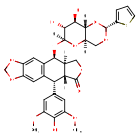
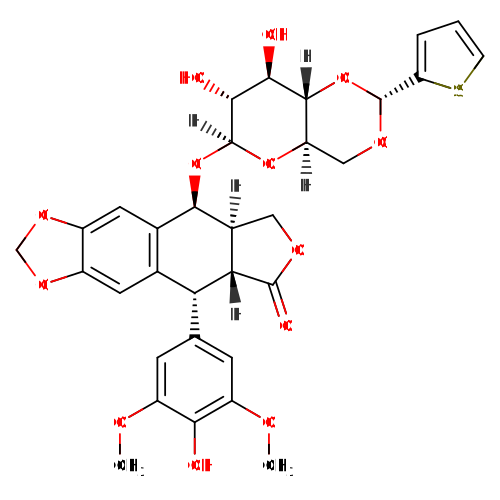
Structure for Teniposide (DB00444)
- Weight
- Average: 656.654
Monoisotopic: 656.1563618 - Chemical Formula
- C32H32O13S
- Synonyms
- 4'-demethylepipodophyllotoxin 9-(4,6-O-(R)-2-thenylidene-beta-D-glucopyranoside)
- Epidophyllotoxin
- Teniposid
- Téniposide
- Teniposide
- Teniposido
- Teniposidum
- External IDs
- EPT
- PGT
- VM-26
- VM26

Pharmacology
- Indication
Teniposide is used for the treatment of refractory acute lymphoblastic leukaemia
 Reduce drug development failure ratesBuild, train, & validate machine-learning modelswith evidence-based and structured datasets.Build, train, & validate predictive machine-learning models with structured datasets.
- Associated Conditions
Indication Type Indication Combined Product Details Approval Level Age Group Patient Characteristics Dose Form Used as adjunct in combination to treat Refractory lymphoblastic leukemia, acute, childhood •••••••••••• ••••••••• - Contraindications & Blackbox Warnings
 Prevent Adverse Drug Events TodayTap into our Clinical API for life-saving information on contraindications & blackbox warnings, population restrictions, harmful risks, & more.Avoid life-threatening adverse drug events with our Clinical API
- Pharmacodynamics
Teniposide is a phase-specific cytotoxic drug, acting in the late S or early G 2 phase of the cell cycle. Teniposide prevents cell mitosis by causing single and double stranded DNA breaks as well as cross linking between protein and DNA.
- Mechanism of action
The mechanism of action appears to be related to the inhibition of type II topoisomerase activity since teniposide does not intercalate into DNA or bind strongly to DNA. Teniposide binds to and inhibits DNA topoisomerase II. The cytotoxic effects of teniposide are related to the relative number of double-stranded DNA breaks produced in cells, which are a reflection of the stabilization of a topoisomerase II-DNA intermediate.
Target Actions Organism ADNA topoisomerase 2-alpha inhibitorHumans - Absorption
Not Available
- Volume of distribution
Not Available
- Protein binding
Not Available
- Metabolism
Hover over products below to view reaction partners
- Route of elimination
From 4% to 12% of a dose is excreted in urine as parent drug. Fecal excretion of radioactivity within 72 hours after dosing accounted for 0% to 10% of the dose.
- Half-life
5 hours
- Clearance
- 10.3 mL/min/m2
- Adverse Effects
 Improve decision support & research outcomesWith structured adverse effects data, including: blackbox warnings, adverse reactions, warning & precautions, & incidence rates. View sample adverse effects data in our new Data Library!Improve decision support & research outcomes with our structured adverse effects data.
- Toxicity
Not Available
- Pathways
Pathway Category Teniposide Action Pathway Drug action Teniposide Metabolism Pathway Drug metabolism - Pharmacogenomic Effects/ADRs
- Not Available
Interactions
- Drug Interactions
- This information should not be interpreted without the help of a healthcare provider. If you believe you are experiencing an interaction, contact a healthcare provider immediately. The absence of an interaction does not necessarily mean no interactions exist.
Drug Interaction Integrate drug-drug
interactions in your softwareAbametapir The serum concentration of Teniposide can be increased when it is combined with Abametapir. Abatacept The metabolism of Teniposide can be increased when combined with Abatacept. Abciximab The risk or severity of bleeding can be increased when Abciximab is combined with Teniposide. Abemaciclib The serum concentration of Abemaciclib can be increased when it is combined with Teniposide. Abrocitinib The metabolism of Abrocitinib can be decreased when combined with Teniposide. - Food Interactions
- Exercise caution with grapefruit products. Teniposide is a CYP3A4 substrate, and grapefruit inhibits CYP3A4 metabolism, coadministration may increase the serum concentrations of teniposide.
- Exercise caution with St. John's Wort. Teniposide is a CYP3A4 substrate, and St. John's Wort induces CYP3A4 metabolism, coadministration may reduce the serum concentrations of teniposide.
Products
 Drug product information from 10+ global regionsOur datasets provide approved product information including:dosage, form, labeller, route of administration, and marketing period.Access drug product information from over 10 global regions.
- International/Other Brands
- Bang Lai (Double-Crane)
- Brand Name Prescription Products
Name Dosage Strength Route Labeller Marketing Start Marketing End Region Image Teniposide Injection, solution 10 mg/1mL Intravenous WG Critical Care, LLC 2013-04-30 Not applicable US 
Vumon Injection, solution 10 mg/1mL Intravenous E.R. Squibb & Sons, L.L.C. 1992-07-14 2015-07-14 US Vumon Liquid 10 mg / mL Intravenous Bristol Myers Squibb 1984-12-31 2018-05-31 Canada 
Categories
- ATC Codes
- L01CB02 — Teniposide
- Drug Categories
- Antineoplastic Agents
- Antineoplastic and Immunomodulating Agents
- BCRP/ABCG2 Substrates
- Carbohydrates
- Cardiotoxic antineoplastic agents
- Cytochrome P-450 CYP2C19 Substrates
- Cytochrome P-450 CYP2C19 Substrates with a Narrow Therapeutic Index
- Cytochrome P-450 CYP2C9 Inhibitors
- Cytochrome P-450 CYP2C9 Inhibitors (strength unknown)
- Cytochrome P-450 CYP2C9 Inhibitors (weak)
- Cytochrome P-450 CYP3A Inhibitors
- Cytochrome P-450 CYP3A Substrates
- Cytochrome P-450 CYP3A4 Inhibitors
- Cytochrome P-450 CYP3A4 Inhibitors (strength unknown)
- Cytochrome P-450 CYP3A4 Substrates
- Cytochrome P-450 CYP3A4 Substrates with a Narrow Therapeutic Index
- Cytochrome P-450 CYP3A5 Substrates
- Cytochrome P-450 CYP3A5 Substrates with a Narrow Therapeutic Index
- Cytochrome P-450 Enzyme Inhibitors
- Cytochrome P-450 Substrates
- Enzyme Inhibitors
- Glucosides
- Glycosides
- Immunosuppressive Agents
- Myelosuppressive Agents
- Narrow Therapeutic Index Drugs
- Neurotoxic agents
- Podophyllotoxin Derivatives
- Topoisomerase II Inhibitors
- Topoisomerase Inhibitors
- Chemical TaxonomyProvided by Classyfire
- Description
- This compound belongs to the class of organic compounds known as podophyllotoxins. These are tetralin lignans in which the benzene moiety of the tetralin skeleton is fused to a 1,3-dioxolane and the cyclohexane is fused to a butyrolactone (pyrrolidin-2-one).
- Kingdom
- Organic compounds
- Super Class
- Lignans, neolignans and related compounds
- Class
- Lignan lactones
- Sub Class
- Podophyllotoxins
- Direct Parent
- Podophyllotoxins
- Alternative Parents
- Aryltetralin lignans / Furanonaphthodioxoles / Tetralins / Pyranodioxins / Dimethoxybenzenes / Methoxyphenols / Benzodioxoles / Anisoles / Phenoxy compounds / Alkyl aryl ethers show 16 more
- Substituents
- 1,2-diol / 1-aryltetralin lignan / Acetal / Alcohol / Alkyl aryl ether / Anisole / Aromatic heteropolycyclic compound / Benzenoid / Benzodioxole / Carbonyl group show 32 more
- Molecular Framework
- Aromatic heteropolycyclic compounds
- External Descriptors
- Not Available
- Affected organisms
- Humans and other mammals
Chemical Identifiers
- UNII
- 957E6438QA
- CAS number
- 29767-20-2
- InChI Key
- NRUKOCRGYNPUPR-QBPJDGROSA-N
- InChI
- InChI=1S/C32H32O13S/c1-37-19-6-13(7-20(38-2)25(19)33)23-14-8-17-18(42-12-41-17)9-15(14)28(16-10-39-30(36)24(16)23)44-32-27(35)26(34)29-21(43-32)11-40-31(45-29)22-4-3-5-46-22/h3-9,16,21,23-24,26-29,31-35H,10-12H2,1-2H3/t16-,21+,23+,24-,26+,27+,28+,29+,31+,32-/m0/s1
- IUPAC Name
- (10R,11R,15R,16S)-16-{[(2R,4aR,6R,7R,8R,8aS)-7,8-dihydroxy-2-(thiophen-2-yl)-hexahydro-2H-pyrano[3,2-d][1,3]dioxin-6-yl]oxy}-10-(4-hydroxy-3,5-dimethoxyphenyl)-4,6,13-trioxatetracyclo[7.7.0.0^{3,7}.0^{11,15}]hexadeca-1,3(7),8-trien-12-one
- SMILES
- [H][C@]12COC(=O)[C@]1([H])[C@H](C1=CC(OC)=C(O)C(OC)=C1)C1=C(C=C3OCOC3=C1)[C@H]2O[C@]1([H])O[C@]2([H])CO[C@H](O[C@@]2([H])[C@H](O)[C@H]1O)C1=CC=CS1
References
- General References
- Not Available
- External Links
- KEGG Drug
- D02698
- KEGG Compound
- C11153
- PubChem Compound
- 452548
- PubChem Substance
- 46507536
- ChemSpider
- 398606
- BindingDB
- 50248198
- 10362
- ChEBI
- 75988
- ChEMBL
- CHEMBL452231
- ZINC
- ZINC000004099009
- Therapeutic Targets Database
- DAP000651
- PharmGKB
- PA451611
- PDBe Ligand
- 9TP
- RxList
- RxList Drug Page
- Drugs.com
- Drugs.com Drug Page
- Wikipedia
- Teniposide
- PDB Entries
- 4l9q
- MSDS
- Download (46.6 KB)
Clinical Trials
- Clinical Trials
Phase Status Purpose Conditions Count 4 Completed Treatment Acute Lymphoblastic Leukemia (ALL) 1 4 Completed Treatment Leukemia, Lymphocytic, Acute, Adult 1 3 Completed Treatment Acute Lymphoblastic Leukemia (ALL) 1 2 Completed Treatment Acute Lymphoblastic Leukemia (ALL) 1 2 Completed Treatment Acute Lymphoblastic Leukemia (ALL) / Lymphoblastic Lymphoma 1
Pharmacoeconomics
- Manufacturers
- Bristol myers squibb co pharmaceutical research institute
- Packagers
- Bristol-Myers Squibb Co.
- Mead Johnson and Co.
- Dosage Forms
Form Route Strength Injection, solution Intravenous 10 mg/1mL Liquid Intravenous 10 mg / mL Injection Parenteral 50 mg - Prices
Unit description Cost Unit Vumon 10 mg/ml ampul 75.31USD ml DrugBank does not sell nor buy drugs. Pricing information is supplied for informational purposes only.- Patents
- Not Available
Properties
- State
- Solid
- Experimental Properties
Property Value Source melting point (°C) 242-246 °C PhysProp logP 1.24 HANSCH,C ET AL. (1995) - Predicted Properties
Property Value Source Water Solubility 0.0598 mg/mL ALOGPS logP 2.78 ALOGPS logP 2.78 Chemaxon logS -4 ALOGPS pKa (Strongest Acidic) 9.33 Chemaxon pKa (Strongest Basic) -3.7 Chemaxon Physiological Charge 0 Chemaxon Hydrogen Acceptor Count 12 Chemaxon Hydrogen Donor Count 3 Chemaxon Polar Surface Area 160.83 Å2 Chemaxon Rotatable Bond Count 6 Chemaxon Refractivity 155.61 m3·mol-1 Chemaxon Polarizability 64.83 Å3 Chemaxon Number of Rings 8 Chemaxon Bioavailability 0 Chemaxon Rule of Five No Chemaxon Ghose Filter No Chemaxon Veber's Rule No Chemaxon MDDR-like Rule Yes Chemaxon - Predicted ADMET Features
Property Value Probability Human Intestinal Absorption + 0.8166 Blood Brain Barrier - 0.9584 Caco-2 permeable - 0.5728 P-glycoprotein substrate Substrate 0.6638 P-glycoprotein inhibitor I Non-inhibitor 0.8656 P-glycoprotein inhibitor II Non-inhibitor 0.9094 Renal organic cation transporter Non-inhibitor 0.8549 CYP450 2C9 substrate Non-substrate 0.7897 CYP450 2D6 substrate Non-substrate 0.9116 CYP450 3A4 substrate Substrate 0.5599 CYP450 1A2 substrate Non-inhibitor 0.7516 CYP450 2C9 inhibitor Non-inhibitor 0.5445 CYP450 2D6 inhibitor Non-inhibitor 0.7197 CYP450 2C19 inhibitor Inhibitor 0.7423 CYP450 3A4 inhibitor Inhibitor 0.7677 CYP450 inhibitory promiscuity High CYP Inhibitory Promiscuity 0.798 Ames test AMES toxic 0.7291 Carcinogenicity Non-carcinogens 0.9303 Biodegradation Not ready biodegradable 0.9254 Rat acute toxicity 2.8354 LD50, mol/kg Not applicable hERG inhibition (predictor I) Weak inhibitor 0.9934 hERG inhibition (predictor II) Non-inhibitor 0.8415
Spectra
- Mass Spec (NIST)
- Not Available
- Spectra
- Chromatographic Properties
Collision Cross Sections (CCS)
Adduct CCS Value (Å2) Source type Source [M-H]- 213.2375 predictedDeepCCS 1.0 (2019) [M+H]+ 215.0624 predictedDeepCCS 1.0 (2019) [M+Na]+ 220.70284 predictedDeepCCS 1.0 (2019)
Targets

- Kind
- Protein
- Organism
- Humans
- Pharmacological action
- Yes
- Actions
- Inhibitor
- General Function
- Ubiquitin binding
- Specific Function
- Control of topological states of DNA by transient breakage and subsequent rejoining of DNA strands. Topoisomerase II makes double-strand breaks. Essential during mitosis and meiosis for proper segr...
- Gene Name
- TOP2A
- Uniprot ID
- P11388
- Uniprot Name
- DNA topoisomerase 2-alpha
- Molecular Weight
- 174383.88 Da
References
- de Lucio B, Manuel V, Barrera-Rodriguez R: Characterization of human NSCLC cell line with innate etoposide-resistance mediated by cytoplasmic localization of topoisomerase II alpha. Cancer Sci. 2005 Nov;96(11):774-83. [Article]
- Uesaka T, Shono T, Kuga D, Suzuki SO, Niiro H, Miyamoto K, Matsumoto K, Mizoguchi M, Ohta M, Iwaki T, Sasaki T: Enhanced expression of DNA topoisomerase II genes in human medulloblastoma and its possible association with etoposide sensitivity. J Neurooncol. 2007 Sep;84(2):119-29. Epub 2007 Mar 15. [Article]
- Winnicka K, Bielawski K, Bielawska A: Cardiac glycosides in cancer research and cancer therapy. Acta Pol Pharm. 2006 Mar-Apr;63(2):109-15. [Article]
- Faure P, Madelaine I: [Topoisomerases: therapeutic value]. Ann Pharm Fr. 1996;54(1):40-4. [Article]
- Umanskaya ON, Ioudinkova ES, Razin SV, Bystritskiy AA: Inhibition of DNA topoisomerase II in living cells stimulates illegitimate recombination. Dokl Biochem Biophys. 2005 Nov-Dec;405:423-5. [Article]
- Chen X, Ji ZL, Chen YZ: TTD: Therapeutic Target Database. Nucleic Acids Res. 2002 Jan 1;30(1):412-5. [Article]
Enzymes
- Kind
- Protein
- Organism
- Humans
- Pharmacological action
- No
- Actions
- Substrate
- General Function
- Oxygen binding
- Specific Function
- Cytochromes P450 are a group of heme-thiolate monooxygenases. In liver microsomes, this enzyme is involved in an NADPH-dependent electron transport pathway. It oxidizes a variety of structurally un...
- Gene Name
- CYP3A5
- Uniprot ID
- P20815
- Uniprot Name
- Cytochrome P450 3A5
- Molecular Weight
- 57108.065 Da
References
- Relling MV, Nemec J, Schuetz EG, Schuetz JD, Gonzalez FJ, Korzekwa KR: O-demethylation of epipodophyllotoxins is catalyzed by human cytochrome P450 3A4. Mol Pharmacol. 1994 Feb;45(2):352-8. [Article]
- Kind
- Protein
- Organism
- Humans
- Pharmacological action
- Unknown
- Actions
- Substrate
- General Function
- Steroid hydroxylase activity
- Specific Function
- Responsible for the metabolism of a number of therapeutic agents such as the anticonvulsant drug S-mephenytoin, omeprazole, proguanil, certain barbiturates, diazepam, propranolol, citalopram and im...
- Gene Name
- CYP2C19
- Uniprot ID
- P33261
- Uniprot Name
- Cytochrome P450 2C19
- Molecular Weight
- 55930.545 Da
References
- Flockhart Table of Drug Interactions [Link]
- Kind
- Protein
- Organism
- Humans
- Pharmacological action
- Unknown
- Actions
- Inhibitor
- Curator comments
- There are limited data supporting this interaction, however, the monograph for teniposide indicates that it is a weak inhibitor of CYP2C9.
- General Function
- Steroid hydroxylase activity
- Specific Function
- Cytochromes P450 are a group of heme-thiolate monooxygenases. In liver microsomes, this enzyme is involved in an NADPH-dependent electron transport pathway. It oxidizes a variety of structurally un...
- Gene Name
- CYP2C9
- Uniprot ID
- P11712
- Uniprot Name
- Cytochrome P450 2C9
- Molecular Weight
- 55627.365 Da
References
- Kind
- Protein
- Organism
- Humans
- Pharmacological action
- Unknown
- Actions
- SubstrateInhibitor
- General Function
- Vitamin d3 25-hydroxylase activity
- Specific Function
- Cytochromes P450 are a group of heme-thiolate monooxygenases. In liver microsomes, this enzyme is involved in an NADPH-dependent electron transport pathway. It performs a variety of oxidation react...
- Gene Name
- CYP3A4
- Uniprot ID
- P08684
- Uniprot Name
- Cytochrome P450 3A4
- Molecular Weight
- 57342.67 Da
References
- Baumhakel M, Kasel D, Rao-Schymanski RA, Bocker R, Beckurts KT, Zaigler M, Barthold D, Fuhr U: Screening for inhibitory effects of antineoplastic agents on CYP3A4 in human liver microsomes. Int J Clin Pharmacol Ther. 2001 Dec;39(12):517-28. [Article]
- Relling MV, Nemec J, Schuetz EG, Schuetz JD, Gonzalez FJ, Korzekwa KR: O-demethylation of epipodophyllotoxins is catalyzed by human cytochrome P450 3A4. Mol Pharmacol. 1994 Feb;45(2):352-8. [Article]
Transporters
- Kind
- Protein
- Organism
- Humans
- Pharmacological action
- Unknown
- Actions
- Substrate
- General Function
- Transporter activity
- Specific Function
- Isoform 1: May participate directly in the active transport of drugs into subcellular organelles or influence drug distribution indirectly. Transports glutathione conjugates as leukotriene-c4 (LTC4...
- Gene Name
- ABCC6
- Uniprot ID
- O95255
- Uniprot Name
- Multidrug resistance-associated protein 6
- Molecular Weight
- 164904.81 Da
References
- Belinsky MG, Chen ZS, Shchaveleva I, Zeng H, Kruh GD: Characterization of the drug resistance and transport properties of multidrug resistance protein 6 (MRP6, ABCC6). Cancer Res. 2002 Nov 1;62(21):6172-7. [Article]
- Kind
- Protein
- Organism
- Humans
- Pharmacological action
- Unknown
- Actions
- Substrate
- General Function
- Xenobiotic-transporting atpase activity
- Specific Function
- High-capacity urate exporter functioning in both renal and extrarenal urate excretion. Plays a role in porphyrin homeostasis as it is able to mediates the export of protoporhyrin IX (PPIX) both fro...
- Gene Name
- ABCG2
- Uniprot ID
- Q9UNQ0
- Uniprot Name
- ATP-binding cassette sub-family G member 2
- Molecular Weight
- 72313.47 Da
References
- Allen JD, Van Dort SC, Buitelaar M, van Tellingen O, Schinkel AH: Mouse breast cancer resistance protein (Bcrp1/Abcg2) mediates etoposide resistance and transport, but etoposide oral availability is limited primarily by P-glycoprotein. Cancer Res. 2003 Mar 15;63(6):1339-44. [Article]

Drug created at June 13, 2005 13:24 / Updated at April 27, 2024 09:44