Identification
- Summary
Rimantadine is an RNA synthesis inhibitor used to prevent influenza A infection.
- Generic Name
- Rimantadine
- DrugBank Accession Number
- DB00478
- Background
An RNA synthesis inhibitor that is used as an antiviral agent in the prophylaxis and treatment of influenza.
- Type
- Small Molecule
- Groups
- Approved, Investigational
- Structure
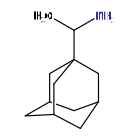
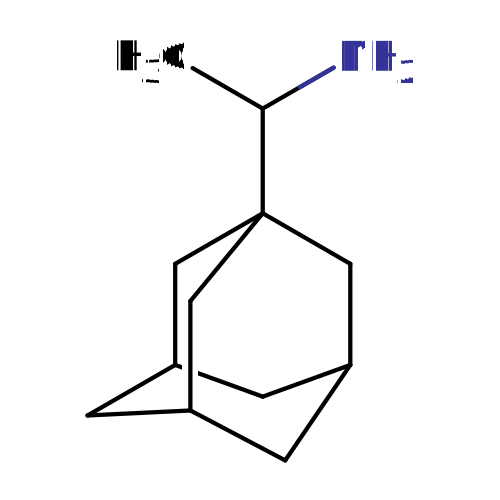
Structure for Rimantadine (DB00478)
- Weight
- Average: 179.3018
Monoisotopic: 179.167399677 - Chemical Formula
- C12H21N
- Synonyms
- alpha-Methyl-1-adamantanemethylamine
- alpha-Methyladamantanemethylamine
- Rimantadina
- Rimantadine
- Rimantadinum

Pharmacology
- Indication
For the prophylaxis and treatment of illness caused by various strains of influenza A virus in adults.
 Reduce drug development failure ratesBuild, train, & validate machine-learning modelswith evidence-based and structured datasets.Build, train, & validate predictive machine-learning models with structured datasets.
- Associated Conditions
Indication Type Indication Combined Product Details Approval Level Age Group Patient Characteristics Dose Form Used in combination to treat Influenza a Combination Product in combination with: Arginine (DB00125) •••••••••••• ••••• Used in combination for prophylaxis of Influenza a Combination Product in combination with: Arginine (DB00125) •••••••••••• Prophylaxis of Influenza a •••••••••••• Treatment of Influenza a •••••••••••• ••••• - Contraindications & Blackbox Warnings
 Prevent Adverse Drug Events TodayTap into our Clinical API for life-saving information on contraindications & blackbox warnings, population restrictions, harmful risks, & more.Avoid life-threatening adverse drug events with our Clinical API
- Pharmacodynamics
Rimantadine, a cyclic amine, is a synthetic antiviral drug and a derivate of adamantane, like a similar drug amantadine. Rimantadine is inhibitory to the in vitro replication of influenza A virus isolates from each of the three antigenic subtypes (H1N1, H2H2 and H3N2) that have been isolated from man. Rimantadine has little or no activity against influenza B virus. Rimantadine does not appear to interfere with the immunogenicity of inactivated influenza A vaccine.
- Mechanism of action
The mechanism of action of rimantadine is not fully understood. Rimantadine appears to exert its inhibitory effect early in the viral replicative cycle, possibly inhibiting the uncoating of the virus. The protein coded by the M2 gene of influenza A may play an important role in rimantadine susceptibility.
Target Actions Organism AMatrix protein 2 other/unknownInfluenza A virus (strain A/Ann Arbor/6/1960 H2N2) - Absorption
Well absorbed, with the tablet and syrup formulations being equally absorbed after oral administration.
- Volume of distribution
Not Available
- Protein binding
Approximately 40% over typical plasma concentrations.
- Metabolism
Following oral administration, rimantadine is extensively metabolized in the liver with less than 25% of the dose excreted in the urine as unchanged drug. Glucuronidation and hydroxylation are the major metabolic pathways.
- Route of elimination
Following oral administration, rimantadine is extensively metabolized in the liver with less than 25% of the dose excreted in the urine as unchanged drug.
- Half-life
25 to 30 hours in young adults (22 to 44 years old). Approximately 32 hours in elderly (71 to 79 years old) and in patients with chronic liver disease. Approximately 13 to 38 hours in children (4 to 8 years old).
- Clearance
Not Available
- Adverse Effects
 Improve decision support & research outcomesWith structured adverse effects data, including: blackbox warnings, adverse reactions, warning & precautions, & incidence rates. View sample adverse effects data in our new Data Library!Improve decision support & research outcomes with our structured adverse effects data.
- Toxicity
Oral LD50 in rats is 640 mg/kg. Overdoses of a related rug, amantadine, have been reported with adverse reactions consisting of agitation, hallucinations, cardiac arrhythmia and death.
- Pathways
- Not Available
- Pharmacogenomic Effects/ADRs
- Not Available
Interactions
- Drug Interactions
- This information should not be interpreted without the help of a healthcare provider. If you believe you are experiencing an interaction, contact a healthcare provider immediately. The absence of an interaction does not necessarily mean no interactions exist.
Drug Interaction Integrate drug-drug
interactions in your softwareAdenovirus type 7 vaccine live The therapeutic efficacy of Adenovirus type 7 vaccine live can be decreased when used in combination with Rimantadine. Anthrax vaccine The therapeutic efficacy of Anthrax vaccine can be decreased when used in combination with Rimantadine. Bacillus calmette-guerin substrain connaught live antigen The therapeutic efficacy of Bacillus calmette-guerin substrain connaught live antigen can be decreased when used in combination with Rimantadine. Bacillus calmette-guerin substrain russian BCG-I live antigen The therapeutic efficacy of Bacillus calmette-guerin substrain russian BCG-I live antigen can be decreased when used in combination with Rimantadine. Bacillus calmette-guerin substrain tice live antigen The therapeutic efficacy of Bacillus calmette-guerin substrain tice live antigen can be decreased when used in combination with Rimantadine. - Food Interactions
- No interactions found.
Products
 Drug product information from 10+ global regionsOur datasets provide approved product information including:dosage, form, labeller, route of administration, and marketing period.Access drug product information from over 10 global regions.
- Product Ingredients
Ingredient UNII CAS InChI Key Rimantadine hydrochloride JEI07OOS8Y 1501-84-4 OZBDFBJXRJWNAV-UHFFFAOYSA-N - Brand Name Prescription Products
Name Dosage Strength Route Labeller Marketing Start Marketing End Region Image Flumadine Tablet 100 mg/1 Oral Sun Pharmaceutical Industries, Inc. 2009-09-22 2017-08-31 US 
Flumadine Syrup 50 mg/5mL Oral Allergan, Inc. 1993-09-17 2008-01-31 US Flumadine Tablet 100 mg/1 Oral Physicians Total Care, Inc. 2009-09-22 2010-06-30 US Flumadine Tablet 100 mg/1 Oral Allergan, Inc. 1993-09-17 2009-09-22 US - Generic Prescription Products
Name Dosage Strength Route Labeller Marketing Start Marketing End Region Image Rimantadine Hydrochloride Tablet, film coated 100 mg/1 Oral Amneal Pharmaceuticals of New York Llc 2021-11-16 Not applicable US Rimantadine Hydrochloride Tablet, film coated 100 mg/1 Oral Sandoz 2001-11-02 2012-03-31 US Rimantadine Hydrochloride Tablet, film coated 100 mg/1 Oral A-S Medication Solutions 2005-04-01 2017-12-31 US Rimantadine Hydrochloride Tablet, film coated 100 mg/1 Oral Carilion Materials Management 2005-04-01 Not applicable US Rimantadine Hydrochloride Tablet, film coated 100 mg/1 Oral bryant ranch prepack 2005-04-01 Not applicable US - Unapproved/Other Products
Name Ingredients Dosage Route Labeller Marketing Start Marketing End Region Image Rimantalist Rimantadine hydrochloride (100 mg/1) + Arginine (60 mg/1) Kit Oral Physician Therapeutics Llc 2011-07-07 Not applicable US
Categories
- ATC Codes
- J05AC02 — Rimantadine
- Drug Categories
- Chemical TaxonomyProvided by Classyfire
- Description
- This compound belongs to the class of organic compounds known as monoalkylamines. These are organic compounds containing an primary aliphatic amine group.
- Kingdom
- Organic compounds
- Super Class
- Organic nitrogen compounds
- Class
- Organonitrogen compounds
- Sub Class
- Amines
- Direct Parent
- Monoalkylamines
- Alternative Parents
- Organopnictogen compounds / Hydrocarbon derivatives
- Substituents
- Aliphatic homopolycyclic compound / Hydrocarbon derivative / Organopnictogen compound / Primary aliphatic amine
- Molecular Framework
- Aliphatic homopolycyclic compounds
- External Descriptors
- Not Available
- Affected organisms
- Human Influenza A Virus
Chemical Identifiers
- UNII
- 0T2EF4JQTU
- CAS number
- 13392-28-4
- InChI Key
- UBCHPRBFMUDMNC-UHFFFAOYSA-N
- InChI
- InChI=1S/C12H21N/c1-8(13)12-5-9-2-10(6-12)4-11(3-9)7-12/h8-11H,2-7,13H2,1H3
- IUPAC Name
- 1-(adamantan-1-yl)ethan-1-amine
- SMILES
- CC(N)C12CC3CC(CC(C3)C1)C2
References
- Synthesis Reference
- US3352912
- General References
- Not Available
- External Links
- Human Metabolome Database
- HMDB0014621
- KEGG Drug
- D08483
- KEGG Compound
- C07236
- PubChem Compound
- 5071
- PubChem Substance
- 46505973
- ChemSpider
- 4893
- BindingDB
- 50216627
- 9386
- ChEBI
- 94440
- ChEMBL
- CHEMBL959
- Therapeutic Targets Database
- DAP001087
- PharmGKB
- PA164748038
- RxList
- RxList Drug Page
- Drugs.com
- Drugs.com Drug Page
- Wikipedia
- Rimantadine
- FDA label
- Download (62.4 KB)
- MSDS
- Download (62.7 KB)
Clinical Trials
- Clinical Trials
Phase Status Purpose Conditions Count 1 Completed Not Available Healthy Volunteers (HV) 1 Not Available Completed Not Available Hepatitis C Virus (HCV) Infection 1
Pharmacoeconomics
- Manufacturers
- Forest laboratories inc
- Caraco pharmaceutical laboratories ltd
- Actavis totowa llc
- Corepharma llc
- Impax laboratories inc
- Packagers
- Caraco Pharmaceutical Labs
- Corepharma LLC
- Dispensing Solutions
- Diversified Healthcare Services Inc.
- Forest Pharmaceuticals
- Global Pharmaceuticals
- H.J. Harkins Co. Inc.
- Impax Laboratories Inc.
- Inwood Labs
- McNeil Laboratories
- Medisca Inc.
- Nucare Pharmaceuticals Inc.
- Ortho-McNeil-Janssen Pharmaceuticals Inc.
- PD-Rx Pharmaceuticals Inc.
- Physicians Total Care Inc.
- Prescript Pharmaceuticals
- Sandoz
- Southwood Pharmaceuticals
- Vistakon Pharmaceuticals LLC
- Dosage Forms
Form Route Strength Syrup Oral 50 mg/5mL Tablet Oral 100 mg/1 Capsule Oral 100.000 mg Solution Oral 5.000 g Tablet, film coated Oral 100 mg/1 Kit Oral - Prices
Unit description Cost Unit Levofloxacin hemihydr 100% powder 42.69USD g Levaquin 750 mg leva-pak tablet 27.51USD tablet Levaquin 750 mg tablet 27.51USD tablet Iquix 1.5% eye drops 15.71USD ml Levaquin 500 mg tablet 14.69USD tablet Levaquin 250 mg tablet 14.09USD tablet Quixin 0.5% eye drops 12.21USD ml Rimantadine hcl 100 mg tablet 2.44USD tablet Flumadine 100 mg tablet 2.4USD tablet Levaquin i.v. 25 mg/ml vial 1.94USD ml Levaquin 500 mg/100 ml d5w 0.44USD ml DrugBank does not sell nor buy drugs. Pricing information is supplied for informational purposes only.- Patents
- Not Available
Properties
- State
- Solid
- Experimental Properties
Property Value Source melting point (°C) >300 °C Not Available water solubility Hydrochloride salt freely soluble (50 mg/ml at 20 °C) Not Available logP 3.6 Not Available - Predicted Properties
Property Value Source Water Solubility 0.00915 mg/mL ALOGPS logP 3.28 ALOGPS logP 2.22 Chemaxon logS -4.3 ALOGPS pKa (Strongest Basic) 10.14 Chemaxon Physiological Charge 1 Chemaxon Hydrogen Acceptor Count 1 Chemaxon Hydrogen Donor Count 1 Chemaxon Polar Surface Area 26.02 Å2 Chemaxon Rotatable Bond Count 1 Chemaxon Refractivity 54.52 m3·mol-1 Chemaxon Polarizability 21.79 Å3 Chemaxon Number of Rings 3 Chemaxon Bioavailability 1 Chemaxon Rule of Five Yes Chemaxon Ghose Filter Yes Chemaxon Veber's Rule Yes Chemaxon MDDR-like Rule No Chemaxon - Predicted ADMET Features
Property Value Probability Human Intestinal Absorption + 1.0 Blood Brain Barrier + 0.9798 Caco-2 permeable + 0.6348 P-glycoprotein substrate Non-substrate 0.6811 P-glycoprotein inhibitor I Non-inhibitor 0.8751 P-glycoprotein inhibitor II Non-inhibitor 0.919 Renal organic cation transporter Non-inhibitor 0.7654 CYP450 2C9 substrate Non-substrate 0.8329 CYP450 2D6 substrate Non-substrate 0.7244 CYP450 3A4 substrate Non-substrate 0.6785 CYP450 1A2 substrate Non-inhibitor 0.9086 CYP450 2C9 inhibitor Non-inhibitor 0.8923 CYP450 2D6 inhibitor Non-inhibitor 0.7561 CYP450 2C19 inhibitor Non-inhibitor 0.872 CYP450 3A4 inhibitor Non-inhibitor 0.7651 CYP450 inhibitory promiscuity Low CYP Inhibitory Promiscuity 0.8323 Ames test Non AMES toxic 0.7955 Carcinogenicity Non-carcinogens 0.8471 Biodegradation Not ready biodegradable 0.9782 Rat acute toxicity 2.0121 LD50, mol/kg Not applicable hERG inhibition (predictor I) Weak inhibitor 0.9845 hERG inhibition (predictor II) Non-inhibitor 0.8704
Spectra
- Mass Spec (NIST)
- Not Available
- Spectra
- Chromatographic Properties
Collision Cross Sections (CCS)
Adduct CCS Value (Å2) Source type Source [M-H]- 140.1059766 predictedDarkChem Lite v0.1.0 [M-H]- 143.84157 predictedDeepCCS 1.0 (2019) [M+H]+ 140.7453766 predictedDarkChem Lite v0.1.0 [M+H]+ 146.19958 predictedDeepCCS 1.0 (2019) [M+Na]+ 140.0627766 predictedDarkChem Lite v0.1.0 [M+Na]+ 154.61546 predictedDeepCCS 1.0 (2019)
Targets

- Kind
- Protein
- Organism
- Influenza A virus (strain A/Ann Arbor/6/1960 H2N2)
- Pharmacological action
- Yes
- Actions
- Other/unknown
- General Function
- Ion channel activity
- Specific Function
- Forms a proton-selective ion channel that is necessary for the efficient release of the viral genome during virus entry. After attaching to the cell surface, the virion enters the cell by endocytos...
- Gene Name
- M
- Uniprot ID
- P21430
- Uniprot Name
- Matrix protein 2
- Molecular Weight
- 11165.62 Da
References
- Imming P, Sinning C, Meyer A: Drugs, their targets and the nature and number of drug targets. Nat Rev Drug Discov. 2006 Oct;5(10):821-34. [Article]
- Jing X, Ma C, Ohigashi Y, Oliveira FA, Jardetzky TS, Pinto LH, Lamb RA: Functional studies indicate amantadine binds to the pore of the influenza A virus M2 proton-selective ion channel. Proc Natl Acad Sci U S A. 2008 Aug 5;105(31):10967-72. doi: 10.1073/pnas.0804958105. Epub 2008 Jul 31. [Article]
- Melidou A, Kyriazopoulou V, Diza E, Alexiou S, Pierroutsakos Y: Antiviral resistance of influenza A (H3N2) strains isolated in northern Greece between 2004 and 2007. Euro Surveill. 2009 Jan 29;14(4). pii: 19104. [Article]
- Chuang GY, Kozakov D, Brenke R, Beglov D, Guarnieri F, Vajda S: Binding hot spots and amantadine orientation in the influenza a virus M2 proton channel. Biophys J. 2009 Nov 18;97(10):2846-53. doi: 10.1016/j.bpj.2009.09.004. [Article]
- Intharathep P, Laohpongspaisan C, Rungrotmongkol T, Loisruangsin A, Malaisree M, Decha P, Aruksakunwong O, Chuenpennit K, Kaiyawet N, Sompornpisut P, Pianwanit S, Hannongbua S: How amantadine and rimantadine inhibit proton transport in the M2 protein channel. J Mol Graph Model. 2008 Oct;27(3):342-8. doi: 10.1016/j.jmgm.2008.06.002. Epub 2008 Jun 8. [Article]

Drug created at June 13, 2005 13:24 / Updated at March 03, 2024 02:34