Identification
- Generic Name
- Phenindione
- DrugBank Accession Number
- DB00498
- Background
An indandione that has been used as an anticoagulant. Phenindione has actions similar to warfarin, but it is now rarely employed because of its higher incidence of severe adverse effects. (From Martindale, The Extra Pharmacopoeia, 30th ed, p234)
- Type
- Small Molecule
- Groups
- Approved, Investigational
- Structure
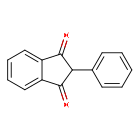
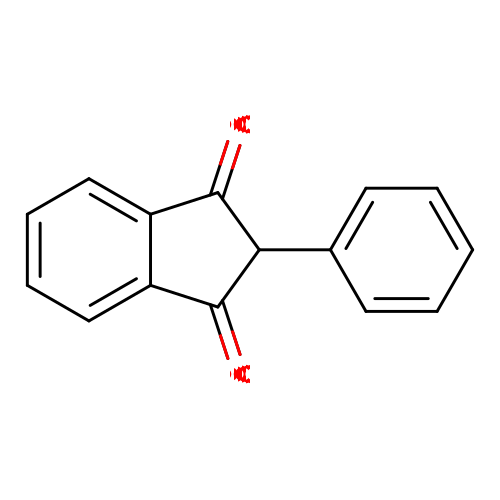
Structure for Phenindione (DB00498)
- Weight
- Average: 222.2387
Monoisotopic: 222.068079564 - Chemical Formula
- C15H10O2
- Synonyms
- 2-phenyl-1,3-diketohydrindene
- 2-Phenyl-1,3-indandione
- 2-phenyl-1,3(2H)-Indenedione
- Fenindiona
- Fenindione
- Phenindion
- Phénindione
- Phenindione
- Phenindionum
- PID

Pharmacology
- Indication
For the treatment of pulmonary embolism, cardiomyopathy, atrial fibrillation and flutter, cerebral embolism, mural thrombosis, and thrombophili. Also used for anticoagulant prophylaxis.
 Reduce drug development failure ratesBuild, train, & validate machine-learning modelswith evidence-based and structured datasets.Build, train, & validate predictive machine-learning models with structured datasets.
- Contraindications & Blackbox Warnings
 Prevent Adverse Drug Events TodayTap into our Clinical API for life-saving information on contraindications & blackbox warnings, population restrictions, harmful risks, & more.Avoid life-threatening adverse drug events with our Clinical API
- Pharmacodynamics
Phenindione thins the blood by antagonizing vitamin K which is required for the production of clotting factors in the liver. Anticoagulants such as Phenindione have no direct effect on an established thrombus, nor do they reverse ischemic tissue damage (damage caused by an inadequate blood supply to an organ or part of the body). However, once a thrombus has occurred, the goal of anticoagulant treatment is to prevent further extension of the formed clot and prevent secondary thromboembolic complications which may result in serious and possibly fatal sequelae. Phenindione has actions similar to warfarin, but it is now rarely employed because of its higer incidence of severe adverse effects.
- Mechanism of action
Phenindione inhibits vitamin K reductase, resulting in depletion of the reduced form of vitamin K (vitamin KH2). As vitamin K is a cofactor for the carboxylation of glutamate residues on the N-terminal regions of vitamin K-dependent proteins, this limits the gamma-carboxylation and subsequent activation of the vitamin K-dependent coagulant proteins. The synthesis of vitamin K-dependent coagulation factors II, VII, IX, and X and anticoagulant proteins C and S is inhibited. Depression of three of the four vitamin K-dependent coagulation factors (factors II, VII, and X) results in decreased prothrombin levels and a decrease in the amount of thrombin generated and bound to fibrin. This reduces the thrombogenicity of clots.
Target Actions Organism AVitamin K epoxide reductase complex subunit 1 inhibitorHumans - Absorption
Absorbed slowly from the gastrointestinal tract.
- Volume of distribution
Not Available
- Protein binding
88%
- Metabolism
Hepatic.
- Route of elimination
Not Available
- Half-life
5-10 hours
- Clearance
Not Available
- Adverse Effects
 Improve decision support & research outcomesWith structured adverse effects data, including: blackbox warnings, adverse reactions, warning & precautions, & incidence rates. View sample adverse effects data in our new Data Library!Improve decision support & research outcomes with our structured adverse effects data.
- Toxicity
Oral, mouse: LD50 = 175 mg/kg; Oral, rat: LD50 = 163 mg/kg.
- Pathways
Pathway Category Phenindione Action Pathway Drug action - Pharmacogenomic Effects/ADRs
- Not Available
Interactions
- Drug Interactions
- This information should not be interpreted without the help of a healthcare provider. If you believe you are experiencing an interaction, contact a healthcare provider immediately. The absence of an interaction does not necessarily mean no interactions exist.
Drug Interaction Integrate drug-drug
interactions in your softwareAbciximab The risk or severity of bleeding can be increased when Abciximab is combined with Phenindione. Aceclofenac The risk or severity of bleeding and hemorrhage can be increased when Aceclofenac is combined with Phenindione. Acemetacin The risk or severity of bleeding and hemorrhage can be increased when Phenindione is combined with Acemetacin. Acenocoumarol The risk or severity of bleeding can be increased when Phenindione is combined with Acenocoumarol. Acetaminophen Acetaminophen may increase the anticoagulant activities of Phenindione. - Food Interactions
- Avoid herbs and supplements with anticoagulant/antiplatelet activity. Examples include ginseng, ginkgo, ginger, and garlic.
Products
 Drug product information from 10+ global regionsOur datasets provide approved product information including:dosage, form, labeller, route of administration, and marketing period.Access drug product information from over 10 global regions.
- International/Other Brands
- Dindevan (Sigma) / Fenindion (Souriree) / Phenindione (Goldshield) / Soluthrombine (Cooper)
Categories
- ATC Codes
- B01AA02 — Phenindione
- Drug Categories
- Chemical TaxonomyProvided by Classyfire
- Description
- This compound belongs to the class of organic compounds known as indanediones. These are compounds containing an indane ring bearing two ketone groups.
- Kingdom
- Organic compounds
- Super Class
- Benzenoids
- Class
- Indanes
- Sub Class
- Indanones
- Direct Parent
- Indanediones
- Alternative Parents
- Aryl alkyl ketones / Beta-diketones / Benzene and substituted derivatives / Organic oxides / Hydrocarbon derivatives
- Substituents
- 1,3-dicarbonyl compound / 1,3-diketone / Aromatic homopolycyclic compound / Aryl alkyl ketone / Aryl ketone / Hydrocarbon derivative / Indanedione / Ketone / Monocyclic benzene moiety / Organic oxide
- Molecular Framework
- Aromatic homopolycyclic compounds
- External Descriptors
- aromatic ketone, beta-diketone (CHEBI:8066)
- Affected organisms
- Humans and other mammals
Chemical Identifiers
- UNII
- 5M7Y6274ZE
- CAS number
- 83-12-5
- InChI Key
- NFBAXHOPROOJAW-UHFFFAOYSA-N
- InChI
- InChI=1S/C15H10O2/c16-14-11-8-4-5-9-12(11)15(17)13(14)10-6-2-1-3-7-10/h1-9,13H
- IUPAC Name
- 2-phenyl-2,3-dihydro-1H-indene-1,3-dione
- SMILES
- O=C1C(C(=O)C2=CC=CC=C12)C1=CC=CC=C1
References
- General References
- Link [Link]
- External Links
- Human Metabolome Database
- HMDB0014641
- KEGG Drug
- D08354
- KEGG Compound
- C07584
- PubChem Compound
- 4760
- PubChem Substance
- 46505018
- ChemSpider
- 4596
- BindingDB
- 50280157
- 8130
- ChEBI
- 8066
- ChEMBL
- CHEMBL711
- ZINC
- ZINC000100004862
- Therapeutic Targets Database
- DAP000769
- PharmGKB
- PA164784031
- PDBe Ligand
- UAS
- Wikipedia
- Phenindione
- PDB Entries
- 6wv6
- MSDS
- Download (62.6 KB)
Clinical Trials
- Clinical Trials
Phase Status Purpose Conditions Count 3 Completed Prevention Anticoagulation in Pregnancy 1 3 Completed Prevention Atrial Fibrillation / Atrial Flutter / Hematoma, Subdural / Intracranial Hemorrhage, Hypertensive / Intracranial Hemorrhages / Intraventricular Hemorrhage (IVH) / Microhemorrhage / Small Vessel Cerebrovascular Disease / Subarachnoid Hemorrhage 1 Not Available Completed Not Available Atrial Fibrillation 1
Pharmacoeconomics
- Manufacturers
- Sanofi aventis us llc
- Packagers
- Not Available
- Dosage Forms
- Not Available
- Prices
- Not Available
- Patents
- Not Available
Properties
- State
- Solid
- Experimental Properties
Property Value Source melting point (°C) 150 °C PhysProp water solubility 27 mg/L (at 20 °C) Not Available logP 2.90 HANSCH,C ET AL. (1995) - Predicted Properties
Property Value Source Water Solubility 0.023 mg/mL ALOGPS logP 3.1 ALOGPS logP 2.88 Chemaxon logS -4 ALOGPS pKa (Strongest Acidic) 4.92 Chemaxon pKa (Strongest Basic) -7.5 Chemaxon Physiological Charge -1 Chemaxon Hydrogen Acceptor Count 2 Chemaxon Hydrogen Donor Count 0 Chemaxon Polar Surface Area 34.14 Å2 Chemaxon Rotatable Bond Count 1 Chemaxon Refractivity 65.23 m3·mol-1 Chemaxon Polarizability 23.24 Å3 Chemaxon Number of Rings 3 Chemaxon Bioavailability 1 Chemaxon Rule of Five Yes Chemaxon Ghose Filter Yes Chemaxon Veber's Rule Yes Chemaxon MDDR-like Rule No Chemaxon - Predicted ADMET Features
Property Value Probability Human Intestinal Absorption + 1.0 Blood Brain Barrier + 0.9816 Caco-2 permeable + 0.7697 P-glycoprotein substrate Non-substrate 0.7593 P-glycoprotein inhibitor I Non-inhibitor 0.5461 P-glycoprotein inhibitor II Non-inhibitor 0.8381 Renal organic cation transporter Non-inhibitor 0.833 CYP450 2C9 substrate Non-substrate 0.8036 CYP450 2D6 substrate Non-substrate 0.9024 CYP450 3A4 substrate Non-substrate 0.6947 CYP450 1A2 substrate Inhibitor 0.9013 CYP450 2C9 inhibitor Non-inhibitor 0.5714 CYP450 2D6 inhibitor Non-inhibitor 0.9231 CYP450 2C19 inhibitor Non-inhibitor 0.7715 CYP450 3A4 inhibitor Non-inhibitor 0.9141 CYP450 inhibitory promiscuity Low CYP Inhibitory Promiscuity 0.598 Ames test AMES toxic 0.7125 Carcinogenicity Non-carcinogens 0.88 Biodegradation Not ready biodegradable 0.8033 Rat acute toxicity 3.1041 LD50, mol/kg Not applicable hERG inhibition (predictor I) Weak inhibitor 0.9414 hERG inhibition (predictor II) Non-inhibitor 0.9008
Spectra
- Mass Spec (NIST)
- Not Available
- Spectra
- Chromatographic Properties
Collision Cross Sections (CCS)
Adduct CCS Value (Å2) Source type Source [M-H]- 157.2824799 predictedDarkChem Lite v0.1.0 [M-H]- 157.4547799 predictedDarkChem Lite v0.1.0 [M-H]- 152.91188 predictedDeepCCS 1.0 (2019) [M+H]+ 157.5947799 predictedDarkChem Lite v0.1.0 [M+H]+ 157.6667799 predictedDarkChem Lite v0.1.0 [M+H]+ 155.30415 predictedDeepCCS 1.0 (2019) [M+Na]+ 157.6589799 predictedDarkChem Lite v0.1.0 [M+Na]+ 157.6414799 predictedDarkChem Lite v0.1.0 [M+Na]+ 161.36304 predictedDeepCCS 1.0 (2019)
Targets

- Kind
- Protein
- Organism
- Humans
- Pharmacological action
- Yes
- Actions
- Inhibitor
- General Function
- Vitamin-k-epoxide reductase (warfarin-sensitive) activity
- Specific Function
- Involved in vitamin K metabolism. Catalytic subunit of the vitamin K epoxide reductase (VKOR) complex which reduces inactive vitamin K 2,3-epoxide to active vitamin K. Vitamin K is required for the...
- Gene Name
- VKORC1
- Uniprot ID
- Q9BQB6
- Uniprot Name
- Vitamin K epoxide reductase complex subunit 1
- Molecular Weight
- 18234.3 Da
References
- Overington JP, Al-Lazikani B, Hopkins AL: How many drug targets are there? Nat Rev Drug Discov. 2006 Dec;5(12):993-6. [Article]
- Imming P, Sinning C, Meyer A: Drugs, their targets and the nature and number of drug targets. Nat Rev Drug Discov. 2006 Oct;5(10):821-34. [Article]
- Mentre F, Pousset F, Comets E, Plaud B, Diquet B, Montalescot G, Ankri A, Mallet A, Lechat P: Population pharmacokinetic-pharmacodynamic analysis of fluindione in patients. Clin Pharmacol Ther. 1998 Jan;63(1):64-78. [Article]
- Chen X, Ji ZL, Chen YZ: TTD: Therapeutic Target Database. Nucleic Acids Res. 2002 Jan 1;30(1):412-5. [Article]

Drug created at June 13, 2005 13:24 / Updated at March 03, 2024 02:26