Identification
- Summary
Dextrothyroxine is a thyroid hormone used to treat hyperlipidemia.
- Generic Name
- Dextrothyroxine
- DrugBank Accession Number
- DB00509
- Background
The major hormone derived from the thyroid gland. Thyroxine is synthesized via the iodination of tyrosines (monoiodotyrosine) and the coupling of iodotyrosines (diiodotyrosine) in the thyroglobulin. Thyroxine is released from thyroglobulin by proteolysis and secreted into the blood. Thyroxine is peripherally deiodinated to form triiodothyronine which exerts a broad spectrum of stimulatory effects on cell metabolism.
- Type
- Small Molecule
- Groups
- Approved, Investigational
- Structure
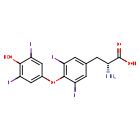
Structure for Dextrothyroxine (DB00509)
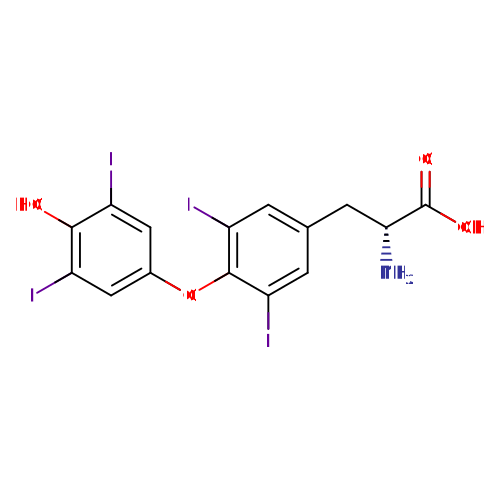
- Weight
- Average: 776.87
Monoisotopic: 776.686681525 - Chemical Formula
- C15H11I4NO4
- Synonyms
- D-thyroxine
- Dextrothyroxine
- Dextrothyroxinum
- O-(4-hydroxy-3,5-diiodophenyl)-3,5-diiodo-D-tyrosine

Pharmacology
- Indication
Used to lower high cholesterol levels in the blood.
 Reduce drug development failure ratesBuild, train, & validate machine-learning modelswith evidence-based and structured datasets.Build, train, & validate predictive machine-learning models with structured datasets.
- Contraindications & Blackbox Warnings
 Prevent Adverse Drug Events TodayTap into our Clinical API for life-saving information on contraindications & blackbox warnings, population restrictions, harmful risks, & more.Avoid life-threatening adverse drug events with our Clinical API
- Pharmacodynamics
Dextrothyroxine, the dextrorotary isomer of the synthetic thyroxine, is a antihyperlipidemic.
- Mechanism of action
Dextrothyroxine is a antihyperlipidemic. The mechanism of action is not completely understood, but dextrothyroxine apparently acts in the liver to stimulate formation of low-density lipoprotein (LDL) and, to a much greater extent, to increase catabolism of LDL. This leads to increased excretion of cholesterol and bile acids via the biliary route into the feces, with a resulting reduction in serum cholesterol and LDL. Dextrothyroxine has no significant effect on high-density lipoproteins (HDL). Inherently, it will also bind to thyroid receptors and as it is a prohormone, it will bind as a substrate to iodide peroxidase.
Target Actions Organism AThyroid hormone receptor alpha agonistHumans AThyroid hormone receptor beta agonistHumans UThyroid peroxidase Not Available Humans - Absorption
Not Available
- Volume of distribution
Not Available
- Protein binding
Not Available
- Metabolism
Hover over products below to view reaction partners
- Route of elimination
Not Available
- Half-life
Not Available
- Clearance
Not Available
- Adverse Effects
 Improve decision support & research outcomesWith structured adverse effects data, including: blackbox warnings, adverse reactions, warning & precautions, & incidence rates. View sample adverse effects data in our new Data Library!Improve decision support & research outcomes with our structured adverse effects data.
- Toxicity
Symptoms of dextrothyroxine overdose are unknown.
- Pathways
- Not Available
- Pharmacogenomic Effects/ADRs
- Not Available
Interactions
- Drug Interactions
- This information should not be interpreted without the help of a healthcare provider. If you believe you are experiencing an interaction, contact a healthcare provider immediately. The absence of an interaction does not necessarily mean no interactions exist.Not Available
- Food Interactions
- Take with or without food. The absorption is unaffected by food.
Products
 Drug product information from 10+ global regionsOur datasets provide approved product information including:dosage, form, labeller, route of administration, and marketing period.Access drug product information from over 10 global regions.
- Product Ingredients
Ingredient UNII CAS InChI Key Dextrothyroxine sodium 0H00N2AHSP 7054-08-2 ANMYAHDLKVNJJO-CURYUGHLSA-M - International/Other Brands
- Choloxin (Knoll (Canada) (discontinued), Baxter (United Kingdom) (discontinued), Boots-Flint (United States) (discontinued)) / Dynothel (Henning (Germany) (discontinued)) / Eulipos (Boehringer Mannheim (Germany) (discontinued)) / Lisolipin (Bracco (Italy) (discontinued))
- Brand Name Prescription Products
Name Dosage Strength Route Labeller Marketing Start Marketing End Region Image Choloxin - Tab 4mg Tablet 4 mg / tab Oral Knoll Pharma Inc. 1996-12-31 1999-12-31 Canada 
Choloxin Tab 2mg Tablet 2 mg / tab Oral Boots Pharmaceuticals Ltd. 1973-12-31 1996-09-09 Canada Choloxin Tab 2mg Tablet 2 mg / tab Oral Knoll Pharma Inc. 1996-12-31 1999-12-31 Canada Choloxin Tablet 4mg Tablet 4 mg / tab Oral Boots Pharmaceuticals Ltd. 1960-12-31 1996-09-09 Canada
Categories
- ATC Codes
- C10AX01 — Dextrothyroxine
- Drug Categories
- Chemical TaxonomyProvided by Classyfire
- Description
- This compound belongs to the class of organic compounds known as phenylalanine and derivatives. These are compounds containing phenylalanine or a derivative thereof resulting from reaction of phenylalanine at the amino group or the carboxy group, or from the replacement of any hydrogen of glycine by a heteroatom.
- Kingdom
- Organic compounds
- Super Class
- Organic acids and derivatives
- Class
- Carboxylic acids and derivatives
- Sub Class
- Amino acids, peptides, and analogues
- Direct Parent
- Phenylalanine and derivatives
- Alternative Parents
- Diphenylethers / Phenylpropanoic acids / Diarylethers / Amphetamines and derivatives / D-alpha-amino acids / Phenoxy compounds / Phenol ethers / O-iodophenols / Aralkylamines / Iodobenzenes show 10 more
- Substituents
- 2-halophenol / 2-iodophenol / 3-phenylpropanoic-acid / Alpha-amino acid / Amine / Amino acid / Amphetamine or derivatives / Aralkylamine / Aromatic homomonocyclic compound / Aryl halide show 27 more
- Molecular Framework
- Aromatic homomonocyclic compounds
- External Descriptors
- thyroxine, D-tyrosine derivative (CHEBI:30659)
- Affected organisms
- Humans and other mammals
Chemical Identifiers
- UNII
- 4W9K63FION
- CAS number
- 51-49-0
- InChI Key
- XUIIKFGFIJCVMT-GFCCVEGCSA-N
- InChI
- InChI=1S/C15H11I4NO4/c16-8-4-7(5-9(17)13(8)21)24-14-10(18)1-6(2-11(14)19)3-12(20)15(22)23/h1-2,4-5,12,21H,3,20H2,(H,22,23)/t12-/m1/s1
- IUPAC Name
- (2R)-2-amino-3-[4-(4-hydroxy-3,5-diiodophenoxy)-3,5-diiodophenyl]propanoic acid
- SMILES
- N[C@H](CC1=CC(I)=C(OC2=CC(I)=C(O)C(I)=C2)C(I)=C1)C(O)=O
References
- General References
- Uchino H, Kanai Y, Kim DK, Wempe MF, Chairoungdua A, Morimoto E, Anders MW, Endou H: Transport of amino acid-related compounds mediated by L-type amino acid transporter 1 (LAT1): insights into the mechanisms of substrate recognition. Mol Pharmacol. 2002 Apr;61(4):729-37. [Article]
- External Links
- Human Metabolome Database
- HMDB0014651
- PubChem Compound
- 8730
- PubChem Substance
- 46508471
- ChemSpider
- 8402
- BindingDB
- 50225220
- 3292
- ChEBI
- 30659
- ChEMBL
- CHEMBL559
- ZINC
- ZINC000003830994
- PharmGKB
- PA164752444
- Wikipedia
- Dextrothyroxine
- MSDS
- Download (60.6 KB)
Clinical Trials
- Clinical Trials
Phase Status Purpose Conditions Count 3 Completed Prevention Cardiovascular Disease (CVD) / Coronary Heart Disease (CHD) / Myocardial Infarction / Myocardial Ischemia 1 Not Available Completed Prevention Cardiovascular Disease (CVD) / Coronary Heart Disease (CHD) / Myocardial Infarction / Myocardial Ischemia 1
Pharmacoeconomics
- Manufacturers
- Abbott laboratories pharmaceutical products div
- Packagers
- Not Available
- Dosage Forms
Form Route Strength Tablet Oral 2 mg / tab Tablet Oral 4 mg / tab - Prices
- Not Available
- Patents
- Not Available
Properties
- State
- Solid
- Experimental Properties
Property Value Source melting point (°C) 235-236 °C Not Available logP 4 Not Available - Predicted Properties
Property Value Source Water Solubility 0.00898 mg/mL ALOGPS logP 1.15 ALOGPS logP 3.73 Chemaxon logS -4.9 ALOGPS pKa (Strongest Acidic) 0.27 Chemaxon pKa (Strongest Basic) 9.43 Chemaxon Physiological Charge 0 Chemaxon Hydrogen Acceptor Count 4 Chemaxon Hydrogen Donor Count 3 Chemaxon Polar Surface Area 92.78 Å2 Chemaxon Rotatable Bond Count 5 Chemaxon Refractivity 126.79 m3·mol-1 Chemaxon Polarizability 49.38 Å3 Chemaxon Number of Rings 2 Chemaxon Bioavailability 1 Chemaxon Rule of Five No Chemaxon Ghose Filter No Chemaxon Veber's Rule No Chemaxon MDDR-like Rule No Chemaxon - Predicted ADMET Features
Property Value Probability Human Intestinal Absorption + 0.7212 Blood Brain Barrier - 0.6886 Caco-2 permeable - 0.653 P-glycoprotein substrate Non-substrate 0.5321 P-glycoprotein inhibitor I Non-inhibitor 0.9175 P-glycoprotein inhibitor II Non-inhibitor 0.9709 Renal organic cation transporter Non-inhibitor 0.8891 CYP450 2C9 substrate Non-substrate 0.8309 CYP450 2D6 substrate Non-substrate 0.9116 CYP450 3A4 substrate Non-substrate 0.6847 CYP450 1A2 substrate Non-inhibitor 0.5924 CYP450 2C9 inhibitor Non-inhibitor 0.7037 CYP450 2D6 inhibitor Non-inhibitor 0.923 CYP450 2C19 inhibitor Non-inhibitor 0.9025 CYP450 3A4 inhibitor Non-inhibitor 0.831 CYP450 inhibitory promiscuity Low CYP Inhibitory Promiscuity 0.8459 Ames test Non AMES toxic 0.7591 Carcinogenicity Non-carcinogens 0.9148 Biodegradation Not ready biodegradable 0.9693 Rat acute toxicity 2.7082 LD50, mol/kg Not applicable hERG inhibition (predictor I) Weak inhibitor 0.9697 hERG inhibition (predictor II) Non-inhibitor 0.8508
Spectra
- Mass Spec (NIST)
- Not Available
- Spectra
- Chromatographic Properties
Collision Cross Sections (CCS)
Adduct CCS Value (Å2) Source type Source [M-H]- 188.9128872 predictedDarkChem Lite v0.1.0 [M-H]- 188.9434872 predictedDarkChem Lite v0.1.0 [M-H]- 214.99162 predictedDeepCCS 1.0 (2019) [M+H]+ 189.1796872 predictedDarkChem Lite v0.1.0 [M+H]+ 217.54193 predictedDeepCCS 1.0 (2019) [M+Na]+ 189.0042872 predictedDarkChem Lite v0.1.0 [M+Na]+ 224.56264 predictedDeepCCS 1.0 (2019)
Targets

- Kind
- Protein
- Organism
- Humans
- Pharmacological action
- Yes
- Actions
- Agonist
- General Function
- Zinc ion binding
- Specific Function
- Isoform Alpha-1: Nuclear hormone receptor that can act as a repressor or activator of transcription. High affinity receptor for thyroid hormones, including triiodothyronine and thyroxine.Isoform Al...
- Gene Name
- THRA
- Uniprot ID
- P10827
- Uniprot Name
- Thyroid hormone receptor alpha
- Molecular Weight
- 54815.055 Da
References
- Jiang W, Miyamoto T, Kakizawa T, Sakuma T, Nishio S, Takeda T, Suzuki S, Hashizume K: Expression of thyroid hormone receptor alpha in 3T3-L1 adipocytes; triiodothyronine increases the expression of lipogenic enzyme and triglyceride accumulation. J Endocrinol. 2004 Aug;182(2):295-302. [Article]
- Kariv R, Enden A, Zvibel I, Rosner G, Brill S, Shafritz DA, Halpern Z, Oren R: Triiodothyronine and interleukin-6 (IL-6) induce expression of HGF in an immortalized rat hepatic stellate cell line. Liver Int. 2003 Jun;23(3):187-93. [Article]
- Mai W, Janier MF, Allioli N, Quignodon L, Chuzel T, Flamant F, Samarut J: Thyroid hormone receptor alpha is a molecular switch of cardiac function between fetal and postnatal life. Proc Natl Acad Sci U S A. 2004 Jul 13;101(28):10332-7. Epub 2004 Jul 6. [Article]
- Sciaudone MP, Yao L, Schaller M, Zinn SA, Freake HC: Diethylenetriaminepentaacetic acid enhances thyroid hormone action by a transcriptional mechanism. Biol Trace Elem Res. 2004 Summer;99(1-3):219-31. [Article]
- Timmer DC, Bakker O, Wiersinga WM: Triiodothyronine affects the alternative splicing of thyroid hormone receptor alpha mRNA. J Endocrinol. 2003 Nov;179(2):217-25. [Article]
- Bernal J: Thyroid hormone receptors in brain development and function. Nat Clin Pract Endocrinol Metab. 2007 Mar;3(3):249-59. [Article]
- Kind
- Protein
- Organism
- Humans
- Pharmacological action
- Yes
- Actions
- Agonist
- General Function
- Zinc ion binding
- Specific Function
- Nuclear hormone receptor that can act as a repressor or activator of transcription. High affinity receptor for thyroid hormones, including triiodothyronine and thyroxine.
- Gene Name
- THRB
- Uniprot ID
- P10828
- Uniprot Name
- Thyroid hormone receptor beta
- Molecular Weight
- 52787.16 Da
References
- Bernal J: Thyroid hormone receptors in brain development and function. Nat Clin Pract Endocrinol Metab. 2007 Mar;3(3):249-59. [Article]
- Gonzalez-Sancho JM, Garcia V, Bonilla F, Munoz A: Thyroid hormone receptors/THR genes in human cancer. Cancer Lett. 2003 Mar 31;192(2):121-32. [Article]
- Imming P, Sinning C, Meyer A: Drugs, their targets and the nature and number of drug targets. Nat Rev Drug Discov. 2006 Oct;5(10):821-34. [Article]
- Overington JP, Al-Lazikani B, Hopkins AL: How many drug targets are there? Nat Rev Drug Discov. 2006 Dec;5(12):993-6. [Article]
- Yen PM, Feng X, Flamant F, Chen Y, Walker RL, Weiss RE, Chassande O, Samarut J, Refetoff S, Meltzer PS: Effects of ligand and thyroid hormone receptor isoforms on hepatic gene expression profiles of thyroid hormone receptor knockout mice. EMBO Rep. 2003 Jun;4(6):581-7. [Article]
- Berman HM, Westbrook J, Feng Z, Gilliland G, Bhat TN, Weissig H, Shindyalov IN, Bourne PE: The Protein Data Bank. Nucleic Acids Res. 2000 Jan 1;28(1):235-42. [Article]
- Wu SY, Sadow PM, Refetoff S, Weiss RE: Tissue responses to thyroid hormone in a kindred with resistance to thyroid hormone harboring a commonly occurring mutation in the thyroid hormone receptor beta gene (P453T). J Lab Clin Med. 2005 Aug;146(2):85-94. [Article]
- Kind
- Protein
- Organism
- Humans
- Pharmacological action
- Unknown
- General Function
- Peroxidase activity
- Specific Function
- Iodination and coupling of the hormonogenic tyrosines in thyroglobulin to yield the thyroid hormones T(3) and T(4).
- Gene Name
- TPO
- Uniprot ID
- P07202
- Uniprot Name
- Thyroid peroxidase
- Molecular Weight
- 102961.63 Da
References
- Visser TJ: The elemental importance of sufficient iodine intake: a trace is not enough. Endocrinology. 2006 May;147(5):2095-7. [Article]
Transporters
- Kind
- Protein
- Organism
- Humans
- Pharmacological action
- Unknown
- General Function
- Sodium-independent organic anion transmembrane transporter activity
- Specific Function
- Mediates the Na(+)-independent uptake of organic anions such as pravastatin, taurocholate, methotrexate, dehydroepiandrosterone sulfate, 17-beta-glucuronosyl estradiol, estrone sulfate, prostagland...
- Gene Name
- SLCO1B1
- Uniprot ID
- Q9Y6L6
- Uniprot Name
- Solute carrier organic anion transporter family member 1B1
- Molecular Weight
- 76447.99 Da
References
- Kullak-Ublick GA, Ismair MG, Stieger B, Landmann L, Huber R, Pizzagalli F, Fattinger K, Meier PJ, Hagenbuch B: Organic anion-transporting polypeptide B (OATP-B) and its functional comparison with three other OATPs of human liver. Gastroenterology. 2001 Feb;120(2):525-33. [Article]
- Kind
- Protein
- Organism
- Humans
- Pharmacological action
- Unknown
- General Function
- Thyroid hormone transmembrane transporter activity
- Specific Function
- Mediates the Na(+)-independent high affinity transport of organic anions such as the thyroid hormones thyroxine (T4) and rT3. Other potential substrates, such as triiodothyronine (T3), 17-beta-gluc...
- Gene Name
- SLCO1C1
- Uniprot ID
- Q9NYB5
- Uniprot Name
- Solute carrier organic anion transporter family member 1C1
- Molecular Weight
- 78695.625 Da
References
- Pizzagalli F, Hagenbuch B, Stieger B, Klenk U, Folkers G, Meier PJ: Identification of a novel human organic anion transporting polypeptide as a high affinity thyroxine transporter. Mol Endocrinol. 2002 Oct;16(10):2283-96. [Article]
- Kind
- Protein
- Organism
- Humans
- Pharmacological action
- Unknown
- General Function
- Thyroid hormone transmembrane transporter activity
- Specific Function
- Mediates the Na(+)-independent transport of organic anions such as the thyroid hormones T3 (triiodo-L-thyronine), T4 (thyroxine) and rT3, and of estrone-3-sulfate and taurocholate.
- Gene Name
- SLCO4A1
- Uniprot ID
- Q96BD0
- Uniprot Name
- Solute carrier organic anion transporter family member 4A1
- Molecular Weight
- 77192.505 Da
References
- Fujiwara K, Adachi H, Nishio T, Unno M, Tokui T, Okabe M, Onogawa T, Suzuki T, Asano N, Tanemoto M, Seki M, Shiiba K, Suzuki M, Kondo Y, Nunoki K, Shimosegawa T, Iinuma K, Ito S, Matsuno S, Abe T: Identification of thyroid hormone transporters in humans: different molecules are involved in a tissue-specific manner. Endocrinology. 2001 May;142(5):2005-12. [Article]
- Kind
- Protein
- Organism
- Humans
- Pharmacological action
- Unknown
- General Function
- Sodium-independent organic anion transmembrane transporter activity
- Specific Function
- Organic anion transporter, capable of transporting pharmacological substances such as digoxin, ouabain, thyroxine, methotrexate and cAMP. May participate in the regulation of membrane transport of ...
- Gene Name
- SLCO4C1
- Uniprot ID
- Q6ZQN7
- Uniprot Name
- Solute carrier organic anion transporter family member 4C1
- Molecular Weight
- 78947.525 Da
References
- Mikkaichi T, Suzuki T, Onogawa T, Tanemoto M, Mizutamari H, Okada M, Chaki T, Masuda S, Tokui T, Eto N, Abe M, Satoh F, Unno M, Hishinuma T, Inui K, Ito S, Goto J, Abe T: Isolation and characterization of a digoxin transporter and its rat homologue expressed in the kidney. Proc Natl Acad Sci U S A. 2004 Mar 9;101(10):3569-74. Epub 2004 Mar 1. [Article]
- Kind
- Protein
- Organism
- Humans
- Pharmacological action
- Unknown
- General Function
- Peptide antigen binding
- Specific Function
- Sodium-independent, high-affinity transport of large neutral amino acids such as phenylalanine, tyrosine, leucine, arginine and tryptophan, when associated with SLC3A2/4F2hc. Involved in cellular a...
- Gene Name
- SLC7A5
- Uniprot ID
- Q01650
- Uniprot Name
- Large neutral amino acids transporter small subunit 1
- Molecular Weight
- 55009.62 Da
References
- Uchino H, Kanai Y, Kim DK, Wempe MF, Chairoungdua A, Morimoto E, Anders MW, Endou H: Transport of amino acid-related compounds mediated by L-type amino acid transporter 1 (LAT1): insights into the mechanisms of substrate recognition. Mol Pharmacol. 2002 Apr;61(4):729-37. [Article]

Drug created at June 13, 2005 13:24 / Updated at March 03, 2024 02:27