Identification
- Summary
Bosentan is a dual endothelin receptor antagonist used to treat pulmonary arterial hypertension.
- Brand Names
- Stayveer, Tracleer
- Generic Name
- Bosentan
- DrugBank Accession Number
- DB00559
- Background
Bosentan is a dual endothelin receptor antagonist marketed under the trade name Tracleer by Actelion Pharmaceuticals. Bosentan is used to treat pulmonary hypertension by blocking the action of endothelin molecules that would otherwise promote narrowing of the blood vessels and lead to high blood pressure.
- Type
- Small Molecule
- Groups
- Approved, Investigational
- Structure
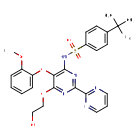
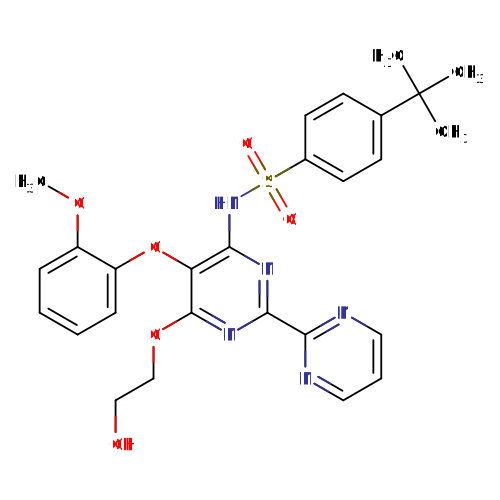
Structure for Bosentan (DB00559)
- Weight
- Average: 551.614
Monoisotopic: 551.183854375 - Chemical Formula
- C27H29N5O6S
- Synonyms
- 4-(1,1-Dimethylethyl)-N-(6-(2-hydroxyethoxy)-5-(2-methoxyphenoxy)-(2,2'-bipyrimidin)-4-yl) benzenesulfornamide
- bosentán
- Bosentan
- bosentan anhydrous
- bosentanum
- p-tert-Butyl-N-(6-(2-hydroxyethoxy)-5-(o-methoxyphenoxy)-2-(2-pyrimidinyl)-4-pyrimidinyl)benzenesulfonamide

Pharmacology
- Indication
Used in the treatment of pulmonary arterial hypertension (PAH), to improve exercise ability and to decrease the rate of clinical worsening (in patients with WHO Class III or IV symptoms).
 Reduce drug development failure ratesBuild, train, & validate machine-learning modelswith evidence-based and structured datasets.Build, train, & validate predictive machine-learning models with structured datasets.
- Associated Conditions
Indication Type Indication Combined Product Details Approval Level Age Group Patient Characteristics Dose Form Used in combination for prophylaxis of Eye inflammation Combination Product in combination with: Dexamethasone (DB01234) •••••••••••• •••••••••• Used in combination to treat Eye inflammation Combination Product in combination with: Dexamethasone (DB01234) •••••••••••• •••••••••• Management of Nyha functional class ii-iv pulmonary arterial hypertension •••••••••••• Used in combination to treat Ocular bacterial infections Combination Product in combination with: Dexamethasone (DB01234) •••••••••••• •••••••••• Used in combination for prophylaxis of Ocular bacterial infections Combination Product in combination with: Dexamethasone (DB01234) •••••••••••• •••••••••• - Contraindications & Blackbox Warnings
 Prevent Adverse Drug Events TodayTap into our Clinical API for life-saving information on contraindications & blackbox warnings, population restrictions, harmful risks, & more.Avoid life-threatening adverse drug events with our Clinical API
- Pharmacodynamics
Bosentan belongs to a class of drugs known as endothelin receptor antagonists (ERAs). Patients with PAH have elevated levels of endothelin, a potent blood vessel constrictor, in their plasma and lung tissue. Bosentan blocks the binding of endothelin to its receptors, thereby negating endothelin's deleterious effects.
- Mechanism of action
Endothelin-1 (ET-1) is a neurohormone, the effects of which are mediated by binding to ETA and ETB receptors in the endothelium and vascular smooth muscle. It displays a slightly higher affinity towards ETA receptors than ETB receptors. ET-1 concentrations are elevated in plasma and lung tissue of patients with pulmonary arterial hypertension, suggesting a pathogenic role for ET-1 in this disease. Bosentan is a specific and competitive antagonist at endothelin receptor types ETA and ETB.
Target Actions Organism AEndothelin B receptor antagonistHumans AEndothelin-1 receptor antagonistHumans - Absorption
Absolute bioavailability is approximately 50% and food does not affect absorption.
- Volume of distribution
- 18 L
- Protein binding
Greater than 98% to plasma proteins, mainly albumin.
- Metabolism
Bosentan is metabolized in the liver by the cytochrome P450 enzymes CYP2C9 and CYP3A4 (and possibly CYP2C19), producing three metabolites, one of which, Ro 48-5033, is pharmacologically active and may contribute 10 to 20% to the total activity of the parent compound.
Hover over products below to view reaction partners
- Route of elimination
Bosentan is eliminated by biliary excretion following metabolism in the liver.
- Half-life
Terminal elimination half-life is about 5 hours in healthy adult subjects.
- Clearance
- 4 L/h [patients with pulmonary arterial hypertension]
- Adverse Effects
 Improve decision support & research outcomesWith structured adverse effects data, including: blackbox warnings, adverse reactions, warning & precautions, & incidence rates. View sample adverse effects data in our new Data Library!Improve decision support & research outcomes with our structured adverse effects data.
- Toxicity
Bosentan has been given as a single dose of up to 2400 mg in normal volunteers, or up to 2000 mg/day for 2 months in patients, without any major clinical consequences. The most common side effect was headache of mild to moderate intensity. In the cyclosporine A interaction study, in which doses of 500 and 1000 mg b.i.d. of bosentan were given concomitantly with cyclosporine A, trough plasma concentrations of bosentan increased 30-fold, resulting in severe headache, nausea, and vomiting, but no serious adverse events. Mild decreases in blood pressure and increases in heart rate were observed. There is no specific experience of overdosage with bosentan beyond the doses described above. Massive overdosage may result in pronounced hypotension requiring active cardiovascular support.
- Pathways
- Not Available
- Pharmacogenomic Effects/ADRs
- Not Available
Interactions
- Drug Interactions
- This information should not be interpreted without the help of a healthcare provider. If you believe you are experiencing an interaction, contact a healthcare provider immediately. The absence of an interaction does not necessarily mean no interactions exist.
Drug Interaction Integrate drug-drug
interactions in your softwareAbaloparatide Abaloparatide may increase the hypotensive activities of Bosentan. Abametapir The serum concentration of Bosentan can be increased when it is combined with Abametapir. Abatacept The metabolism of Bosentan can be increased when combined with Abatacept. Abemaciclib The metabolism of Abemaciclib can be increased when combined with Bosentan. Abrocitinib The metabolism of Abrocitinib can be increased when combined with Bosentan. - Food Interactions
- Take with or without food. The absorption is unaffected by food.
Products
 Drug product information from 10+ global regionsOur datasets provide approved product information including:dosage, form, labeller, route of administration, and marketing period.Access drug product information from over 10 global regions.
- Product Ingredients
Ingredient UNII CAS InChI Key Bosentan monohydrate Q326023R30 157212-55-0 SXTRWVVIEPWAKM-UHFFFAOYSA-N - Brand Name Prescription Products
Name Dosage Strength Route Labeller Marketing Start Marketing End Region Image Act Bosentan Tablet 125 mg Oral Actavis Pharma Company 2012-06-05 2018-04-25 Canada 
Act Bosentan Tablet 62.5 mg Oral Actavis Pharma Company 2012-06-05 2018-04-25 Canada Alembic-bosentan Tablet 125 mg Oral Alembic Pharmaceuticals Limited Not applicable Not applicable Canada Alembic-bosentan Tablet 62.5 mg Oral Alembic Pharmaceuticals Limited Not applicable Not applicable Canada Bosentan Tablet 62.5 mg Oral Panda Pharmaceuticals Inc. Not applicable Not applicable Canada - Generic Prescription Products
Name Dosage Strength Route Labeller Marketing Start Marketing End Region Image Accel-bosentan Tablet 125 mg Oral Accel Pharma Inc Not applicable Not applicable Canada Apo-bosentan Tablet 125.0 mg Oral Apotex Corporation 2017-07-14 Not applicable Canada Apo-bosentan Tablet 62.5 mg Oral Apotex Corporation 2017-07-14 Not applicable Canada Auro-bosentan Tablet 125 mg Oral Auro Pharma Inc Not applicable Not applicable Canada Auro-bosentan Tablet 62.5 mg Oral Auro Pharma Inc Not applicable Not applicable Canada - Mixture Products
Name Ingredients Dosage Route Labeller Marketing Start Marketing End Region Image OCUBRAX® SUSPENSION OFTALMICA Bosentan (3 mg) + Dexamethasone (1 mg) Suspension Conjunctival; Ophthalmic OPHARM LTDA. 2008-07-23 Not applicable Colombia 
Categories
- ATC Codes
- G01AE10 — Combinations of sulfonamides
- G01AE — Sulfonamides
- G01A — ANTIINFECTIVES AND ANTISEPTICS, EXCL. COMBINATIONS WITH CORTICOSTEROIDS
- G01 — GYNECOLOGICAL ANTIINFECTIVES AND ANTISEPTICS
- G — GENITO URINARY SYSTEM AND SEX HORMONES
- Drug Categories
- Amides
- Antihypertensive Agents
- Antihypertensives for Pulmonary Arterial Hypertension
- Benzene Derivatives
- Benzenesulfonamides
- BSEP/ABCB11 Inhibitors
- Cardiovascular Agents
- Cytochrome P-450 CYP2C9 Inducers
- Cytochrome P-450 CYP2C9 Inducers (moderate)
- Cytochrome P-450 CYP2C9 Substrates
- Cytochrome P-450 CYP3A Inducers
- Cytochrome P-450 CYP3A Substrates
- Cytochrome P-450 CYP3A4 Inducers
- Cytochrome P-450 CYP3A4 Inducers (moderate)
- Cytochrome P-450 CYP3A4 Substrates
- Cytochrome P-450 Enzyme Inducers
- Cytochrome P-450 Substrates
- Endothelin Receptor Antagonists
- Genito Urinary System and Sex Hormones
- Gynecological Antiinfectives and Antiseptics
- Hepatotoxic Agents
- OATP1B1/SLCO1B1 Substrates
- Pyrimidines
- Sulfonamides
- Sulfones
- Sulfur Compounds
- Vasodilating Agents
- Chemical TaxonomyProvided by Classyfire
- Description
- This compound belongs to the class of organic compounds known as bipyrimidines and oligopyrimidines. These are organic compounds containing two or more pyrimidine rings directly linked to each other. Pyrimidine is a 6-membered ring consisting of four carbon atoms and two nitrogen centers at the 1- and 3- ring positions.
- Kingdom
- Organic compounds
- Super Class
- Organoheterocyclic compounds
- Class
- Diazines
- Sub Class
- Pyrimidines and pyrimidine derivatives
- Direct Parent
- Bipyrimidines and oligopyrimidines
- Alternative Parents
- Diarylethers / Benzenesulfonamides / Phenylpropanes / Benzenesulfonyl compounds / Phenoxy compounds / Anisoles / Methoxybenzenes / Alkyl aryl ethers / Organosulfonamides / Imidolactams show 8 more
- Substituents
- Alcohol / Alkyl aryl ether / Aminosulfonyl compound / Anisole / Aromatic heteromonocyclic compound / Azacycle / Benzenesulfonamide / Benzenesulfonyl group / Benzenoid / Bipyrimidine show 22 more
- Molecular Framework
- Aromatic heteromonocyclic compounds
- External Descriptors
- sulfonamide, pyrimidines, primary alcohol (CHEBI:51450)
- Affected organisms
- Humans and other mammals
Chemical Identifiers
- UNII
- XUL93R30K2
- CAS number
- 147536-97-8
- InChI Key
- GJPICJJJRGTNOD-UHFFFAOYSA-N
- InChI
- InChI=1S/C27H29N5O6S/c1-27(2,3)18-10-12-19(13-11-18)39(34,35)32-23-22(38-21-9-6-5-8-20(21)36-4)26(37-17-16-33)31-25(30-23)24-28-14-7-15-29-24/h5-15,33H,16-17H2,1-4H3,(H,30,31,32)
- IUPAC Name
- 4-tert-butyl-N-[6-(2-hydroxyethoxy)-5-(2-methoxyphenoxy)-[2,2'-bipyrimidin]-4-yl]benzene-1-sulfonamide
- SMILES
- COC1=CC=CC=C1OC1=C(NS(=O)(=O)C2=CC=C(C=C2)C(C)(C)C)N=C(N=C1OCCO)C1=NC=CC=N1
References
- Synthesis Reference
Maurizio TADDEI, Diletta Naldini, Pietro Allegrini, Gabriele Razzetti, Simone Mantegazza, "Process for the Preparation of Bosentan." U.S. Patent US20090156811, issued June 18, 2009.
US20090156811- General References
- FDA Approved Drugs: Tracleer® oral tablets [Link]
- External Links
- Human Metabolome Database
- HMDB0014699
- KEGG Drug
- D01227
- PubChem Compound
- 104865
- PubChem Substance
- 46507154
- ChemSpider
- 94651
- BindingDB
- 50061101
- 75207
- ChEBI
- 51450
- ChEMBL
- CHEMBL957
- ZINC
- ZINC000001538857
- Therapeutic Targets Database
- DNC000341
- PharmGKB
- PA10034
- PDBe Ligand
- K86
- RxList
- RxList Drug Page
- Drugs.com
- Drugs.com Drug Page
- Wikipedia
- Bosentan
- PDB Entries
- 5xpr
- FDA label
- Download (424 KB)
Clinical Trials
- Clinical Trials
Phase Status Purpose Conditions Count 4 Completed Basic Science Type 2 Diabetes Mellitus 1 4 Completed Supportive Care Type 2 Diabetes Mellitus 1 4 Completed Treatment Digital Ulcers / Systemic Sclerosis (SSc) 1 4 Completed Treatment Eisenmenger's Syndrome 1 4 Completed Treatment Pulmonary Arterial Hypertension (PAH) 4
Pharmacoeconomics
- Manufacturers
- Actelion ltd
- Packagers
- Actelion Pharmaceuticals Inc.
- Action Pharmaceuticals Ltd.
- Haupt Pharma
- Patheon Inc.
- Dosage Forms
Form Route Strength Tablet Oral 125.0 mg Tablet Oral 125 mg/1 Tablet Oral 62.5 mg/1 Tablet, coated Oral 125 mg/1 Tablet, coated Oral 62.5 mg/1 Tablet, film coated Oral 125 mg/1 Tablet, film coated Oral 62.5 mg/1 Tablet, film coated Oral Tablet Oral 125.000 mg Tablet Oral 64.542 mg Tablet Oral 64.541 mg Tablet Oral 64.540 mg Suspension Conjunctival; Ophthalmic Tablet, coated Oral 6250000 mg Tablet, film coated Oral 125.00 mg Tablet, film coated Oral 62.50 mg Tablet, coated Oral 129.08 mg Tablet, coated Oral 64.54 mg Tablet Oral 12500000 mg Tablet, coated Oral 12500000 mg Tablet Oral 125 mg Tablet Oral 62.5 mg Tablet Oral 62.500 mg Tablet, coated Oral 125 mg Tablet, coated Oral 62.5 mg Tablet, for suspension Oral 32 mg/1 Tablet, for suspension Oral 32 MG Tablet Oral 33.045 mg Tablet, film coated Oral 125 mg Tablet, film coated Oral 62.5 mg - Prices
- Not Available
- Patents
Patent Number Pediatric Extension Approved Expires (estimated) Region CA2071193 No 1998-08-25 2012-06-12 Canada US5292740 No 1994-03-08 2015-11-20 US 
US7959945 No 2011-06-14 2027-12-28 US US8309126 No 2012-11-13 2026-05-15 US
Properties
- State
- Solid
- Experimental Properties
Property Value Source water solubility Poorly soluble in water (1.0 mg/100 ml) and in aqueous solutions at low pH (0.1 mg/100 ml at pH 1.1 and 4.0; 0.2 mg/100 ml at pH 5.0). Solubility increases at higher pH values (43 mg/100 ml at pH 7.5). Not Available logP 3.7 Not Available Caco2 permeability -5.98 ADME Research, USCD - Predicted Properties
Property Value Source Water Solubility 0.00904 mg/mL ALOGPS logP 4.18 ALOGPS logP 4.94 Chemaxon logS -4.8 ALOGPS pKa (Strongest Acidic) 5.8 Chemaxon pKa (Strongest Basic) 0.57 Chemaxon Physiological Charge -1 Chemaxon Hydrogen Acceptor Count 9 Chemaxon Hydrogen Donor Count 2 Chemaxon Polar Surface Area 145.65 Å2 Chemaxon Rotatable Bond Count 10 Chemaxon Refractivity 166.66 m3·mol-1 Chemaxon Polarizability 57.89 Å3 Chemaxon Number of Rings 4 Chemaxon Bioavailability 1 Chemaxon Rule of Five No Chemaxon Ghose Filter No Chemaxon Veber's Rule No Chemaxon MDDR-like Rule Yes Chemaxon - Predicted ADMET Features
Property Value Probability Human Intestinal Absorption + 0.9253 Blood Brain Barrier - 0.7419 Caco-2 permeable - 0.8956 P-glycoprotein substrate Non-substrate 0.5738 P-glycoprotein inhibitor I Non-inhibitor 0.6175 P-glycoprotein inhibitor II Non-inhibitor 0.5092 Renal organic cation transporter Non-inhibitor 0.9149 CYP450 2C9 substrate Non-substrate 0.5926 CYP450 2D6 substrate Non-substrate 0.9117 CYP450 3A4 substrate Substrate 0.5132 CYP450 1A2 substrate Non-inhibitor 0.7203 CYP450 2C9 inhibitor Inhibitor 0.518 CYP450 2D6 inhibitor Non-inhibitor 0.8755 CYP450 2C19 inhibitor Non-inhibitor 0.5219 CYP450 3A4 inhibitor Inhibitor 0.8407 CYP450 inhibitory promiscuity High CYP Inhibitory Promiscuity 0.772 Ames test Non AMES toxic 0.6147 Carcinogenicity Non-carcinogens 0.6515 Biodegradation Not ready biodegradable 1.0 Rat acute toxicity 2.2676 LD50, mol/kg Not applicable hERG inhibition (predictor I) Weak inhibitor 0.9679 hERG inhibition (predictor II) Non-inhibitor 0.572
Spectra
- Mass Spec (NIST)
- Not Available
- Spectra
- Chromatographic Properties
Collision Cross Sections (CCS)
Adduct CCS Value (Å2) Source type Source [M-H]- 242.1955365 predictedDarkChem Lite v0.1.0 [M-H]- 254.4531365 predictedDarkChem Lite v0.1.0 [M-H]- 211.8961 predictedDeepCCS 1.0 (2019) [M+H]+ 242.1594365 predictedDarkChem Lite v0.1.0 [M+H]+ 254.9170365 predictedDarkChem Lite v0.1.0 [M+H]+ 214.29167 predictedDeepCCS 1.0 (2019) [M+Na]+ 243.2314365 predictedDarkChem Lite v0.1.0 [M+Na]+ 220.20421 predictedDeepCCS 1.0 (2019)
Targets

- Kind
- Protein
- Organism
- Humans
- Pharmacological action
- Yes
- Actions
- Antagonist
- General Function
- Peptide hormone binding
- Specific Function
- Non-specific receptor for endothelin 1, 2, and 3. Mediates its action by association with G proteins that activate a phosphatidylinositol-calcium second messenger system.
- Gene Name
- EDNRB
- Uniprot ID
- P24530
- Uniprot Name
- Endothelin B receptor
- Molecular Weight
- 49643.255 Da
References
- Chen X, Ji ZL, Chen YZ: TTD: Therapeutic Target Database. Nucleic Acids Res. 2002 Jan 1;30(1):412-5. [Article]
- Gardiner SM, Kemp PA, March JE, Bennett T: Effects of bosentan (Ro 47-0203), an ETA-, ETB-receptor antagonist, on regional haemodynamic responses to endothelins in conscious rats. Br J Pharmacol. 1994 Jul;112(3):823-30. [Article]
- Gupta SK, Saxena A, Singh U, Arya DS: Bosentan, the mixed ETA-ETB endothelin receptor antagonist, attenuated oxidative stress after experimental myocardial ischemia and reperfusion. Mol Cell Biochem. 2005 Jul;275(1-2):67-74. [Article]
- Marano G, Palazzesi S, Bernucci P, Grigioni M, Formigari R, Ballerini L: ET(A)/ET(B) receptor antagonist bosentan inhibits neointimal development in collared carotid arteries of rabbits. Life Sci. 1998;63(18):PL259-66. [Article]
- Richard V, Kaeffer N, Hogie M, Tron C, Blanc T, Thuillez C: Role of endogenous endothelin in myocardial and coronary endothelial injury after ischaemia and reperfusion in rats: studies with bosentan, a mixed ETA-ETB antagonist. Br J Pharmacol. 1994 Nov;113(3):869-76. [Article]
- Said SA, Ammar el SM, Suddek GM: Effect of bosentan (ETA/ETB receptor antagonist) on metabolic changes during stress and diabetes. Pharmacol Res. 2005 Feb;51(2):107-15. [Article]
- Kind
- Protein
- Organism
- Humans
- Pharmacological action
- Yes
- Actions
- Antagonist
- General Function
- Phosphatidylinositol phospholipase c activity
- Specific Function
- Receptor for endothelin-1. Mediates its action by association with G proteins that activate a phosphatidylinositol-calcium second messenger system. The rank order of binding affinities for ET-A is:...
- Gene Name
- EDNRA
- Uniprot ID
- P25101
- Uniprot Name
- Endothelin-1 receptor
- Molecular Weight
- 48721.76 Da
References
- Albertini M, Lafortuna CL, Ciminaghi B, Mazzola S, Clement MG: Endothelin involvement in respiratory centre activity. Prostaglandins Leukot Essent Fatty Acids. 2001 Sep;65(3):157-63. [Article]
- Chen X, Ji ZL, Chen YZ: TTD: Therapeutic Target Database. Nucleic Acids Res. 2002 Jan 1;30(1):412-5. [Article]
- Kiowski W, Sutsch G, Oechslin E, Bertel O: Hemodynamic effects of bosentan in patients with chronic heart failure. Heart Fail Rev. 2001 Dec;6(4):325-34. [Article]
- Kramp R, Fourmanoir P, Caron N: Endothelin resets renal blood flow autoregulatory efficiency during acute blockade of NO in the rat. Am J Physiol Renal Physiol. 2001 Dec;281(6):F1132-40. [Article]
- Martin C, Held HD, Uhlig S: Differential effects of the mixed ET(A)/ET(B)-receptor antagonist bosentan on endothelin-induced bronchoconstriction, vasoconstriction and prostacyclin release. Naunyn Schmiedebergs Arch Pharmacol. 2000 Aug;362(2):128-36. [Article]
- Sihvola RK, Pulkkinen VP, Koskinen PK, Lemstrom KB: Crosstalk of endothelin-1 and platelet-derived growth factor in cardiac allograft arteriosclerosis. J Am Coll Cardiol. 2002 Feb 20;39(4):710-7. [Article]
Enzymes
- Kind
- Protein
- Organism
- Humans
- Pharmacological action
- Unknown
- Actions
- SubstrateInducer
- General Function
- Vitamin d3 25-hydroxylase activity
- Specific Function
- Cytochromes P450 are a group of heme-thiolate monooxygenases. In liver microsomes, this enzyme is involved in an NADPH-dependent electron transport pathway. It performs a variety of oxidation react...
- Gene Name
- CYP3A4
- Uniprot ID
- P08684
- Uniprot Name
- Cytochrome P450 3A4
- Molecular Weight
- 57342.67 Da
References
- Dingemanse J, Schaarschmidt D, van Giersbergen PL: Investigation of the mutual pharmacokinetic interactions between bosentan, a dual endothelin receptor antagonist, and simvastatin. Clin Pharmacokinet. 2003;42(3):293-301. [Article]
- Dingemanse J, van Giersbergen PL: Clinical pharmacology of bosentan, a dual endothelin receptor antagonist. Clin Pharmacokinet. 2004;43(15):1089-115. [Article]
- Zhou SF, Zhou ZW, Yang LP, Cai JP: Substrates, inducers, inhibitors and structure-activity relationships of human Cytochrome P450 2C9 and implications in drug development. Curr Med Chem. 2009;16(27):3480-675. Epub 2009 Sep 1. [Article]
- FDA table of interactions [Link]
- FDA Drug Development and Drug Interactions: Table of Substrates, Inhibitors and Inducers [Link]
- Kind
- Protein
- Organism
- Humans
- Pharmacological action
- Unknown
- Actions
- SubstrateInducer
- General Function
- Steroid hydroxylase activity
- Specific Function
- Cytochromes P450 are a group of heme-thiolate monooxygenases. In liver microsomes, this enzyme is involved in an NADPH-dependent electron transport pathway. It oxidizes a variety of structurally un...
- Gene Name
- CYP2C9
- Uniprot ID
- P11712
- Uniprot Name
- Cytochrome P450 2C9
- Molecular Weight
- 55627.365 Da
References
- Zhou SF, Zhou ZW, Yang LP, Cai JP: Substrates, inducers, inhibitors and structure-activity relationships of human Cytochrome P450 2C9 and implications in drug development. Curr Med Chem. 2009;16(27):3480-675. Epub 2009 Sep 1. [Article]
- Matsunaga N, Kaneko N, Staub AY, Nakanishi T, Nunoya K, Imawaka H, Tamai I: Analysis of the Metabolic Pathway of Bosentan and of the Cytotoxicity of Bosentan Metabolites Based on a Quantitative Modeling of Metabolism and Transport in Sandwich-Cultured Human Hepatocytes. Drug Metab Dispos. 2016 Jan;44(1):16-27. doi: 10.1124/dmd.115.067074. Epub 2015 Oct 26. [Article]
- Cheng JW: Bosentan. Heart Dis. 2003 Mar-Apr;5(2):161-9. [Article]
- van Giersbergen PL, Halabi A, Dingemanse J: Single- and multiple-dose pharmacokinetics of bosentan and its interaction with ketoconazole. Br J Clin Pharmacol. 2002 Jun;53(6):589-95. [Article]
- Elshaboury SM, Anderson JR: Ambrisentan for the treatment of pulmonary arterial hypertension: improving outcomes. Patient Prefer Adherence. 2013 May 8;7:401-9. doi: 10.2147/PPA.S30949. Print 2013. [Article]
- Bosentan FDA label [File]
Transporters
- Kind
- Protein
- Organism
- Humans
- Pharmacological action
- Unknown
- Actions
- Inhibitor
- General Function
- Transporter activity
- Specific Function
- Involved in the ATP-dependent secretion of bile salts into the canaliculus of hepatocytes.
- Gene Name
- ABCB11
- Uniprot ID
- O95342
- Uniprot Name
- Bile salt export pump
- Molecular Weight
- 146405.83 Da
References
- Fattinger K, Funk C, Pantze M, Weber C, Reichen J, Stieger B, Meier PJ: The endothelin antagonist bosentan inhibits the canalicular bile salt export pump: a potential mechanism for hepatic adverse reactions. Clin Pharmacol Ther. 2001 Apr;69(4):223-31. [Article]

Drug created at June 13, 2005 13:24 / Updated at April 26, 2024 00:45