Identification
- Summary
Gonadorelin is a synthetic GnRH used to test the function of gonadotropes and the pituitary.
- Brand Names
- Lutrepulse
- Generic Name
- Gonadorelin
- DrugBank Accession Number
- DB00644
- Background
Gonadorelin is another name for gonadotropin-releasing hormone (GnRH). It is a synthetic decapeptide prepared using solid phase peptide synthesis. GnRH is responsible for the release of follicle stimulating hormone and leutinizing hormone from the anterior pituitary.
- Type
- Small Molecule
- Groups
- Approved, Investigational, Vet approved
- Structure
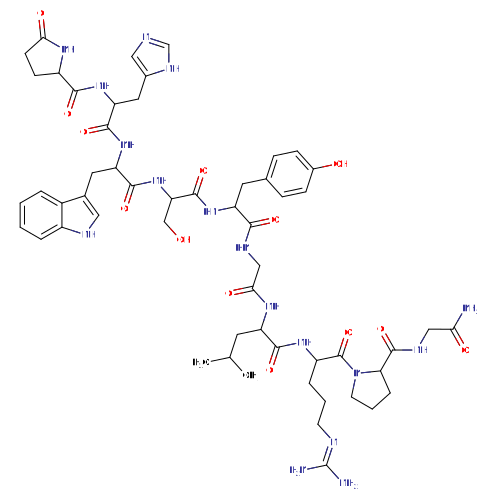
Structure for Gonadorelin (DB00644)
- Weight
- Average: 1182.2901
Monoisotopic: 1181.573025571 - Chemical Formula
- C55H75N17O13
- Synonyms
- GnRH
- Gonadorelin
- Gonadorelina
- Gonadoréline
- Gonadorelinum
- Gonadotropin-releasing hormone
- External IDs
- Abbott 41070
- AY 24031
- Hoe 471
- RU 19847

Pharmacology
- Indication
For evaluating the functional capacity and response of the gonadotropes of the anterior pituitary also for evaluating residual gonadotropic function of the pituitary following removal of a pituitary tumor by surgery and/or irradiation.
 Reduce drug development failure ratesBuild, train, & validate machine-learning modelswith evidence-based and structured datasets.Build, train, & validate predictive machine-learning models with structured datasets.
- Associated Therapies
- Contraindications & Blackbox Warnings
 Prevent Adverse Drug Events TodayTap into our Clinical API for life-saving information on contraindications & blackbox warnings, population restrictions, harmful risks, & more.Avoid life-threatening adverse drug events with our Clinical API
- Pharmacodynamics
Gonadorelin is responsible for the release of follicle stimulating hormone and leutinizing hormone from the anterior pitutitary. In the pituitary GnRH stimulates synthesis and release of FSH and LH, a process that is controlled by the frequency and amplitude of GnRH pulses, as well as the feedback of androgens and estrogens. The pulsatility of GnRH secretion has been seen in all vertebrates, and it is necessary to ensure a correct reproductive function. Thus a single hormone, GnRH, controls a complex process of follicular growth, ovulation, and corpus luteum maintenance in the female, and spermatogenesis in the male. Its short half life requires infusion pumps for its clinical use
- Mechanism of action
Systemic - Like naturally occurring gonadotropin-releasing hormone (GnRH), gonadorelin primarily stimulates the synthesis and release of luteinizing hormone (LH) from the anterior pituitary gland. Follicle-stimulating hormone (FSH) production and release is also increased by gonadorelin, but to a lesser degree. In prepubertal females and some gonadal function disorders, the FSH response may be greater than the LH response. For the treatment of amenorrhea, delayed puberty, and infertility the administration of gonadorelin is used to simulate the physiologic release of GnRH from the hypothalamus in treatment of delayed puberty, treatment of infertility caused by hypogonadotropic hypogonadism, and induction of ovulation in those women with hypothalamic amenorrhea. This results in increased levels of pituitary gonadotropins LH and FSH, which subsequently stimulate the gonads to produce reproductive steroids.
Target Actions Organism AGonadotropin-releasing hormone receptor agonistHumans APutative gonadotropin-releasing hormone II receptor agonistHumans - Absorption
Rapidly absorbed when injected
- Volume of distribution
Not Available
- Protein binding
Not Available
- Metabolism
Rapidly hydrolyzed to inactive peptide components
- Route of elimination
Not Available
- Half-life
Very short, initial, 2 to 10 minutes; terminal, 10 to 40 minutes
- Clearance
Not Available
- Adverse Effects
 Improve decision support & research outcomesWith structured adverse effects data, including: blackbox warnings, adverse reactions, warning & precautions, & incidence rates. View sample adverse effects data in our new Data Library!Improve decision support & research outcomes with our structured adverse effects data.
- Toxicity
LD50>3000 mg/kg (rat, oral)
- Pathways
- Not Available
- Pharmacogenomic Effects/ADRs
- Not Available
Interactions
- Drug Interactions
- This information should not be interpreted without the help of a healthcare provider. If you believe you are experiencing an interaction, contact a healthcare provider immediately. The absence of an interaction does not necessarily mean no interactions exist.
Drug Interaction Integrate drug-drug
interactions in your softwareCapromab pendetide Gonadorelin may decrease effectiveness of Capromab pendetide as a diagnostic agent. Choline C 11 Gonadorelin may decrease effectiveness of Choline C 11 as a diagnostic agent. Corifollitropin alfa The therapeutic efficacy of Corifollitropin alfa can be increased when used in combination with Gonadorelin. - Food Interactions
- No interactions found.
Products
 Drug product information from 10+ global regionsOur datasets provide approved product information including:dosage, form, labeller, route of administration, and marketing period.Access drug product information from over 10 global regions.
- Product Ingredients
Ingredient UNII CAS InChI Key Gonadorelin acetate 2RG1XQ1NYJ 52699-48-6 OOBWZCWPKJOGPF-UHFFFAOYSA-N Gonadorelin diacetate tetrahydrate L8CRY8PWF2 Not Available QZBIKDNLZRFYMZ-KYOBJPNESA-N Gonadorelin hydrochloride 3PFC574ITA 51952-41-1 CXLJLMYFZCNNQA-HBBGHHHDSA-N - International/Other Brands
- Fertagyl / Gonadorelin (Intrapharm) / HRF (Intrapharm) / Hypocrine (Tanabe Mitsubishi Pharma) / Kryptocur (Sanofi-Aventis) / Lutrelef (Ferring) / Relefact (Sanofi-Aventis)
- Brand Name Prescription Products
Name Dosage Strength Route Labeller Marketing Start Marketing End Region Image Factrel Inj 0.5mg/vial Powder, for solution .5 mg / vial Intravenous; Subcutaneous Ayerst Laboratories 1976-12-31 1996-09-10 Canada 
Factrel Pws 100mcg/vial Powder, for solution 100 mcg / vial Intravenous; Subcutaneous Wyeth Ayerst Canada Inc. 1994-12-31 1999-10-26 Canada Factrel Pws 500mcg/vial Powder, for solution 500 mcg / vial Intravenous; Subcutaneous Wyeth Ayerst Canada Inc. 1995-12-31 1999-10-26 Canada Lutrepulse Powder, for solution 3.2 mg / vial Intravenous; Subcutaneous Ferring Pharmaceuticals 1994-12-31 Not applicable Canada Lutrepulse Pws 0.8mg/vial Powder, for solution 0.8 mg / vial Intravenous; Subcutaneous Ferring Pharmaceuticals 1994-12-31 Not applicable Canada - Mixture Products
Name Ingredients Dosage Route Labeller Marketing Start Marketing End Region Image Relisorm 100 for Inj.-pws Liq-kit Sc IV Gonadorelin acetate (100 mcg / vial) + Sodium chloride (0.9 % / vial) Liquid; Powder, for solution Intravenous; Subcutaneous Emd Serono, A Division Of Emd Inc., Canada 1994-12-31 2019-07-04 Canada Relisorm 500 for Inj.-pws Liq-kit IV Sc Gonadorelin acetate (500 mcg / vial) + Sodium chloride (.9 % / vial) Liquid; Powder, for solution Intravenous; Subcutaneous Emd Serono, A Division Of Emd Inc., Canada 1994-12-31 2019-07-04 Canada
Categories
- ATC Codes
- V04CM01 — Gonadorelin
- V04CM — Tests for fertility disturbances
- V04C — OTHER DIAGNOSTIC AGENTS
- V04 — DIAGNOSTIC AGENTS
- V — VARIOUS
- Drug Categories
- Adrenal Cortex Hormones
- Amino Acids, Peptides, and Proteins
- Diagnostic Agents
- Gonadotropin-releasing hormone agonist
- Gonadotropin-Releasing Hormone, agonists
- Gonadotropin-Releasing Hormone, antagonists & inhibitors
- Gonadotropins and Antigonadotropins
- Hormones
- Hormones, Hormone Substitutes, and Hormone Antagonists
- Hypothalamic Hormones
- Nerve Tissue Proteins
- Neuropeptides
- Oligopeptides
- Peptide Hormones
- Peptides
- Pituitary and Hypothalamic Hormones and Analogues
- Pituitary Function
- Pituitary Hormone-Releasing Hormones
- Proteins
- Systemic Hormonal Preparations, Excl. Sex Hormones and Insulins
- Tests for Fertility Disturbances
- Chemical TaxonomyProvided by Classyfire
- Description
- This compound belongs to the class of organic compounds known as polypeptides. These are peptides containing ten or more amino acid residues.
- Kingdom
- Organic compounds
- Super Class
- Organic Polymers
- Class
- Polypeptides
- Sub Class
- Not Available
- Direct Parent
- Polypeptides
- Alternative Parents
- Peptides / Tyrosine and derivatives / Phenylalanine and derivatives / Histidine and derivatives / Leucine and derivatives / N-acyl-alpha amino acids and derivatives / Proline and derivatives / Tryptamines and derivatives / Serine and derivatives / Alpha amino acid amides show 23 more
- Substituents
- 1-hydroxy-2-unsubstituted benzenoid / 2-pyrrolidone / 3-alkylindole / Alcohol / Alpha peptide / Alpha-amino acid amide / Alpha-amino acid or derivatives / Amphetamine or derivatives / Aromatic heteropolycyclic compound / Azacycle show 48 more
- Molecular Framework
- Aromatic heteropolycyclic compounds
- External Descriptors
- Gonadotropin-releasing hormone [KO:K05252] (C07607)
- Affected organisms
- Humans and other mammals
Chemical Identifiers
- UNII
- 9O7312W37G
- CAS number
- 33515-09-2
- InChI Key
- XLXSAKCOAKORKW-UHFFFAOYSA-N
- InChI
- InChI=1S/C55H75N17O13/c1-29(2)19-38(49(80)67-37(9-5-17-60-55(57)58)54(85)72-18-6-10-43(72)53(84)62-25-44(56)75)66-46(77)26-63-47(78)39(20-30-11-13-33(74)14-12-30)68-52(83)42(27-73)71-50(81)40(21-31-23-61-35-8-4-3-7-34(31)35)69-51(82)41(22-32-24-59-28-64-32)70-48(79)36-15-16-45(76)65-36/h3-4,7-8,11-14,23-24,28-29,36-43,61,73-74H,5-6,9-10,15-22,25-27H2,1-2H3,(H2,56,75)(H,59,64)(H,62,84)(H,63,78)(H,65,76)(H,66,77)(H,67,80)(H,68,83)(H,69,82)(H,70,79)(H,71,81)(H4,57,58,60)
- IUPAC Name
- N-(1-{2-[(carbamoylmethyl)carbamoyl]pyrrolidin-1-yl}-5-[(diaminomethylidene)amino]-1-oxopentan-2-yl)-2-{2-[2-(3-hydroxy-2-{2-[3-(1H-imidazol-5-yl)-2-[(5-oxopyrrolidin-2-yl)formamido]propanamido]-3-(1H-indol-3-yl)propanamido}propanamido)-3-(4-hydroxyphenyl)propanamido]acetamido}-4-methylpentanamide
- SMILES
- CC(C)CC(NC(=O)CNC(=O)C(CC1=CC=C(O)C=C1)NC(=O)C(CO)NC(=O)C(CC1=CNC2=CC=CC=C12)NC(=O)C(CC1=CN=CN1)NC(=O)C1CCC(=O)N1)C(=O)NC(CCCN=C(N)N)C(=O)N1CCCC1C(=O)NCC(N)=O
References
- Synthesis Reference
Rainer Uhmann, Kurt Radscheit, "Process for the low-racemization preparation of peptide intermediates of the synthesis of gonadorelin and gonadorelin analogs, and new intermediates for this process." U.S. Patent US4691008, issued December, 1984.
US4691008- General References
- Dungan HM, Clifton DK, Steiner RA: Minireview: kisspeptin neurons as central processors in the regulation of gonadotropin-releasing hormone secretion. Endocrinology. 2006 Mar;147(3):1154-8. Epub 2005 Dec 22. [Article]
- Franceschini I, Lomet D, Cateau M, Delsol G, Tillet Y, Caraty A: Kisspeptin immunoreactive cells of the ovine preoptic area and arcuate nucleus co-express estrogen receptor alpha. Neurosci Lett. 2006 Jul 3;401(3):225-30. Epub 2006 Apr 18. [Article]
- External Links
- Human Metabolome Database
- HMDB0014782
- KEGG Compound
- C07607
- PubChem Compound
- 36523
- PubChem Substance
- 46506144
- ChemSpider
- 33562
- 6384
- ChEMBL
- CHEMBL1981292
- Therapeutic Targets Database
- DAP001052
- PharmGKB
- PA449801
- RxList
- RxList Drug Page
- Drugs.com
- Drugs.com Drug Page
- Wikipedia
- Gonadorelin
- MSDS
- Download (32 KB)
Clinical Trials
- Clinical Trials
Phase Status Purpose Conditions Count 4 Active Not Recruiting Basic Science Aging / Hypoestrogenism / Menopause / Women 1 4 Active Not Recruiting Treatment Menstrual Pain / Recurrent Implantation Failure (RIF) / Uterine Adenomyosis 1 4 Completed Not Available Uterine Fibroids (Leiomyomas) 1 4 Completed Basic Science Depression / Hot Flashes / Menopause 1 4 Completed Treatment Assisted Reproduction 1
Pharmacoeconomics
- Manufacturers
- Ferring pharmaceuticals inc
- Baxter healthcare corp anesthesia critical care
- Packagers
- Hospira Inc.
- Intervet International
- Dosage Forms
Form Route Strength Powder, for solution Intravenous; Subcutaneous .5 mg / vial Powder, for solution Intravenous; Subcutaneous 100 mcg / vial Powder, for solution Intravenous; Subcutaneous 500 mcg / vial Powder Not applicable 1 g/1g Spray Nasal 0.2 MG Spray Nasal 0.2 mg/0.1ml Injection, solution Intravenous 0.1 mg/ml Injection, powder, for solution Parenteral Injection, powder, for solution Parenteral 3.2 mg Powder, for solution Intravenous; Subcutaneous 3.2 mg / vial Powder, for solution Intravenous; Subcutaneous 0.8 mg / vial Liquid; powder, for solution Intravenous; Subcutaneous - Prices
- Not Available
- Patents
- Not Available
Properties
- State
- Liquid
- Experimental Properties
Property Value Source water solubility 1 mg/mL Not Available logP -3.6 Not Available - Predicted Properties
Property Value Source Water Solubility 0.0588 mg/mL ALOGPS logP -0.09 ALOGPS logP -6.3 Chemaxon logS -4.3 ALOGPS pKa (Strongest Acidic) 9.47 Chemaxon pKa (Strongest Basic) 11.16 Chemaxon Physiological Charge 1 Chemaxon Hydrogen Acceptor Count 17 Chemaxon Hydrogen Donor Count 16 Chemaxon Polar Surface Area 474.63 Å2 Chemaxon Rotatable Bond Count 31 Chemaxon Refractivity 302.51 m3·mol-1 Chemaxon Polarizability 120.21 Å3 Chemaxon Number of Rings 6 Chemaxon Bioavailability 0 Chemaxon Rule of Five No Chemaxon Ghose Filter No Chemaxon Veber's Rule No Chemaxon MDDR-like Rule Yes Chemaxon - Predicted ADMET Features
Property Value Probability Human Intestinal Absorption + 0.9695 Blood Brain Barrier - 0.9781 Caco-2 permeable - 0.8941 P-glycoprotein substrate Substrate 0.8607 P-glycoprotein inhibitor I Non-inhibitor 0.8452 P-glycoprotein inhibitor II Non-inhibitor 0.7859 Renal organic cation transporter Non-inhibitor 0.6797 CYP450 2C9 substrate Non-substrate 0.769 CYP450 2D6 substrate Non-substrate 0.7647 CYP450 3A4 substrate Substrate 0.5996 CYP450 1A2 substrate Non-inhibitor 0.842 CYP450 2C9 inhibitor Non-inhibitor 0.8493 CYP450 2D6 inhibitor Non-inhibitor 0.9054 CYP450 2C19 inhibitor Non-inhibitor 0.8136 CYP450 3A4 inhibitor Non-inhibitor 0.7529 CYP450 inhibitory promiscuity Low CYP Inhibitory Promiscuity 0.9411 Ames test Non AMES toxic 0.6992 Carcinogenicity Non-carcinogens 0.7961 Biodegradation Not ready biodegradable 0.9933 Rat acute toxicity 2.6799 LD50, mol/kg Not applicable hERG inhibition (predictor I) Weak inhibitor 0.9038 hERG inhibition (predictor II) Non-inhibitor 0.5274
Spectra
- Mass Spec (NIST)
- Not Available
- Spectra
- Chromatographic Properties
Collision Cross Sections (CCS)
Adduct CCS Value (Å2) Source type Source [M-H]- 387.3166071 predictedDarkChem Lite v0.1.0 [M-H]- 335.76492 predictedDeepCCS 1.0 (2019) [M+H]+ 385.7826071 predictedDarkChem Lite v0.1.0 [M+H]+ 337.47076 predictedDeepCCS 1.0 (2019) [M+Na]+ 386.6399071 predictedDarkChem Lite v0.1.0 [M+Na]+ 343.6276 predictedDeepCCS 1.0 (2019)
Targets

- Kind
- Protein
- Organism
- Humans
- Pharmacological action
- Yes
- Actions
- Agonist
- General Function
- Peptide binding
- Specific Function
- Receptor for gonadotropin releasing hormone (GnRH) that mediates the action of GnRH to stimulate the secretion of the gonadotropic hormones luteinizing hormone (LH) and follicle-stimulating hormone...
- Gene Name
- GNRHR
- Uniprot ID
- P30968
- Uniprot Name
- Gonadotropin-releasing hormone receptor
- Molecular Weight
- 37730.355 Da
References
- Lu ZL, Gallagher R, Sellar R, Coetsee M, Millar RP: Mutations remote from the human gonadotropin-releasing hormone (GnRH) receptor-binding sites specifically increase binding affinity for GnRH II but not GnRH I: evidence for ligand-selective, receptor-active conformations. J Biol Chem. 2005 Aug 19;280(33):29796-803. Epub 2005 Jun 20. [Article]
- Moles G, Carrillo M, Mananos E, Mylonas CC, Zanuy S: Temporal profile of brain and pituitary GnRHs, GnRH-R and gonadotropin mRNA expression and content during early development in European sea bass (Dicentrarchus labrax L.). Gen Comp Endocrinol. 2007 Jan 1;150(1):75-86. Epub 2006 Sep 8. [Article]
- Mamputha S, Lu ZL, Roeske RW, Millar RP, Katz AA, Flanagan CA: Conserved amino acid residues that are important for ligand binding in the type I gonadotropin-releasing hormone (GnRH) receptor are required for high potency of GnRH II at the type II GnRH receptor. Mol Endocrinol. 2007 Jan;21(1):281-92. Epub 2006 Sep 14. [Article]
- Lee PA, Houk CP: Gonadotropin-releasing hormone analog therapy for central precocious puberty and other childhood disorders affecting growth and puberty. Treat Endocrinol. 2006;5(5):287-96. [Article]
- Bliss SP, Navratil AM, Breed M, Skinner DC, Clay CM, Roberson MS: Signaling complexes associated with the type I gonadotropin-releasing hormone (GnRH) receptor: colocalization of extracellularly regulated kinase 2 and GnRH receptor within membrane rafts. Mol Endocrinol. 2007 Feb;21(2):538-49. Epub 2006 Oct 26. [Article]
- Chen X, Ji ZL, Chen YZ: TTD: Therapeutic Target Database. Nucleic Acids Res. 2002 Jan 1;30(1):412-5. [Article]
- Kind
- Protein
- Organism
- Humans
- Pharmacological action
- Yes
- Actions
- Agonist
- General Function
- Gonadotropin-releasing hormone receptor activity
- Specific Function
- Putative receptor for gonadotropin releasing hormone II (GnRH II) which is most probably non-functional.
- Gene Name
- GNRHR2
- Uniprot ID
- Q96P88
- Uniprot Name
- Putative gonadotropin-releasing hormone II receptor
- Molecular Weight
- 32536.935 Da
References
- Morgan K, Sellar R, Pawson AJ, Lu ZL, Millar RP: Bovine and ovine gonadotropin-releasing hormone (GnRH)-II ligand precursors and type II GnRH receptor genes are functionally inactivated. Endocrinology. 2006 Nov;147(11):5041-51. Epub 2006 Aug 17. [Article]
- Mamputha S, Lu ZL, Roeske RW, Millar RP, Katz AA, Flanagan CA: Conserved amino acid residues that are important for ligand binding in the type I gonadotropin-releasing hormone (GnRH) receptor are required for high potency of GnRH II at the type II GnRH receptor. Mol Endocrinol. 2007 Jan;21(1):281-92. Epub 2006 Sep 14. [Article]
- Montagnani Marelli M, Moretti RM, Januszkiewicz-Caulier J, Motta M, Limonta P: Gonadotropin-releasing hormone (GnRH) receptors in tumors: a new rationale for the therapeutical application of GnRH analogs in cancer patients? Curr Cancer Drug Targets. 2006 May;6(3):257-69. [Article]
- Li JH, Choe H, Wang AF, Maiti K, Wang C, Salam A, Chun SY, Lee WK, Kim K, Kwon HB, Seong JY: Extracellular loop 3 (EL3) and EL3-proximal transmembrane helix 7 of the mammalian type I and type II gonadotropin-releasing hormone (GnRH) receptors determine differential ligand selectivity to GnRH-I and GnRH-II. Mol Pharmacol. 2005 Apr;67(4):1099-110. Epub 2005 Jan 5. [Article]
- Silver MR, Sower SA: Functional characterization and kinetic studies of an ancestral lamprey GnRH-III selective type II GnRH receptor from the sea lamprey, Petromyzon marinus. J Mol Endocrinol. 2006 Jun;36(3):601-10. [Article]

Drug created at June 13, 2005 13:24 / Updated at April 26, 2024 00:45