Identification
- Summary
Eplerenone is an aldosterone receptor antagonist used to improve survival of patients with symptomatic heart failure and to reduce blood pressure.
- Brand Names
- Inspra
- Generic Name
- Eplerenone
- DrugBank Accession Number
- DB00700
- Background
Eplerenone, an aldosterone receptor antagonist similar to spironolactone, has been shown to produce sustained increases in plasma renin and serum aldosterone, consistent with inhibition of the negative regulatory feedback of aldosterone on renin secretion. The resulting increased plasma renin activity and aldosterone circulating levels do not overcome the effects of eplerenone. Eplerenone selectively binds to recombinant human mineralocorticoid receptors relative to its binding to recombinant human glucocorticoid, progesterone and androgen receptors.
- Type
- Small Molecule
- Groups
- Approved
- Structure
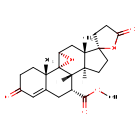
Structure for Eplerenone (DB00700)

- Weight
- Average: 414.4914
Monoisotopic: 414.204238692 - Chemical Formula
- C24H30O6
- Synonyms
- Eplerenona
- Eplerenone
- Epoxymexrenone
- External IDs
- SC-66110
- SC-6611O

Pharmacology
- Indication
For improvement of survival of stable patients with left ventricular systolic dysfunction (ejection fraction <40%) and clinical evidence of congestive heart failure after an acute myocardial infarction.
 Reduce drug development failure ratesBuild, train, & validate machine-learning modelswith evidence-based and structured datasets.Build, train, & validate predictive machine-learning models with structured datasets.
- Associated Conditions
Indication Type Indication Combined Product Details Approval Level Age Group Patient Characteristics Dose Form Management of Heart failure nyha class ii •••••••••••• Management of Hypertension •••••••••••• Management of Lvef <40% congestive heart failure •••••••••••• - Contraindications & Blackbox Warnings
 Prevent Adverse Drug Events TodayTap into our Clinical API for life-saving information on contraindications & blackbox warnings, population restrictions, harmful risks, & more.Avoid life-threatening adverse drug events with our Clinical API
- Pharmacodynamics
Eplerenone, an aldosterone receptor antagonist similar to spironolactone, has been shown to produce sustained increases in plasma renin and serum aldosterone, consistent with inhibition of the negative regulatory feedback of aldosterone on renin secretion. The resulting increased plasma renin activity and aldosterone circulating levels do not overcome the effects of eplerenone. Eplerenone selectively binds to recombinant human mineralocorticoid receptors relative to its binding to recombinant human glucocorticoid, progesterone and androgen receptors.
- Mechanism of action
Eplerenone binds to the mineralocorticoid receptor and thereby blocks the binding of aldosterone (component of the renin-angiotensin-aldosterone-system, or RAAS). Aldosterone synthesis, which occurs primarily in the adrenal gland, is modulated by multiple factors, including angiotensin II and non-RAAS mediators such as adrenocorticotropic hormone (ACTH) and potassium. Aldosterone binds to mineralocorticoid receptors in both epithelial (e.g., kidney) and nonepithelial (e.g., heart, blood vessels, and brain) tissues and increases blood pressure through induction of sodium reabsorption and possibly other mechanisms.
Target Actions Organism AMineralocorticoid receptor antagonistHumans - Absorption
The absolute bioavailability of eplerenone is unknown.
- Volume of distribution
- 43 to 90 L
- Protein binding
50%
- Metabolism
Eplerenone is metabolized primarily by CYP3A4, however, no active metabolites have been identified in human plasma.
Hover over products below to view reaction partners
- Route of elimination
Not Available
- Half-life
4-6 hours
- Clearance
- Apparent plasma cl=10 L/hr
- Adverse Effects
 Improve decision support & research outcomesWith structured adverse effects data, including: blackbox warnings, adverse reactions, warning & precautions, & incidence rates. View sample adverse effects data in our new Data Library!Improve decision support & research outcomes with our structured adverse effects data.
- Toxicity
The most likely symptoms of human overdosage would be anticipated to be hypotension or hyperkalemia. However, no cases of human overdosage with eplerenone have been reported.
- Pathways
Pathway Category Eplerenone Action Pathway Drug action - Pharmacogenomic Effects/ADRs
- Not Available
Interactions
- Drug Interactions
- This information should not be interpreted without the help of a healthcare provider. If you believe you are experiencing an interaction, contact a healthcare provider immediately. The absence of an interaction does not necessarily mean no interactions exist.
Drug Interaction Integrate drug-drug
interactions in your softwareAbacavir Eplerenone may increase the excretion rate of Abacavir which could result in a lower serum level and potentially a reduction in efficacy. Abaloparatide The risk or severity of adverse effects can be increased when Eplerenone is combined with Abaloparatide. Abametapir The serum concentration of Eplerenone can be increased when it is combined with Abametapir. Abatacept The metabolism of Eplerenone can be increased when combined with Abatacept. Acalabrutinib The metabolism of Eplerenone can be decreased when combined with Acalabrutinib. - Food Interactions
- Avoid grapefruit products. Grapefruit juice may increase the serum levels of eplerenone by 25% by inhibiting CYP3A4.
- Take with or without food.
Products
 Drug product information from 10+ global regionsOur datasets provide approved product information including:dosage, form, labeller, route of administration, and marketing period.Access drug product information from over 10 global regions.
- Brand Name Prescription Products
Name Dosage Strength Route Labeller Marketing Start Marketing End Region Image Inspra Tablet, film coated 25 mg/1 Oral Pfizer Laboratories Div Pfizer Inc 2002-09-27 2025-09-30 US 
Inspra Tablet 50 mg Oral Bgp Pharma Ulc 2009-05-05 Not applicable Canada 
Inspra Tablet, film coated 50 mg/1 Oral Viatris Specialty Llc 2024-04-19 Not applicable US Inspra Tablet, film coated 50 mg/1 Oral Physicians Total Care, Inc. 2004-04-14 2011-06-30 US Inspra Tablet 25 mg Oral Bgp Pharma Ulc 2009-05-08 Not applicable Canada - Generic Prescription Products
Name Dosage Strength Route Labeller Marketing Start Marketing End Region Image Apo-eplerenone Tablet 50 mg Oral Apotex Corporation Not applicable Not applicable Canada Apo-eplerenone Tablet 25 mg Oral Apotex Corporation Not applicable Not applicable Canada Eplerenone Tablet 25 mg/1 Oral Apotex Corp 2008-07-30 2019-03-31 US Eplerenone Tablet, coated 25 mg/1 Oral AvKARE 2022-03-03 Not applicable US Eplerenone Tablet, film coated 25 mg/1 Oral Greenstone LLC 2002-09-27 Not applicable US
Categories
- ATC Codes
- C03DA04 — Eplerenone
- Drug Categories
- Agents causing hyperkalemia
- Antihypertensive Agents
- Antihypertensive Agents Indicated for Hypertension
- Cardiovascular Agents
- Cytochrome P-450 CYP3A Substrates
- Cytochrome P-450 CYP3A4 Substrates
- Cytochrome P-450 CYP3A5 Substrates
- Cytochrome P-450 CYP3A7 Substrates
- Cytochrome P-450 Substrates
- Diuretics
- Fused-Ring Compounds
- Hormone Antagonists
- Hormones, Hormone Substitutes, and Hormone Antagonists
- Hypotensive Agents
- Lactones
- Mineralocorticoid (Aldosterone) Receptor Antagonists
- Mineralocorticoid Receptor Antagonists
- Natriuretic Agents
- Potassium-Sparing Diuretics
- Pregnanes
- Pregnenes
- Steroids
- Chemical TaxonomyProvided by Classyfire
- Description
- This compound belongs to the class of organic compounds known as spironolactones and derivatives. These are steroid lactones with a structure based on the spironolactone skeleton.
- Kingdom
- Organic compounds
- Super Class
- Lipids and lipid-like molecules
- Class
- Steroids and steroid derivatives
- Sub Class
- Steroid lactones
- Direct Parent
- Spironolactones and derivatives
- Alternative Parents
- Oxepanes / Cyclohexenones / Gamma butyrolactones / Dicarboxylic acids and derivatives / Tetrahydrofurans / Methyl esters / Oxacyclic compounds / Epoxides / Dialkyl ethers / Organic oxides show 1 more
- Substituents
- Aliphatic heteropolycyclic compound / Carbonyl group / Carboxylic acid derivative / Carboxylic acid ester / Cyclic ketone / Cyclohexenone / Dialkyl ether / Dicarboxylic acid or derivatives / Ether / Gamma butyrolactone show 13 more
- Molecular Framework
- Aliphatic heteropolycyclic compounds
- External Descriptors
- 3-oxo steroid, epoxide, methyl ester, gamma-lactone, oxaspiro compound, steroid acid ester (CHEBI:31547)
- Affected organisms
- Humans and other mammals
Chemical Identifiers
- UNII
- 6995V82D0B
- CAS number
- 107724-20-9
- InChI Key
- JUKPWJGBANNWMW-VWBFHTRKSA-N
- InChI
- InChI=1S/C24H30O6/c1-21-7-4-14(25)10-13(21)11-15(20(27)28-3)19-16-5-8-23(9-6-18(26)30-23)22(16,2)12-17-24(19,21)29-17/h10,15-17,19H,4-9,11-12H2,1-3H3/t15-,16+,17-,19+,21+,22+,23-,24-/m1/s1
- IUPAC Name
- methyl (1'R,2R,2'S,9'R,10'R,11'S,15'S,17'R)-2',15'-dimethyl-5,5'-dioxo-18'-oxaspiro[oxolane-2,14'-pentacyclo[8.8.0.0^{1,17}.0^{2,7}.0^{11,15}]octadecan]-6'-ene-9'-carboxylate
- SMILES
- [H][C@@]12CC[C@@]3(CCC(=O)O3)[C@@]1(C)C[C@H]1O[C@@]11[C@@]2([H])[C@@H](CC2=CC(=O)CC[C@]12C)C(=O)OC
References
- Synthesis Reference
Bhaskar Reddy Guntoori, Svetoslav S. Bratovanov, Mohamed Ibrahim Zaki, Elena Bejan, Stephen E. Horne, "Process for the preparation and purification of eplerenone." U.S. Patent US20080234478, issued September 25, 2008.
US20080234478- General References
- FDA Approved Drug Products: Inspra (eplerenone) tablets for oral administration [Link]
- External Links
- Human Metabolome Database
- HMDB0014838
- KEGG Drug
- D01115
- KEGG Compound
- C12512
- PubChem Compound
- 443872
- PubChem Substance
- 46509053
- ChemSpider
- 10203511
- BindingDB
- 50318300
- 298869
- ChEBI
- 31547
- ChEMBL
- CHEMBL1095097
- ZINC
- ZINC000003985982
- Therapeutic Targets Database
- DAP000085
- PharmGKB
- PA164749044
- Guide to Pharmacology
- GtP Drug Page
- PDBe Ligand
- YNU
- RxList
- RxList Drug Page
- Drugs.com
- Drugs.com Drug Page
- PDRhealth
- PDRhealth Drug Page
- Wikipedia
- Eplerenone
- PDB Entries
- 5mwy
- FDA label
- Download (136 KB)
- MSDS
- Download (68.2 KB)
Clinical Trials
- Clinical Trials
Phase Status Purpose Conditions Count 4 Completed Basic Science Genetics Hypertension / Hypertension 1 4 Completed Basic Science Pharmacodynamics 1 4 Completed Basic Science Syndrome, Metabolic 2 4 Completed Prevention Myocardial Infarction 1 4 Completed Prevention Renal Failure, Chronic Renal Failure 1
Pharmacoeconomics
- Manufacturers
- Apotex inc
- Sandoz inc
- Gd searle llc
- Packagers
- Apotex Inc.
- Eon Labs
- GD Searle LLC
- Greenstone LLC
- Pfizer Inc.
- Physicians Total Care Inc.
- Sandoz
- Dosage Forms
Form Route Strength Tablet, coated Oral 5000000 mg Tablet Oral 25.00 mg Tablet, film coated Oral 25 MG Tablet, film coated Oral 50 MG Tablet, film coated Oral Tablet Oral 50 mg/1 Tablet, coated Oral 25 mg/1 Tablet, coated Oral 50 mg/1 Tablet Oral 25 mg Tablet Oral 50 mg Tablet Oral 25 mg/1 Tablet, film coated Oral 25 mg/1 Tablet, film coated Oral 50 mg/1 Tablet Oral 50.000 mg Tablet, coated Oral 25 mg Tablet, coated Oral 50 mg Tablet, coated Oral 2500000 mg Tablet Oral 25.000 mg - Prices
Unit description Cost Unit Inspra 25 mg tablet 4.87USD tablet Inspra 50 mg tablet 4.87USD tablet Eplerenone 25 mg tablet 4.18USD tablet Eplerenone 50 mg tablet 4.18USD tablet DrugBank does not sell nor buy drugs. Pricing information is supplied for informational purposes only.- Patents
Patent Number Pediatric Extension Approved Expires (estimated) Region US6863902 No 2005-03-08 2020-10-10 US US6410054 Yes 2002-06-25 2020-06-08 US US6410524 Yes 2002-06-25 2020-05-05 US US6495165 Yes 2002-12-17 2020-06-08 US US6534093 Yes 2003-03-18 2020-06-08 US US6558707 Yes 2003-05-06 2020-06-08 US US6747020 Yes 2004-06-08 2020-05-05 US US7157101 Yes 2007-01-02 2020-06-08 US
Properties
- State
- Solid
- Experimental Properties
Property Value Source water solubility Slightly soluble Not Available logP 1.3 Not Available - Predicted Properties
Property Value Source Water Solubility 0.00903 mg/mL ALOGPS logP 1.67 ALOGPS logP 2.33 Chemaxon logS -4.7 ALOGPS pKa (Strongest Acidic) 16.44 Chemaxon pKa (Strongest Basic) -4.2 Chemaxon Physiological Charge 0 Chemaxon Hydrogen Acceptor Count 4 Chemaxon Hydrogen Donor Count 0 Chemaxon Polar Surface Area 82.2 Å2 Chemaxon Rotatable Bond Count 2 Chemaxon Refractivity 106.68 m3·mol-1 Chemaxon Polarizability 43.94 Å3 Chemaxon Number of Rings 6 Chemaxon Bioavailability 1 Chemaxon Rule of Five Yes Chemaxon Ghose Filter Yes Chemaxon Veber's Rule No Chemaxon MDDR-like Rule No Chemaxon - Predicted ADMET Features
Property Value Probability Human Intestinal Absorption + 0.9839 Blood Brain Barrier + 0.8556 Caco-2 permeable + 0.5076 P-glycoprotein substrate Substrate 0.7017 P-glycoprotein inhibitor I Inhibitor 0.8166 P-glycoprotein inhibitor II Inhibitor 0.8066 Renal organic cation transporter Non-inhibitor 0.7209 CYP450 2C9 substrate Non-substrate 0.8229 CYP450 2D6 substrate Non-substrate 0.9117 CYP450 3A4 substrate Substrate 0.7407 CYP450 1A2 substrate Non-inhibitor 0.6978 CYP450 2C9 inhibitor Non-inhibitor 0.7982 CYP450 2D6 inhibitor Non-inhibitor 0.931 CYP450 2C19 inhibitor Non-inhibitor 0.839 CYP450 3A4 inhibitor Non-inhibitor 0.8368 CYP450 inhibitory promiscuity Low CYP Inhibitory Promiscuity 0.8902 Ames test Non AMES toxic 0.7496 Carcinogenicity Non-carcinogens 0.9441 Biodegradation Not ready biodegradable 0.9891 Rat acute toxicity 2.4761 LD50, mol/kg Not applicable hERG inhibition (predictor I) Weak inhibitor 0.9453 hERG inhibition (predictor II) Non-inhibitor 0.7742
Spectra
- Mass Spec (NIST)
- Not Available
- Spectra
Spectrum Spectrum Type Splash Key Predicted GC-MS Spectrum - GC-MS Predicted GC-MS splash10-0adu-0209000000-12b60f587e43aa45d6d6 Predicted MS/MS Spectrum - 10V, Positive (Annotated) Predicted LC-MS/MS splash10-014i-0004900000-df940d98ec6353bda3ab Predicted MS/MS Spectrum - 10V, Negative (Annotated) Predicted LC-MS/MS splash10-03e9-0006900000-da59445448cee3b96496 Predicted MS/MS Spectrum - 20V, Positive (Annotated) Predicted LC-MS/MS splash10-014j-0429300000-5875e2ecc283cb28cb30 Predicted MS/MS Spectrum - 20V, Negative (Annotated) Predicted LC-MS/MS splash10-02t9-0009300000-cd35c93d68ce2bc8bfb1 Predicted MS/MS Spectrum - 40V, Negative (Annotated) Predicted LC-MS/MS splash10-0a4i-0019100000-8a3d5d926d3e25d065d9 Predicted MS/MS Spectrum - 40V, Positive (Annotated) Predicted LC-MS/MS splash10-0pvj-1912000000-4fc2d79f34c2f6720168 Predicted 1H NMR Spectrum 1D NMR Not Applicable Predicted 13C NMR Spectrum 1D NMR Not Applicable - Chromatographic Properties
Collision Cross Sections (CCS)
Adduct CCS Value (Å2) Source type Source [M-H]- 208.71207 predictedDarkChem Lite v0.1.0 [M-H]- 209.91057 predictedDarkChem Lite v0.1.0 [M-H]- 196.93619 predictedDeepCCS 1.0 (2019) [M+H]+ 208.56837 predictedDarkChem Lite v0.1.0 [M+H]+ 209.96767 predictedDarkChem Lite v0.1.0 [M+H]+ 198.76108 predictedDeepCCS 1.0 (2019) [M+Na]+ 209.14317 predictedDarkChem Lite v0.1.0 [M+Na]+ 209.73407 predictedDarkChem Lite v0.1.0 [M+Na]+ 204.3669 predictedDeepCCS 1.0 (2019)
Targets

- Kind
- Protein
- Organism
- Humans
- Pharmacological action
- Yes
- Actions
- Antagonist
- General Function
- Zinc ion binding
- Specific Function
- Receptor for both mineralocorticoids (MC) such as aldosterone and glucocorticoids (GC) such as corticosterone or cortisol. Binds to mineralocorticoid response elements (MRE) and transactivates targ...
- Gene Name
- NR3C2
- Uniprot ID
- P08235
- Uniprot Name
- Mineralocorticoid receptor
- Molecular Weight
- 107066.575 Da
References
- Moore TD, Nawarskas JJ, Anderson JR: Eplerenone: a selective aldosterone receptor antagonist for hypertension and heart failure. Heart Dis. 2003 Sep-Oct;5(5):354-63. [Article]
- Fraccarollo D, Galuppo P, Hildemann S, Christ M, Ertl G, Bauersachs J: Additive improvement of left ventricular remodeling and neurohormonal activation by aldosterone receptor blockade with eplerenone and ACE inhibition in rats with myocardial infarction. J Am Coll Cardiol. 2003 Nov 5;42(9):1666-73. [Article]
- Rogerson FM, Yao Y, Smith BJ, Fuller PJ: Differences in the determinants of eplerenone, spironolactone and aldosterone binding to the mineralocorticoid receptor. Clin Exp Pharmacol Physiol. 2004 Oct;31(10):704-9. [Article]
- Chen X, Ji ZL, Chen YZ: TTD: Therapeutic Target Database. Nucleic Acids Res. 2002 Jan 1;30(1):412-5. [Article]
Enzymes
- Kind
- Protein
- Organism
- Humans
- Pharmacological action
- Unknown
- Actions
- Inhibitor
- General Function
- Steroid 11-beta-monooxygenase activity
- Specific Function
- Preferentially catalyzes the conversion of 11-deoxycorticosterone to aldosterone via corticosterone and 18-hydroxycorticosterone.
- Gene Name
- CYP11B2
- Uniprot ID
- P19099
- Uniprot Name
- Cytochrome P450 11B2, mitochondrial
- Molecular Weight
- 57559.62 Da
References
- Kobayashi N, Yoshida K, Nakano S, Ohno T, Honda T, Tsubokou Y, Matsuoka H: Cardioprotective mechanisms of eplerenone on cardiac performance and remodeling in failing rat hearts. Hypertension. 2006 Apr;47(4):671-9. doi: 10.1161/01.HYP.0000203148.42892.7a. Epub 2006 Feb 27. [Article]
- Kind
- Protein
- Organism
- Humans
- Pharmacological action
- Unknown
- Actions
- Substrate
- General Function
- Vitamin d3 25-hydroxylase activity
- Specific Function
- Cytochromes P450 are a group of heme-thiolate monooxygenases. In liver microsomes, this enzyme is involved in an NADPH-dependent electron transport pathway. It performs a variety of oxidation react...
- Gene Name
- CYP3A4
- Uniprot ID
- P08684
- Uniprot Name
- Cytochrome P450 3A4
- Molecular Weight
- 57342.67 Da
References
- Cook CS, Berry LM, Kim DH, Burton EG, Hribar JD, Zhang L: Involvement of CYP3A in the metabolism of eplerenone in humans and dogs: differential metabolism by CYP3A4 and CYP3A5. Drug Metab Dispos. 2002 Dec;30(12):1344-51. [Article]
- McGraw J, Cherney M, Bichler K, Gerhardt A, Nauman M: The Relative Role of CYP3A4 and CYP3A5 in Eplerenone Metabolism. Toxicol Lett. 2019 Aug 10. pii: S0378-4274(19)30218-8. doi: 10.1016/j.toxlet.2019.08.003. [Article]
- Eplenerone FDA label [File]
- Kind
- Protein
- Organism
- Humans
- Pharmacological action
- Unknown
- Actions
- Substrate
- General Function
- Oxygen binding
- Specific Function
- Cytochromes P450 are a group of heme-thiolate monooxygenases. In liver microsomes, this enzyme is involved in an NADPH-dependent electron transport pathway. It oxidizes a variety of structurally un...
- Gene Name
- CYP3A5
- Uniprot ID
- P20815
- Uniprot Name
- Cytochrome P450 3A5
- Molecular Weight
- 57108.065 Da
References
- Cook CS, Berry LM, Kim DH, Burton EG, Hribar JD, Zhang L: Involvement of CYP3A in the metabolism of eplerenone in humans and dogs: differential metabolism by CYP3A4 and CYP3A5. Drug Metab Dispos. 2002 Dec;30(12):1344-51. [Article]
- McGraw J, Cherney M, Bichler K, Gerhardt A, Nauman M: The Relative Role of CYP3A4 and CYP3A5 in Eplerenone Metabolism. Toxicol Lett. 2019 Aug 10. pii: S0378-4274(19)30218-8. doi: 10.1016/j.toxlet.2019.08.003. [Article]
- Flockhart Table of Drug Interactions [Link]

Drug created at June 13, 2005 13:24 / Updated at April 26, 2024 00:45