Identification
- Summary
Delavirdine is a non-nucleoside reverse transcriptase inhibitor used to treat HIV infection.
- Generic Name
- Delavirdine
- DrugBank Accession Number
- DB00705
- Background
A potent, non-nucleoside reverse transcriptase inhibitor with activity specific for HIV-1.
- Type
- Small Molecule
- Groups
- Approved
- Structure
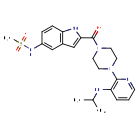
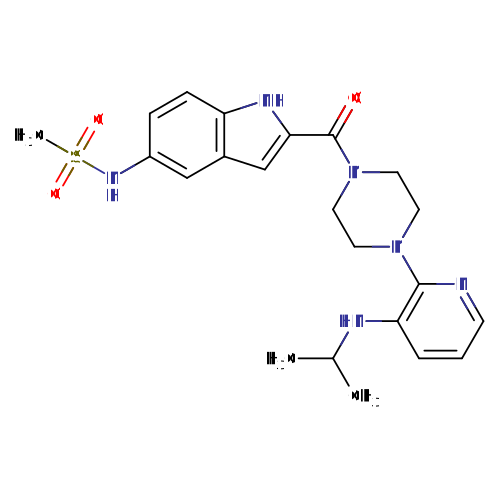
Structure for Delavirdine (DB00705)
- Weight
- Average: 456.561
Monoisotopic: 456.194359482 - Chemical Formula
- C22H28N6O3S
- Synonyms
- (N-[2-[4-[3-(1-methylethylamino)pyridin-2-yl]piperazin-1-yl]carbonyl-1H-indol-5-yl] methanesulfonamide)
- 1-(3-((1-methylethyl)amino)-2-pyridinyl)-4-((5-((methylsulfonyl)amino)-1H-indol-2-yl)carbonyl)piperazine
- 2-(4-(5-methanesulfonamido-1H-indol-2-ylcarbonyl)-1-piperazinyl)-N-(1-methylethyl)-3-pyridinamine
- Delavirdin
- Delavirdina
- Delavirdine
- Delavirdinum
- N-(2-(1-(3-(isopropylamino)pyridin-2-yl)piperazine-4-carbonyl)-1H-indol-5-yl)methanesulfonamide
- N-{2-[4-(3-Isopropylamino-pyridin-2-yl)-piperazine-1-carbonyl]-1H-indol-5-yl}-methanesulfonamide
- External IDs
- U 90152 S

Pharmacology
- Indication
For the treatment of HIV-1 infection in combination with appropriate antiretroviral agents when therapy is warranted
 Reduce drug development failure ratesBuild, train, & validate machine-learning modelswith evidence-based and structured datasets.Build, train, & validate predictive machine-learning models with structured datasets.
- Associated Conditions
Indication Type Indication Combined Product Details Approval Level Age Group Patient Characteristics Dose Form Used in combination to treat Hiv-1 infection •••••••••••• - Contraindications & Blackbox Warnings
 Prevent Adverse Drug Events TodayTap into our Clinical API for life-saving information on contraindications & blackbox warnings, population restrictions, harmful risks, & more.Avoid life-threatening adverse drug events with our Clinical API
- Pharmacodynamics
Delavirdine is a non-nucleoside reverse transcriptase inhibitor (nNRTI) with activity against Human Immunodeficiency Virus Type 1 (HIV-1). Delavirdine binds directly to reverse transcriptase (RT) and blocks the RNA-dependent and DNA-dependent DNA polymerase activities by causing a disruption of the enzyme's catalytic site. The activity of Delavirdine does not compete with template or nucleoside triphosphates. HIV-2 RT and eukaryotic DNA polymerases (such as human DNA polymerases alpha, beta, or sigma) are not inhibited by Delavirdine.
- Mechanism of action
Delavirdine binds directly to viral reverse transcriptase (RT) and blocks the RNA-dependent and DNA-dependent DNA polymerase activities by disrupting the enzyme's catalytic site.
Target Actions Organism AReverse transcriptase/RNaseH inhibitorHuman immunodeficiency virus 1 - Absorption
Rapidly absorbed
- Volume of distribution
Not Available
- Protein binding
98%
- Metabolism
Hepatic
Hover over products below to view reaction partners
- Route of elimination
Delavirdine is extensively converted to several inactive metabolites by cytochrome P450 3A (CYP3A). Delavirdine was excreted in the milk of lactating rats at a concentration three to five times that of rat plasma.
- Half-life
5.8 hours
- Clearance
Not Available
- Adverse Effects
 Improve decision support & research outcomesWith structured adverse effects data, including: blackbox warnings, adverse reactions, warning & precautions, & incidence rates. View sample adverse effects data in our new Data Library!Improve decision support & research outcomes with our structured adverse effects data.
- Toxicity
Major toxicity of delavirdine is rash and should be advised to promptly notify their physician should rash occur. The majority of rashes associated with delavirdine occur within 1 to 3 weeks after initiating treatment with delavirdine. The rash normally resolves in 3 to 14 days and may be treated symptomatically while therapy with delavirdine is continued. Any patient experiencing severe rash or rash accompanied by symptoms such as fever, blistering, oral lesions, conjunctivitis, swelling, muscle or joint aches should discontinue medication and consult a physician.
- Pathways
Pathway Category Delavirdine Action Pathway Drug action - Pharmacogenomic Effects/ADRs
- Not Available
Interactions
- Drug Interactions
- This information should not be interpreted without the help of a healthcare provider. If you believe you are experiencing an interaction, contact a healthcare provider immediately. The absence of an interaction does not necessarily mean no interactions exist.
Drug Interaction Integrate drug-drug
interactions in your software1,2-Benzodiazepine The metabolism of 1,2-Benzodiazepine can be decreased when combined with Delavirdine. Abametapir The serum concentration of Delavirdine can be increased when it is combined with Abametapir. Abatacept The metabolism of Delavirdine can be increased when combined with Abatacept. Abemaciclib The metabolism of Abemaciclib can be decreased when combined with Delavirdine. Abiraterone The metabolism of Abiraterone can be decreased when combined with Delavirdine. - Food Interactions
- Take with or without food. The absorption is unaffected by food.
Products
 Drug product information from 10+ global regionsOur datasets provide approved product information including:dosage, form, labeller, route of administration, and marketing period.Access drug product information from over 10 global regions.
- Product Ingredients
Ingredient UNII CAS InChI Key Delavirdine mesylate 421105KRQE 147221-93-0 MEPNHSOMXMALDZ-UHFFFAOYSA-N - Product Images


- Brand Name Prescription Products
Name Dosage Strength Route Labeller Marketing Start Marketing End Region Image Rescriptor Tablet 100 mg Oral ViiV Healthcare ULC 1998-07-24 2018-11-01 Canada 
Rescriptor Tablet 100 mg/1 Oral ViiV Healthcare Company 2010-10-13 2019-05-31 US 

Rescriptor Tablet 200 mg/1 Oral Agouron Pharmaceuticals 1999-11-03 2015-08-31 US Rescriptor Tablet 200 mg/1 Oral ViiV Healthcare Company 2010-10-13 2010-10-13 US 
Rescriptor Tablet 100 mg/1 Oral Agouron Pharmaceuticals 1997-04-18 2011-04-30 US


Categories
- ATC Codes
- J05AG02 — Delavirdine
- Drug Categories
- Anti-HIV Agents
- Anti-Infective Agents
- Anti-Retroviral Agents
- Antiinfectives for Systemic Use
- Antiviral Agents
- Antivirals for Systemic Use
- Cytochrome P-450 CYP2C19 Inhibitors
- Cytochrome P-450 CYP2C19 Inhibitors (strong)
- Cytochrome P-450 CYP2C9 Inhibitors
- Cytochrome P-450 CYP2C9 Inhibitors (strong)
- Cytochrome P-450 CYP2D6 Inhibitors
- Cytochrome P-450 CYP2D6 Inhibitors (moderate)
- Cytochrome P-450 CYP2D6 Substrates
- Cytochrome P-450 CYP3A Inhibitors
- Cytochrome P-450 CYP3A Substrates
- Cytochrome P-450 CYP3A4 Inhibitors
- Cytochrome P-450 CYP3A4 Inhibitors (strong)
- Cytochrome P-450 CYP3A4 Substrates
- Cytochrome P-450 CYP3A5 Inhibitors
- Cytochrome P-450 CYP3A5 Inhibitors (strength unknown)
- Cytochrome P-450 CYP3A7 Inhibitors
- Cytochrome P-450 CYP3A7 Inhibitors (strength unknown)
- Cytochrome P-450 Enzyme Inhibitors
- Cytochrome P-450 Substrates
- Direct Acting Antivirals
- Enzyme Inhibitors
- Heterocyclic Compounds, Fused-Ring
- Human Immunodeficiency Virus 1 Non-Nucleoside Analog Reverse Transcriptase Inhibitor
- Indoles
- Non-Nucleoside Reverse Transcriptase Inhibitors
- Nonnucleoside Reverse Transcriptase Inhibitors
- Nucleic Acid Synthesis Inhibitors
- Piperazines
- Reverse Transcriptase Inhibitors
- Chemical TaxonomyProvided by Classyfire
- Description
- This compound belongs to the class of organic compounds known as pyridinylpiperazines. These are compounds containing a pyridinylpiperazine skeleton, which consists of a pyridine linked (not fused) to a piperazine by a bond by a single bond that is not part of a ring.
- Kingdom
- Organic compounds
- Super Class
- Organoheterocyclic compounds
- Class
- Diazinanes
- Sub Class
- Piperazines
- Direct Parent
- Pyridinylpiperazines
- Alternative Parents
- Indolecarboxamides and derivatives / N-arylpiperazines / Sulfanilides / Indoles / 2-heteroaryl carboxamides / Dialkylarylamines / Pyrrole carboxamides / Secondary alkylarylamines / Aminopyridines and derivatives / Organic sulfonamides show 12 more
- Substituents
- 2-heteroaryl carboxamide / Amine / Amino acid or derivatives / Aminopyridine / Aminosulfonyl compound / Aromatic heteropolycyclic compound / Azacycle / Benzenoid / Carboxamide group / Carboxylic acid derivative show 31 more
- Molecular Framework
- Aromatic heteropolycyclic compounds
- External Descriptors
- sulfonamide, N-carbonylpiperazine, aminopyridine, indolecarboxamide (CHEBI:119573)
- Affected organisms
- Human Immunodeficiency Virus
Chemical Identifiers
- UNII
- DOL5F9JD3E
- CAS number
- 136817-59-9
- InChI Key
- WHBIGIKBNXZKFE-UHFFFAOYSA-N
- InChI
- InChI=1S/C22H28N6O3S/c1-15(2)24-19-5-4-8-23-21(19)27-9-11-28(12-10-27)22(29)20-14-16-13-17(26-32(3,30)31)6-7-18(16)25-20/h4-8,13-15,24-26H,9-12H2,1-3H3
- IUPAC Name
- N-[2-(4-{3-[(propan-2-yl)amino]pyridin-2-yl}piperazine-1-carbonyl)-1H-indol-5-yl]methanesulfonamide
- SMILES
- CC(C)NC1=C(N=CC=C1)N1CCN(CC1)C(=O)C1=CC2=C(N1)C=CC(NS(C)(=O)=O)=C2
References
- Synthesis Reference
- US5563142
- General References
- Not Available
- External Links
- Human Metabolome Database
- HMDB0014843
- KEGG Compound
- C06941
- PubChem Compound
- 5625
- PubChem Substance
- 46508878
- ChemSpider
- 5423
- BindingDB
- 1944
- 83816
- ChEBI
- 119573
- ChEMBL
- CHEMBL593
- ZINC
- ZINC000018516586
- Therapeutic Targets Database
- DAP000183
- PharmGKB
- PA449223
- PDBe Ligand
- SPP
- Drugs.com
- Drugs.com Drug Page
- Wikipedia
- Delavirdine
- PDB Entries
- 1klm
- FDA label
- Download (645 KB)
Clinical Trials
- Clinical Trials
Phase Status Purpose Conditions Count 3 Completed Treatment Human Immunodeficiency Virus (HIV) Infections 4 2 Completed Treatment Human Immunodeficiency Virus (HIV) Infections 5 2 Terminated Treatment Human Immunodeficiency Virus (HIV) Infections 1 2 Withdrawn Treatment Human Immunodeficiency Virus (HIV) Infections 1 2, 3 Completed Treatment Human Immunodeficiency Virus (HIV) Infections 1
Pharmacoeconomics
- Manufacturers
- Viiv healthcare co
- Packagers
- Agouron Pharmaceuticals Inc.
- A-S Medication Solutions LLC
- Kaiser Foundation Hospital
- Pfizer Inc.
- Pharmacia Inc.
- Physicians Total Care Inc.
- ViiV Healthcare ULC
- Dosage Forms
Form Route Strength Tablet Oral 100 mg Tablet Oral 100 mg/1 Tablet Oral 200 mg/1 - Prices
Unit description Cost Unit Rescriptor 200 mg tablet 1.92USD tablet DrugBank does not sell nor buy drugs. Pricing information is supplied for informational purposes only.- Patents
Patent Number Pediatric Extension Approved Expires (estimated) Region US5563142 No 1996-10-08 2013-10-08 US CA2184598 No 2005-05-03 2015-03-01 Canada CA2071529 No 2001-03-20 2010-12-24 Canada US6177101 No 2001-01-23 2019-06-07 US
Properties
- State
- Solid
- Experimental Properties
Property Value Source melting point (°C) 226-228 °C Not Available logP 2.8 Not Available - Predicted Properties
Property Value Source Water Solubility 0.086 mg/mL ALOGPS logP 2.77 ALOGPS logP 1.02 Chemaxon logS -3.7 ALOGPS pKa (Strongest Acidic) 9.39 Chemaxon pKa (Strongest Basic) 6.82 Chemaxon Physiological Charge 0 Chemaxon Hydrogen Acceptor Count 6 Chemaxon Hydrogen Donor Count 3 Chemaxon Polar Surface Area 110.43 Å2 Chemaxon Rotatable Bond Count 5 Chemaxon Refractivity 126.64 m3·mol-1 Chemaxon Polarizability 49.99 Å3 Chemaxon Number of Rings 4 Chemaxon Bioavailability 1 Chemaxon Rule of Five Yes Chemaxon Ghose Filter Yes Chemaxon Veber's Rule No Chemaxon MDDR-like Rule No Chemaxon - Predicted ADMET Features
Property Value Probability Human Intestinal Absorption + 1.0 Blood Brain Barrier - 0.6449 Caco-2 permeable - 0.6231 P-glycoprotein substrate Substrate 0.7103 P-glycoprotein inhibitor I Inhibitor 0.7647 P-glycoprotein inhibitor II Non-inhibitor 0.5644 Renal organic cation transporter Non-inhibitor 0.7808 CYP450 2C9 substrate Non-substrate 0.6717 CYP450 2D6 substrate Substrate 0.8918 CYP450 3A4 substrate Substrate 0.6707 CYP450 1A2 substrate Non-inhibitor 0.6644 CYP450 2C9 inhibitor Inhibitor 0.6307 CYP450 2D6 inhibitor Non-inhibitor 0.8556 CYP450 2C19 inhibitor Non-inhibitor 0.6078 CYP450 3A4 inhibitor Non-inhibitor 0.6383 CYP450 inhibitory promiscuity High CYP Inhibitory Promiscuity 0.9308 Ames test Non AMES toxic 0.6189 Carcinogenicity Non-carcinogens 0.7517 Biodegradation Not ready biodegradable 0.9891 Rat acute toxicity 2.5840 LD50, mol/kg Not applicable hERG inhibition (predictor I) Weak inhibitor 0.7656 hERG inhibition (predictor II) Inhibitor 0.6118
Spectra
- Mass Spec (NIST)
- Not Available
- Spectra
Spectrum Spectrum Type Splash Key Predicted GC-MS Spectrum - GC-MS Predicted GC-MS splash10-004i-1869800000-919b00dc1b3b74381f73 Predicted MS/MS Spectrum - 10V, Positive (Annotated) Predicted LC-MS/MS splash10-0a4i-0000900000-81c4c2deddb329078e0b Predicted MS/MS Spectrum - 10V, Negative (Annotated) Predicted LC-MS/MS splash10-0a4i-0000900000-6c547a7479f895edc33f Predicted MS/MS Spectrum - 20V, Positive (Annotated) Predicted LC-MS/MS splash10-0a4i-0004900000-055907f9c46e7c0ec1ed Predicted MS/MS Spectrum - 20V, Negative (Annotated) Predicted LC-MS/MS splash10-0a4i-0114900000-d38593a50e2ca8579a67 Predicted MS/MS Spectrum - 40V, Positive (Annotated) Predicted LC-MS/MS splash10-0bu0-0119100000-88e641df8f022d8c7e5f Predicted MS/MS Spectrum - 40V, Negative (Annotated) Predicted LC-MS/MS splash10-08iu-1933500000-832a021dc9c1372d08a8 Predicted 1H NMR Spectrum 1D NMR Not Applicable Predicted 13C NMR Spectrum 1D NMR Not Applicable - Chromatographic Properties
Collision Cross Sections (CCS)
Adduct CCS Value (Å2) Source type Source [M-H]- 233.6803003 predictedDarkChem Lite v0.1.0 [M-H]- 238.1674003 predictedDarkChem Lite v0.1.0 [M-H]- 238.4311003 predictedDarkChem Lite v0.1.0 [M-H]- 198.25618 predictedDeepCCS 1.0 (2019) [M+H]+ 233.6717003 predictedDarkChem Lite v0.1.0 [M+H]+ 238.4894003 predictedDarkChem Lite v0.1.0 [M+H]+ 238.2737003 predictedDarkChem Lite v0.1.0 [M+H]+ 200.65175 predictedDeepCCS 1.0 (2019) [M+Na]+ 233.7769003 predictedDarkChem Lite v0.1.0 [M+Na]+ 238.7264003 predictedDarkChem Lite v0.1.0 [M+Na]+ 239.1959003 predictedDarkChem Lite v0.1.0 [M+Na]+ 206.56427 predictedDeepCCS 1.0 (2019)
Targets

- Kind
- Protein
- Organism
- Human immunodeficiency virus 1
- Pharmacological action
- Yes
- Actions
- Inhibitor
- General Function
- Rna-dna hybrid ribonuclease activity
- Specific Function
- Not Available
- Gene Name
- pol
- Uniprot ID
- Q72547
- Uniprot Name
- Reverse transcriptase/RNaseH
- Molecular Weight
- 65223.615 Da
References
- Geitmann M, Unge T, Danielson UH: Biosensor-based kinetic characterization of the interaction between HIV-1 reverse transcriptase and non-nucleoside inhibitors. J Med Chem. 2006 Apr 20;49(8):2367-74. [Article]
- Xia Q, Radzio J, Anderson KS, Sluis-Cremer N: Probing nonnucleoside inhibitor-induced active-site distortion in HIV-1 reverse transcriptase by transient kinetic analyses. Protein Sci. 2007 Aug;16(8):1728-37. [Article]
- Freimuth WW: Delavirdine mesylate, a potent non-nucleoside HIV-1 reverse transcriptase inhibitor. Adv Exp Med Biol. 1996;394:279-89. [Article]
Enzymes
- Kind
- Protein
- Organism
- Humans
- Pharmacological action
- Unknown
- Actions
- SubstrateInhibitor
- General Function
- Vitamin d3 25-hydroxylase activity
- Specific Function
- Cytochromes P450 are a group of heme-thiolate monooxygenases. In liver microsomes, this enzyme is involved in an NADPH-dependent electron transport pathway. It performs a variety of oxidation react...
- Gene Name
- CYP3A4
- Uniprot ID
- P08684
- Uniprot Name
- Cytochrome P450 3A4
- Molecular Weight
- 57342.67 Da
References
- Zhou SF, Zhou ZW, Yang LP, Cai JP: Substrates, inducers, inhibitors and structure-activity relationships of human Cytochrome P450 2C9 and implications in drug development. Curr Med Chem. 2009;16(27):3480-675. Epub 2009 Sep 1. [Article]
- Voorman RL, Maio SM, Payne NA, Zhao Z, Koeplinger KA, Wang X: Microsomal metabolism of delavirdine: evidence for mechanism-based inactivation of human cytochrome P450 3A. J Pharmacol Exp Ther. 1998 Oct;287(1):381-8. [Article]
- von Moltke LL, Greenblatt DJ, Granda BW, Giancarlo GM, Duan SX, Daily JP, Harmatz JS, Shader RI: Inhibition of human cytochrome P450 isoforms by nonnucleoside reverse transcriptase inhibitors. J Clin Pharmacol. 2001 Jan;41(1):85-91. doi: 10.1177/00912700122009728. [Article]
- Tran JQ, Gerber JG, Kerr BM: Delavirdine: clinical pharmacokinetics and drug interactions. Clin Pharmacokinet. 2001;40(3):207-26. doi: 10.2165/00003088-200140030-00005. [Article]
- Fichtenbaum CJ, Gerber JG: Interactions between antiretroviral drugs and drugs used for the therapy of the metabolic complications encountered during HIV infection. Clin Pharmacokinet. 2002;41(14):1195-211. doi: 10.2165/00003088-200241140-00004. [Article]
- Shelton MJ, Hewitt RG, Adams J, Della-Coletta A, Cox S, Morse GD: Pharmacokinetics of ritonavir and delavirdine in human immunodeficiency virus-infected patients. Antimicrob Agents Chemother. 2003 May;47(5):1694-9. doi: 10.1128/aac.47.5.1694-1699.2003. [Article]
- Clin-Info. (2006). In Compendium of Pharmaceuticals and Specialties: The Canadian Drug Reference for Health Professionals (pp. L54). Canadian Pharmacists Association. [ISBN:1-894402-22-7]
- Flockhart Table of Drug Interactions [Link]
- Delavirdine FDA Label [Link]
- Kind
- Protein
- Organism
- Humans
- Pharmacological action
- Unknown
- Actions
- SubstrateInhibitor
- General Function
- Steroid hydroxylase activity
- Specific Function
- Responsible for the metabolism of many drugs and environmental chemicals that it oxidizes. It is involved in the metabolism of drugs such as antiarrhythmics, adrenoceptor antagonists, and tricyclic...
- Gene Name
- CYP2D6
- Uniprot ID
- P10635
- Uniprot Name
- Cytochrome P450 2D6
- Molecular Weight
- 55768.94 Da
References
- Voorman RL, Payne NA, Wienkers LC, Hauer MJ, Sanders PE: Interaction of delavirdine with human liver microsomal cytochrome P450: inhibition of CYP2C9, CYP2C19, and CYP2D6. Drug Metab Dispos. 2001 Jan;29(1):41-7. [Article]
- Voorman RL, Maio SM, Hauer MJ, Sanders PE, Payne NA, Ackland MJ: Metabolism of delavirdine, a human immunodeficiency virus type-1 reverse transcriptase inhibitor, by microsomal cytochrome P450 in humans, rats, and other species: probable involvement of CYP2D6 and CYP3A. Drug Metab Dispos. 1998 Jul;26(7):631-9. [Article]
- Clin-Info. (2006). In Compendium of Pharmaceuticals and Specialties: The Canadian Drug Reference for Health Professionals (pp. L54). Canadian Pharmacists Association. [ISBN:1-894402-22-7]
- Kind
- Protein
- Organism
- Humans
- Pharmacological action
- Unknown
- Actions
- Inhibitor
- General Function
- Oxygen binding
- Specific Function
- Cytochromes P450 are a group of heme-thiolate monooxygenases. In liver microsomes, this enzyme is involved in an NADPH-dependent electron transport pathway. It oxidizes a variety of structurally un...
- Gene Name
- CYP3A5
- Uniprot ID
- P20815
- Uniprot Name
- Cytochrome P450 3A5
- Molecular Weight
- 57108.065 Da
References
- Flockhart Table of Drug Interactions [Link]
- Kind
- Protein
- Organism
- Humans
- Pharmacological action
- Unknown
- Actions
- Inhibitor
- General Function
- Oxygen binding
- Specific Function
- Cytochromes P450 are a group of heme-thiolate monooxygenases. In liver microsomes, this enzyme is involved in an NADPH-dependent electron transport pathway. It oxidizes a variety of structurally un...
- Gene Name
- CYP3A7
- Uniprot ID
- P24462
- Uniprot Name
- Cytochrome P450 3A7
- Molecular Weight
- 57525.03 Da
References
- Flockhart Table of Drug Interactions [Link]
- Kind
- Protein
- Organism
- Humans
- Pharmacological action
- Unknown
- Actions
- Inhibitor
- General Function
- Steroid hydroxylase activity
- Specific Function
- Cytochromes P450 are a group of heme-thiolate monooxygenases. In liver microsomes, this enzyme is involved in an NADPH-dependent electron transport pathway. It oxidizes a variety of structurally un...
- Gene Name
- CYP2C9
- Uniprot ID
- P11712
- Uniprot Name
- Cytochrome P450 2C9
- Molecular Weight
- 55627.365 Da
References
- von Moltke LL, Greenblatt DJ, Granda BW, Giancarlo GM, Duan SX, Daily JP, Harmatz JS, Shader RI: Inhibition of human cytochrome P450 isoforms by nonnucleoside reverse transcriptase inhibitors. J Clin Pharmacol. 2001 Jan;41(1):85-91. doi: 10.1177/00912700122009728. [Article]
- Voorman RL, Payne NA, Wienkers LC, Hauer MJ, Sanders PE: Interaction of delavirdine with human liver microsomal cytochrome P450: inhibition of CYP2C9, CYP2C19, and CYP2D6. Drug Metab Dispos. 2001 Jan;29(1):41-7. [Article]
- Clin-Info. (2006). In Compendium of Pharmaceuticals and Specialties: The Canadian Drug Reference for Health Professionals (pp. L54). Canadian Pharmacists Association. [ISBN:1-894402-22-7]
- Delavirdine FDA label [File]
- Kind
- Protein
- Organism
- Humans
- Pharmacological action
- Unknown
- Actions
- Inhibitor
- General Function
- Steroid hydroxylase activity
- Specific Function
- Responsible for the metabolism of a number of therapeutic agents such as the anticonvulsant drug S-mephenytoin, omeprazole, proguanil, certain barbiturates, diazepam, propranolol, citalopram and im...
- Gene Name
- CYP2C19
- Uniprot ID
- P33261
- Uniprot Name
- Cytochrome P450 2C19
- Molecular Weight
- 55930.545 Da
References
- Voorman RL, Payne NA, Wienkers LC, Hauer MJ, Sanders PE: Interaction of delavirdine with human liver microsomal cytochrome P450: inhibition of CYP2C9, CYP2C19, and CYP2D6. Drug Metab Dispos. 2001 Jan;29(1):41-7. [Article]

Drug created at June 13, 2005 13:24 / Updated at April 26, 2024 00:45